
Crashes, No Sound, or Screen Glitches?
Random freezes, missing sound and display glitches usually trace back to one bad driver. Find and replace yours safely.Free scan · under a minutePC Slower Than It Used to Be?
A free scan shows the junk files, broken settings and background clutter dragging Windows down - then fixes them in one click.Free scan · Windows 10 & 11iTechGuides is reader-supported. When you buy through links on our site, we may earn an affiliate commission. As an Amazon Associate I earn from qualifying purchases. Learn more
Bitcoin mining difficulty and network hashrate determine your share of the blocks your hardware can expect to earn. A miner’s monthly BTC output is approximately its hashrate divided by the network hashrate, multiplied by the month’s expected blocks and the reward per block, then reduced for downtime, stale shares and pool charges. If your machine stays the same while total network hashrate rises, your expected BTC generally falls.
That relationship makes a fixed monthly promise impossible. Difficulty changes every 2,016 blocks (about two weeks), transaction fees vary by block, and your own uptime and pool performance are never perfect. The method below gives you a transparent forecast that you can refresh after each difficulty adjustment.
The monthly Bitcoin-production formula
For a miner contributing hashrate Hm to a network with hashrate Hn:
The Tool Desk
Outbyte PC Repair FREERepair Windows errors before they cause bigger problemsFix Now →Outbyte Driver Updater FREEFix the driver behind crashes, sound loss and screen glitchesFind Drivers →BTC/month ≈ (Hm ÷ Hn) × blocks/month × (block subsidy + expected transaction fees) × uptime × pool-performance factor
#1 Best Overall

- SLOT - 6/8/12 GPU slots, support 2 ATX power supplies.
- MATERIAL - The open air mining frame case made up of the highest quality stainless steel material, strong, durable and available. Fully protecting your GPU and eectronic device.
- PERFECT DESIGN - Professional design for mining rig frame, accelerating the air convection, super cooling design for heat dissipation. Enough space reserved between the graphics cards.
- EASY TO INSTALL - Easy to install and strong structure. Keep all cables clean and organized, along with everything in your mining machine.
- NEED TO ASSEMBLE BY YOURSELF - For installation steps, please refer to the user manual. The Frame Only, Not includes Fans or other CPU, GPU, PSU, Motherboards, Cables. If you are not 100% satistifed with this Miner, please feel free to contact us, we will offer you a satisfactory soluiton within 24 hours.
This is an expected-value calculation, not a guarantee. Pool mining usually pays close to the value of your contributed shares, while solo mining can produce nothing for a long period and then a full block reward when you happen to find one.
What each input means
| Input | Meaning | How to handle it |
|---|---|---|
| Miner hashrate (Hm) | Your ASIC’s sustained hashing rate, normally stated in TH/s. | Use the rate actually delivered at the wall, not only the manufacturer’s maximum setting. |
| Network hashrate (Hn) | The combined hashing power competing for Bitcoin blocks. | Use a timestamped network estimate; it changes continuously and is often reported as a moving average. |
| Blocks/month | The number of block opportunities in your forecast period. | At the protocol’s target of about 10 minutes per block, 30 days is roughly 4,320 blocks. A 30.44-day calendar average is about 4,383. |
| Block subsidy | New BTC assigned to the winning block. | A U.S. Securities and Exchange Commission filing in 2026 described the then-current subsidy as 3.125 BTC per block. |
| Transaction fees | Fees included by the miner in addition to the subsidy. | Use an average fee assumption for the period; fees can be much higher or lower from one block to the next. |
| Uptime | The fraction of the period your miner is hashing successfully. | Subtract outages, reboots, network loss, thermal throttling and maintenance. For example, 95% uptime is 0.95. |
| Pool-performance factor | The effect of pool fees, stale or rejected shares and payout rules. | A factor below 1.0 represents those losses. Use the pool’s published fee and your observed payout history rather than assuming perfection. |
Why difficulty and network hashrate change your result
Bitcoin difficulty is the protocol’s measure of how hard it is to find a valid block. The Bitcoin Developer Guide states: "The difficulty is adjusted every 2016 blocks to maintain a roughly 10 minute block time." Because 2,016 blocks at roughly 10 minutes is about two weeks, a monthly estimate can cross two or three different difficulty periods.
Network hashrate is the amount of computation miners are actually deploying. When more machines join, the network tends to find blocks faster temporarily; the next difficulty retarget then raises difficulty to bring the average back toward 10 minutes. When machines shut down, the reverse can happen. Hashrate and difficulty are related, but they are not identical measurements and can move on different days.
What happens when your miner stays constant
- Network hashrate rises while your hashrate is unchanged: your fraction of the network shrinks, so expected BTC per month declines.
- Difficulty rises while your machine is unchanged: the work required per expected block increases, reducing your expected share over the new difficulty period.
- Your hashrate doubles and network conditions stay unchanged: expected output approximately doubles. The increase is not guaranteed if network hashrate, fees, uptime or difficulty also change.
- Fees rise without a subsidy change: the reward per block increases for the blocks carrying those fees, lifting everyone’s expected gross output for that interval.
A difficulty adjustment does not create extra BTC. It changes the amount of hashing required to compete for the same protocol-controlled issuance rate and roughly 10-minute block schedule.
Rank #2

- Genuine New Canaan Avalon Q Miner with full manufacturer warranty. Trust a reliable seller – no used or refurbished units
- Maximize profits with 90TH/s hash rate at just 18.6J/TH – one of the most energy-efficient ASIC miners for home or business mining
- Ready to mine right out of the box! Includes a 110V-240V power cord for seamless setup in any standard outlet
- Designed for home-friendly mining with advanced noise reduction – mine Bitcoin without disturbing your household
- Note: All products we offer are brand new and in pristine condition. Returns are accepted. If the return is not due to a verified product failure, a restocking fee will be deducted from your refund to cover handling and logistics costs.
A worked monthly forecast
The following is an illustration with explicit assumptions, not a prediction of current network conditions. Assume a 200 TH/s ASIC, a 700 EH/s network estimate (700,000,000 TH/s), 4,320 blocks in a 30-day month, a 3.125 BTC subsidy, 0.20 BTC average fees per block, 95% uptime and a 98% pool-performance factor.
- Convert units: 700 EH/s equals 700,000,000 TH/s.
- Calculate the miner’s network share:
200 ÷ 700,000,000 = 0.0000002857. - Calculate BTC available in the assumed month:
4,320 × (3.125 + 0.20) = 14,364 BTC. - Apply the share:
14,364 × 0.0000002857 ≈ 0.004104 BTC. - Apply uptime and pool performance:
0.004104 × 0.95 × 0.98 ≈ 0.00382 BTC.
Under those assumptions, the expected payout is about 0.00382 BTC for 30 days. Changing the network estimate, fee average or difficulty after the calculation can materially change the result, so record the timestamp beside every forecast.
Using a published rate-per-TH snapshot
A Satoshi Gazette calculation dated October 2026 reported 47.68 satoshis per TH/s per day. Treat that number as a dated snapshot, not a durable rate. At that snapshot rate, a continuously running 200 TH/s machine would calculate as:
200 × 47.68 satoshis × 30 days = 286,080 satoshis = 0.0028608 BTC
Rank #3

- ⚡ Efficient Home ASIC Miner – Up to 1.1 TH/s hashrate with just 18W power consumption (15 J/TH), perfect for home or small office use.
- 🇪🇺 Made in Europe – Designed and manufactured in Europe with premium components for reliability and long-term performance.
- 🔧 BM1370 ASIC Chip (Antminer S21 Pro) – Same chip used in the Antminer S21 Pro for professional-grade mining power in a compact, open-source form.
- 📡 Wi-Fi & USB-C Connectivity – No monitor or keyboard required – configure and monitor easily via web interface
- 🎁 Complete Kit Included – Delivered fully assembled with EU/UK/US 5V 6A power supply, premium fan, 3D-printed stand, and OLED display.
That quick method is useful for a sanity check, but you still need to confirm what the calculator included—subsidy, fees, pool fees, uptime and the exact timestamp—before comparing it with a detailed model.
How to update a forecast as conditions move
Refresh network inputs after each retarget
Difficulty is retargeted every 2,016 blocks, so use the latest completed adjustment and a current network-hashrate estimate. A monthly projection made before a retarget can be stale halfway through the month. For a calendar-month report, split the month into periods when a retarget occurs and calculate each period with its own network conditions.
Use a range instead of one optimistic number
Prepare at least three cases: low, central and high transaction-fee averages, plus realistic uptime assumptions. Keep the subsidy fixed at the applicable amount for the period you are modeling; the 2026 SEC filing cited 3.125 BTC as the then-current reward. Do not silently carry that figure into a future period after a protocol subsidy change.
Free tools Windows power users keep installed
One-click scans. No signup required.
Model network growth sensitivity
| Change with your miner unchanged | Approximate effect on expected BTC |
|---|---|
| Network hashrate unchanged | Baseline output. |
| Network hashrate increases 25% | Your share becomes 1 ÷ 1.25, or about 80% of the prior output, before other changes. |
| Network hashrate increases 50% | Your share becomes about 66.7% of the prior output. |
| Network hashrate doubles | Your share becomes about 50% of the prior output. |
These are share effects only. Fees, uptime, pool losses and the number of blocks in the actual period can move the final payout in either direction.
Rank #4

- SUPERIOR HASHING POWER: Unlock 13.8 TH/s of mining performance with the updated Rev 3.1 architecture. Engineered for SHA-256 algorithm efficiency, this unit provides a powerful and consistent hashrate for Bitcoin and compatible cryptocurrency mining.
- ULTRA-LOW ENERGY CONSUMPTION: Experience the perfect balance of performance and efficiency. Running at a remarkably low 230W, this miner maximizes your output while keeping your electricity costs manageable, making it the ideal choice for 24/7 sustainable home mining.
- WHISPER-QUIET LIQUID COOLING: Designed specifically for home environments, our advanced integrated hydro-cooling system dissipates heat effectively while maintaining near-silent operation. Enjoy high-performance mining without the noise disturbance typical of industrial-grade equipment.
- PLUG-AND-PLAY SETUP: Get started in minutes with our user-friendly, open-source interface. The device features integrated Wi-Fi connectivity and an intuitive dashboard, allowing both beginners and experienced enthusiasts to manage their mining pool settings with ease.
- COMPACT & ROBUST DESIGN: Built with durability in mind, the Rev 3.1 features a sleek, space-saving form factor that fits perfectly on any desk or shelf. It includes a high-quality power supply unit (PSU) and is ready for immediate deployment in your home or office.
Pool mining versus solo mining
Pool mining
A pool combines many miners’ work and normally distributes rewards in rough proportion to valid shares submitted. This smooths variance: your daily payout is usually small but relatively regular. The trade-offs are pool fees, minimum payout thresholds, payout schedules, rejected or stale shares and the operator’s accounting method. Use the pool’s effective payout history to estimate the performance factor instead of assuming that every theoretical share becomes a credited share.
Solo mining
Solo mining removes the pool’s fee and payout policy, but your variance becomes extreme. Your expected long-run output can be represented by the same hashrate-share formula, yet a short monthly window may contain no block at all. A solo result should therefore be expressed as a probability distribution or long-run expectation, not as a promised monthly BTC amount.
Independent reader supportYour contribution helps us test, update, and keep practical guides available for everyone.Electricity, efficiency and the break-even question
More BTC output is not automatically more profit. ASICs run continuously, so power efficiency and your electricity tariff can outweigh a hashrate advantage.
Use this calculation for energy cost:
monthly kWh = (power draw in kW) × 24 × days × uptimemonthly electricity cost = monthly kWh × electricity price per kWh
Best Value
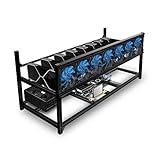
- ✅Premium Aluminum Construction: Constructed from high-quality aluminum for enhanced durability and heat dissipation, ensuring longevity and optimal performance.
- ✅ Accommodates 8 GPUs: Designed to house up to 8 graphics cards, providing ample space for expanding your mining setup and maximizing efficiency.
- ✅ Superior Airflow and Cooling: Engineered with optimized airflow design to prevent overheating and maintain optimal operating temperatures for prolonged mining sessions.
- ✅ Easy Assembly: Simple and straightforward assembly process allows for quick setup, getting you up and running in no time.
- ✅ Sleek and Space-Saving Design: Compact and minimalist design saves space while adding a professional touch to your mining rig setup.
For a simple comparison, consider two hypothetical machines running for 30 days at 95% uptime:
| Machine | Hashrate | Efficiency | Approx. draw | Energy at 95% uptime | Cost at $0.08/kWh |
|---|---|---|---|---|---|
| A | 200 TH/s | 20 J/TH | 4.00 kW | 2,736 kWh | $218.88 |
| B | 150 TH/s | 17 J/TH | 2.55 kW | 1,744.2 kWh | $139.54 |
Machine A has the higher hashrate, but it also uses substantially more electricity. To decide between them, compare expected BTC revenue at the same timestamp with electricity, pool fees, cooling, hosting, maintenance, financing and the purchase price. Electricity rates can vary by tariff, location and time of use; the $0.08 example is only an assumption.
Other hardware factors that change the decision
- Cooling and noise: heat removal and acoustic limits can reduce real uptime or require additional equipment.
- Warranty and repair: a failed hashboard can reduce output for days, and replacement parts add cost.
- Availability and price: a quoted purchase price or specification can change before delivery; verify the seller, model, shipping, taxes and warranty.
- Operating mode: underclocking may reduce hashrate but improve joules per terahash and thermal stability.
A repeatable monthly-calculation procedure
- Record the date and period. State whether you are forecasting 30 days, a calendar month or another interval.
- Measure actual hashrate. Use the pool’s accepted-share rate over several days and note any throttling, rather than relying only on the label.
- Convert units. Put both miner and network hashrate in TH/s (or both in EH/s) before dividing.
- Capture the latest difficulty and network estimate. Note the block height or timestamp so another person can reproduce the input.
- Choose blocks/month. Use approximately 4,320 for 30 days at 10 minutes per block, or calculate the exact calendar interval from the protocol target.
- Set subsidy and fee assumptions. Keep the 3.125 BTC figure qualified to the 2026 filing’s stated period and use a separate, clearly labeled fee average.
- Apply uptime and pool performance. Include outages, stale shares, fees and payout deductions once—do not subtract the same fee twice.
- Run sensitivity cases. Recalculate with plausible network-hashrate, fee and uptime changes.
- Subtract operating costs. Convert power draw to kWh and add cooling, hosting, repairs and other recurring expenses.
- Save the assumptions. When difficulty retargets or your pool statistics change, update the sheet and compare the new result with actual payouts.
Common forecasting mistakes and fixes
- Using miner hashrate alone: BTC is earned from your fraction of network work, not from TH/s in isolation. Always divide by a dated network estimate.
- Treating difficulty as constant for a year: difficulty changes every 2,016 blocks. Recalculate at each adjustment.
- Confusing a block reward with personal income: the 3.125 BTC subsidy belongs to the winning block; a pool participant receives only its proportional share after fees and rules.
- Ignoring downtime: a miner that is switched off, overheated or disconnected cannot contribute shares. Use measured uptime.
- Mixing units: EH/s is one billion TH/s. A unit error can make an estimate wrong by orders of magnitude.
- Using a calculator snapshot as a promise: the October 2026 47.68-satoshi rate is tied to its date and assumptions. Timestamp every external rate and refresh it within a short freshness window.
- Counting gross BTC as profit: subtract electricity and all operating costs before deciding whether additional hardware is worthwhile.
What the numbers mean in practice
Difficulty and network hashrate answer the allocation question: what fraction of Bitcoin’s block production can your machine expect? The subsidy and transaction fees answer how much BTC each block carries. Uptime, pool performance and operating efficiency determine how much of that expected share reaches you and whether it is economically sensible.
What’s actually slowing this PC down?
Pick the symptom - the matching free tool is one click away.
Use the formula with dated inputs, recalculate after every 2,016-block difficulty adjustment, and present a range rather than a single guaranteed monthly figure. A higher-hashrate ASIC can raise BTC output, but only relative to the network and only if its additional power, heat, capital and maintenance costs are justified.
Quick Recap
Product prices and availability are accurate as of the date/time indicated and are subject to change. Any price and availability information displayed on Amazon at the time of purchase will apply.

