
The Tool Desk
Outbyte PC Repair FREERepair Windows errors before they cause bigger problemsFix Now →Outbyte Driver Updater FREEFix the driver behind crashes, sound loss and screen glitchesFind Drivers →iTechGuides is reader-supported. When you buy through links on our site, we may earn an affiliate commission. As an Amazon Associate I earn from qualifying purchases. Learn more
AI data center networking moves information between GPUs, servers, and other infrastructure so distributed work can run across a cluster. Ethernet and InfiniBand are two ways to build that network fabric; optical fiber is a way to carry signals over a physical link, not a third competing fabric. Ethernet can be configured for AI traffic with RoCE, while InfiniBand is a separate high-performance fabric with RDMA capability. Neither is universally faster or better: the right choice depends on workload, cluster design, operational needs, and link requirements.
What the network does in an AI data center
A data center fabric is the interconnection system that links compute nodes and other infrastructure. In an AI cluster, that means network traffic can pass among servers and the GPUs inside them, as well as to storage and other systems. When work is distributed across multiple servers, the network carries the information those systems need to coordinate.
| # | Preview | Product | Price | |
|---|---|---|---|---|
| 1 |

|
InfiniBand Network Cable | $69.99 | Buy on Amazon |
| 2 |

|
HP InfiniBand Network Cable | $58.88 | Buy on Amazon |
| 3 |
|
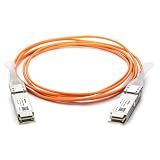
10Gtek 40G QSFP+ AOC Fiber Cable for Cisco QSFP-H40G-AOC10M, 10m/33ft | $58.99 | Buy on Amazon |
| 4 |

|
HP Infiniband Splitter Network Cable | $105.00 | Buy on Amazon |
| 5 |

|
Cable Matters 10Gbps DAC Twinax SFP+ Cable, 1m/3.3ft | $14.99 | Buy on Amazon |
That traffic is often described as GPU-to-GPU or east-west traffic: communication moving between systems within the data center rather than simply entering or leaving it. The network is therefore part of the compute system’s design. A cluster’s GPUs may have substantial processing capacity, but they still need a fabric suited to the communication patterns of the workload.
“Network speed” alone does not describe the whole design. A useful comparison asks what fabric technology is used, how the cluster is connected, what the workload demands, and whether the physical links suit the distances and equipment. The selected network has to work as an end-to-end system, from the network interfaces and switches to the cables or optical connections between them.
#1 Best Overall
Fabric technology and physical link are different choices
Ethernet and InfiniBand describe fabric technologies: they determine how networked equipment communicates. Optical fiber describes a physical medium used to carry signals between equipment. An optical link may be used with either an Ethernet or an InfiniBand fabric where the equipment and link design support it.
At an optical connection, transceivers convert electrical signals at network equipment into optical signals for transmission through fiber, then convert received optical signals back into electrical ones. An active optical cable integrates optical components at both ends. In a pluggable-transceiver design, separate modules connect to the equipment and to the fiber. Those are different physical arrangements for a link, not different network fabrics.
This distinction prevents a common category error: “Ethernet versus fiber” is not the same kind of comparison as “Ethernet versus InfiniBand.” A deployment can select a fabric and then determine which physical links are appropriate for its port compatibility, distance, fiber, connector, and cable-management needs.
Free tools Windows power users keep installed
One-click scans. No signup required.
Rank #2
- Network cable for Network Device, Switch - 3.28 ft - 1 x QSFP+ - 1 x QSFP+
How Ethernet is used for AI cluster traffic
Ethernet is a family of networking technology used to build data center fabrics. For AI traffic, an Ethernet deployment may use RDMA over Converged Ethernet, or RoCE. RDMA stands for remote direct memory access; in this context, RoCE is the method for providing RDMA transport over an Ethernet network.
That does not mean every Ethernet network is automatically an AI-optimized fabric. The network must be designed and configured for its intended traffic, and the interfaces, switches, and other components must fit that design. NVIDIA describes Spectrum-X as an AI-oriented Ethernet platform that combines Spectrum switches with BlueField-3 SuperNICs and ConnectX network interface cards for GPU-to-GPU east-west networking. This is a vendor-specific platform description, not a claim about ordinary Ethernet deployments in general.
NVIDIA’s HGX AI Factory reference material describes BlueField-3 connectivity of up to 400 Gb/s with RDMA and RoCE acceleration. That figure belongs to the named product description; it is not a general Ethernet speed or a guarantee of application performance. A link rate describes a component capability, not how quickly every AI workload will complete.
Rank #3
- Compatible for Cisco QSFP-H40G-AOC10M
- 40G QSFP Active Optical Cable, 10 meters
- QSFP+ AOC, 40G AOC, QSFP+ to QSFP+ AOC, QSFP+ Active Optical Cable
- 100% Compatible with Cisco. 10Gtek owns Compatibility LAB to meet the coding requirements for various brands of switches and routers. Each AOC Cable is individually tested before delivery
- 10Gtek offer more compatible options, if your brands not listed above, pls contact us
How InfiniBand fits into the fabric
InfiniBand is a distinct high-performance networking technology with RDMA capability. It is not an Ethernet mode or a type of optical cable. NVIDIA’s DGX SuperPOD component documentation describes InfiniBand as high-performance, low-latency, and RDMA-capable, and the DGX B300 reference material names XDR InfiniBand as an interconnect option.
Quick wins for a faster PC:
Scan for outdated or missing drivers - takes under a minuteDriver Scan →Clear out junk files and repair common Windows errorsFree Scan →Those descriptions establish InfiniBand’s role as a fabric option, but they do not prove it is faster than Ethernet for every workload or deployment. A fair comparison would need to hold the workload, topology, equipment, configuration, and measurement method constant. The sources described here do not provide a neutral, controlled comparison that establishes a universal winner.
Ethernet and InfiniBand also need not be treated as mutually exclusive across an entire data center. NVIDIA’s DGX B300 reference architecture lists both XDR InfiniBand and Spectrum-X Ethernet among interconnect options in the same large-scale system. That shows that a system architecture can include multiple networking technologies for different functions; it does not imply that every cluster should use both.
Rank #4
- Cable Length: 3.28 ft
- Compatibility: HP 5900 Switch Series
- Hpe part Number: JG329A
Where NVLink belongs
NVLink is not another name for the data center fabric or for an optical cable. NVIDIA’s DGX B300 material names NVLink alongside Ethernet and InfiniBand, but it connects GPUs at a different layer. When comparing cluster networking, distinguish links within GPU systems from the fabric that connects systems across the cluster. They address related communication needs, but they are not interchangeable choices.
Comparison: Ethernet, InfiniBand, and optical links
| Question | Ethernet | InfiniBand | Optical connection |
|---|---|---|---|
| What is it? | A family of networking technology used to build data center fabrics; an AI-oriented design may use RoCE. | A distinct high-performance fabric technology with RDMA capability. | A physical link method using optical transceivers and fiber, or an active optical cable. It is not a separate fabric protocol. |
| What does it determine? | How the Ethernet fabric is built and configured to deliver the required cluster communication. | Whether an InfiniBand fabric fits the workload and cluster’s performance and operational needs. | How signals travel between equipment, including the reach, fiber, connector, module, and cable arrangement required. |
| What is established here? | NVIDIA documents an AI Ethernet platform and RoCE-based GPU-to-GPU networking. | NVIDIA identifies InfiniBand as a high-performance, low-latency, RDMA-capable technology. | NVIDIA’s cabling guidance describes reach and cable-format tradeoffs, with distances dependent on the configuration. |
| What should not be assumed? | That any Ethernet network automatically behaves like an AI-optimized fabric. | That it is always faster or better than Ethernet for every workload. | That fiber alone determines performance or that any optical module will work with any equipment. |
What optical links change—and what they do not
Optical fiber can provide greater reach and a smaller cable diameter than passive copper, according to NVIDIA’s cabling guidance. Those advantages matter when selecting links for a particular physical layout, but they come with tradeoffs: optical connections require powered electronics, can cost more, and introduce module interfaces when pluggable transceivers and separate fiber are used. Connectors and cable handling also become part of the design and maintenance work.
Optical reach is not one fixed property of “fiber.” It depends on the particular transceiver and cable configuration, including the fiber type and link components. NVIDIA’s guide gives HDR InfiniBand examples of up to 100 m for one short-range module and up to 2 km for a single-mode example. These are examples for those named module types, not distances to apply to other generations, Ethernet optics, or unspecified equipment.
Best Value
- 10 GbE high bandwidth cable connects a switch, server, NIC, or transceiver for Network Attached Storage (NAS), Storage Area Network (SAN), and High Performance Computing (HPC) applications such as Fibre Channel, InfiniBand, and SONET
- Passive SFP+ cable connects equipment up to 7 meters for high density networking environments with Top of Rack (TOR) or Middle of Row (MOR) switching requirements; Low power consumption SFP+ twinaxial cable provides a cost-effective fiber alternative to installing fiber transceivers and cables to connect a 10G network
- SFP+ Small Form Factor Pluggable Plus cable is hot pluggable with an SFP+ 20-Pin connector; Quick release latch provides a secure connection until the release tab is pulled
- Superior engineering of SFP cable includes 30 AWG wire and connectors with a metal die-cast backshell for superior EMI performance and minimal insertion loss; Copper SFP+ cable offers low power consumption and low latency to operate in a high bandwidth storage area network
- Cisco compatible SFP+ 10Gig cable is designed for compatibility with the majority of switch, network adapter card, or network attached storage equipment according to the Multi-Source Agreement SFF-8431 specifications; Ideal replacement Cisco SFP-H10GB-CU1M cable
A separate NVIDIA structured-cabling guide sets maximum-reach assumptions for particular 400/800G Ethernet and InfiniBand link configurations, including patch-panel and connector assumptions. Those limits are meaningful only with the configuration they describe. For an actual design, verify the exact module, fiber, connector, switch, and network-interface compatibility rather than selecting by a headline distance alone.
Independent reader supportYour contribution helps us test, update, and keep practical guides available for everyone.How to choose for a cluster
Choose the fabric and links as connected but separate decisions. Start with the workload and cluster design, then check whether the proposed components and physical routes support that design. These questions help turn the comparison into an architecture decision rather than a choice based on a single speed label.
- Describe the communication pattern. Identify how the distributed workload communicates among GPUs and servers and what the fabric must support. A platform described for AI traffic is not, by itself, proof that it fits every workload.
- Compare fabric options against actual requirements. Evaluate Ethernet with the intended RoCE design against InfiniBand for the cluster’s required communication performance. Do not infer a winner from a vendor description or an isolated port-rate figure.
- Map the topology and scale. Determine how many systems must connect and how those connections are arranged. The DGX B300 reference architecture’s use of both XDR InfiniBand and Spectrum-X Ethernet demonstrates that roles can be deployment-specific; it does not prescribe a topology for other systems.
- Include operational fit. Consider the organization’s networking design, staffing, maintenance procedures, and interoperability requirements. A fabric is a system to operate, not just a specification on a switch or network card.
- Specify the physical links. For each route, establish the required reach, fiber type, connector, module compatibility, power needs, and cable-management approach. Decide whether a pluggable-transceiver-and-fiber arrangement or an active optical cable is appropriate for the equipment and deployment.
- Validate the complete equipment combination. Check compatibility among switches, network interfaces, transceivers or active cables, and the specified fiber and connectors. Confirm that any distance limit applies to the complete link configuration, including patch panels where relevant.
How to read vendor specifications responsibly
Vendor reference architectures are useful for understanding supported platform roles and example configurations. They are not independent benchmarks of Ethernet against InfiniBand. NVIDIA’s materials describe Spectrum-X as designed to improve AI Ethernet performance and describe InfiniBand in positive performance terms; both should be read as vendor claims, not as the result of a controlled, workload-by-workload comparison.
What’s actually slowing this PC down?
Pick the symptom - the matching free tool is one click away.
Similarly, a stated connection rate or optical reach should travel with its qualification. The up-to-400-Gb/s BlueField-3 description is tied to that vendor’s product material, while the 100 m and 2 km reach examples are tied to specific HDR InfiniBand module examples. Neither figure should be generalized to all Ethernet, all InfiniBand, or all optical connections.
For procurement or architecture work, request the compatibility and distance details for the exact equipment and cabling configuration being considered. The important comparison is not simply the name of a fabric, but whether the proposed system—fabric, interfaces, switches, and physical links—meets the cluster’s needs and can be operated as designed.
Quick Recap
Product prices and availability are accurate as of the date/time indicated and are subject to change. Any price and availability information displayed on Amazon at the time of purchase will apply.

