
Quick wins for a faster PC:
Fix the driver behind crashes, sound loss and screen glitchesFind Drivers →Clear out junk files and repair common Windows errorsFree Scan →Scan for outdated or missing drivers - takes under a minuteDriver Scan →iTechGuides is reader-supported. When you buy through links on our site, we may earn an affiliate commission. As an Amazon Associate I earn from qualifying purchases. Learn more
Researchers can read parts of a sealed scroll without physically opening it by combining X-ray tomography, 3D surface mapping, digital flattening and ink analysis. The result is a page-like image reconstructed from the scroll’s interior, while the artifact itself remains rolled. The method is best known from the carbonized Herculaneum papyri, where opening fragile manuscripts could destroy the evidence they contain.
What “digital unrolling” actually means
Digital, virtual or computational unrolling is not a machine that unwraps paper. It is a reconstruction process. A scanner records the scroll’s internal volume; software identifies the papyrus surfaces inside that volume; geometry turns a curved, folded surface into a flat representation; and image analysis looks for writing on the resulting virtual sheet.
The connection to the original object is retained. A researcher can move from a suspected letter in the flattened image back to its position in the three-dimensional scan. That matters because a mark that looks like ink in a two-dimensional rendering must still be checked against the physical layer, neighboring surfaces and imaging artefacts.
Recommended Free Tools
The process therefore has four distinct outcomes: an image of the volume, a model of the layers, a flattened surface and an interpretation of marks. Success at one stage does not automatically deliver success at the next.
#1 Best Overall
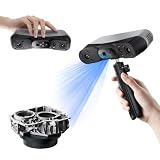
- 【Industrial-Grade Accuracy】Achieve single-frame accuracy up to 0.03 mm and volumetric accuracy of 0.03 mm + 0.05 mm x L(m), faithfully reproducing the finest surface details and complex geometries with exceptional consistency. Full-Field Structured Light accuracy reaches 0.08 mm; VCSEL mode delivers 0.10 mm @ 300-500 mm and 0.20 mm @ 500-800 mm. Engineered to meet the demanding requirements of 3D printing, reverse engineering, and precision modeling applications.
- 【Ultra-Fast Scanning & Robust Frame Rate】Multi-line Laser mode delivers up to 105 fps with NVIDIA GPU acceleration. Full-Field Structured Light mode achieves up to 5,000,000 points/s. The high frame rate ensures a smooth, uninterrupted scanning experience, especially suited for rapidly capturing large objects and complex scenes, significantly boosting overall workflow efficiency.
- 【AI-Powered & Photo-Grade Retopology】 AI object segmentation (Windows only) identifies your target in one click, tracks it throughout the scan, and auto-filters background noise — delivering clean data and streamlining post-processing. The patented 3D Gaussian Splatting converts point cloud and RGB data into true-to-life 1:1 photorealistic models; import photos from your phone or camera to apply real textures, then export in splat format for gaming, animation, and VR.
- 【All-Weather Outdoor Scanning】Multi-line Laser mode operates reliably up to 50,000 lux; with an outdoor filter attached, scanning remains stable in lighting conditions of up to 100,000 lux; VCSEL mode operates reliably in up to 100,000 lux ambient light. Designed to overcome lighting challenges, it provides consistent all-weather performance for construction sites, archaeological digs, and industrial fieldwork.
- 【5 Scanning Modes】NIR band supports Full-Field HD Scanning (markerless, fine structured light), Hybrid HD Scanning (dual projectors, fast high-quality modeling), and VCSEL Rapid Scanning (high-density pattern, fast markerless capture). Blue light band supports 30-Cross Laser Lines Scanning (handles high-reflectivity metals & dark objects) and Single-Line Deep Hole Scanning (captures from deep holes & narrow grooves). Five modes for comprehensive indoor and outdoor coverage.
Why the Herculaneum papyri are the landmark case
The papyri from Herculaneum were carbonized by the eruption of Vesuvius in 79 CE. Heat turned the manuscripts into fragile, coal-like rolls. The National Endowment for the Humanities (NEH) describes about 1,800 scrolls discovered in the eighteenth century and calls the collection the only library from the classical world to survive in its entirety. It contains philosophical and literary works that would otherwise be lost.
| Fact | What it means for digital unrolling |
|---|---|
| Carbonization in 79 CE | The scrolls survived, but their material is brittle and difficult to handle. |
| About 1,800 scrolls | Any successful reading technique could potentially apply to a large, previously inaccessible collection; it does not mean all 1,800 have been read. |
| Discovered in the eighteenth century | Many manuscripts have remained unread for more than two centuries. |
| Philosophical and literary contents | Recovering even a small passage can change knowledge of ancient writing and intellectual history. |
NEH describes the challenge this way: “These fragile coal-like scrolls have been completely unreadable for more than two centuries, but NEH funding has helped researchers refine computerized techniques to digitally unroll X-rayed layers of the compacted papyri to try to discern and decipher their carbon-based ink writings.” The statement is from the NEH project page, not a claim that every scroll is now readable.
How researchers read a scroll without unrolling it
1. Capture a volumetric scan
The first step is a non-destructive X-ray scan that records the interior rather than just the outside of the roll. The 2016 Nature Communications study used X-ray phase-contrast tomography and demonstrated that unopened Herculaneum papyri could contain recoverable writing. More recent Vesuvius Challenge data are reconstructed micro-CT volumes.
Do these 3 things before closing this tab:
1Clear out junk files and repair common Windows errors2Scan for outdated or missing drivers - takes under a minute3Repair Windows errors before they cause bigger problemsTomography produces many cross-sectional measurements that can be assembled into a three-dimensional volume. The scanner does not open the artifact, but the scroll still has to be transported and positioned in specialist imaging equipment. This is not a consumer project involving an ordinary office or medical scanner: the cited work depends on high-resolution facilities, reconstruction software and substantial computing resources.
Rank #2

- EASY TO USE FOR BEGINNERS – Perfect for entry-level users, DIY creators, and 3D printing enthusiasts. Quick start, with simple practice giving optimal scan results.
- SMOOTH WIRELESS SCANNING – WiFi6-powered Ferret Pro ensures fast, stable scanning. Works with Windows, macOS, Android, and iOS for flexible cross-platform use.
- HIGH-PRECISION 3D MODELS – Capture detailed 3D models with full-color 24-bit scanning and anti-shake technology. Offers up to 0.1mm accuracy with full-color scanning. Ideal for objects from 50mm to 2000mm. Not suitable for very small or highly detailed items like jewelry or precision parts.cccc
- VERSATILE OUTPUT & ENVIRONMENT – Export in OBJ, STL, or PLY. Works reliably in most settings, including outdoor light (<30,000 lux). Avoid reflective, transparent, or very dark surfaces for best results.
- LIGHTWEIGHT & PORTABLE – Weighing just 105g, carry and scan anywhere—home, studio, or on the go. Compact, convenient, and ready for travel.
2. Reconstruct and segment the papyrus layers
A scan is not automatically a stack of readable pages. Software and researchers must trace the papyrus surfaces through thousands or millions of voxels. They identify which boundaries belong to the sheet, distinguish them from cracks and debris, and follow each surface as it bends around the roll.
Carbonized papyrus creates difficult geometry. Layers may be compressed together, folded back, torn, distorted or separated by gaps. A tracing error can cause a flattened image to jump from one layer to another, stretch a letter or duplicate a feature. Recent computer-vision work describes surface tracing and geometric reconstruction; a 2026 IEEE/CVF WACV paper reports experiments involving high-resolution scans of two scrolls, so its results should be understood as work on specific scans rather than a universal solution for every manuscript.
3. Flatten the mapped surface
Once a surface has been traced, a mathematical transformation unwraps it into a page-like image. The transformation changes the geometry, not the artifact. Curves are laid out on a plane while the software retains a map back to the original three-dimensional coordinates.
Flattening can be performed at different scales. A broad view helps a researcher understand the writing direction and the relationship between columns; a local view can enlarge a suspected stroke. The best rendering is not necessarily the flattest one: excessive stretching can blur features, while insufficient correction can leave lines curved or overlapping.
Rank #3
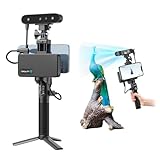
- 【High Accuracy & Fast Scanning】The Creality CR-Scan Ferret Pro 3D scanner delivers up to 0.1mm accuracy, 0.16mm resolution, and 30FPS scanning speed. It captures detailed dimensional data and complex shapes smoothly, creating highly realistic 3D models with ease.
- 【WiFi6 Wireless Transmission】Featuring advanced WiFi6, this handheld 3D scanner offers speeds 3x faster than WiFi5. The high bandwidth ensures stable, efficient data transfer for high-precision scanning and smoother workflow.
- 【Outdoor Scanning & Flexible File Export】Powered by upgraded optical technology and intelligent algorithms, the scanner delivers reliable performance in outdoor environments with ambient light up to 30,000 lux. Export models in OBJ, STL, or PLY formats for seamless integration with 3D printing, design, and reverse engineering workflows. For optimal results, avoid scanning highly reflective, transparent, or extremely dark surfaces.
- 【Anti-Shake Tracking】Equipped with one-shot 3D imaging, the Ferret Pro improves tracking accuracy and scanning success rates. Even with hand movements or quick object shifts, it ensures smooth, error-free scanning—perfect for beginners.
- Ferret Series Performance requirements: Windows: i5-Gen8 CPU or later Windows 10/11 (64-bit), RAM: >8GB, Software: >V2.3.0 Mac OS: M1/M2/M3/M4 series, macOS 11.7.7+ or Intel i5-Gen8+, RAM: >8GB Android: OS: Android 10.0+, RAM: >8GB, Connectivity: Wi-Fi 6, App: V2.0.2 iOS: Model: iPhone 11+, iOS 15+, RAM: >4GB
4. Detect ink and interpret the text
Finding a surface is different from seeing its writing. Herculaneum inks are carbon-based, and the papyrus itself was also transformed into carbon-rich material. In some scans, ink does not produce a strong, clean contrast with the substrate. Image processing and machine-learning models can enhance likely strokes, but they cannot turn every ambiguous texture into a reliable letter.
Scholars therefore compare enhanced imagery with the three-dimensional context, writing conventions, neighboring letters and known languages. A machine-learning suggestion is evidence to inspect, not an automatic transcription. Reading may require several renderings of the same surface and independent review by papyrologists or other specialists.
What the published milestones do—and do not—show
The 2016 peer-reviewed study established that virtual unrolling and deciphering could reveal portions of text inside unopened Herculaneum papyri. It did not establish that an entire scroll, or the entire collection, had been read.
What’s actually slowing this PC down?
Pick the symptom - the matching free tool is one click away.
NEH later reported porphyras, meaning “purple,” as the first word recovered from the charred scrolls. The same project page describes a first full passage decoded by three student researchers. Those are specific milestones: one recovered word and one passage, not a complete catalogue of the library.
Rank #4

- AI Visual Tracking Technology: Equipped with a new generation of single-frame encoded structured light units that improve surface feature detection for smooth, marker free scanning
- High Precision Scanning: Achieves 0.05mm accuracy using blue light technology, making your model size closely approach reality for detailed reproduction
- Fine Resolution Capability: Features 0.10mm resolution with detailed point clouds that preserve object details providing refined models for printing or display projects
- Versatile Scan Range: Capable of scanning objects ranging from 15mm to 1500mm, accommodating a wide variety of object sizes
- Integrated Software Solution: JMStudio scanning software integrates scanning, editing, and optimizing into one seamless process for efficient workflow
Search records also identify a 2026 paper titled “Complete virtual unwrapping and reading of a rolled Herculaneum papyrus.” A title alone does not establish the paper’s methods, the amount of text independently reviewed or its acceptance by the wider papyrological community. Treat claims of a first complete scroll as provisional until the full work and scholarly assessment are available.
Where the method can fail
| Stage | Typical problem | Why it matters |
|---|---|---|
| Imaging | Resolution, noise or material similarity can hide boundaries and ink. | Information that was never captured cannot be recovered by later software. |
| Segmentation | A traced surface can switch layers, stop at a fold or follow a crack. | The flattened image may contain distortions or text from the wrong part of the roll. |
| Flattening | Strong curvature and compression require geometric correction. | Over-correction can stretch strokes; under-correction can leave writing overlapped. |
| Ink detection | Carbon ink may be difficult to distinguish from carbonized papyrus. | Enhancement can expose genuine marks but can also emphasize artefacts. |
| Interpretation | Faint or partial marks can support more than one reading. | A plausible character sequence still needs expert and, where possible, independent review. |
| Completeness | Only a portion of a surface may be reconstructed or legible. | Reading a passage does not establish that the rest of the scroll is readable. |
This chain explains why an impressive scan is not the same thing as a translated book. Imaging, geometry, visibility and scholarship are separate technical and interpretive tasks.
Independent reader supportYour contribution helps us test, update, and keep practical guides available for everyone.How X-rays can reveal writing inside a rolled object
Tomography measures how X-rays interact with material from many angles. Reconstruction combines those measurements into a volume in which folds, voids, denser inclusions and other structures can be located. The writing is not read from a single shadow image; it is sought on a surface reconstructed from the volume.
The Tool Desk
Outbyte PC Repair FREEClear out junk files and repair common Windows errorsFree Scan →Outbyte Driver Updater FREEScan for outdated or missing drivers - takes under a minuteDriver Scan →For ink to be useful, it must create a measurable difference from the papyrus or be recoverable through a pattern that image processing can enhance. The difference may be subtle, which is why phase-contrast methods, high-resolution micro-CT and carefully chosen renderings matter. The approach is strongest when the scan preserves both the sheet’s geometry and enough signal from the writing.
Best Value

- HIGH ACCURACY & FASTER: Boasting an impressive accuracy of up to 0.1mm, a resolution of 0.16mm, and a scanning speed of 30FPS, the Creality CR-Scan Ferret SE 3D scanner demonstrates outstanding performance in capturing extensive dimensional data and intricate details to shape highly realistic models smoothly and quickly
- ANTI-SHAKE TACKING: CR-Scan Ferret SE 3D scanner equipped with the new one-shot 3D imaging technology, this advanced feature enhances tracking efficiency and significantly increases the success rate of scans , ensures smooth, error-free scanning results even with shaky hands or rapid movements, ideal for beginners
- COLORFUL & VIVID TEXTURES: The CR Scan Ferret SE color 3D scanner built-in with the 2MP high-resolution color camera, captures intricate details and colored 3D models in their original colors, vividly bringing every intricate detail to life
- FLEXIBLE SCANNING RANGE: Provides a flexible scanning range of 150mm to 2000mm and a single capture range of up to 560*820mm, easily and efficiently handles the scanning of medium to large objects
- SCAN BLACK/METAL OBJECTS WITHOUT SPRAYING: The Ferret SE is optimized for scanning black or metal objects, it doesn't required you to use a white powder or spray to create a contrasting surface for black objects, much easier and faster to help you to finish your work
Open scan data for learning and verification
The AWS Registry of Open Data entry for the Vesuvius Challenge lists reconstructed micro-CT volumes for virtual unwrapping, segmentation and text recovery. The registry describes the data in OME-Zarr multiscale format, provides public S3 access without requiring an AWS account and says that additional material is added as scans are reconstructed.
OME-Zarr stores image data at multiple resolutions, allowing a viewer or analysis program to begin with a lower-resolution overview and load finer levels when needed. Anyone reusing the files should read the current dataset documentation for file names, citation requirements and license conditions. The registry is a data source, not a guarantee that every volume has been segmented, flattened or proven to contain readable ink.
A safe way to explore the public volumes
- Open the registry page and read its current documentation before downloading anything.
- Confirm which scan and resolution level you need; multiscale data can be very large.
- Keep the original volume unchanged and record the dataset version or file path used for an experiment.
- Inspect a surface in three dimensions before trusting a flattened rendering, so you can see whether it crosses folds or gaps.
- Label any detected mark as a candidate until its position, rendering and interpretation have been checked independently.
- Follow the registry’s citation and license instructions when publishing images, code or derived annotations.
How to judge a claim about a digitally unrolled scroll
Headlines often compress several achievements into the word “read.” A careful comparison should ask the following questions:
- What imaging modality and resolution were used? Phase-contrast tomography and micro-CT are not interchangeable descriptions of a scan.
- Was ink actually distinguishable? A volume can show layers clearly while still failing to show writing.
- How much surface was segmented and flattened? A few centimeters, one line, one column and an entire scroll represent very different achievements.
- Was the reading independently reviewed? A machine-generated suggestion, a researcher’s provisional transcription and a published scholarly reading should not be presented as equivalent.
- Did the artifact have to be opened or altered? Virtual unrolling’s central conservation advantage is avoiding physical opening, although scanning still requires careful handling and transport.
- Are the results reproducible? Public volumes, documented software and coordinates allow others to inspect the same feature rather than relying only on a cropped illustration.
What digital unrolling changes for conservation and scholarship
Physical unrolling can expose a surface but may fracture, abrade or permanently deform a carbonized roll. Digital unrolling offers a way to investigate internal layers while leaving the object closed. It also allows the same scan to be rendered repeatedly: one scholar can study writing direction, another can test a segmentation method, and a conservator can preserve the original object while analysis continues.
The trade-off is that digital access moves risk from the artifact to the interpretation pipeline. Poor segmentation, missing metadata or an overconfident transcription can create a misleading result without visibly damaging the scroll. Preservation therefore includes both the physical manuscript and the scan, coordinates, processing history and scholarly record needed to audit a conclusion.
What readers should expect next
The Vesuvius Challenge registry is updated as additional scans are reconstructed, so the available evidence can expand without any new physical opening of the manuscripts. Better surface-tracing algorithms may reduce layer-switching errors, and improved rendering may make faint ink easier to inspect. Those advances still depend on the quality of each scan and on specialists deciding whether a visible mark is writing.
The realistic promise is cumulative: more usable volumes, more accurately mapped surfaces and more passages that can be checked by multiple readers. It is not a promise that every Herculaneum scroll will yield a complete, unambiguous text.
Outdated Drivers Are Slowing You Down
One free scan finds every outdated or missing driver and matches the right update for your exact hardware.Free scan · exact hardware matchPC Slower Than It Used to Be?
A free scan shows the junk files, broken settings and background clutter dragging Windows down - then fixes them in one click.Free scan · Windows 10 & 11Quick Recap
Product prices and availability are accurate as of the date/time indicated and are subject to change. Any price and availability information displayed on Amazon at the time of purchase will apply.

