
Free tools Windows power users keep installed
One-click scans. No signup required.
iTechGuides is reader-supported. When you buy through links on our site, we may earn an affiliate commission. As an Amazon Associate I earn from qualifying purchases. Learn more
Choose between pixel and tunnel mode based on how your camera system needs to handle CSI-2 framing—not on an assumed speed advantage. Pixel mode sends pixel payload and reconstructs CSI-2 framing at the receiver, enabling some device-specific stream adjustments. Tunnel mode forwards the CSI-2 structure and can preserve the source’s CSI-2 CRC to the processor on supported components. The right choice depends on both endpoints, PHYs, aggregation, channel mapping, and the exact parts in your design.
What pixel and tunnel modes do
GMSL—Gigabit Multimedia Serial Link—is Analog Devices’ serializer/deserializer technology for carrying high-speed video over a cable. In a typical camera link, the serializer sits near the camera sensor and the deserializer near the processor or other sink. The modes discussed here apply to GMSL components that support CSI-2; do not assume the same features apply to GMSL1 or every later-generation part. Control-channel functions are separate from the video mode.
Pixel mode: transport payload, rebuild framing
The serializer checks the incoming CSI-2 CRC, removes the CSI-2 header and footer, and sends the payload across the GMSL link as pixel data. The deserializer reconstructs CSI-2 framing and generates a new header, footer, and CRC. This permits some packet-level changes in supported devices, but the original sensor-side CSI-2 CRC is not carried unchanged to the processor. Analog Devices’ mode overview and MAX96717FR user guide describe the relevant implementation details.
Tunnel mode: forward CSI-2 structure
Tunnel mode repacketizes the CSI-2 stream for the GMSL link without converting it to pixel-based data. On supported components, the source’s CSI-2 CRC can reach the processor unchanged; GMSL-level CRC separately protects the serializer-to-deserializer segment. Some parts can also check CSI-2 CRC inline at the deserializer and report errors. Consult the specific part’s guide to confirm exactly what it monitors and reports. The MAX96716A/MAX96716F guide and MAX96714FR guide illustrate why behavior must be verified by device.
#1 Best Overall

- 【Continuous Upgraded 1080P AHD Backup Camera】After launching three car backup cameras, PixelMan further upgrade and launch the new reversing camera PMD2A-S. This car camera use the latest chip special for reversing camera made in Japan, this chip not only has excellent image output, but also has stunning performance under strong light and dark light. Strict in details and only make the best products is what PixelMan pursues. It is also essential to you, isn't it?
- 【Support HD and AHD switching】This upgraded back up camera even supports HD and AHD switching. Each optimization improves the definition, signal stability, waterproof performance, durability, installation, etc. Our vehicle backup camera can be switched to AHD signal output to achieve 1080P display (Under the premise that the screen supports AHD signal).
- 【1/2.7in AHD 1080P Large Chip Adopted in This Reverse Cam】The chip size determines the amount of reversing camera output pixels, compared with 1/4in chip used in ordinary backup cam, the most apparent feature is the enhanced brightness and color saturation besides of the sufficient clarity. The colors become more vivid and true, the increased brightness makes the images more clearly, meanwhile, the night vision effect also be enhanced, you can back the car easily without extra light at night.
- 【170° Wide Angle Optical Glass HD Lens】The lens is the core component of the reverse camera for car. The HD lens used in PMD2A-S wide angle backup camera is very different from ordinary lens in appearance, it has a larger aperture and a stronger sense of technology. High transmittance glass, fish eye appearance, F1.4 aperture, all these features directly determine the wide angle, maximum output pixels and night vision performance of the license plate camera.
- 【Back Up The Car Easily】Whether it is day or night, you can see almost everything behind the car when reversing, PixelMan camera for car reverse will let your driving easier and safer. Isn’t it what you need?
How the tradeoffs compare
| Design concern | Pixel mode | Tunnel mode |
|---|---|---|
| Stream handling | Transports pixel payload; the deserializer reconstructs CSI-2 framing. | Forwards the CSI-2 structure in GMSL packets without pixel-level processing. |
| CSI-2 CRC visibility | The serializer checks the incoming CRC; the deserializer creates a new one. | Preserves the source CRC to the processor on supported parts; some parts add inline checking and error reporting. |
| PHY translation | Can support translation such as D-PHY to C-PHY when the selected devices support it. | Generally retains the original PHY; Analog Devices identifies MAX96724-family exceptions. Check the exact device documentation. |
| Virtual-channel handling | Reassignment can be available on supported devices. | Device-dependent; some configurations require unique channel IDs at the sources. |
| Aggregation | Supported streams can be aggregated when the relevant ports use the same mode. | Supported streams can be aggregated when the relevant ports use the same mode. |
| Mixing modes in an aggregate | The cited implementations do not allow pixel-mode and tunnel-mode streams to be aggregated together. | |
| Configuration | The chosen mode must be supported and configured at both ends. Depending on the part, configuration may use register writes or device-specific default pin settings. | |
The aggregation and mixed-mode constraints are also addressed in Analog Devices’ FAQ on mixing pixel and tunnel streams. A GMSL2 article also discusses a 10 Gbps D-PHY limit in the specific context of merged streams; that is a stated technical limit in that context, not a measured speed difference between the two modes. Check the article and relevant device documentation before applying it to a design.
Which mode should you use?
Analog Devices’ FAQ recommends tunnel mode where possible. That is a starting preference for retaining the source CSI-2 structure and CRC, not a guarantee that tunnel mode is best for every system. Pixel mode may be necessary if a selected device does not support tunnel mode, or useful when the design needs supported pixel-mode functions such as virtual-channel or data-type editing. As Analog Devices senior field application engineer Flavius Luntrașu put it: “In simplified terms, pixel mode provides more system flexibility, while tunnel mode enhances data integrity, sacrificing some of the system versatility.” The statement appears in his Analog Devices article.
Rank #2
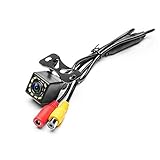
- LED Night Vision Car Vehicle Front /Rear View / Side View Camera. Eliminating dangerous blind spots. Protect your car around of Kids and little pets.
- High-definition HD color image camera. Angle adjustable parking aid, 12 night vision LEDs, waterproof, universal mounting. Perfect to install on all sorts of vehicles. perfect clarity and functionality during the rainy day.
- Power supply: DC 12V - video cable connection. A wide camera lens viewing angle makes sure that you can see enough to park and reverse safely.
- You will never have to worry about taking your camera on a bad day as it is very weather resistant and will support you through storms.
- The cable length about 6m(20ft), so it is perfect for most cars. Easy to operate.
Check these design requirements before selecting
- Both endpoints: Confirm the serializer and deserializer support the intended mode, and configure them to match. A mismatch prevents video transmission, although the article says supported peripheral links such as I²C, UART, and GPIO are not affected by this video-mode mismatch.
- Source and sink PHYs: Verify the sensor output and processor input requirements. Do not assume that a mode or device supports D-PHY/C-PHY translation without checking its guide.
- Channels and stream edits: List each camera’s virtual-channel IDs and required data types. Confirm which endpoint can perform any reassignment or edits and whether tunnel-mode sources need unique IDs.
- Aggregation and routing: Check which ports can be combined, whether all streams use the same mode, and how the deserializer routes outputs to the processor.
- Bandwidth: Calculate the combined stream demand against the limits of the exact link, deserializer, output PHY, and processor input. The mode choice alone does not establish a general bandwidth or latency advantage.
- Exact generation and part: Use the current datasheet and user guide for the selected components. GMSL products do not share a universal feature set, and these CSI-2 mode details should not be projected onto GMSL1.
Analog Devices’ FAQ, “Should I use pixel or tunneling mode in my camera system?” likewise treats the choice as dependent on device capabilities and system needs. The source material does not establish a general percentage improvement, latency reduction, or bandwidth gain for either mode.
Does the mode change board layout?
The cited overview reports no meaningful schematic or PCB-layout change solely from choosing pixel rather than tunnel mode. That does not remove the need to design the board for the selected components, PHYs, connectors, and signal-integrity requirements; those details remain part-specific.
Rank #3

- Helps assist driver awareness
- Read the vehicle owner's manual for important feature limitations and information
- Some GM Genuine Parts may have formerly appeared as ACDelco GM Original Equipment (OE)
- GM Engineers design and validate OE parts specifically for your Chevrolet, Buick, GMC, or Cadillac vehicle
Evaluating a GMSL camera setup
For a development setup, Analog Devices’ MAX96724R product page discusses evaluation-kit connections involving cameras and supported processing platforms, including Raspberry Pi or NVIDIA development platforms, and identifies the AD-GMSLCAMRPI-ADP adapter. This is not evidence that the adapter works with every camera or board, or that it is currently available from a particular retailer. Confirm interfaces and compatibility for the exact combination of hardware.
Quick Recap
Best Value

- Wide Angle - 170-degree wide angle view for maximum visibility behind your vehicle
- 170 Degree Angle - Wide view for maximum visibility behind your vehicle
- Resolution - With a resolution of 640 x 480, you will be sure to see everything in crisp, clear detail
- Guide Distance - Unique distance guide lines on the image repeat object’s distortion and help to control the distance to obstacles from any angle
- Visibility - The LPCB40 has a Lux rating of 0.1. A camera with a 0.1 Lux rating can see better in darker conditions than a camera with a 0.5 lux rating
Rank #4

- The GMSL-2MP-Camera-A camera module adopts a 2MP automotive-grade CMOS image sensor and integrates the MAXIM MAX96717F GMSL serializer
- It includes a professionally calibrated image signal processor (ISP), delivering clear and stable image quality
- The entire unit features an IP67-rated case and comes with an AA lens, and each unit is precisely focused and glue-secured before shipment, making it well-suited for automotive and other demanding applications
Product prices and availability are accurate as of the date/time indicated and are subject to change. Any price and availability information displayed on Amazon at the time of purchase will apply.

