
Free tools Windows power users keep installed
One-click scans. No signup required.
iTechGuides is reader-supported. When you buy through links on our site, we may earn an affiliate commission. As an Amazon Associate I earn from qualifying purchases. Learn more
GarageBand’s Feedback Protection can stop input monitoring when it detects feedback, but a warning does not always mean you can hear a feedback loop. Apple says some USB microphones with internal limiting or gain control can trigger warnings when no feedback is occurring. The right next step depends on whether you hear feedback, see only a warning, or are using GarageBand on iPhone or iPad.
What Feedback Protection does in GarageBand for Mac
Input monitoring routes a live microphone or instrument signal through GarageBand so you can hear it while recording or playing. If speakers send that sound back into a microphone or instrument pickup, the signal can loop and produce audible feedback. GarageBand’s Feedback Protection can stop monitoring when feedback occurs.
Apple notes that some USB microphones with internal limiting or gain control can cause Feedback Protection warning messages even when feedback is not occurring. In that specific case, Apple suggests changing the track’s Monitor setting from “On with Feedback Protection” to “On.” This is a targeted workaround for the documented USB-microphone behavior, not a general recommendation to turn protection off for every setup. Apple Support: GarageBand: Feedback Protection may be very sensitive with some USB mics
Do these 3 things before closing this tab:
1Fix the driver behind crashes, sound loss and screen glitches2Repair Windows errors before they cause bigger problems3Scan for outdated or missing drivers - takes under a minuteChoose the right fix for what you’re experiencing
If you hear a feedback loop
- Use headphones instead of speakers while monitoring. Headphones avoid sending the project’s speaker output back into the recording space, which helps remove that feedback path.
- Lower speaker output if speakers must remain in use, and check that only the input you intend to hear is being monitored.
- Turn monitoring off when you are not actively playing or singing into the monitored track.
GarageBand Help recommends listening through headphones rather than speakers and turning monitoring off when it is not needed. GarageBand Help: Turn on input monitoring for audio tracks
#1 Best Overall

- Music Production and Beat Maker Essential -USB powered MIDI controller with 25 mini MIDI keyboard velocity-sensitive keys for studio production, virtual synthesizer control and beat production
- Total Control of your Production - Innovative 4-way thumbstick for dynamic pitch and modulation control, plus a built-in arpeggiator with adjustable resolution, range and modes
- Native Kontrol Standard (NKS) Integration - Akai Professional and Native Instruments have partnered to bring NKS support to the MPK Controller series, get ready to Kontrol straight from your MPK
- Choose Your Exclusive Complimentary NKS Bundle - Browse and control Native Instruments presets and sound libraries; select one of three curated Komplete 15 Select bundles: Beats, Band, or Electronic
- The MPC Experience - 8 backlit velocity-sensitive MPC-style MIDI beat pads with Note Repeat and Full Level for programming drums, triggering samples and controlling virtual synthesizer / DAW controls
If you see a warning but hear no feedback
First check whether your input is a USB microphone with internal limiting or gain control. Apple documents false warning messages for some microphones with those features. If that matches your setup, select “On” rather than “On with Feedback Protection” for Monitor and see whether the warning stops. A warning alone is not proof of audible feedback, but this behavior does not establish that every warning is false. Apple Support’s USB microphone guidance
How to change protection settings on iPhone or iPad
GarageBand for iPhone and iPad documents a related but differently named option: Crosstalk Protection. It applies when a guitar or bass is connected through the headphone port and monitoring is on. Protection can change the instrument’s sound while you monitor it.
Rank #2

- Mini Keys, Major Performance - 25-key MIDI controller keyboard with responsive keys to play with feel and dynamics; Enjoy expressive songwriting, composing, jamming, playing melodies, bass lines, and more
- Full Range Experience - Play every note with ease; Use the dedicated octave up and down buttons to transpose the range of your software instruments plus a sustain button for expressive performances
- Feature Packed - Use the built-in arpeggiator and clock for creative control of any of your sound sources like software instruments, synthesizers, or USB-enabled modular gear, all by one USB cable
- Customized Production - With 8 programmable preset slots you can instantly recall your mappings for DAWs, virtual instruments, and more; Create, edit, and manage all your presets from the computer
- Versatile Performance - The USB Studio MIDI controller is perfect for your songwriting, beat-making, and DJ remixes whenever you're inspired; The sleek design fits alongside your studio equipment
- Close GarageBand.
- Open the device’s Settings app.
- Tap Apps, then choose GarageBand.
- Toggle Crosstalk Protection.
Apple’s GarageBand User Guide for iPhone describes this setting and its effect on monitored guitar or bass sound. The setting should not be confused with the Mac feature or its USB-microphone warnings.
The Tool Desk
Outbyte Driver Updater FREEScan for outdated or missing drivers - takes under a minuteDriver Scan →Outbyte PC Repair FREERepair Windows errors before they cause bigger problemsFix Now →Using an external microphone with iPhone Audio Recorder
On iPhone, Audio Recorder monitoring is available when an external microphone or audio device—such as a headset or interface—is connected. Input level control depends on whether the connected source supports it. Apple documents these input and monitoring conditions in its Audio Recorder guide.
Quick Recap
Best Value

- Full Creative Control - A dynamic 37-Key MPK Mini keybed for 3 full octaves of melodic and harmonic performance; Easily connect to your DAW or studio equipment with the USB-powered MIDI Controller
- Advanced Connectivity - Connect to different sound sources with CV/Gate and MIDI I/O; Control modular gear, sound modules, synthesizers, and more to bring new sound sources into your music production
- Native Kontrol Standard (NKS) Integration - Akai Professional and Native Instruments have partnered to bring NKS support to the MPK Controller series, get ready to Kontrol straight from your MPK
- Choose Your Exclusive Complimentary NKS Bundle - Browse and control Native Instruments presets and sound libraries; select one of three curated Komplete 15 Select bundles: Beats, Band, or Electronic
- Record and Compose Without a Computer - Connect to your production station and use the built-in 64-step sequencer featuring one track for drums and one for melodies or chords, with up to 8 notes each
Rank #4

- 【Powerful keyboard】 Songwriters and Beat Maker Essential - USB powered MIDI controller with 25 mini MIDI keyboard velocity-sensitive keys for studio production, virtual synthesizer control and beat production.
- 【Wireless keyboard】It's very compact and portable, and you can connect it wirelessly to your device with Bluetooth, built-in 2,000 mAh battery can work for about 16 hours, you can easily slip this ultra-portable MIDI keyboard into almost any bag and take it with you to the studio, cafe or hotel to compose music.
- 【Music Production】 25 velocity-sensitive keys, 8 RGB backlit velocity-sensitive pads, 8 assignable rotary enconders, 2 Capactive touch stripes pitch bend to all your music studio plugins for mixing, tweaking synth controls and more.
- 【Smart keyboard】Compatible with Windows, Mac OS, Android and iOS,The K5 compatible with all digital audio worksstation, Ableton live,Fl Studio,Cubase,Logic Pro X,Bitwig,Reason,Studio One,GarageBand(iOS) etc.,
- 【Scale feature】Integrate the smart chord and smart sound function, users can choose quickly through the keys. very suitable for setting this function during performance and practice.
Rank #3
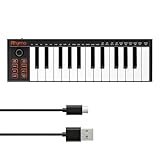
- 【Ultra-Portable USB-C MIDI Controller】Rhymo 25-key portable MIDI keyboard is slim, compact, and powered directly via USB-C from your computer or tablet. No batteries or adapters required for a truly hassle-free, on-the-go music production setup.
- 【Complete Performance & Creative Controls】Features X-Y joystick for pitch bend & modulation, arpeggiator with latch & multiple modes, loop function, tap tempo, and transpose control. Octave buttons expand up to 10-octave range for full melodic flexibility.
- 【Professional Playability Features】Equipped with Full Level mode, 16 user-selectable MIDI channels, and a 6.35mm sustain pedal interface. The velocity-sensitive keyboard delivers dynamic, expressive playing for both beginners and experienced producers.
- 【Universal DAW & System Compatibility】Class-compliant USB-MIDI and Bluetooth MIDI work with Mac, PC, iOS, and all major DAWs including GarageBand, FL Studio, Ableton Live, Logic Pro, Cubase, and more. Plug & play with no extra drivers required.
- 【Versatile I/O & Easy Operation】Includes USB-C port, 3.5mm TRS MIDI output for external synths, and clear LED indicator lights. User-friendly button layout for ARP, loop, tempo, octave, and transpose for fast, intuitive music creation.
Quick troubleshooting checklist
- Audible feedback: switch to headphones, reduce speaker output, verify the monitored input, and disable monitoring when you are not using it.
- Warning without audible feedback on Mac: if you use a USB microphone with internal limiting or gain control, try Monitor “On” instead of “On with Feedback Protection.”
- Guitar or bass through the headphone port on iPhone or iPad: review Crosstalk Protection in Settings > Apps > GarageBand and listen for any change in monitored tone.
Product prices and availability are accurate as of the date/time indicated and are subject to change. Any price and availability information displayed on Amazon at the time of purchase will apply.

