
iTechGuides is reader-supported. When you buy through links on our site, we may earn an affiliate commission. As an Amazon Associate I earn from qualifying purchases. Learn more
Stop construction around the discovery, leave everything in place, secure the area, and notify the authority responsible for the land. Do not clean, pocket, move, or dig for more objects. If bones or a possible burial are present, treat the find as a potential crime scene and call law enforcement and the coroner or medical examiner immediately. The correct contact, ownership rule, and time before work can restart depend on your jurisdiction, the land status, and whether the find could be human remains.
What to do in the first 10 minutes
- Stop work in the immediate area. Shut down excavation, grading, trenching, drilling, and equipment that could strike or bury the discovery. Keep workers and vehicles outside the affected area. You may continue work only in clearly separate areas that an authority or qualified archaeologist confirms are outside the discovery vicinity.
- Leave the discovery exactly where it is. Do not pick it up, brush it, wash it, restore it, break it apart, or separate it from surrounding soil. British Columbia guidance says not to disturb archaeological remains, and Washington State Parks says not to touch, move, or further disturb exposed material.
- Protect the location. Use temporary construction fencing, barrier tape, flagging, stakes, or other visible markers to create a no-entry zone. Keep machinery, spoil piles, tools, animals, and bystanders away. The barrier is a site-control measure, not permission to resume work or to investigate the find.
- Keep the location confidential. Do not post exact coordinates, identifying photographs, or social-media updates. Confidentiality protects a potential site from looting and is expressly required for certain resources evaluated under Bureau of Ocean Energy Management rules.
- Document without disturbing anything. If it is safe and allowed, photograph the object in place with a simple scale such as a coin or pen. Record the address, GPS coordinates or a precise site description, depth, date and time, construction activity, equipment in use, weather and soil conditions, visible contents, witnesses, and the protective steps you took.
- Notify the right authority. Call the archaeology or historic-preservation office named by your permit, the local or state/provincial archaeology branch, the land-management agency, or the project archaeologist. On federal or tribal land, follow the responsible agency’s Native American Graves Protection and Repatriation Act (NAGPRA) procedure and notify an affiliated tribe or Native Hawaiian organization when identifiable.
- Escalate suspected human remains immediately. Call law enforcement and the county coroner or medical examiner, even if the bones look old. Do not attempt to decide age, cultural affiliation, or cause of death yourself.
- Wait for clearance. Resume work near the find only after the responsible authority or qualified archaeologist provides instructions, completes the required assessment or treatment plan, or issues any written certification required by law or permit.
Why the correct response depends on jurisdiction
There is no single homeowner rule. A property can be private, state or provincial, federal, tribal, or subject to a special permit, and each category can assign different authorities and ownership or disposition rules. The same object may be handled differently depending on whether it is an isolated modern item, an archaeological feature such as a hearth or wall, or possible human remains.
| Situation | First contact | Typical protection or restart requirement | Important qualification |
|---|---|---|---|
| Ordinary-looking object on private land | Local or state/provincial archaeology office, permit contact, or project archaeologist | Keep the object and soil undisturbed; follow the official assessment or clearance instruction | Private ownership does not automatically permit removal, sale, or destruction |
| Archaeological site or feature on public or private land in British Columbia | British Columbia Archaeology Branch or the authority identified for the project | Alteration requires the applicable permit; protect the site while it is evaluated | Archaeological sites on private land are protected under provincial law |
| Suspected human remains anywhere | Law enforcement and the coroner or medical examiner | Preserve the scene and await official instructions | Moving bones or associated objects can destroy forensic and archaeological evidence |
| Native American human remains or cultural items on federal or tribal land | Responsible federal or tribal official and, when identifiable, the affiliated tribe or Native Hawaiian organization | Follow NAGPRA notice, protection, consultation, and certification procedures | Written certification may be required before construction resumes |
| Covered construction on the federal Outer Continental Shelf | Bureau of Ocean Energy Management | Halt seafloor-disturbing activity and notify BOEM within 72 hours under 30 CFR § 585.702 | This is an offshore rule, not a general deadline for private home construction |
How to handle bones or a possible grave
Assume bones could be human until a competent authority identifies them. They may be recent, historic, or archaeological, and visual guesses are unreliable. Florida guidance warns that moving or removing items can destroy forensic or archaeological data. Tennessee guidance states that tampering with human burials or funerary objects without a court order is illegal.
Preserve the scene
Stop nearby activity, establish a perimeter, and keep people out. Do not lift bones, expose more of a skeleton, sift the soil, remove clothing or objects, or reposition machinery to obtain a better view. Leave spoil piles where they are unless police direct otherwise.
#1 Best Overall

- Top Metal Detector: PANCKY adult metal detector has 5 different modes. All METAL MODE, DISC MODE, MEMORY MODE, JEWELRY MODE, PINPOINTER. Do not use the JEWELRY MODE to detect precious metals. It will exclude any similar to iron, including gold and silver
- Upgraded DSP Chip: The second-generation DSP chip metal detector developed by PANCKY providing higher 25% detection speed, sensitivity, and accuracy than other detectors on the market. Focus on valuable targets while ignoring unwanted items, avoid trash
- Intuitive Large LCD Display with Backlight: User-friendly interface designed specifically for beginners. Display can be viewed from multiple angles. The backlight function makes it easy to read for treasure in low light or night conditions, even at night
- Detect More Effectively: Silicone buttons for easy operation, provides satisfying tactile feedback and greater sensitivity. It's convenient for you to get the type of metal target, depth, ecognition, sensitivity level, operation mode by LCD display
- IP68 Waterproof: The IP68 waterproof search coil allows metal detecting enthusiasts to find treasure even in shallow water. Please use the lowest sensitivity to minimize interference when used in seawater. Note: The control box is NOT waterproof
Make the emergency calls
Call law enforcement and the county coroner or medical examiner immediately. Washington State Parks summarizes the operational sequence as “Stop,” “Protect,” and “Notify.” Queensland’s development guidance likewise requires immediate notification to the Queensland Police Service when human remains are suspected.
Protect privacy and evidence
Do not publish photographs or the exact address. Give images and notes directly to investigators or the archaeology authority through a secure channel they specify. Keep a log of who entered the area and when, so officials can distinguish original evidence from later activity.
What counts as a discovery
An artifact can be a stone tool, pottery fragment, glass or metal object, worked bone, bead, coin, or other item made or modified by people. The context around it may be more important than the object itself. A layer of soil, a post hole, hearth, wall, midden, cemetery, or group of objects can indicate a site that extends beyond the visible find.
Do not widen the excavation
Searching for additional material, scraping the trench walls, or removing “just one more” layer can destroy the relationships archaeologists need to date and interpret a site. Leave associated fragments, soil, charcoal, shells, and building materials where they lie.
Rank #2

- [360° Comprehensive Detection] - With its 360° side-scan capability and impressive 3.5-inch detection depth, this metal detector pinpointer guarantees thorough detection of all metals. Quickly pinpoint targets with precision, maximizing your efficiency and ensuring every dig is worthwhile.
- [User-Friendly Operation] - With simple single-button operation and intuitive sound plus vibration alerts mode, the pinpointer metal detector makes detecting a breeze. Just power it on and let the alarms guide you to your target effortlessly.
- [Compact and Portable Design] - Designed with mobility in mind, the hand held metal detector wand is lightweight and includes practical accessories like a spring clip and belt loop. Facilitating easy transport and use wherever you go. Ideal for those on the move, it's your trusty companion for any detecting expedition.
- [IP68 Waterproof Functionality] - Designed for durability and versatility, the waterproof tip and scale section provide enhanced protection and durability. Whether you're exploring indoors, outdoors, on the beach, or in the grass, the SUNPOW metal detector pinpointer waterproof can handle any environment with ease.
- [Popular Gift Choice with Premium Service] - Our pin pointers for metal detectors include everything you need: Metal Detector Wand OTMD12*1, Retractable Hanging Wire*1, Belt loop*1, User manual*1, 9V Battery*1. It's the ideal gift for both adults and kids during the holidays. Plus, our dedicated customer service team is always available to address any questions or concerns.
Do not assume an object is worthless
Modern-looking items can be part of a historic deposit, and a common object can establish a site’s age or cultural connection. Officials, not the construction crew, should decide whether an item is archaeological, historic, forensic, or ordinary debris.
How to document the find for officials
Write the record before memories fade, but do not move anything to improve a photograph. Include:
- Property address, parcel or permit number, and whether the land is private, municipal, state or provincial, federal, or tribal.
- Date and time discovered, the crew and witnesses present, and the person who first saw it.
- The exact construction task, equipment, trench or grading method, and whether the object was exposed by a bucket, auger, hand tool, or natural erosion.
- Depth below the original ground surface, horizontal position, orientation, and nearby features.
- A neutral description of each visible item, including material, approximate dimensions, color, and condition. Avoid declaring an object “human” or assigning a date.
- Photographs from several angles with a scale, if the area is safe and the authority permits photography.
- GPS coordinates or a measured site sketch, while keeping that information private.
- Weather, soil, water, and visibility conditions that could affect what was observed.
- When work stopped, how the perimeter was secured, and any later disturbance or access.
NAGPRA documentation must identify the location, contents, and protective measures taken. Keep a copy of your notes and the names, telephone numbers, and case or permit references supplied by each authority.
Jurisdiction examples you may encounter
British Columbia
The Province of British Columbia page reviewed January 27, 2026, specifically addresses discoveries during home renovations and property development. It states that archaeological sites on private land are protected and directs people not to disturb finds or remains. Altering a protected site generally requires the applicable archaeological permit, so contact the Archaeology Branch or the project contact before changing the excavation.
Rank #3

- [High-quality Material&Efficient and Sensitive Detection] Impact high-quality ABS material provides the product with excellent durability and weather adaptability, which makes it adaptable to different outdoor environments.Built-in upgraded microcomputer processor control chip and instrument self-test system help you accurately locate metal and achieve efficient and sensitive detection, which will greatly improve efficiency, and save time and energy.
- [Easy Operation&Using] The detector and indicator with modular buttons and lights allow you to easily adjust the range, depth, and metal type (gold, silver, copper, diamond) to meet different detection needs. The detector handle with a non-slip design fits in the palm of your hand and gives you a comfortable feeling.Built-in high-capacity lithium battery (800mAh) provides 3 to 8 hours of use without frequent charging.
- [Large Detection Range&Automatic Rotation Detection] 3248ft of detection range and 3.3 feet to 52.5 feet of detection depth can meet the needs of different ranges of detection.sensitive and efficient automatic rotation detection to help you easily achieve 360° full angle metal detection without manual rotation, which is more labor-saving and accurate
- [Easy to Carry] Lightweight, compact metal detector (net weight 6.2 pounds, size: 11 * 4 * 7.4 inches) and toolbox with handles and buckles provide portability for the use of the product, which facilitates the use of different sites.Strong cartons and provide comprehensive protection for products to prevent damage during transportation.
- [User-friendly Design] The headphones are used to listen to the frequency of the corresponding metal at night and determine whether the machine is working properly when scanning for metal.The protective edge of the detector can effectively prevent impact and drop to extend the service life.Signal bars help enhance the detection signal for more accurate and efficient detection.The display shows the depth, range, and speed of the search, which is convenient for accurate adjustment.
Queensland
Queensland’s Department of Environment, Science and Innovation guidance, reviewed June 6, 2025, says development work must stop when human remains are suspected and that the Queensland Police Service must be notified immediately. Failure to report discoveries can attract fines. Police and the relevant heritage authority determine the next steps.
United States federal and tribal lands
NAGPRA procedures apply to Native American human remains, funerary objects, sacred objects, and objects of cultural patrimony in the circumstances covered by the law. Notify the responsible federal or tribal official, protect the discovery, and provide the written location and contents report requested. If cultural affiliation can be identified, the agency must involve the appropriate tribe or Native Hawaiian organization. Do not treat a federal or tribal site like an ordinary private building lot.
Washington and Alexandria operational models
Washington State Parks asks discoverers to stop, protect, and notify, including photographs with a scale and geospatial information when feasible. Alexandria Archaeology’s construction standard says the contractor shall immediately halt activity within the area surrounding a discovery and allows work elsewhere only when it is outside that vicinity. These procedures illustrate the level of site control an authority may require even when the find is not human remains.
Recommended Free Tools
Why the BOEM 72-hour figure is different
Under 30 CFR § 585.702, an operator conducting covered construction on the Outer Continental Shelf must halt seafloor-disturbing activities immediately and notify BOEM within 72 hours. That deadline belongs to the offshore federal leasing regime. It is not a safe waiting period or a general reporting rule for a house extension, driveway, pool, or basement.
Rank #4
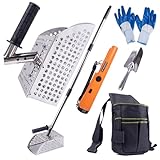
- 【SAND SCOOP FOR METAL DETECTING】This metal detector accessory kit includes 1x sand scoop, 1x shovel, 1x metal detecting pinpointer ,1x carry bag,one pair of gloves. Crafted from durable 304 stainless steel, this sand shovel ensures rust-free performance for prolonged use at the beach
- 【ENHANCE YOUR METAL DETECTING EXPERIENCE】 2-in-1 Design: Use as a Standalone Sand Scoop or Pair with an Extension Pole. Featuring an added long-handle design that is detachable to meet different height requirements, it allows you to maintain a standing posture while working, eliminating the need to bend or squat
- 【METAL DETECTING PINPOINTER】The metal detector allows you to scan large areas quickly, then use precise positioning tips to narrow and precisely locate the target before excavation. The bar probe design allows you to hand-held metal detector for detection
- 【PERFECT DETECTING KIT】Whether you're shoveling sand, panning for gold, or excavating archaeological, this detecting kit can help you quickly sift through items and enhance your efficiency in uncovering valuable finds
- 【IDEA GIFT】This sand scoop set is the perfect gift for Treasure hunters. You can give it as a Christmas gift or a birthday present
How long will construction be stopped?
No universal number of hours or days applies. The pause lasts until the responsible authority determines what was found and what treatment is required. A small isolated object may receive instructions quickly; a feature, cemetery, or culturally affiliated material may require mapping, consultation, testing, a treatment plan, monitoring, or recovery.
Ask the official for four specific answers: the protected boundary, the work that may continue elsewhere, the documents or assessment required, and the person authorized to release the area. Get the restart decision in writing when the permit or agency requires written certification. Do not promise a contractor a restart date based on an informal estimate.
Can you keep, sell, or throw away the object?
Do not make that decision at the discovery point. Ownership and disposition can depend on land status, the type of object, human-remains laws, cultural affiliation, permit conditions, and state, provincial, federal, or tribal statutes. Even on private property, removal can violate site-protection law or destroy evidence. Keep the object in place and ask the responsible authority what happens next; do not list it for sale, give it to a collector, or discard associated fragments.
Do these 3 things before closing this tab:
1Fix the driver behind crashes, sound loss and screen glitches2Repair Windows errors before they cause bigger problems3Scan for outdated or missing drivers - takes under a minuteCommunicating with your contractor and neighbors
Tell the contractor in writing that the marked area is a no-work zone pending official direction. Provide the authority’s contact and case number, but do not circulate sensitive coordinates beyond people who need them for safety or compliance. If a subcontractor arrives, brief the supervisor before equipment enters the property. Replace damaged flagging or fencing and record every intrusion. A temporary construction safety fence or barrier tape is useful for controlling access, but it never replaces reporting, consultation, or professional assessment.
When to bring in a qualified archaeologist
An agency may require a cultural-resource consultant to map the site, monitor excavation, prepare a treatment plan, or coordinate consultation. Use a qualified local professional when the authority requests one, and confirm the consultant’s scope, reporting duties, confidentiality requirements, insurance, and authority to clear work. A consultant cannot override a police, coroner, land-management, or permitting decision.
Quick Recap
A practical decision tree
- Is there any possibility of human bone or a burial? Stop, protect, and call law enforcement and the coroner or medical examiner immediately.
- If not, is the object or feature embedded in undisturbed soil or part of a group? Treat it as a potential archaeological site, leave it in place, secure the area, and contact the archaeology or permit authority.
- What land status applies? Identify private, state or provincial, federal, tribal, or special-permit status before assuming who controls the discovery.
- What did the authority require? Follow its boundary, documentation, consultation, treatment, monitoring, and written-clearance instructions exactly.
Product prices and availability are accurate as of the date/time indicated and are subject to change. Any price and availability information displayed on Amazon at the time of purchase will apply.

