
Quick wins for a faster PC:
Scan for outdated or missing drivers - takes under a minuteDriver Scan →Clear out junk files and repair common Windows errorsFree Scan →Fix the driver behind crashes, sound loss and screen glitchesFind Drivers →iTechGuides is reader-supported. When you buy through links on our site, we may earn an affiliate commission. As an Amazon Associate I earn from qualifying purchases. Learn more
The coolest Ford Mustang concepts were not simply preview models. They were experiments in layout, body shape, racing purpose, materials and performance. From the mid-engine, two-seat Mustang I that ran at Watkins Glen in 1962 to the Cobra Jet Twin-Turbo drag-racing showcase at SEMA in 2012, these nine studies show Ford repeatedly testing what a Mustang could be. “Coolest” is an editorial judgment here, based on originality, technical ambition, intended purpose and influence—not an official Ford ranking.
How to judge the coolest Mustang concept cars
A concept can matter even when no dealer ever sells it. Some of the cars below were working demonstrators built to test hardware; others were styling exercises intended to measure public reaction. Their historical value comes from the question each one asked.
- Purpose: Was it a design study, show car, performance demonstrator or racing/drag showcase?
- Form: Did it change the Mustang’s number of seats, roofline, proportions or body style?
- Experiment: Did it test a mid-engine layout, lightweight construction, a high-output engine, turbocharging or competition hardware?
- Influence: Is there documented evidence of a later production relationship, or is its importance chiefly that it expanded Ford’s thinking?
Ford never published an official “coolest concepts” list, and the available descriptions do not provide a consistent scoring system. The selection therefore treats design originality and engineering intent as more meaningful than a simple popularity contest.
What’s actually slowing this PC down?
Pick the symptom - the matching free tool is one click away.
Mustang I: the two-seat, mid-engine starting point (1962)
The Mustang I is the essential answer to “What was the Mustang I concept?” It was not a shortened version of the production Mustang. Ford’s own history calls it “a two-seater concept car that also borrowed from European styling notes.” Its engine sat behind the seats, making it a mid-engine experiment at a time when Ford was investigating a smaller, sportier car.
#1 Best Overall

- Authentic Ford Design: Each model kit accurately captures the signature style and details of iconic Ford vehicles.
- Precision-Molded Parts: High-quality, finely molded components ensure a realistic and detailed build.
- Customizable Features: Includes decals and optional parts for a personalized, unique build.
- Ideal for Hobbyists: Perfect for model builders of all skill levels, from beginners to experienced collectors.
- Display-Ready Models: Create a stunning Ford model that’s ready to showcase in your collection or as a standout display piece.
Ford created two versions. The first was a fiberglass show car; the second was a functioning example. The running car debuted at Watkins Glen in October 1962, then traveled to car shows and college campuses so Ford could gauge interest in compact sporty cars. That public-feedback mission explains why the Mustang I looks more like a lightweight roadster prototype than a practical family coupe.
The production Mustang took a different path. Ford unveiled it at the New York World’s Fair on April 17, 1964, with a more usable front-engine layout and room for more occupants. In Ford’s 2021 historical account of early production buyers, the median purchaser age was 31 and more than 28% of buyers were younger than 25; those figures describe production-car customers, not the Mustang I’s show audiences. The concept’s lasting importance is the experiment itself: it proved that a Mustang idea could attract attention before Ford settled on the formula that reached showrooms.
Mustang Mach I concept: the elongated nose before the badge (1967–1968)
The Mach I name appeared first on an experimental vehicle, before it identified the production performance model. A Mustang performance concept shown in 1967 was refreshed for 1968, and its most conspicuous feature was an unusually elongated front treatment. That nose gave the car a more dramatic, almost prototype-like stance than the production Mach 1 that followed.
This is a useful example of a concept whose historical value is partly linguistic and partly visual. Ford was trying out the attitude that a “Mach” Mustang should communicate: speed, aggression and a clear break from an ordinary coupe. The production Mach 1 adopted the name and performance-oriented identity, but not a literal copy of the concept’s extended front end. The relationship is therefore one of direction rather than direct component carryover.
Mustang Milano: a 1970 styling probe
The Milano was a 1970 design study with a lower, sleeker profile and a fastback-like rear treatment. Unlike a race demonstrator, it was primarily a styling question: would Mustang buyers respond to a more sculpted, less upright shape?
The period account describing the car says Ford built it to gauge reaction to possible design changes and later influenced Mustang and wider Ford design directions. That influence should be read as attributed reporting, not as a proven one-to-one source for a particular production panel. What is clear is the experiment’s intent. Milano used proportion and surface treatment to test whether the Mustang could look more sophisticated without abandoning its recognizable sporting character.
Mustang IMSA: racing vocabulary without a rulebook (late 1970s)
The Mustang IMSA show car borrowed the visual language of road racing: altered bodywork, a more competition-focused stance and an interior styled to suggest a race cockpit. It was a late-1970s display car rather than a homologation special.
Free tools Windows power users keep installed
One-click scans. No signup required.
Rank #2

- These highly detailed kits come with everything you need to build them including the screwdriver
- Opening parts, Rolling Wheels
- Easy assembly, Pre-painted metal body
- When finished the vehicles are fully functional
- Rolling die-cast replica
The contemporary description also makes an important qualification: the car was not built to a specific IMSA series rulebook. “IMSA” in the name signaled racing inspiration, not eligibility for a particular championship. That distinction matters because a show car can explore the appearance and atmosphere of competition without meeting the structural, aerodynamic or engine requirements of an actual race class.
Mustang RSX: a Ghia rally interpretation (around 1979–1980)
The RSX was a Ghia rally-inspired study from around 1979 or 1980; the chronology is presented as approximate because accounts use both dates. Its interest lies in altered proportions and rally styling rather than a major powertrain upgrade.
That makes RSX a different kind of “cool.” It asked whether Mustang could communicate off-road agility and European rally energy instead of the long-hood, straight-line muscle image associated with the name. The body changes did most of the work. For readers asking which Mustang concepts never made production, RSX is a clear example: its rally-focused proportions remained a design exercise rather than a showroom body style.
Mustang Mach III: a two-seat technology roadster
Mach III returned the Mustang concept to a two-seat roadster format, but with a stronger emphasis on performance technology. The described car paired a high-output V8 with lightweight body construction, presenting a compact, dramatic alternative to the production Mustang’s conventional seating and body proportions.
A Ford launch description quoted by SlashGear said the concept was designed to “blend the styling cues of the classic Mustang with Ford’s state-of-the-art design and technology.” The wording captures the car’s purpose: not a nostalgic replica, and not merely a clay styling model, but a demonstration of how classic Mustang references could be combined with contemporary engineering.
Mach III’s significance is therefore conceptual rather than a claim that its exact chassis or materials entered production. It showed Ford that a Mustang-themed vehicle could serve as a technology showcase while retaining enough visual connection to the original car to be immediately legible.
Mustang GT-R: a functional fifth-generation performance testbed (2004)
The Mustang GT-R was reported as a functional one-off developed around the launch of the fifth-generation Mustang in 2004. Its job was practical: use a race-oriented Mustang to test performance parts and competition-style modifications rather than simply display a new color or trim package.
Rank #3

- 1:25 scale, skill level 2, paint & glue required 169 parts Molded in white, clear and transparent red, with chrome-plated parts. Black vinyl tires Metal axle Built size: 7.125 inches long Ages 10+
That purpose separates GT-R from the pure styling studies. A working demonstrator can reveal cooling, braking, suspension, packaging and durability issues that a static show car cannot. The available account describes the car’s racing focus and competition-oriented equipment, but detailed percentage improvements and individual component claims belong to that secondary report and should not be treated as independently confirmed Ford specifications.
Do these 3 things before closing this tab:
1Scan for outdated or missing drivers - takes under a minute2Repair Windows errors before they cause bigger problems3Fix the driver behind crashes, sound loss and screen glitchesGT-R is among the coolest concepts because it connected the launch of a new Mustang generation to a credible performance-development exercise. Even without becoming a production model, it made the case that the new shape could support serious track hardware.
Mustang by Giugiaro: a 2006 Italian design collaboration
The Mustang by Giugiaro was a 2006 project created by Fabrizio Giugiaro, not his father Giorgetto. The design project describes it as a concept inspired by historic 1960s Mustangs, so its retro references were deliberate rather than accidental echoes.
Ford Argentina’s historical description adds substantial mechanical detail: a supercharged 4.6-liter V8 and a special glass roof intended to filter ultraviolet rays. Those choices made the car more than a sketch. The roof became a visible body and material statement, while the supercharged engine gave the styling exercise credible performance hardware.
Giugiaro’s car is especially notable for the tension between familiarity and reinvention. The design looked back to the first-generation Mustang for its inspiration, then used a conspicuously modern body treatment and roof solution to show how far a one-off could move from production constraints. It remained a collaboration concept, not a production replacement for the contemporary Mustang.
Mustang Cobra Jet Twin-Turbo: a 2012 SEMA drag showcase
The Cobra Jet Twin-Turbo concept appeared at SEMA in 2012 as a showcase for a turbocharged drag-racing powertrain. Its intended audience was not someone choosing a daily-driver body style; it was the performance community interested in what forced induction could do in a purpose-built straight-line Mustang.
Ford did not publish horsepower or quarter-mile figures in the cited release, so those numbers should not be supplied as fact. The important documented point is the experiment: twin turbochargers applied to the Cobra Jet idea and presented in a SEMA setting where extreme powertrain development is part of the appeal.
Rank #4
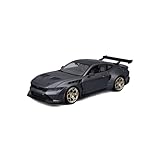
- Detailed Die-cast metal body with plastic parts
- Large Apx 9-1/2" replica
- Opening doors and engine compartment
- Full functioning steering
- Four-wheel suspension
This concept belongs on a coolest list because it demonstrates how the Mustang name can function as a laboratory for drag racing. It also shows the difference between a concept intended to preview a production model and one intended to attract attention to a technical direction.
Independent reader supportYour contribution helps us test, update, and keep practical guides available for everyone.All nine concepts compared
| Concept | Era | Primary purpose | Body or layout experiment | Relationship to production |
|---|---|---|---|---|
| Mustang I | 1962 | Market-research show car and functional prototype | Two-seat, mid-engine roadster | Tested interest; production Mustang used a more practical layout |
| Mustang Mach I concept | 1967–1968 | Performance-themed design study | Extended front treatment | Name and attitude preceded the production Mach 1 |
| Milano | 1970 | Styling-reaction study | Low, sleek, fastback-like profile | Later influence is reported, not a proven direct carryover |
| Mustang IMSA | Late 1970s | Racing-inspired show car | Altered bodywork and competition-style cabin | Not built to a specific IMSA rulebook |
| Mustang RSX | Around 1979–1980 | Ghia rally design study | Rally-influenced proportions | No production RSX body style |
| Mustang Mach III | Concept era not specified in the cited account | Technology and performance demonstrator | Two-seat roadster, lightweight body | Showed a possible technology-led Mustang direction |
| Mustang GT-R | 2004 | Functional racing/performance demonstrator | Competition-oriented fifth-generation Mustang | One-off testbed, not a regular production model |
| Mustang by Giugiaro | 2006 | International styling collaboration | 1960s-inspired design with special glass roof | One-off concept with documented V8 hardware |
| Cobra Jet Twin-Turbo | 2012 | SEMA drag-racing powertrain showcase | Turbocharged Cobra Jet concept | Performance showcase; published output figures were not stated |
What these concepts reveal about Mustang history
Ford explored more than one Mustang formula
The nine cars move through radically different answers to the same question. Mustang I is a mid-engine two-seater; Mach III is a technology roadster; Milano and Giugiaro investigate surface design; RSX looks toward rallying; GT-R and Cobra Jet Twin-Turbo concentrate on track and drag performance. The production Mustang’s familiar front-engine, four-seat-friendly formula was one successful route, not the only route Ford considered.
Not every concept had the same job
Calling every show car a prototype obscures the differences. Mustang I gathered public reaction with a running vehicle. GT-R tested performance hardware. Mach I, Milano and RSX primarily explored appearance and positioning. IMSA and Cobra Jet Twin-Turbo used racing imagery or hardware to demonstrate a purpose. Mach III and Giugiaro sat between those categories, using real performance or material features to make a design statement credible.
Influence can be indirect
A concept does not need to become a catalog model to matter. The Mach I concept helped establish a performance identity before the production Mach 1. Milano is reported to have influenced later Mustang and Ford design thinking, although a direct causal chain is not established here. Mustang I demonstrated demand for a sporty compact before the 1964 production launch. Other concepts contributed by expanding the visual and technical vocabulary available to Ford designers.
Which Mustang concepts never made production?
All nine entries are best understood as concepts or one-offs rather than production models carrying the same specifications. The production Mustang that arrived in 1964 was not a mid-engine Mustang I derivative, and the production Mach 1 did not copy the concept’s elongated nose. GT-R, Mach III, Giugiaro, RSX, IMSA, Milano and Cobra Jet Twin-Turbo likewise remained individual studies or demonstrators. Their lack of showroom continuity is precisely why they are useful historical evidence: they document paths Ford considered and then left open.
Why the list still matters
These cars are cool for different reasons. Mustang I is the foundational experiment; Mach I and Milano show Ford testing identity and proportion; IMSA and RSX borrow competition cultures; Mach III and Giugiaro turn the Mustang into a technology-and-design canvas; GT-R and Cobra Jet Twin-Turbo prove that one-off performance work can be as revealing as a production launch. Taken together, they form a history of deliberate exploration rather than a single uninterrupted design line.
Quick Recap
Product prices and availability are accurate as of the date/time indicated and are subject to change. Any price and availability information displayed on Amazon at the time of purchase will apply.

