
What’s actually slowing this PC down?
Pick the symptom - the matching free tool is one click away.
iTechGuides is reader-supported. When you buy through links on our site, we may earn an affiliate commission. As an Amazon Associate I earn from qualifying purchases. Learn more
Flexible crystalline-silicon solar modules could make some lightweight or curved roofs easier to cover with solar, but the technology is not yet evidence of a broad rollout across difficult buildings. One manufacturer reports a silicon module as light as 2.82 kg/m² and able to bend to a radius of 0.5 m; those are company-reported specifications, not independent field comparisons. Roof suitability still depends on the structure, weatherproofing, electrical design and the specific product.
Why flexible silicon could expand where rooftop solar fits
Conventional framed panels can be a poor match for roofs with limited load capacity or pronounced curves. A lighter, thinner module that can follow some curvature may give building owners and designers another option where a conventional array is unsuitable. That does not mean every weak or curved roof can safely take solar: the roof and proposed system still need project-specific assessment.
Polyshine Solar says it applies a weather-resistant polymer composite to crystalline-silicon solar-cell modules to make lighter, more flexible products for existing roofs with limited load capacity and curved surfaces. Its current company page lists a minimum module weight of 2.82 kg/m², a thickness of 2.5 mm and a bending radius of up to 0.5 m. These figures describe the company’s product claims; they are not a standardized comparison with framed panels or a guarantee for every configuration. Polyshine Solar
What the published specifications do—and do not—show
Polyshine also states that its polymer has at least 91% light transmittance, and reports 20,000 hours of accelerated-aging data and 20 years of outdoor-application data for the polymer materials. Those are company statements about the materials. They should not be read as independently verified results or as a service-life claim for a complete solar module.
#1 Best Overall

- High Power Output - The flexible solar panel can provide an average of 500 Watt-hours of electricity per day (depending on sun availability).
- Easy to Transport, Carry and Install - The 100 watt solar panel suits most curved surfaces as it is bendable within 240 degrees. the flexible 100 watt solar panel weighs only 1/3 of the rigid panel and presents an all-black glare-free appearance.
- Industry-leading Tech - Renogy 100w solar panel is equipped with half-cut PERC cell technology that enhances solar light capture and electrical performance, therefore improving the output efficiency.
- Reliable & Durable - This solar panel 100w accomplishes with IP67 rated waterproof junction box and solar connectors. Withstand up to 5400 Pa of heavy snow load and up to 2400 Pa of high wind.
- Ready for Installation - Renogy flexible solar panels come with pre-drilled mounting holes and 2.3 feet long solar connector cables for quick and easy installation.
The cited specifications do not establish how much electricity a particular roof would generate. Actual yield depends on the module configuration and site conditions, including orientation, shading and weather. Nor do the figures alone establish that a roof can carry the whole installation: mounting hardware, wiring and other system components also matter.
“Flexible solar” describes different technologies
Similar marketing language can refer to different cell technologies. That distinction matters when comparing products or deciding what evidence applies to a building.
Rank #2
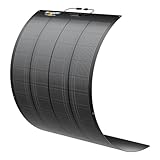
- More Stable Output: Say goodbye to unstable energy output with BougeRV Arch Pro Solar Panel. Built-in bypass diode technology captures more energy even in low-light conditions or partial shading, ensuring stable power output
- More Busbar, More Power: BougeRV Arch Pro solar panel uses the high-level N-type16BB cell design with a 25% highest conversion rate. It makes the solar panel have a longer service life. Also, it can charge a 12V battery or a 24/48V battery by wiring several solar panels in series
- NOTE: The open circuit voltage range of the BougeRV 200W bendable panel (36V ± 5%) may not be compatible with certain power stations. Please carefully check your power station's specifications before purchasing (see details pic5)
- Longer Lifespan: BougeRV upgraded shade-tolerant diodes technology enhances resistance to hot-spot effects, reduces the risk of panel damage, and extends the lifespan of the solar panel
- ETFE Coating for Outdoor Use: Built with ETFE instead of PET, this panel features an anti‑scratch, self‑cleaning, and sand‑proof surface. The coating is abrasion and impact resistant, making it suitable for outdoor installations and transport
- Flexible crystalline silicon: Polyshine describes its products as crystalline-silicon modules made lighter and flexible with a polymer composite.
- CIGS thin film: MiaSolé describes flexible roofing products based on copper indium gallium selenide (CIGS), including use on commercial and metal roofs and conformity to curved structures. CIGS is not silicon. MiaSolé
- Perovskite film: A University of Sheffield report dated 30 July 2026 describes the POP-PV project with Power Roll and Dyenamo, focused on manufacturing and materials barriers for perovskite solar cells. The report describes Power Roll’s micro-groove film as an ultra-lightweight alternative to conventional silicon panels and says the work aims to move the technology from pilot-scale development toward commercial deployment. This is a separate technology and development effort, not evidence of flexible-silicon readiness. University of Sheffield
Building-integrated solar is not automatically flexible
Building-integrated photovoltaics (BIPV) combine solar generation with part of a building’s envelope, such as a roof covering. An integrated roof can address installation and architectural needs without using flexible solar cells.
Fraunhofer CSP’s GiSMo roof system
Fraunhofer CSP describes GiSMo as a lightweight in-roof system that combines roof covering and PV in an overlapping shingle arrangement, with water routing and replaceable modules. The center lists the system at less than 9 kg/m² and describes customized BIPV module production and consulting for special formats and 3D geometries. This is evidence of work on lightweight, shaped building-integrated PV—not evidence that GiSMo uses Polyshine’s flexible crystalline-silicon design. The page was updated on 30 September 2026. Fraunhofer CSP
Rank #3

- 【High Power Output】 Renogy 200w flexible solar panel can provide an average of 1000 Watt-hours of electricity per day (caculates with 5 hours sunlight).
- 【Easy to Transport, Carry and Install】 The 200 watt solar panel suits most curved surfaces as it is bendable within 240 degrees. the solar panel weighs only 1/2 of the rigid panel and presents an all-black glare-free appearance.
- 【Industry-leading Tech】The flexible solar panel is equipped with half-cut PERC cell technology that enhances solar light capture and electrical performance, therefore improving the output efficiency.
- 【Reliable and Durable】 This 200w solar panel accomplishes with IP67 rated waterproof junction box and solar connectors. Withstand up to 5400 Pa of heavy snow load and up to 2400 Pa of high wind.
- 【Ready for Installation】 Renogy flexible solar panel comes with pre-drilled mounting holes and 12 AWG 27.6 in long solar connector cables for quick and easy installation.
ArcelorMittal Helioroof
Helioroof combines TOPCon silicon solar cells with an insulated roofing panel and is described as a building-integrated product with long, custom panel formats. Its cells are not established as flexible in the product information. The current product page lists 307–2,148 Wp and 200 Wp/m² for solar laminates; these figures relate to the product configurations described there, so buyers should verify the exact configuration being considered. ArcelorMittal Building Solutions
What to check before specifying a system
A low module weight or bend radius is a starting point, not a complete roof specification. Ask suppliers and the project team to address the following for the exact building and product:
Rank #4

- Extremely Flexible: Update to latest version size: 36.22inch*23.22inch*0.11inch/920*590*3MM, The minimum radius of the arc that a 100 watts flexible solar panel can reach is 45cm (17.7 in). It is capable of meeting a wide range of applications where standard solar panels can be inconvenient to mount, suitable for off-grid applications that include trailers, marine, boats, cabins, tents, cars, trucks, yachts, RVs, campervans, caravans, sheds, residential rooftop, home garden outdoor, or any other irregular surface.
- Lightweight & Easy to Install: It is only 0.1 inches in height and weighs only 4.4LB (2KG), the solar panel is easy to transport, install, hang and remove. The metal pre-drilled holes and PV solar connectors help you install easily and quickly.
- 9 Busbars Solar Cell, High Conversion Efficiency: 9BB & A Grade Monocrystalline silicon solar cell provides high conversion efficiency up to 23%. The narrower busbar space and more cells receiving surface bring lower cost and increase the output of the PV module. Compared with 5BB panel, the 9BB solar panel ensures lower risks of microcracks and longer service life.
- Waterproof & Dustproof: This flexible solar panel is equipped with IP67-rated junction box to effectively block water splashes and dust from outside, making it perfect to be used outdoors. It is much more durable than traditional glass and aluminum model solar panels. 2 pieces bypass-diodes are built in the junction box.
- Excellent Quality: The flexible solar panel is made of ETFE material, which has a higher light transmission and longer service life than ordinary materials. The back panel is made of TPT, which is good for heat dissipation, waterproof, high temperature resistant and easy to clean.
- Roof capacity: Assess the roof structure and the full installed system, not just the module mass.
- Curvature: Confirm that the roof geometry is within the product’s permitted bend radius and that the proposed installation method is approved for that surface.
- Energy yield: Estimate output for the actual orientation, shading and local conditions rather than inferring generation from weight or flexibility.
- Mounting and waterproofing: Establish how the system attaches, routes water and protects roof penetrations and edges.
- Durability and certification: Request product-specific weather, fire and other applicable certification information. Material-aging data should not substitute for evidence about the complete module and installed system.
- Electrical integration: Confirm compatibility with the inverter, wiring, protection equipment and system design.
- Installed cost: Compare the complete project cost, including mounting, roof work and electrical installation, rather than module prices alone.
The cited product and project information does not provide a standardized head-to-head comparison across these factors. Treat manufacturer and organization specifications as starting points for due diligence, not comparable field-performance measurements.
Recommended Free Tools
How far along is flexible crystalline silicon?
The available examples show that lightweight, shaped and integrated solar products are being developed and offered in distinct forms. They do not establish widespread deployment of flexible crystalline-silicon modules on difficult buildings, or a market-wide count of buildings that could use them. The Sheffield project’s stated move from pilot-scale development toward commercial deployment concerns perovskite technology, not flexible silicon.
Best Value

- Extremely Flexible: Update to latest version size: 36.22inch*23.22inch*0.11inch/920*590*3MM, The minimum radius of the arc that a 100 watts flexible solar panel can reach is 45cm (17.7 in). It is capable of meeting a wide range of applications where standard solar panels can be inconvenient to mount, suitable for off-grid applications that include trailers, marine, boats, cabins, tents, cars, trucks, yachts, RVs, campervans, caravans, sheds, residential rooftop, home garden outdoor, or any other irregular surface.
- Lightweight & Easy to Install: It is only 0.1 inches in height and weighs only 4.4LB (2KG), the solar panel is easy to transport, install, hang and remove. The metal pre-drilled holes and PV solar connectors help you install easily and quickly.
- 9 Busbars Solar Cell, High Conversion Efficiency: 9BB & A Grade Monocrystalline silicon solar cell provides high conversion efficiency up to 23%. The narrower busbar space and more cells receiving surface bring lower cost and increase the output of the PV module. Compared with 5BB panel, the 9BB solar panel ensures lower risks of microcracks and longer service life.
- Waterproof & Dustproof: This flexible solar panel is equipped with IP67-rated junction box to effectively block water splashes and dust from outside, making it perfect to be used outdoors. It is much more durable than traditional glass and aluminum model solar panels. 2 pieces bypass-diodes are built in the junction box.
- Excellent Quality: The flexible solar panel is made of ETFE material, which has a higher light transmission and longer service life than ordinary materials. The back panel is made of TPT, which is good for heat dissipation, waterproof, high temperature resistant and easy to clean.
The practical takeaway is narrower: flexible crystalline silicon could offer another route for selected roofs where weight or curvature limits conventional panels, but suitability and commercial availability must be confirmed product by product and building by building.
Quick Recap
Product prices and availability are accurate as of the date/time indicated and are subject to change. Any price and availability information displayed on Amazon at the time of purchase will apply.

