
Quick wins for a faster PC:
Repair Windows errors before they cause bigger problemsFix Now →Scan for outdated or missing drivers - takes under a minuteDriver Scan →Clear out junk files and repair common Windows errorsFree Scan →iTechGuides is reader-supported. When you buy through links on our site, we may earn an affiliate commission. As an Amazon Associate I earn from qualifying purchases. Learn more
For most adults, start by gradually adding fiber-rich foods and drinking enough fluid for your circumstances. Foods provide fiber in meals across grains, beans, fruit, vegetables and nuts. A supplement can be a measured, convenient option when food alone is difficult or does not provide enough. Official guidance does not show that supplements are universally more effective than food, so the practical choice depends on tolerance, convenience, diet variety, health conditions and the reason for your constipation.
What constipation means before you choose a fiber source
Constipation is not defined only by how often you use the toilet. NIDDK describes symptoms that can include fewer than three bowel movements in a week, hard, dry or lumpy stool, difficult or painful passage, or a feeling that not all stool has passed. Normal bowel patterns differ, so one person’s usual frequency may not be another person’s problem. Constipation can also be a symptom of another medical issue rather than a simple lack of fiber.
NIDDK’s 2018 review page, citing an American Gastroenterological Association medical position statement from 2013, estimates that about 16 out of 100 adults in the United States have constipation symptoms. The same NIDDK page, citing Rose’s 2014 practical book, estimates symptoms in about 33 out of 100 adults age 60 and older. These figures describe symptoms in the cited sources; they are not a prediction of your individual risk.
The short answer: food first for variety, supplements for convenience
There is no universal winner between a supplement and food. A food-first approach lets you spread fiber through ordinary meals and supplies a broad range of foods. A supplement gives you a consistent, measured way to increase intake when planning, appetite, access, chewing, cooking or other circumstances make a food-only plan hard to maintain. Either approach can be unsuitable if you increase fiber abruptly or do not drink enough liquid.
#1 Best Overall

- WHAT'S INCLUDED: One 17.6-ounce bottle of unflavored Benefiber Daily Prebiotic Fiber Supplement Powder for Digestive Health (1)
- BENEFIBER HELPS YOU FEEL FULLER LONGER: GLP-1 support for fiber gap*
- SUPPORTS DIGESTIVE HEALTH: Daily fiber powder supplement that nourishes the growth of good bacteria that exist in your gut to help you maintain good digestive health
- DISSOLVES CLEAR AND COMPLETELY: Benefiber Prebiotic Fiber Supplement Powder is taste free, grit free, and dissolves clear and completely when you mix into non carbonated beverages and food (2)
- PLANT-BASED PREBIOTIC FIBER: Made with wheat dextrin, a plant-based fiber that nourishes your gut’s good bacteria and helps them grow (1)
Use this decision rule:
- Choose food as your starting point when you can change meals comfortably and want more dietary variety.
- Consider a supplement when you need a predictable amount, cannot regularly prepare high-fiber meals, or have tried food changes without reaching a level that works for you.
- Ask a healthcare professional first when constipation persists, a medicine may be contributing, or you have a relevant medical history rather than relying on fiber alone.
NIDDK lists over-the-counter fiber supplements such as Citrucel, FiberCon and Metamucil as possible treatment options. Calling them options does not mean everyone needs one or that they outperform food.
How much fiber adults need
NIDDK’s nutrition guidance says adults generally need 22–34 grams of fiber per day, depending on age and sex. This range comes from the Dietary Guidelines for Americans 2015–2020 as cited on an NIDDK page reviewed in May 2018. It is a population guideline, not a personalized prescription.
NHS general digestion guidance uses a 30-gram daily target. That figure is a United Kingdom public-health target and should not be treated as an interchangeable universal requirement. Your clinician may set a different goal because of age, sex, symptoms, activity, medications or another condition. If you already know your target, compare your usual intake with that target rather than trying to reach a larger number suddenly.
Outdated Drivers Are Slowing You Down
One free scan finds every outdated or missing driver and matches the right update for your exact hardware.Free scan · exact hardware matchWindows Errors? Fix Them Before They Spread
Repair common Windows errors and clear accumulated junk for a smoother, more stable PC - no reinstall needed.Free scan · no reinstallNutrition labels can help you estimate fiber from foods or a supplement. Check the serving size and the amount of fiber per serving, then account for how many servings you actually use. Do not assume that a product’s suggested serving is appropriate for your circumstances; ask a pharmacist or clinician when you are unsure.
What fiber-rich foods provide
Food lets you build fiber into meals instead of treating it as a separate task. NIDDK examples span several groups:
| Food group | Examples named in official guidance | Ways to use them |
|---|---|---|
| Whole grains | Whole-wheat bread and pasta, oatmeal, bran-flake cereals | Use oatmeal at breakfast, choose whole-wheat bread for a sandwich, or replace refined pasta with whole-wheat pasta. |
| Legumes and pulses | Lentils, black beans, kidney beans, soybeans, chickpeas | Add beans or lentils to soups, salads, stews or grain bowls; use chickpeas in a meal or spread. |
| Fruit | Berries, apples with skin, oranges, pears | Keep fruit available for snacks and include a piece with breakfast or lunch. |
| Vegetables and greens | Carrots, broccoli, green peas, collard greens | Add a vegetable side to the meals you already eat rather than changing every meal at once. |
| Nuts | Almonds, peanuts, pecans | Use a small portion with a meal or snack, taking account of your overall dietary needs. |
NHS guidance for irritable bowel syndrome (IBS) identifies oats, pulses, carrots, peeled potatoes and linseeds as soluble-fiber foods. That list is useful when symptom type matters, but it is not a ranking of all foods for ordinary constipation.
Rank #2
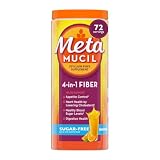
- 4 HEALTH BENEFITS, 1 DAILY FIBER. Metamucil is the only leading fiber brand made with psyllium husk fiber
- for 4-in-1 health benefits!
- PSYLLIUM HUSK FIBER helps support: digestive health*, heart health by lowering cholesterol, healthy blood sugar levels*, and appetite control*
- SUGAR-FREE AND DELICIOUS smooth textured fiber powder with a refreshing orange flavor.
- FEEL WHAT LIGHTER FEELS LIKE. Metamucil psyllium husk fiber helps promote regularity* so you can feel lighter and more energetic**
Food also brings other nutrients and lets you vary textures and flavors. The trade-off is that shopping, preparation and repeated meal changes require more planning than measuring a supplement. Access, budget, cooking facilities and appetite are legitimate reasons a supplement may be easier to use consistently.
What a fiber supplement changes
A supplement concentrates fiber into a product that can be measured and taken separately from meals. Psyllium husk is a common supplement category, and NIDDK names Citrucel, FiberCon and Metamucil as examples of over-the-counter fiber products. The cited guidance does not establish current formulations, prices, rankings or that any one brand is best.
The main advantage is repeatability: you can follow the label’s serving instructions and adjust only one variable at a time. That can be useful if you are tracking how your stool responds or if your meals vary from day to day. The disadvantages are equally practical. A supplement does not replace the variety of whole grains, legumes, fruit, vegetables and nuts, and some people find a rapid increase uncomfortable. Product labels differ, so compare the actual fiber amount and directions rather than assuming two products are equivalent.
Because supplements are concentrated, use the product’s instructions and seek professional advice if you have a health condition that affects your fluid intake, digestion or medication schedule. Do not treat a supplement as permission to ignore symptoms that need evaluation.
Soluble and insoluble fiber: what the evidence does and does not say
Soluble fiber
Soluble fiber is found in foods such as beans, fruit and oats. NHS IBS guidance also lists carrots, peeled potatoes and linseeds as soluble-fiber foods. NIDDK’s IBS guidance says research suggests soluble fiber may be more helpful for IBS symptoms.
Insoluble fiber
Insoluble fiber is found in foods such as whole grains and vegetables. It contributes to the fiber in a varied diet, but the IBS guidance does not say it is the best choice for every person or every symptom.
Rank #3

- PURE POWDER: Fibersol-2 is a tasteless, soluble fiber derived from non-GMO corn that can help manage hunger and promote a feeling of fullness up to two hours after a typical meal in healthy adults while also helping maintain healthy, normal glucose levels*
- EXCELLENT SOURCE OF FIBER: Fibersol-2 also acts as a prebiotic fiber that can help to nourish intestinal flora and maintain a healthy intestinal tract environment*
- MAINTAINS REGULARITY*: Dissolves rapidly in water or your favorite beverage and is a convenient and effective way to help maintain regularity*
- GMP Quality Assured: NPA A-rated GMP certification means that every aspect of the NOW manufacturing process has been examined, including our laboratory/testing methods (for stability, potency, and product formulation)
- Founded in 1968 by Elwood Richard, NOW is one of the largest independent, family- and employee-owned manufacturers of natural products
Do not turn the IBS finding into a universal comparison
The statement about soluble fiber applies to IBS symptoms. It is not proof that a soluble-fiber supplement beats insoluble-fiber foods, or that any supplement beats food, for constipation in general. If you have IBS as well as constipation, discuss the type and pace of fiber changes with a clinician who knows your symptoms.
How to increase fiber without making symptoms worse
NIDDK’s practical recommendation is: “Eat enough fiber. Drink plenty of liquids to help the fiber work better.” The same guidance says to increase fiber a little at a time so the body has time to adjust. A sudden change can be uncomfortable for some people.
- Record your baseline. For several days, note the foods you eat, your approximate fiber intake if labels provide it, bowel frequency and stool characteristics. This gives you a comparison point.
- Change one meal first. Add one high-fiber choice, such as oatmeal, a bean serving, a pear or a vegetable side, while leaving the rest of your routine familiar.
- Keep the change steady long enough to judge tolerance. If you feel comfortable, add another food source or use a supplement according to its label. Do not make several large increases at once.
- Drink enough liquid for your circumstances. Liquids help fiber work, but the right amount depends on health, activity and other circumstances. A clinician can give you a safe target if you have been told to restrict fluids.
- Adjust rather than forcing a target. If bloating, discomfort or a change in stool makes the plan hard to continue, pause the increase and ask a healthcare professional how to proceed.
The goal is a sustainable intake, not the fastest possible jump to a number. Keep the fiber source, serving size, timing and fluid pattern clear enough that you can identify what helped or caused difficulty.
Do these 3 things before closing this tab:
1Clear out junk files and repair common Windows errors2Fix the driver behind crashes, sound loss and screen glitches3Repair Windows errors before they cause bigger problemsA practical food-first plan
Build a day from familiar meals
Start breakfast with oatmeal or a bran-flake cereal. Add fruit such as berries, an apple with its skin, an orange or a pear when it fits your diet. At lunch or dinner, include lentils, black beans, kidney beans, soybeans or chickpeas in a soup, salad or main dish. Add carrots, broccoli, green peas or collard greens as a side, and choose whole-wheat bread or pasta when practical. Almonds, peanuts or pecans can provide another food-based source.
Use substitutions instead of a complete overhaul
Replace one refined grain with a whole-grain version, add beans to a dish you already cook, or put fruit beside a meal. Substitutions reduce the planning burden and make it easier to increase fiber gradually.
Track comfort as well as grams
A higher number is not automatically a better result if the plan causes discomfort or is impossible to maintain. Record which foods you tolerate, how quickly you changed them and whether stool passage became easier. Bring that record to a clinician if constipation continues.
Rank #4

- EXCELLENT SOURCE OF FIBER: Soluble fiber from foods such as psyllium seed husks, as part of a diet low in saturated fat and cholesterol, may reduce the risk of heart disease
- DIRECTIONS: Vigorously mix 1 level tablespoon daily into at least 12 oz. of water or juice and consume immediately
- 6 GRAMS OF SOLUBLE FIBER: A serving of psyllium husk powder supplies 6 grams of the 7 grams soluble fiber necessary per day
- GMP Quality Assured: NPA A-rated GMP certification means that every aspect of the NOW manufacturing process has been examined, including our laboratory/testing methods (for stability, potency, and product formulation)
- Packaged in the USA by a family owned and operated company since 1968
When a supplement may fit better
- Irregular meal access: Work schedules, travel or limited cooking facilities can make high-fiber meals unreliable.
- Difficulty reaching a target with food: A measured product can fill a gap after you have identified what your meals provide.
- Preference for a consistent routine: Taking the same labeled serving may be simpler than estimating portions across changing meals.
- Need for a specific fiber type: A professional may suggest a product based on your symptoms, including IBS symptoms, without implying that it is universally superior.
Before choosing, read the full label, check the fiber amount per serving, follow preparation directions and consider how it fits with your medicines and fluid guidance. Ask a pharmacist or clinician if you take prescription or over-the-counter products, because some medicines and supplements can worsen constipation and timing may matter.
Free tools Windows power users keep installed
One-click scans. No signup required.
Medication-related constipation changes the decision
NIDDK notes that medicines and supplements can contribute to constipation, including iron, some antacids and some prescription medicines. If constipation began after starting, stopping or changing a product, make a list of everything you take and discuss it with a healthcare professional.
Do not stop, skip or change a prescribed medicine or an over-the-counter product on your own. A professional may decide that the medicine is necessary, alter the dose, change the timing or recommend another treatment. Adding fiber without addressing a contributing medicine may not solve the problem.
Food versus supplement: a decision table
| Question | Fiber-rich foods | Fiber supplement |
|---|---|---|
| Convenience | Requires shopping, preparation and meal planning, but can fit naturally into meals. | Provides a measured option that may be easier when meals are inconsistent. |
| Variety | Offers grains, legumes, fruit, vegetables and nuts in a varied diet. | Usually centers on the product’s fiber ingredient and does not replace food variety. |
| Fiber type | You can select foods with soluble or insoluble fiber; IBS guidance discusses soluble fiber separately. | Type depends on the product; read the label and ask a professional when symptom context matters. |
| Pace and tolerance | Portions can be increased gradually across meals. | Serving changes should also be gradual and follow the label; a concentrated increase may be uncomfortable. |
| Fluids | Enough liquid helps fiber work; personal needs vary. | The same fluid principle applies, with preparation instructions adding product-specific requirements. |
| Evidence of superiority | Official guidance recommends adequate fiber but does not establish food as universally superior. | NIDDK lists supplements as options but does not establish them as necessary or universally more effective. |
Common mistakes and how to correct them
Increasing fiber all at once
Problem: A large overnight change can be uncomfortable and makes it hard to identify the cause. Correction: Add one source at a time and give your body time to adjust.
Ignoring fluids
Problem: Fiber works better with adequate liquid, but people often increase fiber without considering their own fluid needs. Correction: Follow NIDDK’s advice to drink plenty of liquids while checking with a professional if illness or treatment affects how much you should drink.
Recommended Free Tools
Assuming a supplement is automatically stronger
Problem: A measured product can look more medical or powerful than a meal, but the guidance does not prove universal superiority. Correction: Choose based on consistency, tolerance, fiber type, diet variety and your health circumstances.
Best Value

- 4 HEALTH BENEFITS, 1 DAILY FIBER. Metamucil is the only leading fiber brand made with psyllium husk fiber
- for 4-in-1 health benefits!
- PSYLLIUM HUSK FIBER helps support: digestive health*, heart health by lowering cholesterol, healthy blood sugar levels*, and appetite control*.
- SUGAR-FREE fiber powder with refreshing orange flavor (not a low calorie food).
- FEEL WHAT LIGHTER FEELS LIKE. Metamucil psyllium husk fiber helps promote regularity* so you can feel lighter and more energetic**.
Using IBS advice for every constipation case
Problem: Soluble fiber may help IBS symptoms, but that finding is narrower than constipation in general. Correction: Keep the IBS qualification and seek individualized advice when both conditions are present.
Changing a medicine without advice
Problem: You may remove a necessary treatment or miss another cause. Correction: Review medicines and supplements with a healthcare professional before changing them.
Chasing a number instead of a workable routine
Problem: Reaching a target quickly can undermine comfort and adherence. Correction: Increase gradually, monitor symptoms and use the population targets only as context for a personalized plan.
What’s actually slowing this PC down?
Pick the symptom - the matching free tool is one click away.
When self-care is not enough
Contact a healthcare professional if constipation does not go away with self-care, if symptoms repeatedly return, or if you have a family history of colon or rectal cancer. NIDDK specifically advises seeking care in these circumstances. Bring your symptom timeline, food and fluid changes, supplement labels and complete medicine list.
Seek advice sooner if you are unsure whether your symptoms represent constipation, if a new medicine or supplement preceded the change, or if you cannot safely follow general fluid advice because of another condition. Fiber is one part of management; persistent or unexplained symptoms require evaluation rather than an ever-larger dose.
How to discuss the choice with a clinician or pharmacist
- Describe your usual bowel pattern and which constipation symptoms you have.
- Give the date symptoms began and list recent diet, fluid, medicine and supplement changes.
- State whether you have IBS symptoms or another diagnosed condition that affects digestion or fluid intake.
- Ask what daily fiber range is appropriate for your age, sex and health circumstances.
- Ask whether a food-first plan, a specific supplement category or another treatment is appropriate, and how gradually to change it.
- Confirm when to stop self-care and return for evaluation if symptoms persist.
Bottom line for choosing between the two
Begin with a gradual, sustainable increase in fiber-rich foods when you can, using whole grains, legumes, fruit, vegetables and nuts across meals. Drink enough liquid for your personal circumstances. If food alone is impractical or insufficient, a labeled fiber supplement can be a convenient option, but it is not automatically better and it does not replace dietary variety. Keep IBS-specific evidence in its proper scope, review constipation-causing medicines with a professional, and seek care when self-care fails or a concerning history applies.
Quick Recap
Product prices and availability are accurate as of the date/time indicated and are subject to change. Any price and availability information displayed on Amazon at the time of purchase will apply.
The Tool Desk
Outbyte Driver Updater FREEScan for outdated or missing drivers - takes under a minuteDriver Scan →Outbyte PC Repair FREERepair Windows errors before they cause bigger problemsFix Now →
