
iTechGuides is reader-supported. When you buy through links on our site, we may earn an affiliate commission. As an Amazon Associate I earn from qualifying purchases. Learn more
Neither fabric is a universal winner. InfiniBand is a purpose-built, tightly integrated high-performance fabric with native RDMA, adaptive routing, congestion control and in-network collective operations. Ethernet offers a broader standards-based ecosystem, but demanding AI clusters should be compared with a specifically engineered RoCE (RDMA over Converged Ethernet) design—not with ordinary enterprise Ethernet. Choose after measuring your actual training or inference workload, GPU count, congestion and failure behavior on complete, equivalent fabrics.
What “Ethernet vs. InfiniBand for AI” really compares
Distributed training and large-scale inference split work across many servers. GPUs exchange gradients, activations, parameters and control messages repeatedly; storage and checkpoint traffic may compete for the same links. As the cluster grows, network bandwidth, latency, congestion and recovery time can become part of every job step. The relevant comparison is therefore a complete fabric design, not a label on a cable or a single network card.
| # | Preview | Product | Price | |
|---|---|---|---|---|
| 1 |

|
InfiniBand Network Cable | $69.99 | Buy on Amazon |
| 2 |

|
HP InfiniBand Network Cable | $58.88 | Buy on Amazon |
| 3 |
|
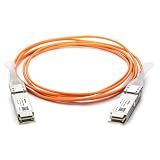
10Gtek 40G QSFP+ AOC Fiber Cable for Cisco QSFP-H40G-AOC10M, 10m/33ft | $58.99 | Buy on Amazon |
| 4 |

|
HP Infiniband Splitter Network Cable | $105.00 | Buy on Amazon |
| 5 |

|
Cable Matters 10Gbps DAC Twinax SFP+ Cable, 1m/3.3ft | $14.99 | Buy on Amazon |
“Ethernet” can describe two very different choices:
- General-purpose Ethernet: familiar switches and adapters designed for ordinary data-center traffic. It may work for management, storage or modest distributed jobs, but it is not automatically suitable for synchronized GPU collectives.
- AI-optimized Ethernet: a tuned RoCE fabric using suitable host adapters or SuperNICs, loss-management and congestion controls, telemetry, topology planning and software integration. NVIDIA describes its Spectrum-X platform in these terms: standards-based Ethernet with purpose-built switches and SuperNICs for AI fabrics.
InfiniBand is a specialized fabric whose platform features are designed around high-performance computing and AI communication. A fair decision compares InfiniBand with an equivalently engineered RoCE system, including adapters, switches, optics or cables, drivers, orchestration, monitoring and support.
#1 Best Overall
How AI traffic stresses a data-center fabric
Synchronized collective communication
Training frameworks use collectives such as all-reduce, all-gather and reduce-scatter. Many GPUs send and receive at nearly the same time, creating large synchronized flows rather than independent web-style requests. One congested link can delay an entire group of workers, so the slowest or “tail” transfer often determines the next training step.
RDMA and CPU bypass
Remote Direct Memory Access (RDMA) lets an adapter move data between hosts with less CPU intervention and fewer copies. InfiniBand provides RDMA natively. RoCE carries RDMA over Ethernet, but it requires careful loss, priority, queue and congestion configuration; simply enabling an RDMA-capable NIC does not create a reliable AI fabric.
Congestion, isolation and failure recovery
AI traffic can fill links for long periods. Queue buildup, packet drops, retransmissions or a noisy neighbor can increase tail latency even when average link utilization looks acceptable. A production design must show how it detects congestion, routes around faults, isolates tenants and restores service when a link, adapter or switch fails.
Recommended Free Tools
What InfiniBand provides
Native fabric features
NVIDIA describes its Quantum InfiniBand platform as combining RDMA, adaptive routing, congestion control, performance isolation and in-network computing. Its SHARP technology can execute selected collective operations inside the network, reducing some host-to-host data movement. These capabilities are integrated into the platform rather than assembled from generic Ethernet components.
Quantum-2 specifications
NVIDIA’s current Quantum-2 product information (accessed October 13, 2026) lists speeds of up to 400 Gb/s per port. The Quantum-2 switch configurations listed by the manufacturer include 64 ports at 400 Gb/s or 128 ports at 200 Gb/s, with 51.2 Tb/s bidirectional aggregate throughput. Those are maximum platform specifications, not a guarantee that an application will achieve the same sustained throughput.
The same platform family includes ConnectX-7 InfiniBand adapters. NVIDIA lists PCIe Gen4 and Gen5 options with one or two ports operating at up to 400 Gb/s. An adapter is only one element of the fabric: the server slot and PCIe generation, firmware, driver stack, switch, topology and cabling must all be compatible.
Rank #2
- Network cable for Network Device, Switch - 3.28 ft - 1 x QSFP+ - 1 x QSFP+
Where InfiniBand fits well
- Tightly engineered HPC or AI clusters with predictable, high-volume collectives.
- Deployments that can operate a dedicated fabric and adopt the selected vendor’s software and support model.
- Workloads where measured collective tail latency and job-step time matter more than using an existing general-purpose network.
InfiniBand still requires specialist operations. Teams must understand fabric management, partitioning, firmware coordination, topology and health telemetry; the exact staffing burden depends on the supplier and deployment.
Crashes, No Sound, or Screen Glitches?
Random freezes, missing sound and display glitches usually trace back to one bad driver. Find and replace yours safely.Free scan · under a minuteWindows Errors? Fix Them Before They Spread
Repair common Windows errors and clear accumulated junk for a smoother, more stable PC - no reinstall needed.Free scan · no reinstallWhat Ethernet provides for AI
Standards and ecosystem breadth
Ethernet is widely available across servers, switches, cabling, operating systems and monitoring tools. Existing data-center teams may already have skills, spare capacity and processes for Ethernet, and standards-based components can simplify integration with storage, service networks and multi-tenant cloud environments.
Why ordinary Ethernet is not an InfiniBand substitute
Conventional Ethernet does not automatically deliver loss behavior, congestion response or collective performance suitable for a large GPU job. Oversubscribed topologies, default queue settings and shared traffic can produce packet loss and unpredictable tail latency. A comparison that tests InfiniBand against an untuned Ethernet network measures deployment quality as much as technology.
AI-optimized RoCE
RoCE uses Ethernet links for RDMA. An AI implementation typically combines RDMA-capable adapters or SuperNICs, switches with suitable buffering and queue features, priority and congestion controls, telemetry, carefully selected topology and software validation. NVIDIA positions Spectrum-X as such a platform for multi-tenant AI clouds, GPU-to-GPU training and distributed inference.
RoCE can integrate with an Ethernet-centered operating model, but it is not “plug and play.” Correct priority-group design, congestion notification, firmware, driver versions, routing and monitoring must be validated under the actual collective workload. Interoperability should be tested rather than inferred from standards compliance alone.
Ethernet vs. InfiniBand: comparison by decision axis
| Decision axis | InfiniBand | Ethernet for AI | What to verify |
|---|---|---|---|
| Fabric design | Dedicated high-performance interconnect. NVIDIA’s Quantum platform includes RDMA, adaptive routing, congestion control and SHARP in-network computing. | Standards-based Ethernet. An AI-optimized RoCE design can add tuned congestion control, telemetry, adaptive routing and isolation. | Evaluate the complete design: adapters, switches, software, cabling or optics and topology. |
| Published port figures | Quantum-2 is listed at up to 400 Gb/s per port; listed switch options are 64 × 400 Gb/s or 128 × 200 Gb/s, with 51.2 Tb/s bidirectional aggregate throughput. | No single Ethernet figure represents all deployments; speed depends on the selected NICs, switches, optics and configuration. | Check line rate and measured application throughput for the exact bill of materials. |
| Workload positioning | Established HPC and AI-factory positioning in NVIDIA’s platform descriptions. | AI-optimized platforms are positioned for multi-tenant clouds, distributed training and inference. | Run the real training collectives, inference pattern, storage traffic and concurrency profile. |
| Congestion and tail latency | Adaptive routing and congestion control are described as platform features. | General Ethernet needs careful tuning; AI-specific RoCE platforms implement congestion-aware mechanisms and telemetry. | Measure collective tail latency, retransmissions or drops, link utilization and noisy-neighbor effects. |
| Ecosystem and operations | Specialized fabric components and operational practices; staffing depends on the supplier and deployment. | Broad Ethernet standards and skills, while high-performance RoCE still needs specialist configuration and validation. | Assess staff skills, monitoring, software support, interoperability, serviceability and lock-in. |
| Cost and availability | Current price and total deployment cost are not established by the cited material; they vary with support, optics, cabling and sourcing. | The same qualification applies. Broad availability does not prove lower AI-cluster TCO. | Obtain current, comparable quotes including power, support, cabling, utilization and operations. |
Which fabric fits common AI workloads?
Large synchronous training
For a tightly coupled training cluster, start with both a validated InfiniBand design and a validated RoCE design if your organization can support them. Compare end-to-end step time and collective tail behavior at the target GPU count, not just a point-to-point bandwidth test. InfiniBand’s native routing, congestion and in-network features may make it a strong candidate when the platform’s measured results meet the job’s scaling target. A well-engineered RoCE fabric can also fit when Ethernet integration and multi-tenant operations are important.
Rank #3
- Compatible for Cisco QSFP-H40G-AOC10M
- 40G QSFP Active Optical Cable, 10 meters
- QSFP+ AOC, 40G AOC, QSFP+ to QSFP+ AOC, QSFP+ Active Optical Cable
- 100% Compatible with Cisco. 10Gtek owns Compatibility LAB to meet the coding requirements for various brands of switches and routers. Each AOC Cable is individually tested before delivery
- 10Gtek offer more compatible options, if your brands not listed above, pls contact us
Distributed inference
Inference traffic varies widely. Model parallelism and high request concurrency can create bursty, latency-sensitive exchanges; replicated models may be less network-intensive. Measure the service-level objective you actually promise, including p95 or p99 response time under concurrent requests, model loading, telemetry and failure recovery. Do not select a fabric from training benchmarks alone.
Multi-tenant GPU clouds
Tenants can start and stop jobs independently, producing changing traffic matrices and interference. An AI Ethernet platform may align with an organization that already operates Ethernet clouds, but only if isolation and congestion controls hold under mixed jobs. InfiniBand can also serve shared clusters; verify partitioning, scheduling integration and behavior when tenants contend for the same paths.
Clusters sharing storage and service traffic
Decide whether GPU collectives use a physically separate network, a logically isolated virtual fabric or shared links. Include checkpoint writes, dataset reads, management, monitoring and control-plane traffic in testing. A fabric that performs well with only all-reduce traffic may behave differently when storage bursts arrive.
Free tools Windows power users keep installed
One-click scans. No signup required.
Build the comparison around a complete fabric
Request a bill of materials and compatibility matrix for every candidate. At minimum, document:
- Host adapters: port count and speed, PCIe generation and slot availability, firmware, driver and RDMA support.
- Switches: port count, radix, buffering, line-rate behavior, routing and congestion features, management software and telemetry.
- Connectivity: copper or optical cables, transceivers, reach, breakout requirements and spare strategy.
- Topology: leaf-spine or other arrangement, oversubscription, rail mapping, path diversity and placement of storage links.
- Software: operating-system and accelerator-driver compatibility, collective libraries, orchestration, fabric management and upgrade policy.
- Operations: alerting, congestion visibility, replacement procedures, support escalation, firmware lifecycle and staff expertise.
A single 400-Gb/s adapter does not create a 400-Gb/s cluster fabric. The slowest PCIe path, oversubscribed uplink, incompatible optic or misconfigured queue can become the effective limit.
How to run a fair proof of concept
- Freeze the workload profile. Record model size, parallelism strategy, GPU type and count, batch size, message sizes, collective mix, checkpoint pattern and expected concurrency.
- Match the hardware scope. Use equivalent GPU servers, PCIe generations, adapter counts, switch radix, link rates, cable lengths and topology. Include the same storage and management traffic.
- Validate software before measuring. Record operating-system, accelerator-driver, collective-library, adapter-firmware and switch-software versions. Resolve compatibility warnings rather than treating them as benchmark results.
- Measure application outcomes. Capture training step time, time-to-accuracy, sustained throughput, inference throughput and p95/p99 latency. Record collective completion time and its tail distribution.
- Stress congestion and sharing. Run large collectives with storage traffic, concurrent jobs and deliberately uneven flows. Observe queue depth, packet drops or retransmissions, link utilization and tenant interference.
- Test failures. Remove or flap a link, adapter or switch path according to the supplier’s safe procedure. Measure detection, rerouting, job impact, recovery time and whether work must restart.
- Record energy and operating effort. Measure system and network power for the same completed work, plus engineer time for deployment, tuning, upgrades and incident response.
- Document acceptance thresholds. Define the maximum acceptable step-time increase, tail latency, recovery interval, power per completed job and maintenance burden before reviewing results.
Vendor demonstrations can help identify features, but they are not a neutral substitute for this test. NVIDIA’s published Spectrum-X material includes vendor-defined configurations and simulations for congestion and failure scenarios; those figures should be read as results for the stated platform and conditions, not as a general Ethernet-versus-InfiniBand benchmark.
Rank #4
- Cable Length: 3.28 ft
- Compatibility: HP 5900 Switch Series
- Hpe part Number: JG329A
Cost, sourcing and availability
The available evidence does not establish a current, apples-to-apples total-cost winner. Hardware quotes can differ because of switch radix, optics, support terms, spare inventory, software subscriptions, power, rack density and utilization. Ethernet’s broad market availability may reduce procurement friction in one organization, while a specialized InfiniBand design may reduce engineering work or deliver more completed jobs per hour in another. Neither outcome can be assumed from the protocol name.
Do these 3 things before closing this tab:
1Scan for outdated or missing drivers - takes under a minute2Repair Windows errors before they cause bigger problems3Fix the driver behind crashes, sound loss and screen glitchesAsk suppliers for comparable five-year or project-life models that include:
- Adapters, switches, optics or cables and required spares.
- Power, cooling and rack space at the planned utilization.
- Fabric-management, monitoring and support charges.
- Engineering and training time for initial deployment and upgrades.
- Expected utilization, job throughput and the cost of lost capacity during failures.
If evaluating a ConnectX-7 InfiniBand adapter, verify the server slot and PCIe generation, one- or two-port requirement, port speed, firmware and driver support, compatible switch, and exact cable or optic. It is specialist enterprise hardware; retail availability, seller quality and pricing were not established here.
Independent reader supportYour contribution helps us test, update, and keep practical guides available for everyone.Common mistakes and how to correct them
Comparing InfiniBand with default Ethernet
Symptom: the Ethernet test uses ordinary switches and default queues while InfiniBand receives a tuned fabric. Correction: compare InfiniBand with a complete, AI-optimized RoCE design and publish both configurations.
Using port speed as application performance
Symptom: a 400-Gb/s specification is treated as guaranteed training throughput. Correction: report sustained collective throughput and job-step time, including PCIe, topology and software overhead.
What’s actually slowing this PC down?
Pick the symptom - the matching free tool is one click away.
Ignoring tail behavior
Symptom: average latency looks acceptable but jobs pause unpredictably. Correction: capture percentile latency, straggler frequency, queueing, retransmissions and link-level congestion during synchronized collectives.
Best Value
- 10 GbE high bandwidth cable connects a switch, server, NIC, or transceiver for Network Attached Storage (NAS), Storage Area Network (SAN), and High Performance Computing (HPC) applications such as Fibre Channel, InfiniBand, and SONET
- Passive SFP+ cable connects equipment up to 7 meters for high density networking environments with Top of Rack (TOR) or Middle of Row (MOR) switching requirements; Low power consumption SFP+ twinaxial cable provides a cost-effective fiber alternative to installing fiber transceivers and cables to connect a 10G network
- SFP+ Small Form Factor Pluggable Plus cable is hot pluggable with an SFP+ 20-Pin connector; Quick release latch provides a secure connection until the release tab is pulled
- Superior engineering of SFP cable includes 30 AWG wire and connectors with a metal die-cast backshell for superior EMI performance and minimal insertion loss; Copper SFP+ cable offers low power consumption and low latency to operate in a high bandwidth storage area network
- Cisco compatible SFP+ 10Gig cable is designed for compatibility with the majority of switch, network adapter card, or network attached storage equipment according to the Multi-Source Agreement SFF-8431 specifications; Ideal replacement Cisco SFP-H10GB-CU1M cable
Testing only an idle cluster
Symptom: a fabric passes a single-job test but degrades when storage or another tenant is active. Correction: include realistic mixed traffic, noisy-neighbor scenarios and admission or isolation policies.
Treating a vendor claim as a universal benchmark
NVIDIA’s May 28, 2023 Spectrum-X launch announcement claimed 1.7× better overall AI performance and power efficiency in its stated comparison context. That historical manufacturer claim is not an independent benchmark and should not be presented as a direct, universal comparison with InfiniBand. More recent vendor reports likewise need their configuration and simulation conditions attached.
Assuming a published model report proves a networking choice
The DeepSeek-V3 technical report, submitted December 27, 2024 and revised February 18, 2025, is a model report, not evidence of a general Ethernet-versus-InfiniBand comparison. Use model reports to understand workload characteristics, then benchmark the network on your own implementation.
Quick wins for a faster PC:
Scan for outdated or missing drivers - takes under a minuteDriver Scan →Repair Windows errors before they cause bigger problemsFix Now →Should you use RoCE or InfiniBand for a GPU cluster?
Use this decision sequence:
- Set the workload requirement. Quantify collective time, service latency, scale-out efficiency, concurrency and recovery objectives.
- Check organizational fit. Identify existing Ethernet operations, InfiniBand expertise, support contracts, supplier constraints and required interoperability.
- Shortlist complete architectures. Include adapters, switches, topology, optics, software and monitoring—not just protocol names.
- Run a target-scale proof of concept. Use equivalent hardware and mixed-traffic, failure and multi-tenant tests.
- Choose the design that meets thresholds with acceptable full-system cost and operational risk.
InfiniBand is a sensible candidate for a dedicated, tightly engineered HPC or AI cluster when its native features and measured collectives meet requirements. AI-optimized Ethernet is a sensible candidate when standards-based integration, multi-tenant cloud operations and existing Ethernet capabilities matter and the RoCE fabric passes the same validation. These are conditional fits, not a universal speed ranking.
Evidence limits to keep in mind
The available platform documentation establishes product features and manufacturer specifications, but it does not establish a neutral, current, workload-matched performance benchmark or comparative total cost of ownership. Results from one vendor’s configuration, simulation or launch claim should remain attributed to that vendor. A decision based on your GPU count, traffic mix, failure policy and operating model is more defensible than a generic claim that one fabric is always faster or cheaper.
Quick Recap
Product prices and availability are accurate as of the date/time indicated and are subject to change. Any price and availability information displayed on Amazon at the time of purchase will apply.

