
iTechGuides is reader-supported. When you buy through links on our site, we may earn an affiliate commission. As an Amazon Associate I earn from qualifying purchases. Learn more
A straight-through Ethernet patch cable connects matching pins at both ends; a crossover cable changes the transmit/receive pair connections for interfaces that need that wiring. For an everyday connection from a PC, printer, or server to a switch, a straight-through patch cable is the usual choice. Auto-MDIX can make a crossover cable unnecessary on compatible, properly configured ports, so check the devices’ documentation before deciding.
The difference is how the wires connect
“Patch cable” describes a cable commonly used to connect network equipment; in this comparison, it means a straight-through Ethernet cable. With straight-through wiring, pin 1 connects to pin 1, pin 2 connects to pin 2, and the remaining pins connect in order to their counterparts. A crossover cable instead crosses the transmit and receive pairs for interfaces that require that arrangement.
The distinction is not the cable’s length, color, or the fact that it has RJ-45 plugs. Those visible features do not tell you whether the cable is wired straight-through or crossover. The wiring between the plugs is what matters to the connected interfaces. Cisco’s Ethernet cabling guidance describes the matching-pin arrangement for straight-through cables and the use of crossover cabling for interfaces that need the transmit and receive connections exchanged.
Do these 3 things before closing this tab:
1Clear out junk files and repair common Windows errors2Fix the driver behind crashes, sound loss and screen glitches3Repair Windows errors before they cause bigger problemsIn practical terms, these are two wiring arrangements for Ethernet cables, not two categories of network device or two kinds of connection speed. The right choice depends on what the ports at both ends expect and whether either interface can adjust automatically. A crossover cable is not an upgrade over a patch cable, and the word “crossover” does not by itself mean a connection will be faster or more reliable. Choose the wiring that the equipment supports.
#1 Best Overall

- High-Performance Connectivity: This Cat 6 ethernet cable is designed for superior performance, with a 24 AWG copper wire core. It provides universal connectivity as an ethernet cord for LAN network components such as PCs, servers, printers, routers, and more, ensuring reliable and fast network connections
- Advanced Cat6 Technology: Experience Cat6 performance with higher bandwidth at a Cat5e price. This network cable is future-proof, ready for 10-Gigabit Ethernet and backwards compatible with any existing Cat 5 cable network. It meets or exceeds Category 6 performance according to the TIA/EIA 568-C.2 standard
- Reliable Wired Network Solution: Known variously as a Cat6 network cable, ethernet cable Cat 6, or Cat 6 data/LAN cable, this RJ45 cable offers a more secure and reliable connection than wireless networks. It's ideal for internet connections that demand consistency and security
- Durable and Secure Design: The connectors of this ethernet cable feature gold-plated contacts and strain-relief boots for enhanced durability. Bare copper conductors not only improve cable performance but also comply with communication cable specifications
- High-Speed Data Transfer: With up to 550 MHz bandwidth, this ethernet cord is ideal for server applications, cloud computing, video surveillance, and streaming high-definition video. It also supports Power over Ethernet (PoE, PoE+, PoE++) for powering devices like IP cameras, VoIP phones, and wireless access points, ensuring fast and reliable network performance.
When shopping, read the product description carefully. An ordinary Ethernet patch cable is the straightforward choice for a routine device-to-switch link. If the equipment documentation specifically calls for crossed pairs, look for an Ethernet crossover cable. Do not rely on a cable’s color, the shape of its connectors, or the fact that it is sold as an Ethernet cable to identify the wiring arrangement.
Which cable should you use?
End device to switch: start with straight-through
For a PC, server, printer, or other end-user device connected to a switch, use a straight-through Ethernet patch cable. Cisco recommends this arrangement for those device-to-switch links. For example, if you are connecting a desktop computer to a switch port, a straight-through patch cable is the normal starting choice; the same guidance applies to a printer or server connecting to a switch.
Choose the cable category and length to suit the equipment and the installation rather than assuming that crossover wiring will improve the connection. The question of straight-through versus crossover is separate from the category question: category describes a cable specification, while straight-through and crossover describe how the conductors connect between the plugs. A Cat5e or Cat6 cable may be the appropriate product if it suits the equipment and run, but its category alone does not tell you whether its wiring is straight-through or crossover.
The Tool Desk
Outbyte PC Repair FREERepair Windows errors before they cause bigger problemsFix Now →Outbyte Driver Updater FREEScan for outdated or missing drivers - takes under a minuteDriver Scan →Same-type or older equipment: check before choosing
Traditional guidance calls for crossover cabling for some same-type port pairings, such as switch-to-switch, while common unlike pairings use straight-through cables. Treat that as a conditional rule, not a decision based solely on whether the two boxes have similar names or functions. Port roles, hardware capabilities, and Auto-MDIX settings can change what is required. Consult both devices’ documentation, especially for older equipment or a direct connection that does not pass through a switch.
That distinction matters because a familiar rule of thumb is not a substitute for checking the actual ports. “Switch to switch” is an example of a pairing that traditional guidance may identify for crossover wiring; it does not prove that every switch-to-switch link needs a crossover. A port with compatible, working Auto-MDIX may adjust to the cable instead. Likewise, two devices that appear to be different types do not automatically settle the question if their port documentation specifies a particular arrangement.
Rank #2

- High-Performance Connectivity: This Cat 6 ethernet cable is designed for superior performance, with a 24 AWG copper wire core. It provides universal connectivity as an ethernet cord for LAN network components such as PCs, servers, printers, routers, and more, ensuring reliable and fast network connections
- Advanced Cat6 Technology: Experience Cat6 performance with higher bandwidth at a Cat5e price. This network cable is future-proof, ready for 10-Gigabit Ethernet and backwards compatible with any existing Cat 5 cable network. It meets or exceeds Category 6 performance according to the TIA/EIA 568-C.2 standard
- Reliable Wired Network Solution: Known variously as a Cat6 network cable, ethernet cable Cat 6, or Cat 6 data/LAN cable, this RJ45 cable offers a more secure and reliable connection than wireless networks. It's ideal for internet connections that demand consistency and security
- Durable and Secure Design: The connectors of this ethernet cable feature gold-plated contacts and strain-relief boots for enhanced durability. Bare copper conductors not only improve cable performance but also comply with communication cable specifications
- High-Speed Data Transfer: With up to 550 MHz bandwidth, this ethernet cord is ideal for server applications, cloud computing, video surveillance, and streaming high-definition video. It also supports Power over Ethernet (PoE, PoE+, PoE++) for powering devices like IP cameras, VoIP phones, and wireless access points, ensuring fast and reliable network performance.
Use this quick decision table
| Connection or question | Practical choice |
|---|---|
| PC, printer, or server connected to a switch | Straight-through Ethernet patch cable |
| Ports that traditional guidance identifies as requiring crossed pairs | Check the device documentation and Auto-MDIX support; use crossover wiring if the interfaces require it |
| Equipment supports and has working Auto-MDIX | Either wiring type may work, subject to the device’s documented behavior |
| Unsure whether a crossover is needed | Start with the port documentation and settings rather than assuming based on device type alone |
The table is a starting point, not a universal compatibility chart. It does not replace the manuals for the exact equipment in the link. In particular, the table’s “either wiring type may work” entry depends on Auto-MDIX support and configuration; it should not be read as a promise that every port accepts either cable.
How Auto-MDIX changes the choice
Auto-MDIX detects whether a straight-through or crossover connection is needed and configures the interface accordingly. Cisco describes the feature as internally crossing the connection when needed, which can eliminate the need to select a crossover cable manually. Therefore, a crossover cable that was necessary with one device or port configuration may not be necessary with another.
PC Slower Than It Used to Be?
A free scan shows the junk files, broken settings and background clutter dragging Windows down - then fixes them in one click.Free scan · Windows 10 & 11Outdated Drivers Are Slowing You Down
One free scan finds every outdated or missing driver and matches the right update for your exact hardware.Free scan · exact hardware matchAuto-MDIX is not a universal guarantee that any cable will work with any port. Support and behavior depend on the hardware and software, and the feature must be enabled under the conditions the device requires. Cisco’s feature documentation says that, in its documented context, Auto-MDI/MDIX is enabled by default with auto-negotiation on RJ-45 interfaces. It also says speed or duplex auto-negotiation must remain active; explicitly fixing both disables the feature. The same page notes that Gigabit Ethernet configured to 1000/full always auto-negotiates in that documented context. These are Cisco-specific details, not universal settings for every manufacturer or model. Verify the behavior for the exact equipment you use in Cisco’s Auto-MDI/MDIX feature documentation or the relevant device manual.
This is why an older cable-selection rule and a modern port configuration can appear to disagree. The traditional rule describes which wiring is needed when the interfaces require a particular transmit/receive arrangement. Auto-MDIX can perform an internal adjustment on a supported interface, removing the need to choose the cable by that rule. If Auto-MDIX is unsupported, disabled, or unavailable under the current negotiation settings, the cable wiring still matters.
If a device offers settings for speed or duplex, do not change them solely to make a crossover cable work without checking the manual. In Cisco’s documented case, explicitly fixing both speed and duplex disables Auto-MDIX, while the feature requires speed or duplex auto-negotiation. That behavior is specific to the documented Cisco context. Other manufacturers may expose different settings or requirements, so verify the exact model and software rather than applying Cisco’s setting details to every Ethernet port.
Rank #3
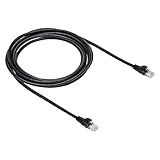
- IN THE BOX: 10-foot Cat-6 UTP Ethernet patch cable with 250 MHz bandwidth
- CONVENIENT: Ideal for connecting networked devices such as computers, printers, routers, and more
- UNIVERSAL COMPATIBILITY: RJ45 connectors ensure universal connectivity
- FAST CONNECTION: Transmission speed up to 10 gigabit per second with minimal signal loss
- SNAGLESS PLUG: Helps prevent damage when plugging and unplugging cable
Choose the category and construction for the installation
Wiring type and cable category answer different questions: straight-through versus crossover describes the connections between pins, while category describes the cable specification. A cable can be a straight-through patch cable and also be Cat5, Cat5e, or Cat6. Select a category appropriate for the connected equipment and the installation requirements. When comparing products, check both things: whether the wiring arrangement is suitable and whether the category and construction meet the equipment’s requirements.
What’s actually slowing this PC down?
Pick the symptom - the matching free tool is one click away.
For relevant RJ-45 Ethernet ports, Cisco’s connector guide lists Category 5, 5e, or 6 UTP cabling and calls for four twisted pairs on 10/100/1000 ports. Check the requirements for your actual equipment and run; the guide is specific to its documented switch context. See Cisco’s Catalyst switch cable and connector guide for those details.
Those connector-guide details are not a universal shopping specification for every installation. Use them as context for the equipment Cisco’s guide covers, then confirm the port requirements for the devices you own. The guide’s four-pair detail applies to the cited 10/100/1000 port context; do not assume that category, pair count, or any other construction requirement can be selected independently of the equipment documentation.
For a typical device-to-switch link, a Cat5e or Cat6 straight-through patch cable is a reasonable product category to consider when it matches the equipment and installation. If the ports need crossover wiring and do not have working Auto-MDIX, the cable must also be a crossover. A category label does not compensate for wiring that the interfaces cannot use, and crossover wiring does not remove the need to select a suitable cable category.
What to check when a link does not come up
If the connection fails, do not assume immediately that you need a crossover cable. Work through the factors that determine whether the cable and interfaces can establish the link:
Rank #4

- High Performance : Cat 6 ethernet cable support up to 10 Gbps and 550 Mhz application. Cat6 patch cable are made of 26 AWG pure copper with reliable performance. Ethernet cables compliant with ANSI TIA 568.2 D standard.
- Clean Up Home network: Cat6 short patch cable is perfect to connect patch panel to switch, clean up your network rack with the cables all be the same and save hours of time to make your own patch cable.
- Widely Compatible : Cat6 ethernet cable are widely use in data center application. Ethernet patch cable connect patch panels to switch and other various devices. Cat6 cable also used for homenetwork such as router, computer, tv and server.
- Easy Unplug Design: Cat6 ethernet cord with snagless plug protects plugs when routing through cable managers or pathways. Cat 6 patch cable are easy plug and unplug from ports.
- Support POE POE+:Cat 6 ethernet cables are made of pure copper conductors. Cat 6 cable supports IEEE802.3at and IEEE802.3af protocol poe power supply.
- Confirm the intended connection. Identify which devices and ports are connected. For a typical end device-to-switch link, the recommended starting point is a straight-through patch cable. Make sure the connection you are troubleshooting is the one you think it is, rather than applying a cable rule based on the device names alone.
- Check the port documentation. Look for the required cable wiring, Auto-MDIX support, and any model- or software-specific conditions. A traditional same-type pairing rule alone does not establish that crossover wiring is required. Check both ends when possible, since the link depends on the capabilities and settings of the interfaces involved.
- Review Auto-MDIX and negotiation settings. If relying on Auto-MDIX, confirm that the feature is supported and enabled, and check the required speed and duplex negotiation settings. On Cisco equipment, explicitly fixing both speed and duplex disables Auto-MDIX in the documented context cited above. Do not assume that the same setting behavior applies to another vendor’s equipment.
- Verify category and construction. Match the cable to the equipment and installation requirements. For the Cisco RJ-45 port context described in its guide, the listed UTP categories are Cat5, Cat5e, and Cat6, with four twisted pairs for 10/100/1000 ports. Check whether the documentation for your actual ports calls for those or other requirements.
- Try the cable type the port documentation specifies. If the interfaces do not support working Auto-MDIX and require crossed pairs, use a crossover cable. If they support Auto-MDIX, a crossover may be unnecessary. For routine device-to-switch connections, begin with straight-through cabling as Cisco recommends.
These checks distinguish a wiring mismatch from a configuration or equipment-specific requirement without assuming that cable type is the only possible cause of a failed link. If changing cable type does not resolve the issue, return to the device and port documentation rather than repeatedly swapping cable types based on a general rule.
Independent reader supportYour contribution helps us test, update, and keep practical guides available for everyone.What to buy—and when not to buy a crossover
For the common job of connecting a PC, printer, server, or other end-user device to a switch, shop for a straight-through Ethernet patch cable in a category appropriate for the equipment and installation. A Cat6 Ethernet patch cable or Cat5e Ethernet cable may suit the job if those specifications meet the port and run requirements. The product choice should be driven by the documented equipment needs, not by the idea that crossover wiring is inherently better.
Buy an Ethernet crossover cable when the connected interfaces require crossed transmit and receive pairs and do not have working Auto-MDIX. That is a conditional purchase, particularly relevant when dealing with older equipment or a confirmed setup that lacks working Auto-MDIX. Before buying one, confirm the requirement in the device manuals or port settings. A crossover cable may be unnecessary on compatible ports with Auto-MDIX.
No specific retailer, active affiliate program, commission, or tested cable model is established here. If comparing products, focus on the wiring type, category, construction, and fit for your equipment. Do not treat a product link as evidence that a particular cable has been tested or that it will work in every configuration.
Bottom line for choosing
For routine connections from an end device to a switch, choose a straight-through Ethernet patch cable in the category and length appropriate for the installation. Consider a crossover cable only when the connected interfaces require crossed transmit and receive pairs and do not have working Auto-MDIX. When in doubt, the port documentation and settings—not the apparent similarity of the devices—should decide.
Best Value

- IN THE BOX: 5-foot RJ45 Cat-6 Ethernet patch Internet cable (5-pack); black/red/blue/white/green
- CONVENIENT: Ideal for connecting networked devices such as computers, printers, routers, and more
- RELIABLE PERFORMANCE: Low signal loss with a transmission speed up to 10 Gbps and 100 meter distance
- GOLD-PLATED CONNECTORS: Gold-plated contacts and bare copper conductors improve signal integrity and resist corrosion
- SNAGLESS DESIGN: Snagless plug helps prevent damage when plugging and unplugging cable
Frequently Asked Questions
Is an Ethernet patch cable the same as a straight-through cable?
In this comparison, “patch cable” means an ordinary straight-through Ethernet cable: pin 1 connects to pin 1, pin 2 to pin 2, and the remaining pins connect to their counterparts. Check the product description if the wiring type is not clear.
When do I need an Ethernet crossover cable?
Use one when the connected interfaces require crossed transmit and receive pairs and do not have working Auto-MDIX. Traditional guidance identifies some same-type port pairings, such as switch-to-switch, as crossover cases, but check the exact ports and documentation rather than relying on the device names alone.
Can I use a straight-through cable instead of a crossover cable?
Often, if the interfaces support and have working Auto-MDIX, because the port can detect the needed wiring and configure itself. Support and settings vary by device. If Auto-MDIX is unavailable and the ports require crossed pairs, use a crossover cable.
Quick wins for a faster PC:
Repair Windows errors before they cause bigger problemsFix Now →Scan for outdated or missing drivers - takes under a minuteDriver Scan →Does Auto-MDIX work if speed and duplex are manually set?
It depends on the equipment. Cisco’s documented feature behavior says speed or duplex auto-negotiation must remain active and that explicitly fixing both speed and duplex disables Auto-MDIX in that context. Check the manual for your specific model and software.
Are crossover cables faster than patch cables?
The distinction covered here is wiring, not a speed advantage. Choose the wiring arrangement the connected interfaces require, then select a cable category and construction that meet the equipment and installation requirements.
Does Cat6 mean a cable is straight-through?
No. Cat6 identifies a cable category, while straight-through or crossover describes how the connections are wired between the plugs. Check both the category and wiring description when choosing a cable.
The Bottom Line
Choose a straight-through patch cable for the usual end-device-to-switch connection. Use crossover wiring only if the ports require it and do not have working Auto-MDIX. Confirm the wiring, category, construction, and negotiation requirements in the documentation for your exact equipment.
Quick Recap
Product prices and availability are accurate as of the date/time indicated and are subject to change. Any price and availability information displayed on Amazon at the time of purchase will apply.

