
Recommended Free Tools
iTechGuides is reader-supported. When you buy through links on our site, we may earn an affiliate commission. As an Amazon Associate I earn from qualifying purchases. Learn more
Usually, yes: an ESP32 running an ESPHome Bluetooth proxy can also read a local wired sensor, such as a 1-Wire temperature probe. The proxy and sensor are separate ESPHome components in the same node. You still need a suitable, unused GPIO on your exact board, correct sensor wiring, and enough capacity for the BLE connections your setup needs.
What the Bluetooth proxy does—and what it does not
An ESPHome Bluetooth proxy forwards Bluetooth Low Energy (BLE) traffic to Home Assistant; it does not proxy Bluetooth Classic devices. ESPHome’s proxy configuration uses the BLE tracker and proxy components in an ESPHome node. Home Assistant can receive readings that a BLE sensor broadcasts in advertisements without opening a connection. Other devices need an active two-way GATT connection to read or write characteristics.

Those connection types matter when you decide whether reusing the board suits your setup. A sensor that only advertises readings does not consume an active connection slot. A device that remains actively connected occupies one for as long as the connection is open.
Quick wins for a faster PC:
Clear out junk files and repair common Windows errorsFree Scan →Scan for outdated or missing drivers - takes under a minuteDriver Scan →Which wired sensor can you add?
A GPIO-based 1-Wire bus with a Dallas temperature sensor is a documented example. ESPHome’s Dallas sensor component supports this kind of wired probe, including a DS18B20 as one possible sensor. The precise probe, supply voltage, wiring, and board pin must all be compatible; the component documentation does not make every probe-and-board combination electrically safe by default.
#1 Best Overall
In your ESPHome configuration, the Bluetooth proxy and the wired sensor are configured as components of the same device. Follow the current component documentation for the required configuration and wiring:
- ESPHome Bluetooth Proxy documentation
- ESPHome Dallas temperature sensor documentation
- Home Assistant Bluetooth integration documentation
Check your specific board before using a pin
“Spare pins” are board-specific. A GPIO exposed on one ESP32 board may be reserved or unsuitable on another. Onboard LEDs, flash, Ethernet hardware, strapping requirements, and the board layout can affect pin choice. Check the pinout and documentation for the exact board, then confirm the pin is available and appropriate for the sensor before connecting wires. ESPHome’s component documentation does not certify a safe pin for every ESP32 board.
Rank #2
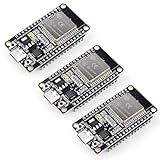
- Dual-Core Performance Up to 240 MHz: Run sensor processing, wireless communication, automation logic and connected-device tasks on a 32-bit dual-core ESP32 platform designed for responsive embedded and IoT projects
- Built-in Wi-Fi and Bluetooth 4.2: Connect to 2.4 GHz Wi-Fi networks or use Bluetooth Classic and BLE for wireless sensors, smart devices, remote controls, home automation and other connected projects
- Flexible Power-Saving Modes: ESP32 power-management features support dynamic clock scaling and low-power operating modes, helping developers reduce energy use in compatible sensing, monitoring and connected-device applications, suitable for battery-powered Internet of Things (IoT) devices.
- USB-C Programming with CP2102: Connect through USB-C for power, sketch uploads and serial monitoring, while GPIO, UART, SPI and I2C interfaces support sensors, displays, motor drivers and other modules (USB-C cable not included)
- Over-the-Air Update Support: Configure OTA functionality through a compatible ESP-32 software framework to update deployed firmware over Wi-Fi without reconnecting the board by USB for every revision
- Identify a suitable GPIO that is exposed and unused on your board.
- Check the probe’s power and wiring requirements against the board.
- Use the sensor component’s current configuration instructions for the chosen GPIO and bus.
- After adding it, confirm that both the sensor and proxy work as expected in your setup.
How active BLE connections affect capacity
ESPHome’s current Bluetooth Proxy documentation gives ESP32 proxies a default of three simultaneous active GATT connection slots. Each configured slot uses about 1 KB of RAM, and ESPHome recommends configuring no more than five to avoid stability and memory issues. These are configuration guidelines, not performance-test results for a proxy sharing a device with a sensor.
Think about the behavior of your BLE devices, not just their number. Devices that broadcast readings without connecting do not use these active slots. Brief connections occupy a slot only while open; continuously connected devices, such as some locks or thermostats, keep a slot occupied. If your setup relies on active connections, account for those long-lived connections before changing the slot configuration.
Rank #3

- ESP32 WI-FI & 4MB FLASH: Powered by ESP32-PICO-D4 dual-core 240 MHz with 4 MB Flash and built-in 3D antenna – delivers reliable 2.4 GHz Wi-Fi for IoT nodes, wearable devices, and embedded applications.
- ULTRA-COMPACT 24×24mm BODY: Measures just 24×24×9.5 mm and weighs only 5.5 g with M2 screw hole mounting – fits into the tightest spaces for seamless integration into smart wearable and custom IoT builds.
- IR TRANSMITTER & RGB LED: Built-in IR transmitter and SK6812 RGB LED provide wireless remote control and visual status feedback – ideal for smart home control and interactive embedded IoT applications.
- USB TYPE-C & MULTI-PLATFORM: USB Type-C enables direct programming and serial communication; supports UiFlow1/2, Arduino IDE, ESP-IDF & PlatformIO – accessible for beginners and experienced developers alike.
- 6 GPIO & GROVE EXPANSION: Provides 6 GPIO pins (G19/G21/G22/G23/G25/G33) plus GROVE I2C/I/O/UART interface – enables flexible sensor and peripheral expansion for diverse embedded IoT project builds.
Wi-Fi, Ethernet, and proxy performance
ESP32 Wi-Fi and Bluetooth share radio resources. ESPHome recommends Ethernet-connected hardware when Bluetooth performance is important because Ethernet offloads Wi-Fi traffic from the ESP32 radio. That is a network-and-radio consideration, separate from whether the board can read a wired sensor.
ESPHome recommends the default scan parameters for most users. More aggressive scanning can increase CPU use and network traffic, and may cause overheating on PoE proxy boards or Wi-Fi instability on Wi-Fi boards. The documentation does not provide a universal measurement of the performance impact of adding a wired sensor, so do not assume every board and configuration will behave identically.
Rank #4

- 2.4GHz Dual Mode WiFi + Bluetooth Development Board
- Support LWIP protocol, Freertos;ESP32 is a safe, reliable, and scalable to a variety of applications
- SupportThree Modes: AP, STA, and AP+STA
- Ultra-Low power consumption, Compatible with Arduino IDE
- 1PCS 30Pin ESP32 Development Board 2.4GHz WiFi Dual Cores Microcontroller Integrated with Antenna RF Low Noise Amplifiers Filters
When reusing the proxy makes sense
Use the ESP32 you already own when its board exposes a suitable GPIO, the sensor is electrically compatible, and the proxy still meets your BLE needs. Consider another board or a different proxy platform only if the existing board lacks an appropriate pin, or its connection and radio constraints do not suit the devices you need to support.
What’s actually slowing this PC down?
Pick the symptom - the matching free tool is one click away.
Platform support is not identical across hardware. ESPHome documents active proxy connections on ESP32 and RP2040/RP2350, while BK72xx and LN882x proxies support advertisements only. ESPHome announced proxy support on additional non-ESP32 platforms in release 2026.8.0; check the current documentation for the supported features of your specific device and ESPHome version.
Quick Recap
Best Value

- (2.4Ghz)Wi-Fi 6, Zigbee, and Thread, Matter wireless protocols are supported
- Built-in infrared LED and RGB
- Equipped with Grove port
- Ceramic antenna
- Super Small and Compact
Product prices and availability are accurate as of the date/time indicated and are subject to change. Any price and availability information displayed on Amazon at the time of purchase will apply.

