
Quick wins for a faster PC:
Clear out junk files and repair common Windows errorsFree Scan →Scan for outdated or missing drivers - takes under a minuteDriver Scan →iTechGuides is reader-supported. When you buy through links on our site, we may earn an affiliate commission. As an Amazon Associate I earn from qualifying purchases. Learn more
An ESP32 can generate a PWM control signal, but it cannot safely power a UVC LED directly from a GPIO pin. Before using one in a flow-through water-treatment system, verify the entire electrical chain, design for a fail-off state, assess optical and ozone hazards, and validate the reactor under the water-quality and flow conditions you intend to claim. A timer, nominal flow rate, or LED duty cycle alone does not establish a delivered UV dose or disinfection performance.
What must be identified before choosing a control method?
Start with the complete system, not just the microcontroller. The correct control interface depends on the specific ESP32 chip and board, LED emitter, driver, reactor, intended water, and treatment target. The cited Espressif, EPA, FDA, and IEC materials do not validate a particular DIY assembly.
| Part of the system | Information to establish | Why it matters |
|---|---|---|
| ESP32 controller | Exact chip and module, development board, firmware framework, and version | GPIO limits and peripheral behavior depend on the specific device and implementation. |
| UVC LED emitter | Wavelength or spectrum, electrical operating range, thermal limits, optical-output data, and permitted modulation method | The driver and operating conditions must match the selected emitter; an advertised electrical rating does not establish reactor performance. |
| LED driver | Constant-current behavior, supply range, enable polarity, dimming interface, logic levels, accepted PWM frequency and duty range, startup behavior, and open- or short-LED response | The ESP32 signal must be electrically compatible with the driver, including during startup and faults. |
| Reactor and application | Reactor geometry, intended water quality, operating flow range, treatment endpoint, and applicable regulatory or certification requirements | These define the conditions in which safety and treatment performance must be assessed. |
Can an ESP32 control a UVC LED with PWM?
Use LEDC as a signal source, not as the LED power supply
Espressif documents the ESP32 LEDC peripheral for generating PWM through a timer, channel, and GPIO configuration. That establishes a control capability; it does not show that a particular driver accepts the resulting signal. Check the selected driver’s dimming input specifications before choosing LEDC settings. Do not connect a power LED directly to a microcontroller GPIO, and do not infer a suitable driver or LED current from the controller documentation.
Free tools Windows power users keep installed
One-click scans. No signup required.
Check voltage limits and interface behavior
Espressif’s Hardware Design FAQ states that ESP chip GPIO voltage tolerance is 3.6 V. Treat that as a limit to verify against the exact chip and module documentation, not as a recommended operating voltage or permission to expose a pin to that voltage in every condition. Confirm the driver’s logic levels and ensure its output or fault behavior cannot place an overvoltage on the ESP32 pin.
#1 Best Overall

- 2.4GHz Dual Mode WiFi + Bluetooth Development Board
- Support LWIP protocol, Freertos
- SupportThree Modes: AP, STA, and AP+STA
- Ultra-Low power consumption, Compatible with Arduino IDE
- ESP32 is a safe, reliable, and scalable to a variety of applications
Also establish what the driver does when PWM is absent, the input is floating, the ESP32 is unpowered, or the controller is booting. A control signal that works during normal firmware operation may not provide a safe state during reset or power loss.
How should the system respond to faults?
Choose the safe state before writing control logic. The software should initialize with the UV source disabled, and the hardware should tend toward off when the ESP32 is unpowered, resetting, disconnected, or still starting. Determine the driver’s input default rather than assuming that no PWM means off. Use independent hardware interlocks where needed; software alone should not be the only barrier against unintended exposure or operation without suitable water flow.
Rank #2
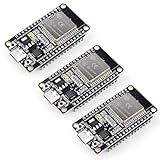
- Dual-Core Performance Up to 240 MHz: Run sensor processing, wireless communication, automation logic and connected-device tasks on a 32-bit dual-core ESP32 platform designed for responsive embedded and IoT projects
- Built-in Wi-Fi and Bluetooth 4.2: Connect to 2.4 GHz Wi-Fi networks or use Bluetooth Classic and BLE for wireless sensors, smart devices, remote controls, home automation and other connected projects
- Flexible Power-Saving Modes: ESP32 power-management features support dynamic clock scaling and low-power operating modes, helping developers reduce energy use in compatible sensing, monitoring and connected-device applications, suitable for battery-powered Internet of Things (IoT) devices.
- USB-C Programming with CP2102: Connect through USB-C for power, sketch uploads and serial monitoring, while GPIO, UART, SPI and I2C interfaces support sensors, displays, motor drivers and other modules (USB-C cable not included)
- Over-the-Air Update Support: Configure OTA functionality through a compatible ESP-32 software framework to update deployed firmware over Wi-Fi without reconnecting the board by USB for every revision
The exact interlock circuit depends on the equipment, product class, jurisdiction, and risk assessment. EPA guidance supports keeping UV reactors within validated operating conditions, while FDA and IEC materials establish relevant safety concerns; they do not prescribe one universal circuit for a small LED reactor.
Do these 3 things before closing this tab:
1Repair Windows errors before they cause bigger problems2Fix the driver behind crashes, sound loss and screen glitches3Clear out junk files and repair common Windows errorsInclude these fault cases in the design review
- No flow, low or excessive flow, and implausible flow-sensor readings.
- Loss of water, air pockets, leakage, or loss of reactor pressure where relevant.
- An opened enclosure, damaged optical barrier, or failed cover switch.
- ESP32 boot, watchdog reset, brownout, firmware failure, or loss of network connectivity if the design depends on it.
- LED-driver overtemperature, open or short LED, and loss of power.
- A blocked, fouled, aged, or displaced optical window or sleeve.
For each case, specify how it is detected, whether the UV source is disabled, what fault indication or recovery is allowed, and whether a restart requires a deliberate check. EPA discusses flow monitoring and operation within validated conditions, but the appropriate sensors and shutdown architecture for an unspecified LED reactor are not established by that guidance.
Rank #3

- Powerful ESP-32 Board: Unlock the world of Internet of Things (IoT) and advanced electronics with the heart of this kit: the ESP-32 board. It features a powerful dual-core processor, integrated Wi-Fi and Bluetooth 4.2, making it perfect for building connected, smart devices that communicate with your phone or the cloud. It's fully compatible with the Arduino IDE for easy programming.
- Super Starter Kit: This kit contains over 35 different modules and electronic components, including sensors, displays, motors, and input devices. From LEDs and buttons to an OLED screen, servo motor, and keypad, you have everything needed to explore a vast range of projects in one box.
- Step by Step Online Tutorial: Jump right in with our detailed, beginner-friendly tutorial. Access 30+ projects with complete code, clear circuit diagrams, and step-by-step instructions. Learn the fundamentals of electronics, coding, and how to utilize the ESP-32's unique capabilities without any prior experience.
- Hands-on Learning for All Skill Levels: Perfect for students, makers, engineers, and hobbyists. Start with basic circuits and coding, then progress to intermediate and advanced IoT applications. Build practical projects like weather stations, smart home controllers, remote-controlled devices, and interactive gadgets. The skills you learn are the foundation for real-world innovation.
- Quality & Great Support: Elegoo is committed to quality. We provide a clear, detailed tutorial guide, refined code, and a well-organized component kit. All modules are carefully selected for reliability and ease of use. Our dedicated technical support team and active online community are ready to help you succeed in your learning journey.
What UVC safety and standards issues apply?
FDA warns that UVC exposure can cause severe skin burns and eye injuries, including photokeratitis. It also notes that some UVC lamps generate ozone, which can irritate the respiratory tract. Enclosure design, optical barriers, and interlocks therefore need to be treated as safety controls, not cosmetic additions. A clear-looking enclosure or a status indicator by itself does not demonstrate that people are protected.
IEC identifies several relevant standards by scope:
Rank #4

- 2.4GHz Dual Mode WiFi + Bluetooth Development Board
- Support LWIP protocol, Freertos;ESP32 is a safe, reliable, and scalable to a variety of applications
- SupportThree Modes: AP, STA, and AP+STA
- Ultra-Low power consumption, Compatible with Arduino IDE
- 1PCS 30Pin ESP32 Development Board 2.4GHz WiFi Dual Cores Microcontroller Integrated with Antenna RF Low Noise Amplifiers Filters
- IEC 62471-6:2022 covers optical-radiation safety for ultraviolet lamp products, including UV LED lamp products, with provisions concerning assessment, risk groups, user information, and labeling.
- IEC 60335-2-109 addresses the safety of UV-radiation water-treatment appliances for household and similar use, including DC-supplied appliances within its specified voltage scope.
- IEC PAS 63313:2021 provides general UV-C safety guidance for sources within its wavelength scope, but explicitly excludes devices with their own product safety standard, including UV-C water-treatment equipment.
These scopes do not establish that a DIY system conforms. Before marketing or relying on an assembly, check the complete current standard text and applicable local rules with a qualified safety or compliance specialist. FDA’s consumer UV-wand safety communication illustrates that a device marketed for disinfection can still expose nearby people to unsafe UV; its findings about those tested wand products are not measurements of a different enclosed water reactor.
The Tool Desk
Outbyte Driver Updater FREEFix the driver behind crashes, sound loss and screen glitchesFind Drivers →Outbyte PC Repair FREERepair Windows errors before they cause bigger problemsFix Now →How can you tell whether the reactor delivers the intended treatment?
You cannot establish a validated UV dose by multiplying LED duty cycle by nominal residence time. EPA’s UV Treatment Toolkit says that water quality and desired production define the conditions for reactor validation and operation; it discusses dedicated flowmeters and active or passive flow control to keep a reactor within validated limits. EPA’s UV manual also explains that reactor hydraulics matter: lamp placement, inlet and outlet geometry, baffles, and mixing can create non-uniform dose delivery, including short-circuiting and dead zones.
Best Value

- 2.4GHz Dual Mode WiFi + Bluetooth Development Board
- Ultra-Low power consumption, works perfectly with the Arduino IDE
- Support LWIP protocol, Freertos
- SupportThree Modes: AP, STA, and AP+STA
- ESP32 is a safe, reliable, and scalable to a variety of applications
Define the operating envelope to be validated
- The target organism or treatment endpoint and required reduction.
- The emitter’s wavelength spectrum and measured optical output at operating temperature.
- Water UV transmittance or other water-quality constraints, including turbidity where applicable.
- Minimum, worst-case, and maximum flow conditions.
- Reactor geometry and flow distribution.
- Sensor accuracy, calibration, fouling behavior, and response to faults.
- Emitter aging, optical-surface fouling, cleaning, and replacement intervals.
- Independent test or validation evidence that matches the claimed operating envelope.
The available guidance does not establish a universal wavelength, optical output, flow rate, or exposure time for an unspecified system. Do not claim drinking-water, medical, or regulated-use disinfection based on a timer, clear water, an indicator LED, or the presence of an enclosure. Determine the certification and regulatory requirements for the jurisdiction and intended claims; they cannot be resolved without knowing the application.
How should candidate systems be compared?
If you are evaluating complete systems, compare documented performance and safeguards on the same criteria. Do not rank them by advertised wattage or a “sterilizer” label alone. No specific product model is established as compatible or validated here.
Quick Recap
| Comparison criterion | Evidence to request |
|---|---|
| Emitter and optical output | Documented wavelength or spectrum and measured output under stated operating conditions. |
| Validated treatment envelope | Validated flow range and water-quality limits tied to the intended treatment endpoint. |
| Safety provisions | Enclosure, optical barriers, interlocks, and the response to relevant fault conditions. |
| Control compatibility | Driver input requirements and documented compatibility with the controller’s electrical levels and PWM signal. |
| Standards and certification | Applicable standards or certifications identified for the product and intended market. |
| Maintenance | Serviceability, emitter replacement, and documented cleaning or replacement intervals. |
| Independent evidence | Test or validation results that apply to the actual configuration and claimed operating conditions. |
Product prices and availability are accurate as of the date/time indicated and are subject to change. Any price and availability information displayed on Amazon at the time of purchase will apply.

