
Do these 3 things before closing this tab:
1Fix the driver behind crashes, sound loss and screen glitches2Repair Windows errors before they cause bigger problems3Scan for outdated or missing drivers - takes under a minuteiTechGuides is reader-supported. When you buy through links on our site, we may earn an affiliate commission. As an Amazon Associate I earn from qualifying purchases. Learn more
For people who print regularly, an Epson EcoTank can cost less over time because refill bottles generally let you print more pages before buying ink again. A cartridge printer can cost less overall if its lower purchase price matters more than ink savings—for example, when you print only occasionally or expect to replace it soon. The answer depends on the exact printers, local prices, page volume, page mix, and how long you keep the machine. Compare the printer and ink together over the same ownership period; ink cost per page by itself cannot tell you which option wins.
What “costs less over time” should include
A fair comparison adds the printer’s purchase price to the ink you expect to use during a defined period. A three-year comparison is useful if that matches your plans, but it is not a universal lifespan or the right period for every household. Choose a period that reflects how long you realistically expect to keep the printer, then use it for both options.
Paper is usually a shared cost: if both printers do the same job on the same paper, it does not explain a difference between their ink systems. Add it only when the print tasks or paper requirements differ. The comparison should focus on the expenses that actually change between the two printers.
- Printer price: Use the price you can pay in your region now, not an old list price or a discount that is no longer available.
- Ink: Include the exact cartridges or bottle set compatible with each printer and enough ink to cover the pages you expect to print.
- Usage: Estimate monthly pages and whether they are mostly text, color documents, photos, or a mix.
- Time: Use the same ownership period for both options and account for any ink you expect to need near the end of it.
- Comparable features: Compare printers with similar functions so that a difference in scanning, duplex printing, or paper capacity does not get mistaken for an ink-system cost.
The totals are estimates, not guarantees. Your result depends on the products’ current prices and how you use them.
#1 Best Overall

- Innovative Cartridge-Free Printing ― High-capacity ink tanks mean no more tiny, expensive ink cartridges; Epson’s exclusive EcoFit ink bottles make filling easy and worry-free
- Impressive Print Quality ― Unique Micro Piezo Heat-Free Technology produces sharp text – plus impressive color photos and graphics – on virtually any paper type
- Zero Cartridge Waste – By using an EcoTank printer, you can help reduce the amount of cartridge waste ending up in landfills
- Built-in Scanner & Copier ― High-resolution flatbed scanner and a color display for easy document copying and navigation
What Epson’s published savings comparison can—and cannot—tell you
Epson’s EcoTank Savings page presents a three-year comparison of printer hardware plus ink for its ET-2980 against comparable cartridge printers at different monthly print volumes. Its illustrations use scenarios of 35, 75, and 125 ISO pages per month. These are modeled usage levels, not universal break-even points, and they should not be read as a promise that every EcoTank buyer will save money.
For its stated cost-per-ISO-page method, Epson says it uses replacement-bottle costs and enough standard-capacity cartridges to match their page yields. The company says the comparison draws on Epson MSRP and cartridge yields for similarly featured consumer inkjet printers as of March 2025. It also cautions that actual costs vary with print task, volume, and usage conditions. This is manufacturer-published evidence, not an independent test of every printer and ink combination; Epson itself notes that “Actual savings of money, waste, and hassle will vary.”
| What the comparison shows | How to use it |
|---|---|
| Three-year hardware-plus-ink cost | Useful as a manufacturer scenario for the models and assumptions Epson selected; recalculate with your own current prices and usage. |
| 35, 75, and 125 ISO pages per month | Reference points in Epson’s ET-2980 illustration, not recommended minimums or guaranteed crossover volumes. |
| Replacement bottles and standard-capacity cartridges | A stated comparison method; check the exact consumables and yields for any printers you plan to buy. |
| March 2025 MSRP and cartridge-yield data | A dated input to Epson’s method, not a current price quote for your retailer or region. |
Use the comparison to understand why volume matters and what costs to include. Do not copy its savings figure as a personalized forecast: your printer price, ink prices, print mix, and ownership period may differ from Epson’s assumptions.
Quick wins for a faster PC:
Scan for outdated or missing drivers - takes under a minuteDriver Scan →Repair Windows errors before they cause bigger problemsFix Now →Fix the driver behind crashes, sound loss and screen glitchesFind Drivers →How to calculate your own total
Gather prices and yields for the specific printers you are considering. Use prices available to you in your country, and record the date you checked them; retailer prices and promotions change. If you cannot establish a current price or comparable yield, leave the result as an estimate rather than inventing a precise saving.
- Choose an ownership period. Decide how many years you expect to keep the printer. Use that same number of months for both options.
- Estimate your monthly workload. Count pages you actually expect to print. Separate mostly-black text from color documents and photos if those jobs use ink differently. A monthly average is more useful than counting only a busy month.
- Match the printers by features. Compare similar consumer inkjet models with the functions you need, such as scanning, automatic two-sided printing, fax, and paper capacity. Do not attribute an entire purchase-price gap to the ink system if one machine includes more hardware.
- Find compatible consumables. Check the printer maker’s model-specific compatibility information. For each printer, note the price of the cartridges or full bottle set you would actually buy and the published yield for the relevant consumable.
- Estimate ink required for the workload. Multiply your monthly pages by the ownership period in months. Divide the expected pages by the relevant published yield to estimate the number of consumable sets required, then price those sets. For color work, account for the color inks rather than treating every page as black-only.
- Add printer and ink costs. Calculate a total for each printer, using the same period and print workload. Include enough ink to cover expected use; do not count the ink included in the box as though it necessarily covers the full period.
- Check the assumptions. Recalculate if you print more photos, more color, or fewer pages than expected, or if a price changes. A comparison is only as useful as its inputs.
A practical model is:
Total cost over the chosen period = printer purchase price + cost of ink needed for the expected pages during that period.
Rank #2

- INNOVATIVE CARTRIDGE-FREE PRINTING — No more dealing with lots of tiny ink cartridges; With this wireless document and photo printer each ink bottle set is equivalent to about 90 individual cartridges²
- LESS FREQUENT INK REPLACEMENT — Replacement ink bottles don't have to be changed nearly as often as ink cartridges¹; When you choose this combination printer, scanner and copier you can print up to 4,500 pages black/7,500 color³
- COLOR PRINTING — Up to 2 years of ink in the box4 (and with every replacement ink set) for fewer out-of-ink frustrations
- ZERO CARTRIDGE WASTE — By using an Epson EcoTank printer you can help reduce the amount of cartridge waste ending up in landfills
- HOME PRINTER DESIGNED FOR RELIABILITY — The Epson EcoTank ET-2800 All-in-One Supertank Color Printer creates vivid, detailed prints and documents thanks to Micro Piezo Heat-Free Technology; Fire off 10 ISO pages per minute1 to easily finish large jobs
For cartridges, estimate the required quantity using the exact printer’s compatible cartridge prices and published yields. For a tank printer, do the same with the compatible bottle set and its realistic yields. Published yields are a starting point for the arithmetic, not a promise that your pages will match the test conditions.
How to read the break-even point
The tank printer’s higher upfront price is a hurdle its lower ink expense must overcome. If you know the purchase prices and a defensible per-page ink-cost estimate for each model, an approximate crossover is:
Break-even pages = (tank printer price − cartridge printer price) ÷ (cartridge ink cost per page − tank ink cost per page).
This calculation is useful only when the tank really has the lower estimated ink cost per page and both estimates use comparable print assumptions. It is an arithmetic estimate based on your inputs, not a published Epson threshold or independently validated result. If the price difference is small, the crossover may be reached sooner; if the tank printer costs much more or you print very little, it takes longer. If the denominator is zero or negative, the assumed ink costs do not show a tank-ink advantage, so this formula does not produce a meaningful crossover.
Compare the resulting page count with the pages you expect to print over your ownership period. If your expected pages fall short, the tank’s lower ink cost may not repay the hardware premium before you replace it. If your expected volume exceeds the estimate, the tank may come out ahead—provided the prices, yields, and print mix in the calculation remain reasonable. Re-run the arithmetic when any of those inputs changes instead of treating a single crossover number as permanent.
Rank #3
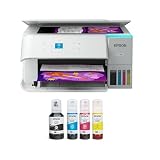
- STRESS-FREE PRINTING — Epson EcoTank comes with enough ink to print up to 6,600 pages black/5,500 color¹⁰ for fewer out-of-ink frustrations. Each replacement ink bottle set is equivalent to about 80 cartridges¹¹
- SIMPLE INK REFILLING — Supersized ink tanks and uniquely keyed EcoFit bottles make refilling ink simple—no mess, no stress and no ink bottle mix-ups
- THE WORLD’S #1 SELLING SUPERTANK PRINTER² — Epson invented EcoTank to revolutionize the way people print; we’ve sold 100 million EcoTanks worldwide⁷ and this is our 7th generation of cartridge-free printers
- ADVANCED PRODUCTIVITY FEATURES — Fast 15 black/8 color ISO ppm print speeds with zero warmup time, built-in scanner, 100-sheet paper tray, auto duplex printing and a 1.44" color display for easy navigation
- STUNNING PRINT QUALITY — High 4800 x 1200 dpi print resolution for exceptional photos and text; enjoy amazing image quality on a wide range of media
Why advertised page yields may not match your prints
Epson’s ET-2760 product page lists manufacturer replacement-bottle yields of 7,500 black pages and 6,000 color pages. These are model-specific manufacturer estimates under Epson’s stated methodology, not guaranteed results for every owner or a yield claim for every EcoTank. They also do not establish that a particular bottle set fits another model.
Free tools Windows power users keep installed
One-click scans. No signup required.
Epson says actual yields vary with the images printed, settings, temperature, humidity, infrequent use, and printing mostly one color. Some ink from the included supply is used during initial setup. All colors are used for printing and maintenance, so even a workload that appears mostly black is not necessarily a calculation that can ignore color ink entirely. Those factors can make the number of pages you get differ from the published estimate.
To make your estimate more useful, base it on the work you really do. A household printing mostly short text documents should not assume its costs are identical to a small business printing color charts or a photo hobbyist printing images. If you cannot translate your print mix into reliable yield assumptions, calculate a range rather than presenting one exact total. Keep the same assumptions for both printer types where possible.
Check compatibility and model details before comparing prices
“EcoTank” describes a family of refillable tank printers, not one universal bottle system. Epson’s ET-2760 information lists 502-series replacement bottles; that compatibility detail applies to that model and should not be generalized to other EcoTanks. Confirm the consumable family for the exact model number before using a bottle price or yield in your calculation.
Model names and availability also change. Epson identifies the ET-3950 as the replacement for the older ET-3760. That makes a direct comparison using an old model’s price or a discontinued competitor’s cartridges especially easy to misread. Check that both printers are available to you and that the prices and consumables you have gathered refer to the exact models under consideration. Epson’s US listing for the ET-4950 includes a 250-sheet tray and places it among home-office models; those details do not make it a feature-equivalent match for every cartridge printer.
Rank #4

- INNOVATIVE CARTRIDGE-FREE PRINTING — No more dealing with tiny, expensive ink cartridges; With this wireless printer each ink bottle set is equivalent to about 80 individual cartridges²
- LESS FREQUENT INK REPLACEMENT — Replacement ink bottles don't have to be changed nearly as often as ink cartridges¹; Color printer lets you print up to 4,500 black and white pages and 7,200 color³
- PRINT FOR LONGER — Up to 2 years of ink in the box⁴ (and with every replacement ink set) for fewer out-of-ink frustrations; This home printer keeps printing longer
- HIGH CAPACITY INK TANKS – Printer, scanner and copier utilizes Epson’s exclusive EcoFit ink bottles, making the refill process easy and worry-free
- ZERO CARTRIDGE WASTE — By using an Epson EcoTank printer you can help reduce the amount of cartridge waste ending up in landfills; Cartridge-free printer utilizes ink bottles for more convenience and less waste
Make the comparison fair on features and timing
A printer that costs more may include features you would otherwise buy in another device or simply may be a higher-tier model. If an EcoTank option includes a scanner, duplexing, fax, or more paper capacity that the cartridge option lacks, either find a more closely matched cartridge printer or state that the comparison includes those extra features. Otherwise, you risk calling a feature premium an ink-system premium.
Use current local prices for both printer and ink. A discounted printer can change the upfront gap substantially, while a temporary ink promotion can alter the estimated ongoing cost. Do not compare one model’s current sale price with another model’s old MSRP. If prices fluctuate, note the date and treat the result as a snapshot rather than a lasting ranking.
Also keep replacement timing consistent. A three-year total should cover the ink needed for three years of expected printing for each option. Avoid comparing the tank’s entire initial bottle set with only one cartridge purchase if the workload would require more cartridges during the period. Conversely, do not charge a tank for bottles you would not need to buy by the end of that period. Count the consumables expected to be purchased, while recognizing that actual use can vary.
Which type is more likely to cost less for you?
An EcoTank is worth calculating if you print steadily
Regular printing gives a tank printer more opportunity to offset its larger initial cost with lower refill expense. That is especially relevant if your page volume is high enough that cartridge replacements would accumulate during your ownership period. Still, “steady” is not a fixed number of pages: the result depends on the specific printer prices, ink costs, yield assumptions, and how long you keep the printer. Use your own workload in the calculation rather than treating Epson’s 35-, 75-, or 125-page monthly scenarios as a universal threshold.
What’s actually slowing this PC down?
Pick the symptom - the matching free tool is one click away.
A cartridge printer can be the lower-cost choice for light or short-term use
If you print only a small number of pages, buy a printer at a substantially lower price, or expect to replace the machine before ink savings can accumulate, a cartridge option may have the lower total. The key question is not whether cartridges have a higher estimated ink cost per page in isolation; it is whether the avoided upfront expense exceeds the extra cartridge spending for the period you actually plan to own the printer.
Neither choice wins from the category name alone
A tank model is not automatically cheaper because it uses bottles, and a cartridge model is not automatically more expensive because it uses cartridges. The comparison needs current, feature-matched products and the consumables that fit those exact printers. If reliable competitor prices, yields, or features are unavailable, the evidence does not support naming a universal winner or an exact present-day crossover.
A final decision checklist
- Have you chosen a realistic ownership period and used it for both printers?
- Are the printer prices current in your region, with any temporary promotions identified?
- Do the printers have comparable features, or have you separated the value of extra hardware from ink costs?
- Have you confirmed the exact cartridge or bottle family for each model?
- Does the yield assumption fit your black, color, and photo workload, and account for test conditions?
- Have you included the ink needed for the full period rather than relying only on what comes in the box?
- Does the estimated page count you will print reach the tank’s calculated crossover before you expect to replace the printer?
If the answers are clear, compare the two totals and choose the lower-cost option that also meets your feature needs. If they are not, collect current model-specific prices and yields before relying on a claimed saving.
Quick Recap
Product prices and availability are accurate as of the date/time indicated and are subject to change. Any price and availability information displayed on Amazon at the time of purchase will apply.

