
iTechGuides is reader-supported. When you buy through links on our site, we may earn an affiliate commission. As an Amazon Associate I earn from qualifying purchases. Learn more
Verdict: The Edifier M60 is a genuine powered stereo pair that makes a strong desktop option when space, USB-C convenience, Bluetooth, and clear nearfield listening matter more than deep bass or room-filling volume. Its compact cabinets, included angled stands, and three useful inputs are unusually practical for a computer setup.
It is not a substitute for larger bookshelf speakers or a subwoofer-equipped system. Independent measurements place useful bass extension around 67–70 Hz, while output compression and distortion rise when the small drivers are pushed hard. For arm’s-length listening at ordinary to lively levels, the M60 is a well-balanced design; for parties, large rooms, or powerful low bass, choose a larger system.
What the Edifier M60 is
The M60 is an active stereo pair: two separate left and right speakers with amplification built in. You do not need a receiver, power amplifier, or other external amplifier. One speaker connects to power and the pair operates as a stereo system rather than as a single portable Bluetooth speaker.
Quick wins for a faster PC:
Repair Windows errors before they cause bigger problemsFix Now →Fix the driver behind crashes, sound loss and screen glitchesFind Drivers →Clear out junk files and repair common Windows errorsFree Scan →Edifier positions the M60 for desktops and other nearfield setups. That distinction matters. Nearfield listening puts your ears relatively close to the drivers, so the speakers can deliver a coherent stereo image without having to fill an entire room. A desk, small office, bedroom, or compact studio is a natural use case; a large lounge or party is not.
#1 Best Overall

- [Compact and Delicate Design] Measuring 100mm (W) x 168mm (H) x 147 mm (D) per speaker, with the similar width and height of an often-seen mobile, the M60 is suitable for any desktop setup style
- [Powerful Output] The M60 has a total output power of 66W RMS, consisting of 18W+18W (mid-low) and15W+15W (treble), equipped with 1" silk dome tweeters and 3" long-throw aluminum diaphragm mid-low drivers, and features a high-efficiency closed-loop Class-D audio amplifier
- [High-Quality Audio Processing] Experience high-resolution audio with M series speakers, featuring full digital processing, Class-D amplification, and Hi-Res Audio certification for both wired and wireless transmission, along with precise two-way active crossover and dynamic range control provided by a built-in DSP
- [Multiple Inputs] The M60 offers versatile connectivity with Bluetooth V5.3 for wireless streaming, and both USB-C and AUX inputs for wired connections
- [Bluetooth 5.3 Connectivitity] The Bluetooth V5.3 audio receiver supports the LDAC codec, offering a maximum transmission bitrate of up to 990 kbps, enabling the streaming of high-resolution audio up to 24-bit/96kHz from Android devices running version 8.0 or later
MyHiFi summarizes the design goal as “The Edifier M60 is built around a sensible promise: make a real stereo pair small enough for a crowded desk, then give it the inputs modern computers and phones actually use.” MyHiFi’s review treats that promise as the central trade-off: space efficiency and connectivity in exchange for limited low-frequency headroom.
Edifier M60 specifications
| Specification | Edifier’s published information |
|---|---|
| System type | Active, powered stereo pair with built-in Class-D amplification and DSP crossover |
| Total output | 66 W RMS total: 15 W × 2 for the tweeters and 18 W × 2 for the mid-low drivers |
| Drivers | One 3-inch long-throw aluminum mid-low driver and one 1-inch silk-dome tweeter per speaker |
| Published frequency response | 58 Hz–40 kHz; Edifier does not publish a tolerance alongside the 58 Hz endpoint |
| Signal-to-noise ratio | At least 85 dB(A) |
| Wired inputs | USB-C and 3.5mm AUX |
| Bluetooth | Bluetooth 5.3 with SBC and LDAC codecs |
| High-resolution Bluetooth note | Supported Android 8.0-or-later devices can stream up to 24-bit/96 kHz over LDAC |
| Dimensions | 100 × 168 × 147 mm per speaker |
| Net weight | 3.07 kg for the set |
| Finish options shown by Edifier | Black, white, and classic oak |
These are manufacturer specifications from the official Edifier M60 product page. The response range should not be read as a guarantee of flat output: no tolerance is provided, and a frequency endpoint does not indicate how loudly or evenly the speaker reproduces that frequency.
Why the M60 works well on a desk
Small footprint
Each cabinet is only 100 mm wide, 168 mm tall, and 147 mm deep. Tom’s Guide rounds the dimensions to roughly four inches wide and six-and-a-half inches tall and calls the pair suitable for compact setups. That is a reviewer’s characterization, not a promise that every monitor, shelf, or riser will have enough clearance.
What’s actually slowing this PC down?
Pick the symptom - the matching free tool is one click away.
The footprint leaves more room for a keyboard, mouse, monitor stand, or notebook than a conventional bookshelf pair. Measure the available depth before buying, especially if your display sits close to the back edge of the desk.
Rank #2

- [Compact and Delicate Design] Measuring 100mm (W) x 168mm (H) x 147 mm (D) per speaker, with the similar width and height of an often-seen mobile, the M60 is suitable for any desktop setup style
- [Powerful Output] The M60 has a total output power of 66W RMS, consisting of 18W+18W (mid-low) and15W+15W (treble), equipped with 1" silk dome tweeters and 3" long-throw aluminum diaphragm mid-low drivers, and features a high-efficiency closed-loop Class-D audio amplifier
- [High-Quality Audio Processing] Experience high-resolution audio with M series speakers, featuring full digital processing, Class-D amplification, and Hi-Res Audio certification for both wired and wireless transmission, along with precise two-way active crossover and dynamic range control provided by a built-in DSP
- [Multiple Inputs] The M60 offers versatile connectivity with Bluetooth V5.3 for wireless streaming, and both USB-C and AUX inputs for wired connections
- [Bluetooth 5.3 Connectivitity] The Bluetooth V5.3 audio receiver supports the LDAC codec, offering a maximum transmission bitrate of up to 990 kbps, enabling the streaming of high-resolution audio up to 24-bit/96kHz from Android devices running version 8.0 or later
Included angled stands
Edifier includes angled metal stands. The tilt helps aim the tweeters toward your ears when the speakers sit below ear level. MyHiFi notes that stand angle and listener ear height affect vertical response, so place the stands symmetrically and adjust your chair height or speaker angle rather than assuming the default position is optimal.
Keep the left and right speakers at similar distances from your listening position. A small amount of toe-in can improve center imaging, while placing one speaker much closer to a side wall can pull voices and instruments toward that side.
Touch controls
Tom’s Guide highlights the touch controls as a useful design feature. They keep the front of the speaker clean, but the same review found cycling through source modes inconvenient. If you frequently switch between a computer, phone, and analog source, the controls may feel slower than a remote or clearly labeled physical buttons.
How to connect the Edifier M60 to a computer or phone
USB-C from a computer
- Place the speakers on their stands with the left and right channels positioned symmetrically.
- Connect the included USB-C cable between the computer’s USB-C audio-capable port and the M60’s USB-C input.
- Power on the speakers and select the M60 as the computer’s output device in the operating system’s sound settings.
- Play a test track, then set a moderate system volume before raising the speaker level.
USB-C is the most direct choice for a modern laptop or desktop that supports USB audio. It avoids Bluetooth compression and does not require a separate analog adapter. The included USB-C-to-USB-C cable is shown in Edifier’s box contents, although a computer with a different port may require a suitable cable or adapter.
Rank #3
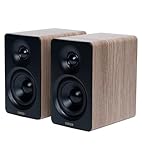
- [Compact and Delicate Design] Measuring 100mm (W) x 168mm (H) x 147 mm (D) per speaker, with the similar width and height of an often-seen mobile, the M60 is suitable for any desktop setup style
- [Powerful Output] The M60 has a total output power of 66W RMS, consisting of 18W+18W (mid-low) and15W+15W (treble), equipped with 1" silk dome tweeters and 3" long-throw aluminum diaphragm mid-low drivers, and features a high-efficiency closed-loop Class-D audio amplifier
- [High-Quality Audio Processing] Experience high-resolution audio with M series speakers, featuring full digital processing, Class-D amplification, and Hi-Res Audio certification for both wired and wireless transmission, along with precise two-way active crossover and dynamic range control provided by a built-in DSP
- [Multiple Inputs] The M60 offers versatile connectivity with Bluetooth V5.3 for wireless streaming, and both USB-C and AUX inputs for wired connections
- [Bluetooth 5.3 Connectivitity] The Bluetooth V5.3 audio receiver supports the LDAC codec, offering a maximum transmission bitrate of up to 990 kbps, enabling the streaming of high-resolution audio up to 24-bit/96kHz from Android devices running version 8.0 or later
Bluetooth 5.3
- Switch the M60 to Bluetooth mode using the speaker controls.
- Open Bluetooth settings on the phone, tablet, or computer and select the M60 from the available devices.
- Confirm pairing and start playback.
- For compatible Android 8.0-or-later devices, select LDAC in the device’s Bluetooth settings if you want the supported 24-bit/96 kHz mode.
Edifier lists both SBC and LDAC. LDAC availability depends on the source device and its software settings; it is not a guarantee that every phone or computer will offer the same codec or bitrate.
3.5mm AUX
- Connect the source’s headphone or line output to the M60’s 3.5mm AUX input.
- Select AUX mode on the speakers.
- Start with the source volume low, then raise it until the desired listening level is reached without audible clipping.
Edifier shows a 3.5mm cable and a 3.5mm-to-RCA cable in the box. The RCA adapter can connect a source with red-and-white line outputs. Do not buy replacement cables or stands unless your particular source or placement requires something different.
Sound quality and bass: what the evidence supports
Nearfield presentation
Tom’s Guide reports punchy bass and strong sound relative to the M60’s size. Those are listening impressions from that review, not universal results. In a close desktop position, the separate left and right cabinets can create a convincing stereo image that a single compact wireless speaker cannot match.
MyHiFi’s review is more measurement-focused. It finds useful small-signal bass extension around 67–70 Hz, then explains that practical bass output is more limited once available headroom is considered. The distinction is important: a speaker may produce a low-frequency tone at a modest level yet struggle to reproduce that same bass loudly and cleanly in music.
Rank #4
- [Compact and Delicate Design] Measuring 100mm (W) x 168mm (H) x 147 mm (D) per speaker, with the similar width and height of an often-seen mobile, the M60 is suitable for any desktop setup style
- [Powerful Output] The M60 has a total output power of 66W RMS, consisting of 18W+18W (mid-low) and15W+15W (treble), equipped with 1" silk dome tweeters and 3" long-throw aluminum diaphragm mid-low drivers, and features a high-efficiency closed-loop Class-D audio amplifier
- [High-Quality Audio Processing] Experience high-resolution audio with M series speakers, featuring full digital processing, Class-D amplification, and Hi-Res Audio certification for both wired and wireless transmission, along with precise two-way active crossover and dynamic range control provided by a built-in DSP
- [Multiple Inputs] The M60 offers versatile connectivity with Bluetooth V5.3 for wireless streaming, and both USB-C and AUX inputs for wired connections
- [Bluetooth 5.3 Connectivitity] The Bluetooth V5.3 audio receiver supports the LDAC codec, offering a maximum transmission bitrate of up to 990 kbps, enabling the streaming of high-resolution audio up to 24-bit/96kHz from Android devices running version 8.0 or later
What the 58 Hz specification does and does not mean
Edifier publishes a 58 Hz–40 kHz response, but gives no tolerance for the lower endpoint. Without a tolerance, the number cannot tell you whether 58 Hz is near-flat, several decibels down, or measured under a particular test condition. It also says nothing about maximum clean output.
MyHiFi’s independent result of approximately 67–70 Hz is therefore useful context, but it is not a replacement for Edifier’s specification and should not be treated as a universal laboratory standard. The two figures describe different things: a manufacturer-published range and a reviewer’s measured practical extension.
Low-volume and high-volume behavior
At arm’s length and ordinary-to-lively desktop levels, MyHiFi considers the M60 effective. As the small drivers are pushed toward high playback levels, the review reports increasing compression and distortion. That is the physical limit to keep in mind when judging the 66 W RMS rating: amplifier power does not turn a 3-inch driver into a large woofer.
Crashes, No Sound, or Screen Glitches?
Random freezes, missing sound and display glitches usually trace back to one bad driver. Find and replace yours safely.Free scan · under a minuteWindows Errors? Fix Them Before They Spread
Repair common Windows errors and clear accumulated junk for a smoother, more stable PC - no reinstall needed.Free scan · no reinstallBass-heavy electronic music, cinematic effects, and kick drums will sound more restrained than they would through a larger bookshelf speaker or a system with a subwoofer. The M60 can still sound lively and balanced at a desk; it simply is not designed to maintain deep, forceful bass across a large room.
Best Value

- Hi-Res Audio Certified – Experience superior sound with Hi-Res Audio certification, delivering a flat response across 52Hz to 40kHz for precise and accurate monitoring, music creation, or everyday listening.
- Rich Connectivity – Balanced TRS, RCA, and AUX inputs, headphone output, with Bluetooth supporting multi-point connection. RCA and AUX inputs enable simultaneous connection with more audio devices.
- Powerful Sound Output – Enjoy 18W*2 RMS output with a peak SPL of 92.5dB, enhanced by 3.5" mid-low drivers and 1" tweeters for rich, full-range sound.
- Customizable Sound Experience – Easily switch between Music, Monitor, and Custom modes to suit your needs. Fine-tune your sound precisely through the EDIFIER ConneX app, offering in-depth adjustments and personalized EQ control.
- User-Friendly Design – Equipped with an MDF cabinet to reduce distortion, making it ideal for audio production, video editing, guitar playing, and daily listening.
Inputs, missing features, and control trade-offs
- USB-C: convenient for modern computers and useful when you want a wired digital connection.
- Bluetooth 5.3: practical for phones, tablets, and wireless computer playback, with SBC and LDAC listed by Edifier.
- 3.5mm AUX: works with analog headphone or line outputs, and the included RCA cable supports a source with RCA outputs.
- No optical input: MyHiFi specifically notes that the M60 does not accept optical audio.
- No subwoofer output: the independent reviews report no dedicated subwoofer connection, so expansion with a powered subwoofer is not a built-in upgrade path.
- No included remote: Tom’s Guide lists the absence of a remote and found source-mode cycling through the touch controls inconvenient.
These omissions are not automatically faults. They matter only if your setup depends on optical output, remote operation, or future subwoofer expansion. A computer with USB-C and Bluetooth may never need optical, while a television or game console with only optical output may require a different speaker system or an additional converter.
How the M60 compares with larger alternatives
The right comparison is not simply “which speaker sounds best?” It is whether the extra size, inputs, and cost of another system solve a problem you actually have.
| Priority | Where the M60 fits | What a larger or different system may add |
|---|---|---|
| Limited desk space | Very strong fit: 100 × 168 × 147 mm per speaker and included angled stands | A traditional bookshelf pair occupies more desk or shelf area |
| Close listening | Designed for arm’s-length, ordinary-to-lively listening | Larger monitors can provide more headroom when you sit farther away |
| Deep bass | Independent measurements place useful extension around 67–70 Hz, with compression and distortion increasing at high output | Larger cabinets or a subwoofer-capable system can deliver stronger low-frequency output |
| Computer connectivity | USB-C, Bluetooth 5.3, and 3.5mm AUX cover many modern computers and phones | Some alternatives prioritize optical, balanced, or additional analog inputs |
| Subwoofer upgrade | No subwoofer output is reported by the independent reviews | A system designed for subwoofer integration offers a clearer expansion route |
| Controls | Touch controls on the speaker; no included remote | Other designs may use a remote or physical source controls |
| Desk footprint versus conventional bookshelf speakers | More space-efficient than the larger Edifier R1280DB | MyHiFi notes that the R1280DB adds optical connectivity and a more traditional bookshelf form |
MyHiFi also discusses the ADAM Audio D3V, Kali Audio LP-UNF, and ELAC Debut ConneX DCB41 as comparison candidates with different balances of output, monitor use, inputs, size, and price. Those are alternatives to investigate for a specific need, not a universal ranking. The M60’s defensible advantages are its small footprint, true stereo arrangement, USB-C input, and newer Bluetooth support.
Do these 3 things before closing this tab:
1Fix the driver behind crashes, sound loss and screen glitches2Clear out junk files and repair common Windows errors3Scan for outdated or missing drivers - takes under a minutePrice and regional availability
Prices vary by country, retailer, color, stock, and date. Edifier’s US page listed the M60 at $199.99 USD when accessed in 2026. Tom’s Guide recorded approximately $199 in the US and £159 in the UK in its review, with Amazon identified as the marketplace in that snapshot.
MyHiFi recorded US pricing of $169.99 on sale or $199.99 regular, and Canadian pricing of approximately C$199.99 on sale or C$249.99 regular, on July 16, 2026. These are dated observations, not guaranteed current prices. Check the live price and stock in your region before ordering.
Who should buy the Edifier M60?
It makes sense when you need
- A real left/right stereo pair for a crowded desk.
- Built-in amplification without a separate receiver.
- USB-C for a computer, Bluetooth for mobile devices, and AUX for an analog source.
- Clear nearfield listening at normal or moderately lively volume.
- Included stands and basic cables rather than a list of required accessories.
Choose something else when you need
- Strong sub-bass for electronic music, films, or games at high levels.
- Room-filling output or clean playback well beyond a desktop listening distance.
- An optical input for a television, console, or other optical-only source.
- A subwoofer output for a planned bass upgrade.
- A remote control for frequent source and volume changes from across the room.
Desktop setup checklist
- Measure the desk depth and confirm each speaker can sit securely without blocking the display or keyboard.
- Use the included angled stands and keep both speakers at similar ear height.
- Place the speakers at equal distances from your chair and angle them slightly toward you.
- Choose USB-C for a compatible computer, Bluetooth for wireless convenience, or AUX for an analog source.
- Start at low volume and increase gradually; distortion or obvious bass compression means the drivers are being pushed too hard.
- If you need deeper bass or louder playback, move to larger speakers rather than expecting the M60’s published wattage to overcome its small drivers.
Bottom line
The Edifier M60 is worth considering as a compact computer-desk stereo pair, especially when USB-C, Bluetooth, and a small footprint are more important than optical input or subwoofer expansion. Its 66 W RMS rating, angled stands, and separate left/right cabinets make it substantially more capable than a single desktop wireless speaker for close listening. The practical limit is bass and headroom: independent measurements put useful extension around 67–70 Hz, and compression and distortion rise at high output. Buy it for an efficient nearfield system, not as a miniature room-filling or deep-bass setup.
Quick Recap
Product prices and availability are accurate as of the date/time indicated and are subject to change. Any price and availability information displayed on Amazon at the time of purchase will apply.
The Tool Desk
Outbyte PC Repair FREEClear out junk files and repair common Windows errorsFree Scan →Outbyte Driver Updater FREEFix the driver behind crashes, sound loss and screen glitchesFind Drivers →
