
iTechGuides is reader-supported. When you buy through links on our site, we may earn an affiliate commission. As an Amazon Associate I earn from qualifying purchases. Learn more
Choose DJI Neo if you mainly want quick, close-range videos of yourself: it can launch from your palm, track a person, run automatic QuickShots and use full-coverage propeller guards. Choose DJI Mini 4K if you want to learn conventional controller flying, shoot landscapes or have more time in the air. Its three-axis mechanical gimbal, 31-minute published maximum flight time and Level 5 wind-resistance rating make it the more traditional aerial camera.
Both record 4K video at 30 frames per second and capture 12-megapixel stills. Those matching headline numbers do not make them interchangeable: their stabilization, controls, flight endurance and intended shooting distances are different.
DJI Neo and Mini 4K at a glance
| Reader priority | Better fit | Reason |
|---|---|---|
| Palm takeoff, personal clips and subject tracking | DJI Neo | Palm takeoff and landing, tracking, QuickShots, several control methods and full-coverage propeller guards. DJI states that Neo has no obstacle avoidance. |
| Landscapes and conventional aerial compositions | DJI Mini 4K | Three-axis mechanical gimbal, controller-based operation and a longer manufacturer-rated flight time. |
| Lowest carry weight | DJI Neo | Approximately 135 g, compared with 246 g standard aircraft weight for Mini 4K. |
| More time per battery | DJI Mini 4K | DJI publishes a maximum of 31 minutes, versus approximately 18 minutes for Neo or approximately 17 minutes with its guards fitted. |
The figures in this article come from DJI product, specification and support pages. Flight-time and wind ratings are manufacturer test maxima, not independent test results or guaranteed real-world performance.
What each drone is designed to do
DJI Neo: a close-range personal camera
Neo is built around getting a camera into the air with minimal setup. You can launch and land from your palm, select automated filming modes and have the aircraft follow a person for casual clips. Full-coverage propeller guards are included in Neo’s design, which is useful when filming yourself at relatively close distances or operating around family members, although guards do not make collisions harmless or a location automatically safe.
#1 Best Overall

- No Registration Needed - Under 249 g, this drone with camera for adults 4K does not require FAA registration or Remote ID for recreational use. Visit the FAA's official website for requirements related to drone registration and Remote ID. [1]
- 4K Ultra HD & 3-Axis Gimbal for Cinematic Quality Shooting - Capture stunning moments in any light—sunrises, sunsets, and night scenes with crystal-clear 4K resolution. Thanks to the 3-axis gimbal, you can achieve cinematic-quality footage with this advanced drone with camera.
- 38kph (Level 5) Wind Resistant - This drone for adults has a stable flight even in Level 5 winds. Brushless motors enhance power and allow takeoff at altitudes up to 4,000 meters.
- Due to platform compatibility issue, the DJI Fly app has been removed from Google Play. To ensure a better product usage experience, please log in to the DJI official website to download the latest version of DJI Fly.
- Uninterrupted Creation with Extended Battery Life - There are three sets available for you to choose from: 1-battery set (31-min), 2-battery set (62-min), or 3-battery set (93-min). [3] Say goodbye to battery anxiety and let nothing hold you back.
DJI also lists multiple ways to control Neo. That flexibility lets a beginner choose a low-friction method for a short clip rather than always setting up a conventional remote controller. The trade-off is that Neo’s published endurance and wind rating are lower than Mini 4K’s, and DJI’s product FAQ explicitly says Neo does not support obstacle avoidance.
DJI Mini 4K: a conventional camera drone
Mini 4K follows the familiar camera-drone pattern: a dedicated remote controller, one-tap takeoff and landing, hovering and return-to-home functions. It is the better starting point if your goal is to learn aircraft positioning, controlled camera moves and landscape framing rather than simply record yourself.
The aircraft’s three-axis mechanical gimbal is designed to keep the camera level as the drone moves and turns. That hardware is a substantial distinction from Neo’s single-axis mechanical tilt gimbal with electronic stabilization options. Mini 4K therefore suits wide establishing shots, smooth reveals and other footage where horizon behavior and movement continuity matter.
Free tools Windows power users keep installed
One-click scans. No signup required.
Camera quality: equal resolution, different footage
Shared recording and still-image figures
DJI’s comparison material lists 4K/30fps video and 12MP still photos for both models. Resolution tells you the size of the image, not how stable or cinematic it will look. Wind, the aircraft’s flight path, the distance to the subject and the stabilization system all affect the finished clip.
Rank #2

- No Registration Needed - Under 249 g, this drone with camera for adults 4K does not require FAA registration or Remote ID for recreational use. Visit the FAA's official website for requirements related to drone registration and Remote ID. [1]
- 4K Ultra HD & 3-Axis Gimbal for Cinematic Quality Shooting - Capture stunning moments in any light—sunrises, sunsets, and night scenes with crystal-clear 4K resolution. Thanks to the 3-axis gimbal, you can achieve cinematic-quality footage with this advanced drone with camera.
- 38kph (Level 5) Wind Resistant - This drone for adults has a stable flight even in Level 5 winds. Brushless motors enhance power and allow takeoff at altitudes up to 4,000 meters.
- 10km Max HD Video Transmission-up to 10 km (32,800 feet) [2] of HD video transmission and has excellent anti-interference capabilities, giving you the ability to freely explore vast landscapes and see clearer.
- Due to platform compatibility issue, the DJI Fly app has been removed from Google Play. To ensure a better product usage experience, please log in to the DJI official website to download the latest version of DJI Fly.
Mini 4K’s three-axis gimbal
Mini 4K uses a three-axis mechanical gimbal, the more capable arrangement for conventional aerial photography. Mechanical correction can counter roll, pitch and yaw changes while the aircraft banks or rotates, helping a landscape remain composed during a planned movement. It does not remove the need for smooth stick input, sensible wind conditions or a safe flight path, but it gives the camera a stronger foundation for those techniques.
Neo’s single-axis gimbal and electronic modes
Neo has a single-axis mechanical tilt gimbal. DJI’s Neo specifications also list RockSteady and HorizonBalancing electronic stabilization options, with mode and aspect-ratio qualifications. Electronic stabilization can be useful for quick personal clips, but it is not the same mechanical system as Mini 4K’s three-axis gimbal. Expect Neo to be strongest when the subject and camera distance are the priority, not when you need long, sweeping, perfectly level landscape moves.
Flight time, batteries and wind
Published maximums
| Specification | DJI Neo | DJI Mini 4K |
|---|---|---|
| Maximum flight time | Approximately 18 minutes | Up to 31 minutes |
| With propeller guards | Approximately 17 minutes | Not stated; the cited Mini 4K pages do not give a guarded-flight figure |
| Wind resistance | Level 4, up to 8 m/s | Level 5, up to 38 kph |
DJI says these numbers were measured under specified test conditions. Temperature, wind, flight speed, maneuvers, payload, battery condition, firmware and the use of guards can change the result. Treat 18 and 31 minutes as ceiling figures for planning, not as the amount of usable footage you are guaranteed to obtain. You should land with a reserve rather than deliberately exhaust a battery.
What’s actually slowing this PC down?
Pick the symptom - the matching free tool is one click away.
Planning a flying day
Mini 4K’s longer rating is valuable when you need time to travel to a viewpoint, compose several takes and return safely. Neo’s shorter session is less restrictive for a single tracking clip, but a day of repeated takes may require more charged batteries and more frequent pauses.
Rank #3

- No Registration Needed - Under 249 g, this drone with camera for adults 4K does not require FAA registration or Remote ID for recreational use. Visit the FAA's official website for requirements related to drone registration and Remote ID. [1]
- 4K Ultra HD & 3-Axis Gimbal for Cinematic Quality Shooting - Capture stunning moments in any light—sunrises, sunsets, and night scenes with crystal-clear 4K resolution. Thanks to the 3-axis gimbal, you can achieve cinematic-quality footage with this advanced drone with camera.
- 38kph (Level 5) Wind Resistant - This drone for adults has a stable flight even in Level 5 winds. Brushless motors enhance power and allow takeoff at altitudes up to 4,000 meters.
- 10km Max HD Video Transmission-up to 10 km (32,800 feet) [2] of HD video transmission and has excellent anti-interference capabilities, giving you the ability to freely explore vast landscapes and see clearer.
- Due to platform compatibility issue, the DJI Fly app has been removed from Google Play. To ensure a better product usage experience, please log in to the DJI official website to download the latest version of DJI Fly.
DJI’s US Mini 4K Fly More Combo page lists two additional batteries and a two-way charging hub in that bundle. Bundle contents are regional and can change, so confirm the contents shown for the country and package you are buying. Neo’s support material lists compatible batteries and charging accessories; verify model compatibility before ordering a spare.
Controls and the beginner learning curve
When Neo’s automation helps
Neo’s palm takeoff and landing remove a controller setup step. Person tracking and QuickShots can produce a usable clip while you concentrate on where you are walking, cycling or standing. This is particularly practical for solo creators who would otherwise need another person to pilot.
Automation is not a substitute for site assessment. You still need room for the aircraft to climb, turn and stop, and you must keep it within a safe visual line of sight. A tracked subject can move toward trees, wires, people or buildings faster than a beginner expects.
When Mini 4K’s controller is the advantage
The Mini 4K’s conventional remote controller gives you direct, repeatable input for altitude, direction, speed and camera movement. That makes it a better teaching tool if you want to understand how a drone responds to stick movements and how to reproduce a shot later. One-tap takeoff and landing, hovering and return-to-home reduce workload, but they do not remove the need to monitor the aircraft.
Rank #4
- No Registration Needed - Under 249 g, this drone with camera for adults 4K does not require FAA registration or Remote ID for recreational use. Visit the FAA's official website for requirements related to drone registration and Remote ID. [1]
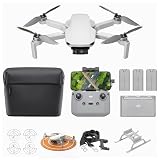
- Includes DJI Mini 4K, 3 batteries, a two-way charging hub, shoulder bag, and everything else you need for extended flight. Two extra batteries.Lanyard, Landing Pad, Landing Gear, Propeller Guard
- 4K Ultra HD & 3-Axis Gimbal for Cinematic Quality Shooting - Capture stunning moments in any light—sunrises, sunsets, and night scenes with crystal-clear 4K resolution. Thanks to the 3-axis gimbal, you can achieve cinematic-quality footage with this advanced drone with camera.
- 38kph (Level 5) Wind Resistant - This drone for adults has a stable flight even in Level 5 winds. Brushless motors enhance power and allow takeoff at altitudes up to 4,000 meters.
- 10km Max HD Video Transmission-up to 10 km (32,800 feet) [2] of HD video transmission and has excellent anti-interference capabilities, giving you the ability to freely explore vast landscapes and see clearer.
Portability, weight and local rules
| Model | Published weight | What the figure means |
|---|---|---|
| DJI Neo | Approximately 135 g | DJI’s listed aircraft weight; the support page does not present it as a promise that every configured flight setup weighs exactly the same. |
| DJI Mini 4K | 246 g standard aircraft weight | DJI defines this figure as including the battery, propellers and microSD card. |
Neo is easier to carry for spontaneous clips. Mini 4K remains below 249 g on DJI’s stated standard-weight definition. DJI says under-249-g products avoid registration in most countries and regions, but that is not a universal exemption: registration, pilot competency, operating zones, identification and privacy rules depend on where you fly. Check the aviation authority and local restrictions for your exact location before the first flight.
Weight does not determine whether a flight is safe. Line-of-sight judgment, weather, takeoff and landing surfaces, separation from people and respect for privacy matter for both models.
Obstacle avoidance and return-to-home: what they do not mean
Neo has no obstacle avoidance
DJI’s Neo FAQ answers the question directly: “No. To ensure flight safety, fly in an open area or within a visual line of sight.” Propeller guards protect the rotating blades from some incidental contact; they are not sensors and cannot detect a tree, cable, wall or person. Do not describe Neo as collision-proof or safe to operate in confined spaces simply because guards are fitted.
The Tool Desk
Outbyte Driver Updater FREEScan for outdated or missing drivers - takes under a minuteDriver Scan →Outbyte PC Repair FREEClear out junk files and repair common Windows errorsFree Scan →Return-to-home is a recovery function, not a collision guarantee
DJI’s comparison material identifies return-to-home functionality for both models. RTH can help an aircraft head toward its recorded home point when triggered, but it does not guarantee a clear route, prevent an impact or recover a drone that has lost an appropriate position reference. Set a sensible home point, maintain visual awareness and leave a clear margin around obstacles.
Best Value

- No Registration Needed - Under 249 g, this drone with camera for adults 4K does not require FAA registration or Remote ID for recreational use. Visit the FAA's official website for requirements related to drone registration and Remote ID. [1]
- 4K Ultra HD & 3-Axis Gimbal for Cinematic Quality Shooting - Capture stunning moments in any light—sunrises, sunsets, and night scenes with crystal-clear 4K resolution. Thanks to the 3-axis gimbal, you can achieve cinematic-quality footage with this advanced drone with camera.
- 38kph (Level 5) Wind Resistant - This drone for adults has a stable flight even in Level 5 winds. Brushless motors enhance power and allow takeoff at altitudes up to 4,000 meters.
- Due to platform compatibility issue, the DJI Fly app has been removed from Google Play. To ensure a better product usage experience, please log in to the DJI official website to download the latest version of DJI Fly.
- Uninterrupted Creation with Extended Battery Life :31-minute extended battery life.Say goodbye to battery anxiety and let nothing hold you back.
The cited Mini 4K material does not establish an obstacle-avoidance system. Treat that feature as not stated rather than assuming the aircraft will detect and bypass hazards.
Independent reader supportYour contribution helps us test, update, and keep practical guides available for everyone.Which drone fits common beginner projects?
Choose Neo for personal and family clips
- You want to film walking, running, cycling or outdoor activities without recruiting a pilot.
- You value palm launch and automatic modes more than long sessions or advanced camera movement.
- Your shots will stay close to you in open, controllable areas.
- You are willing to plan around approximately 18-minute maximum flights, or approximately 17 minutes with guards.
Choose Mini 4K for landscapes and learning to pilot
- You want broad scenery, conventional aerial perspectives or repeatable camera moves.
- You prefer a dedicated controller and direct manual input.
- You expect the longer 31-minute published maximum to matter during a session.
- You often fly in conditions where DJI’s stated Level 5 wind resistance is more useful than Neo’s Level 4 rating.
Consider the filming distance before the camera specification
A person-focused clip can look successful even when the camera is not moving through an elaborate path; the subject’s presence and the timing of the automated shot carry much of the result. A landscape shot exposes horizon drift, vibration and abrupt changes in speed. That is why Mini 4K’s gimbal advantage can matter more than the shared 4K label for scenic work.
A practical buying decision in five steps
- Name the first three shots you will make. If all three involve you as the subject at close range, start with Neo. If they involve a horizon, a building exterior or a moving aerial reveal, start with Mini 4K.
- Choose your control style. Select Neo when palm launch and automated options remove the biggest barrier. Select Mini 4K when learning a remote controller is part of the goal.
- Set an endurance requirement. For a single short take, Neo’s approximately 18-minute maximum may be adequate. For several compositions in one outing, Mini 4K’s 31-minute maximum gives more planning margin, subject to real conditions.
- Check your normal weather. Compare DJI’s Level 4, up-to-8-m/s Neo rating with Mini 4K’s Level 5, up-to-38-kph rating. Neither rating means you should fly in gusts that make control or visibility uncertain.
- Verify rules and the exact package. Confirm local registration and operating requirements, then check whether the regional listing includes the controller, spare batteries, charging hub or guards you need.
First-flight checklist for either model
- Read the current aircraft and battery instructions for your model and region.
- Charge the aircraft, controller or control device and any spare batteries.
- Choose an open takeoff area away from people, trees, wires, roads and restricted locations.
- Confirm the home point and understand how return-to-home behaves before launching.
- Keep the aircraft within visual line of sight throughout the flight.
- Start with a short hover, observe drift and wind, then practice controlled turns before attempting tracking or cinematic moves.
- Leave battery reserve for the trip back and landing; do not plan to use the published maximum as usable airtime.
- After landing, inspect propellers, guards and the gimbal for damage before the next flight.
Specifications side by side
| Feature | DJI Neo | DJI Mini 4K |
|---|---|---|
| Primary concept | Palm-sized personal camera for close-range, subject-focused filming | Conventional controller-flown camera drone for aerial photography |
| Video | 4K at 30fps | 4K at 30fps |
| Still photos | Up to 12MP | 12MP |
| Mechanical stabilization | Single-axis tilt gimbal | Three-axis mechanical gimbal |
| Electronic stabilization | RockSteady and HorizonBalancing options, subject to DJI’s mode and aspect-ratio qualifications | Not stated in the cited comparison pages |
| Maximum flight time | Approximately 18 minutes; approximately 17 minutes with propeller guards | 31 minutes |
| Wind rating | Level 4, up to 8 m/s | Level 5, up to 38 kph |
| Weight | Approximately 135 g | 246 g standard aircraft weight, including battery, propellers and microSD card under DJI’s definition |
| Takeoff and landing | Palm takeoff and landing | One-tap takeoff and landing |
| Tracking and automated shots | Person tracking and QuickShots | Not stated in the cited Mini 4K material |
| Obstacle avoidance | No, according to DJI’s FAQ | Not stated in the cited product material |
| Return-to-home | Supported according to DJI’s comparison material | Supported according to DJI’s comparison material |
Bottom line for a first purchase
Buy DJI Neo when the drone’s job is to get a short, personal clip with as little piloting friction as possible. Its palm launch, tracking, QuickShots and guards directly serve that use, provided you fly in an open area and accept the shorter endurance, lower wind rating and lack of obstacle avoidance.
Recommended Free Tools
Buy DJI Mini 4K when you want a small conventional aerial camera to practice with and use for landscapes. The three-axis gimbal, controller workflow, 31-minute manufacturer maximum and Level 5 wind-resistance claim give it more headroom for traditional aerial work. Neither model is the universal beginner winner; the right choice follows the subject, distance and control style you will actually use.
Quick Recap
Product prices and availability are accurate as of the date/time indicated and are subject to change. Any price and availability information displayed on Amazon at the time of purchase will apply.

