
iTechGuides is reader-supported. When you buy through links on our site, we may earn an affiliate commission. As an Amazon Associate I earn from qualifying purchases. Learn more
Direct-to-chip cooling loops can drift from their design basis through coolant changes, trapped air, inadequate stainless-steel passivation, or pressure conditions that were not fully accounted for. A CDU typically separates the facility water system from the technology cooling system that serves IT equipment, so the two sides need their own specifications. For the IT-side loop, use the equipment maker’s requirements and the project design—not a generic water recipe or pressure limit.
Why the CDU boundary matters
A common liquid-cooling arrangement sends facility chilled water to a heat exchanger in a coolant distribution unit (CDU). The CDU separates that facility water system (FWS) from the technology cooling system (TCS), the secondary loop that carries coolant to IT equipment and its cold plates.
The TCS may include supply and return manifolds, server cooling loops, hoses and tubes, valves, quick disconnects, sensors, and controllers. A CDU commonly includes pumps, valves, temperature, pressure, and flow sensors, and operating software. The precise arrangement varies by system.
| System | What it serves | Why its water requirements differ |
|---|---|---|
| Facility water system (FWS) | Building-side cooling infrastructure and the CDU heat exchanger | Its water-quality specification is for the facility side; it is not automatically suitable for the IT-side passages. |
| Technology cooling system (TCS) | CDU secondary piping and IT equipment, including cold plates | Small, sensitive passages make the loop more vulnerable to corrosion, scale, fouling, particulates, and microbial issues. |
ASHRAE’s 2019 paper Water-Cooled Servers: Common Designs, Components, and Processes warns against applying the wrong guidance table to the IT side. The practical rule is to apply facility-water guidance to the FWS and technology-cooling guidance to the TCS. The correct water-quality targets and treatment strategy depend on the applicable ASHRAE edition, site water, system materials, and IT manufacturer requirements; there is no single specification established here for every installation.
#1 Best Overall

- Includes: 1x iCUE LINK XC7 RGB ELITE CPU Block, 1x iCUE LINK XD6 RGB Pump Reservoir Combo, 3x iCUE LINK RX120 RGB fans, 1x XR5 360mm Radiator, 1x iCUE LINK System Hub, XT Hardline Tubing & Fittings
- Gorgeous Hardline Cooling, Made Simple – This complete Hydro X Series custom cooling kit delivers the stunning look that only hardline loops can achieve, with iCUE LINK making the build simpler than ever.
- Dynamic RGB Lighting - Individually addressable RGB LEDs integrated into the CPU water block, pump/reservoir, and cooling fans give your PC a striking look to make it stand out from the crowd.
- Low-Noise Custom Cooling - CORSAIR iCUE software lets you adjust fan and pump settings, monitor temperatures, customize RGB lighting, and synchronize it with all iCUE-compatible products in your setup.
Four reported ways a TCS can depart from its design basis
A StorageReview report dated August 30, 2026, describing ASHRAE TC 9.9’s 2026 TCS coolant-integrity bulletin, identifies four risk areas. The committee’s publication list confirms that the bulletin exists, but the detailed points below are attributed to StorageReview’s account rather than presented as independently verified bulletin text.
1. Coolant formulation changes
Coolant properties—including viscosity, density, specific heat, and thermal conductivity—affect how the system moves and transfers heat. A change in formulation or concentration can therefore alter pressure drop, shift a pump’s operating point, affect heat-exchanger performance, and complicate CDU control. Mixing or diluting fluids without checking compatibility and system effects can move the loop away from the assumptions used to design it.
StorageReview says the bulletin advises meeting applicable ASHRAE minimum water-quality guidance or the IT manufacturer’s specification, and calls for technical review before mixing coolants when the effects are uncertain. Treat any nominal blend mentioned in a report as an example, not a recipe for another system: the acceptable fluid depends on the equipment and project design.
Do these 3 things before closing this tab:
1Repair Windows errors before they cause bigger problems2Fix the driver behind crashes, sound loss and screen glitches3Clear out junk files and repair common Windows errorsRank #2

- CONTACT FRAME FOR INTEL LGA1851 | LGA1700: Optimized contact pressure distribution for longer CPU life and better heat dissipation
- ARCTIC's P12 PRO FAN: More power at any speed - more powerful and quieter than the P12, especially at low speeds. Higher maximum speed for optimal cooling performance under high load
- NATIVE OFFSET MOUNTING FOR INTEL AND AMD: Shifting the cold plate center towards the CPU hotspot ensures more efficient heat transfer
- INTEGRATED VRM FAN: PWM-controlled fan that lowers the temperature of the voltage converters and thus ensures reliable performance
- INTEGRATED CABLE MANAGEMENT: The PWM cables of the radiator fans are integrated in the sheathing of the hoses so that only a single visible cable is connected to the motherboard
2. Air remains in the loop or enters later
Entrained air can impair heat transfer, contribute to pump cavitation, accelerate corrosion, and make commissioning take longer. Air-related effects may not be obvious immediately: StorageReview reports that degassing can be more effective at elevated temperatures that may only occur under substantial load, so symptoms can emerge after startup as the loop reaches steady operating temperatures.
Air management depends on system geometry and operation, including separator placement and the location of vents and high points. The report discusses these design considerations, but does not establish a universal installation layout or venting procedure. Confirm the approach for the actual loop with its designer and equipment documentation rather than applying a generic arrangement.
3. Fabricated stainless steel is not adequately passivated
Welding, grinding, and field fabrication can damage the protective surface film on stainless steel. According to StorageReview’s account, if cleaning and passivation are inadequate, free iron can enter the coolant and contribute to contamination that fouls cold-plate microchannels. A component’s material label alone does not establish that its fabricated surface is ready for service.
Rank #3
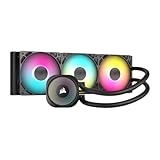
- Simple, High-Performance All-in-One CPU Cooling: Renowned CORSAIR engineering delivers strong, low-noise cooling that helps your CPU reach its full potential
- Efficient, Low-Noise Pump: Keeps your coolant circulating at a high flow rate while generating a whisper-quiet 20 dBA
- Convex Cold Plate with Pre-Applied Thermal Paste: The slightly convex shape ensures maximum contact with your CPU’s integrated heat spreader, with thermal paste applied in an optimised pattern to speed up installation
- RS120 ARGB Fans: RS ARGB fans create strong airflow and high static pressure, with easy ARGB control via a compatible motherboard. CORSAIR AirGuide technology and Magnetic Dome bearings ensure great cooling performance and low noise
- Easy Daisy-Chained Connections: Reduce the wiring in your system by daisy-chaining your RS ARGB fans and connecting them to just one 4-pin PWM fan header and one +5V ARGB header
Include fabricated and field-worked components in the project’s material preparation and acceptance plan. The report emphasizes the risk of a single unpassivated installed component, but does not provide a procedure that should be treated as universal; the applicable method and verification belong to the project specification and qualified fabricator or water-treatment specialists.
The Tool Desk
Outbyte PC Repair FREEClear out junk files and repair common Windows errorsFree Scan →Outbyte Driver Updater FREEScan for outdated or missing drivers - takes under a minuteDriver Scan →4. Pressure limits overlook an operating state
A pressure design must account for more than the steady-state reading. StorageReview says the bulletin recommends modeling the pressure cascade across normal operation, filling and flushing, static height, relief settings, expansion-tank precharge, and connection or disconnection transients. A design or component selection that considers only one operating condition may miss pressure exposure elsewhere in the system.
Pressure-test and relief-valve decisions also depend on the system and applicable standards. The report points to the maximum working pressure published by the IT equipment manufacturer; it does not establish a blanket pressure setting for all TCS installations. Have the project engineer reconcile equipment limits, component ratings, transient conditions, and code requirements.
Rank #4

- CONTACT FRAME FOR INTEL LGA1851 | LGA1700: Optimized contact pressure distribution for longer CPU life and better heat dissipation
- ARCTIC's P12 PRO FAN: More power at any speed - more powerful and quieter than the P12, especially at low speeds. Higher maximum speed for optimal cooling performance under high load
- NATIVE OFFSET MOUNTING FOR INTEL AND AMD: Shifting the cold plate center towards the CPU hotspot ensures more efficient heat transfer
- INTEGRATED VRM FAN: PWM-controlled fan that lowers the temperature of the voltage converters and thus ensures reliable performance
- INTEGRATED CABLE MANAGEMENT: The PWM cables of the radiator fans are integrated in the sheathing of the hoses so that only a single visible cable is connected to the motherboard
How to keep the installed loop aligned with its design
The reported failure paths point to a practical control: preserve the design basis through procurement, commissioning, and operation, and verify changes before they reach the IT equipment.
- Document the fluid specification. Record the approved coolant and concentration, relevant quality limits, compatible materials, and the equipment requirements in the project and turnover documents.
- Verify fluid condition at meaningful points. The StorageReview account describes laboratory checks at initial fill, after significant makeup-fluid additions, and periodically. Set the actual sampling method and interval for the system rather than treating those checkpoints as a universal schedule.
- Check new fluid and additions before use. Confirm they meet the approved specification and are compatible with the existing coolant; do not assume that two fluids are safe to mix because each is acceptable in a different system.
- Confirm uniformity after filling. The report describes checking blend uniformity after vacuum filling. Use the commissioning plan to define the appropriate verification and acceptance criteria.
- Track air management through commissioning and loaded operation. Assess air removal and system behavior under the operating conditions specified by the project. A loop that appears stable at low load may not yet show effects that become apparent at higher temperatures.
- Close out fabrication and pressure reviews. Confirm that fabrication and surface treatment meet the project requirements, and review pressure conditions across operating, service, and connection states before approving components or procedures.
ASHRAE’s 2019 water-cooled-server paper also notes that installation of new IT equipment can introduce contaminants, that larger systems can bring more contamination risk and stagnant branches, and that TCS filtration can help mitigate particulates introduced during service or commissioning. It recommends site-specific water treatment and monitoring coordinated with water-treatment specialists. Filtration is one control, not a substitute for the right fluid specification or clean installation practices.
Keep cooling performance and equipment requirements in view
Coolant integrity is only part of a reliable liquid-cooling design. ASHRAE Handbook chapter 20 (2023) describes dew-point control as an important CDU function: if liquid temperature and room conditions are not properly controlled, condensation can occur. It also emphasizes design redundancy for liquid-cooling resilience. These system-level requirements should be considered alongside the four reported failure paths, not used to replace the IT equipment maker’s limits or the project’s engineering and code requirements.
For final fluid, pressure, passivation, and service decisions, follow the applicable equipment documentation, system design, and standards. The 2026 bulletin’s detailed recommendations are described here through StorageReview’s August 30, 2026 report; the available committee listing confirms the publication but is not a substitute for checking the bulletin itself.
Quick Recap
Product prices and availability are accurate as of the date/time indicated and are subject to change. Any price and availability information displayed on Amazon at the time of purchase will apply.

