
The Tool Desk
Outbyte PC Repair FREEClear out junk files and repair common Windows errorsFree Scan →Outbyte Driver Updater FREEScan for outdated or missing drivers - takes under a minuteDriver Scan →iTechGuides is reader-supported. When you buy through links on our site, we may earn an affiliate commission. As an Amazon Associate I earn from qualifying purchases. Learn more
An AI digital human is not simply a chatbot with a face. It is an interactive service that connects a human-like visual or other embodied representation with conversation, speech, nonverbal behavior, and the system behind the interaction. That changes the design task: teams must coordinate the whole service, then test whether embodiment helps people complete their work.
What is an AI digital human?
In this article, an AI digital human is a human-like virtual agent whose conversational capability is connected to an embodied representation and nonverbal behaviors. Depending on the product, those elements may include a rendered character, dialogue and emotion processing, speech, facial or body animation, and controls for how the interaction unfolds.
The term covers different kinds of experiences. An interactive digital human responds to a person in a two-way service. A character used in a prerecorded video or broadcast may look similar but is not necessarily an interactive conversational system. ITU-T Recommendation F.748.30 describes roles, communication types, and a concept model for digital-human communication services: ITU-T F.748.30. Its contents include dialogue and emotion processing, selection or creation of a digital human, speech, and animation: F.748.30 table of contents.
Digital human, avatar, virtual human, or chatbot?
- Chatbot: A conversational system that may be text-only or voice-based and may have no visible character.
- Avatar: A visual identity or representation; the label alone does not imply that it can converse.
- Virtual human: A broader term for a computer-generated human-like character, which may or may not be connected to a live service.
- Digital human: Here, an embodied representation linked to an interactive conversational service.
How is a digital human different from a chatbot?
A conventional chatbot is often designed around the exchange of messages: what the user says, how the system responds, and what happens next. A digital human adds more coordinated parts to that exchange. The system may need to select a response, produce speech, animate a face or body, and keep the character’s timing and behavior consistent with the conversation.
#1 Best Overall

- 【Humanoid Robot with ESP32】 Powered by ESP32 and 17 intelligent servos, Tonybot smart humanoid robot delivers smooth, dynamic performance. Use the app to easily control it for walking, dancing, kicking, and more. Tonybot can stand up automatically, which is great for playing football and performing gymnastics.
- 【Multimodal Large AI Models】Powered by an AI model module that combines language, voice, and vision models, Tonybot Ultimate Kit unlocks advanced embodied AI functions such as natural conversation and scene understanding. (Ultimate Kit Only)
- 【AI Vision & Voice Interaction】Equipped with an ESP32-S3 vision module and voice interaction module, Tonybot AI robot enables offline face recognition, target tracking, visual line following, voice control, and more. Customize commands and train it to be your AI assistant.
- 【Expandable AI Development with Sensors】 Tonybot robot kit comes with an ultrasonic sensor, IMU sensor, buzzer, and supports modules like dot matrix display, fan, temp/humidity sensors, and WiFi for endless AI-driven development.
- 【3 Programming Options & Comprehensive Tutorials】Tonybot smart AI robot supports Arduino, Python, and Scratch programming, with open-source low-level code and step-by-step tutorials covering everything from beginner learning to advanced humanoid robot development.
ITU’s digital-human systems work spans assets, multimodal AI, rendering, platform interfaces, and evaluation. The ITU also identifies image, speech, and animation modules as part of the system landscape: ITU Digital Human Systems. F.748.30 similarly frames dialogue and emotion processing, selection or creation, speech, and animation as components of a communication service.
That broader scope makes coordination a product requirement. Dialogue, voice, response latency, facial movement, gestures, and turn-taking should be designed as one experience rather than treated as independent features. A technically convincing character can still make a service harder to use if its speech and movement feel out of sync, its response takes too long, or users cannot tell how to proceed.
Rank #2

- 【Next-Generation Robotic Companion: Meet the Unitree Go2 Robotic Dog】 The Unitree Go2 Pro is a powerful and intelligent quadruped robot designed for tech enthusiasts and advanced users alike. It measures 27.6"x12.2"x15.7" and weighs just 33 lbs, yet carries up to 17.8 lbs and reaches speeds of 3.5 m/s. Its advanced joint mobility allows it to climb 40° slopes and overcome 6.3" obstacles. An 8000 mAh battery provides 1–2 hours of operation.
- 【Intelligent Navigation with 3D LiDAR & Obstacle Avoidance】 Featuring ultra-wide 3D LiDAR with 360°x96° perception, the Go2 Pro detects obstacles as close as 2 inches for reliable all-terrain navigation and real-time avoidance. Note: Obstacle avoidance must be manually enabled.
- 【High-Definition Vision & Seamless App Integration】 A front HD camera streams 1280x720 video to the app. Control the robot, view real-time data, use graphical programming, and update firmware via OTA. Connectivity includes WiFi6 and Bluetooth 5.2. *Note: Voice/GPT features are Pro/X-exclusive; 4G modules are unavailable in North America.*
- 【Advanced Joint & Cooling Design for Enhanced Durability】 Joints provide 45 N·m peak torque for dynamic, precise movement. Internal wiring reduces wear, and an integrated knee heat pipe improves thermal management for stable extended use. Warning: Not waterproof. Avoid rain or water.
- 【Complete Package & Important Guidelines】 Each Go2 Pro comes with a handheld remote control and a 33.6V/3.5A standard charger. Please note that this product is non-returnable and non-exchangeable once activated, except for quality-related issues. We strongly recommend reviewing all specifications before purchase. Warranty: Go2 Air – 6 months; Go2 Pro/Go2 X – 12 months. The warranty does not cover damage caused by modifications, disassembly, or misuse. Users are advised to operate the robot responsibly and in compliance with local regulations.
When should a product use a digital human?
Use an embodied interface only when it serves the task and the people doing it. A visible agent may be useful when the service benefits from spoken interaction, visible demonstrations, or a human-like presentation. It may add friction when users need to scan information quickly, work in a noisy or private setting, use assistive technology, or complete a task more easily through text or conventional controls.
Crashes, No Sound, or Screen Glitches?
Random freezes, missing sound and display glitches usually trace back to one bad driver. Find and replace yours safely.Free scan · under a minuteWindows Errors? Fix Them Before They Spread
Repair common Windows errors and clear accumulated junk for a smoother, more stable PC - no reinstall needed.Free scan · no reinstallThere is no general rule that a realistic face improves trust, engagement, conversion, empathy, or task performance. The standards and design sources describe system scope and evaluation approaches; they do not establish that an embodied interface is preferable for every task. Virtual-human design research has long treated effective interaction, constraints on form and function, and validation as central design concerns: Dagstuhl proceedings on interactive experiences for virtual humans.
Rank #3
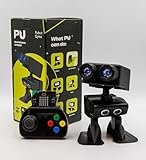
- Interactive Bipedal Robot with Self-Balancing Motion: Engineered with smooth self-balancing control to walk, spin, moonwalk, and even play soccer. Features integrated expressive LED eyes, custom light effects, a night-light mode, and audio capabilities to talk, sing, and sync dance routines to music.
- Smart Obstacle Avoidance & Multi-Robot Interaction: Equipped with intelligent autonomous navigation sensors to glide smoothly around barriers in autopilot mode. Built to detect, communicate, and interact with other Robot PU units for collaborative robotics games and classroom group challenges.
- STRUCTURED STEM CURRICULUM & 70+ PROJECTS: Designed alongside the official companion Kindle textbook, “Coding Adventures with Robot PU” by Coach Hao (Search Amazon ASIN: B0HJ52X3F6). Includes progressive, self-paced lessons crafted specifically for homeschoolers, robotics clubs, and aspiring young engineers. Students explore 70+ comprehensive, step-by-step project walk-throughs and video lessons covering block coding, sensor interaction, and bipedal mechanics—no prior programming experience required.
- OPEN-SOURCE CODING FROM BLOCKS TO PYTHON: Powered by Microsoft MakeCode with open-source project libraries on GitHub. Learners seamlessly transition through three programming tiers: visual drag-and-drop block coding, JavaScript, and full Python script control for advanced robotics algorithms.
- EXPANDABLE MAKER ARCHITECTURE & FUTURE-READY AI: Built for curious makers and creative problem solvers who love hands-on experimenting. Customize PU’s chassis with snap-on building brick mounts, open-source 3D-printable armor, and rich I/O expansion headers for external sensors, servo brackets, and breadboards. Designed for seamless integration with next-generation smart accessories, including the upcoming CogniCap AI vision and voice module (add-ons sold separately). Ideal for open-ended tinkering, maker faires, and advanced DIY robotics showcases.
Before committing to an embodiment, compare it with a simpler option for the same user journey. A text or voice interface may be easier to maintain and may better fit a task where the character contributes no necessary information or interaction capability.
What should teams evaluate?
Evaluate the complete service, not just the character’s appearance. The following questions turn the technical and human-centered concerns into concrete design checks.
Rank #4

- Three models, one lightweight platform R1 Air (20 DOF, monocular camera), R1 (26 DOF, binocular camera, head+waist joints), and R1 Edu (26 DOF + SDK/API for programming). All weigh ~29kg / 123cm – one person can lift, move, and fit into a car trunk.
- Easy setup – no coding required for basic use Unbox, power on, and start. Manual teaching feature: physically pose the robot, and it replays the motion. Graphical drag-and-drop programming also available.
- More DOF = more expressive movement 26‑DOF models (R1 / R1 Edu) add head and waist articulation for smoother dance and running. For safety reasons, only basic actions are currently available; advanced movements are not yet released.
- Voice interaction + two color options Responds to English voice commands (music, conversation, photo). Choose Gold or Blue‑White with automotive‑grade gloss paint.
- R1 Edu adds open development SDK/API access for custom programming, simulation platforms, and future Unistore content downloads. Adult use only – under 18 requires adult supervision.
| Design area | Questions to test | What the evidence establishes |
|---|---|---|
| Task fit | Does the embodied agent help people complete the task? What should happen when it cannot answer? | Virtual-human design research emphasizes effective interaction and constraints on form and function; it does not offer a universal task-fit rule. Dagstuhl proceedings |
| Modality and access | Can people complete the task using an appropriate combination of text, speech, video, animation, and controls? Can they avoid relying on one sensory or input channel? | ITU’s systems work covers image, speech, and animation, but each product still requires its own accessibility validation. ITU Digital Human Systems |
| Timing and presence | Are speech, lip movement, gestures, and response timing coherent for this use case? | ITU’s 2022 recommendation for non-interactive 2D real-person digital humans addresses action fluency, audio/video synchronization, and character fidelity. That evaluation scope is not a complete user-experience standard. ITU Digital Human Systems |
| Functional quality | Does the service perform reliably under the expected operating conditions and traffic? | IEEE 3079.3-2023 provides a digital-human quality-evaluation framework. IEEE 3079.3-2023 |
| User and workflow impact | Can users understand the interaction, recover from errors, and complete the task? Does the service fit staff workflows? | Digital.gov recommends involving participants and stakeholders in discovery and considering how proposed changes affect their work. Digital.gov: Design for humans |
| Context and data | What contextual information is necessary? Who controls it, how is it used, and how long is it retained? | A 2026 conceptual preprint proposes context awareness, proactivity, cross-device interaction, personalization, privacy, and data governance as design dimensions. These are proposed directions, not evidence of universal benefits. Chen et al., “Designing Digital Humans with Ambient Intelligence” |
| Escalation | Can users recognize the system’s limits and move to another channel or a person when needed? | The cited standards do not prescribe one handoff pattern. Validate an escalation path in the service’s actual context. |
How should teams test the experience?
Bring affected users and stakeholders into discovery, then test the proposed interaction in the workflow where it will actually be used. Digital.gov’s human-centered design guidance calls for considering participants’ needs and the effects of a change on their work: Principle 3: Design for humans.
- Define the task and fallback. Write down what users need to accomplish, what the agent can and cannot do, and where a person or another channel takes over.
- Choose the minimum useful embodiment. Decide whether the task needs a character, speech, animation, or only a conversational interface. Avoid adding visual realism without a user-facing reason.
- Prototype the full exchange. Include dialogue, turn-taking, speech, timing, animation, controls, error states, and handoff—not just a static character or ideal response.
- Test with affected people. Observe whether users understand what the system can do, complete representative tasks, recover from mistakes, and know how to reach another form of help.
- Review system and service quality separately. Assess technical behavior such as reliability and synchronization, then assess task outcomes, accessibility, workflow impact, and user comprehension. A quality framework can inform the technical assessment, but it cannot substitute for contextual user testing.
What standards say—and what they do not
Standards help teams describe system components and evaluation concerns, but their existence does not establish market adoption, user preference, or better outcomes for a particular product.
- ITU-T F.748.30 (June 2024) sets out communication-service requirements, roles, communication types, and a concept model. Its contents cover dialogue and emotion processing, selection or creation, speech, and animation. ITU work programme entry
- IEEE 3079.3-2023 is a published standard providing a framework for digital-human quality evaluation. It is a way to structure quality assessment, not proof that a given implementation performs well for its users. IEEE Standards Association
- IEEE P2048.121 is an active project for proposed technical requirements for service-oriented AI digital humans, including guidance for design, development, testing, application, and management. It is a project, not a completed published standard. IEEE Standards Association
- ITU’s broader systems work describes areas including asset modeling, multimodal AI, rendering, access interfaces, platform architecture, operations, and evaluation. Its listed recommendations include work on different system types and applications. ITU Digital Human Systems
What changes as digital humans become more contextual?
Some emerging research considers digital humans that use environmental context, take initiative, or coordinate across devices. A 2026 arXiv preprint proposes these as ambient-intelligence design dimensions alongside personalization, privacy, and data governance: Chen et al., “Designing Digital Humans with Ambient Intelligence”. This is conceptual work, not evidence that proactive or cross-device behavior reliably improves service outcomes.
For product teams, each added context signal raises practical questions: whether it is necessary, whether users know it is being used, who can access it, and how it affects decisions or escalation. Treat contextual capability as a design and governance choice to validate, not an automatic benefit of embodiment.
Quick Recap
Product prices and availability are accurate as of the date/time indicated and are subject to change. Any price and availability information displayed on Amazon at the time of purchase will apply.

