
Crashes, No Sound, or Screen Glitches?
Random freezes, missing sound and display glitches usually trace back to one bad driver. Find and replace yours safely.Free scan · under a minuteWindows Errors? Fix Them Before They Spread
Repair common Windows errors and clear accumulated junk for a smoother, more stable PC - no reinstall needed.Free scan · no reinstalliTechGuides is reader-supported. When you buy through links on our site, we may earn an affiliate commission. As an Amazon Associate I earn from qualifying purchases. Learn more
Software developers can learn from children’s learning by building on what learners already know, giving them meaningful things to do, offering support when it is useful, and increasing difficulty in steps. The lesson is not to make every product playful or hands-off: exploration alone does not ensure learning, and a design that works for one age, subject, or goal may not work for another.
Start with what learners already know
Children do not approach a new task as blank slates. They bring ideas, skills, and ways of interpreting the world that can help—or sometimes interfere with—learning. The National Research Council’s 2007 report, Taking Science to School, describes these prior resources as a foundation instruction can build on.
For developers, that means observing how intended users understand a task before deciding what to explain. A learner may already know how to compare objects, recognize a pattern, or make a prediction, even if they do not know the formal vocabulary. An interface that assumes no prior understanding can waste time; one that assumes too much can leave users lost. Test the product’s language, controls, and examples with the audience it is meant to serve.
Free tools Windows power users keep installed
One-click scans. No signup required.
There is no universally best instructional format. The useful question is “better for what?” A design intended to teach a concept may need different support from one intended to build a process skill or sustain motivation.
#1 Best Overall

- TURN MATH INTO AN ADVENTURE! – Make math practice fun with this interactive math board game for kids! This addition and subtraction game is perfect for preschool, 1st, 2nd, and 3rd graders, and family game night.
- LEARNING THROUGH PLAY – No boring worksheets! With Number Hunter kids board game, kids embark on a fun expedition around the world, learning addition, subtraction, and even and odd numbers without even realizing it.
- EASY TO LEARN, FUN TO PLAY – Roll the dice, add or subtract the numbers, and move forward. Land on a star tile to complete a fun action or math challenge. Be the first to reach the finish line to win!
- BUILD EARLY STEM SKILLS – This number game for kids 5-7 supports early math learning, critical thinking, and problem-solving in a playful, stress-free way.
- HOMESCHOOL ESSENTIAL – This kids game is a great choice for parents and teachers looking for a fun number game that can be used as part of homeschool supplies.
Make exploration purposeful
Giving learners freedom to explore can create opportunities to notice patterns and test ideas, but activity is not the same as learning. The National Research Council cautions that “Simple experience with inquiry alone does not lead to acquisition of better experimentation skills or conceptual mastery.” A learner can click through an interactive activity without understanding what its results mean.
Anchor exploration in a question or task. Make relevant actions and their consequences visible, so learners can connect what they tried with what happened. When a task has many possible paths, guidance can help learners attend to the evidence that matters rather than wander or fixate on irrelevant details.
The balance between autonomy and direction depends on the goal. The National Research Council’s 2011 report on games and simulations notes that some learner control can support motivation, while open-ended inquiry without enough guidance can confuse. Choice is useful when it supports the intended learning, not when it simply adds options.
Rank #2

- Educational Journey: Embark on an exciting educational journey with the Scholastic Race Across the USA Game. Explore the diverse geography of our country while having fun with this engaging board game.
- State-Hopping Adventure: Visit six states, answer geography questions, and race back to your home state to claim victory! The game combines learning and entertainment, making it an ideal choice for educational play.
- Grade-Appropriate Questions: Tailored to each player's grade level, the game ensures that questions are suitable for their educational stage. Enjoy a personalized learning experience that adapts to the unique needs of players.
- Inclusive Gameplay: Designed for kids aged 8 and up, this game allows children from different grades to play together on an even field. Foster friendly competition and collaboration as players of various ages join forces in this educational adventure.
- Perfect for Group Play: Whether it's a family game night or a classroom setting, the Scholastic Race Across the USA Game encourages group play. Bring kids together for a shared learning experience that promotes camaraderie and knowledge sharing.
Use scaffolding to make harder thinking possible
Scaffolding is support that helps a learner do more sophisticated work than they could manage alone. It can come from a teacher, another person, physical materials, or software. In a digital product, scaffolds might include a visual cue that draws attention to a relevant feature, a prompt to compare two results, or a hint that helps a learner explain the evidence behind a choice.
A useful hint supports thinking rather than merely reporting whether an answer is right. For example, instead of revealing the answer immediately, an activity might point to a variable the learner has not considered or ask them to compare an outcome with their prediction. The appropriate level of help depends on the learner and the task; support that is helpful at one point can become unnecessary or intrusive later.
That timing matters. In a study by Melissa N. Callaghan, published online in 2020 and in a 2021 journal volume, 240 children aged 4–5 used an app to learn novel words under different feedback and challenge conditions. Scaffolded verbal hints were especially useful early in play. This is a finding from one preschool app study, not a guarantee that the same hint strategy will work in other products or with older learners.
Rank #3

- BUILD YOUR OWN SENTENCES!: Turn sentence and grammar building skills into a fun adventure with this hands-on activity! Young learners will gain confidence in reading and writing while exploring creative ways to form sentences.
- INCLUDES: 120+ color-coded word tiles (1.3 x 1 inches) organized by parts of speech, 20 wooden sentence builder tiles, 2 cloth bags, and an easy-to-follow instruction manual.
- HOW TO PLAY: Lay out the wooden sentence builder tiles and place all the colored tiles in one bag. Draw 10 colored tiles from the bag, read them aloud with your child, and work together to create sentences. Toss the used words into the second bag and refresh with new ones to keep the activity going!
- LOOKING FOR FUN WAYS TO LEARN? Designed by educators, this engaging activity helps kids focus on building sentences step-by-step, improving their vocabulary, grammar, and overall language development.
- STEP-BY-STEP GUIDE: The included instruction manual provides a clear, step-by-step guide to building sentences and introduces basic sentence-building rules, helping kids learn essential grammar concepts in a fun and interactive way.
Increase challenge in a deliberate sequence
Challenge can help learners build skill, but the order in which difficulty changes may affect how they respond. In Callaghan’s study, children exposed to gradually increasing challenge responded faster and more accurately than children who received challenges in a random order. The result supports testing a progression of difficulty rather than assuming that a random mix is equivalent.
Quick wins for a faster PC:
Clear out junk files and repair common Windows errorsFree Scan →Fix the driver behind crashes, sound loss and screen glitchesFind Drivers →A practical progression might begin with a task that makes the basic relationship visible, then ask learners to apply it with fewer cues or to a less familiar example. The exact sequence should follow the skill being taught: increasing difficulty is not useful if it changes several things at once and makes it unclear what the learner is practicing.
Evaluate the sequence with the intended users and measure performance on the target skill. The study involved preschool children learning novel words in an app; it does not establish a universal progression for every age, topic, or software experience.
Rank #4

- WHAT'S INCLUDED: This engaging math game features 50 item cards with play paper money and coins. Players use mental math to subtract the price of an item from the amount paid to make the correct change and collect items for bonus points
- LEARN ABOUT MONEY: Our Making Change game introduces children to practical money management and real-world math skills. Kids develop confidence in calculating change & understanding currency values while having fun competing with friends and family
- DEVELOPS ESSENTIAL SKILLS: This game builds mental math abilities, practical money skills, subtraction fluency, and strategic thinking. Perfect for individual practice or group play that encourages conversation and healthy competition among players
- DESIGNED FOR: Ages 5 and up. Features colorful item cards across 10 different categories. Ideal for home learning, classroom math instruction, or family game nights that make money skills engaging and educational
- SAFE & SUSTAINABLE: Sustainably sourced and made with FSC-certified paper, printed using vegetable-based inks. eeBoo is a Woman Owned, Mother Run business dedicated to sustainability, safety, and the creation of quality products
Measure learning, not just engagement
A learner spending time in an app, finishing a level, or reporting that an activity was enjoyable does not by itself show that they learned or can use what they learned elsewhere. Decide what outcome the product is meant to support, then choose measures that match it. Conceptual understanding, process skill, motivation, and transfer are different outcomes and should not be treated as interchangeable.
The National Research Council’s 2011 review found promising evidence that simulations can support conceptual understanding and moderate evidence that they can support motivation. It also judged the evidence for games limited and inconclusive, and emphasized that even simulations require good design, testing, and appropriate scaffolding. The evidence base was not strong enough to treat either format as an automatic route to learning.
For a science activity, for example, a completion metric might show that learners finished an experiment, but a separate task may be needed to see whether they can identify what changed, interpret the result, or apply the idea in a new situation. Choose measures based on the learning objective, not the feature being shipped.
Best Value
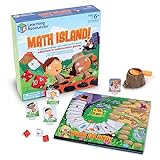
- FUN LEARNING EXPERIENCE - Turn math practice into an exciting adventure game where kids solve addition and subtraction problems to navigate through a volcano island, making learning enjoyable
- BUILDS MATH CONFIDENCE - Children practice essential math facts with two 10-sided number dice and an operation die that create varied equations, helping them develop quick mental math skills
- ENGAGING GAMEPLAY MECHANICS - The exciting volcano popper launches dice when players land on special spaces, adding a thrilling element that keeps children asking to play again
- FAMILY GAME NIGHT OR CLASSROOM - Designed for 2-4 players ages 6+, making it ideal for siblings of different ages or parents wanting quality educational time with their children or in classroom math centers
- HIGH-QUALITY COMPONENTS - Includes a colorful game board, 4 adventure character pieces, volcano popper mechanism, 2 number dice, 1 operation die, and easy-to-follow instructions
Make help relevant to the task
Support from parents, teachers, or peers can shape a learning experience, but the form of interaction matters. A 2019 study of children learning to code with ScratchJr found that task-relevant parent-child interaction predicted coding learning, while question-asking was a negative predictor in that particular study. That result should not be read as a general warning against questions: it shows that a prompt’s value depends on its context and how it relates to the learner’s task.
When designing prompts for adults or peers to use alongside software, make it possible to connect the conversation to what the learner is doing—such as discussing a choice, a result, or a strategy. Test those prompts in context instead of assuming that more interaction, or a particular prompt style, will always improve learning.
Personalize cautiously and test in context
Learners can respond differently to the same explanation, representation, or level of challenge because they bring different prior knowledge and needs. Adaptive pacing or alternate representations may help, but personalization is a design hypothesis to evaluate with the intended audience, not a benefit to assume.
Do these 3 things before closing this tab:
1Scan for outdated or missing drivers - takes under a minute2Clear out junk files and repair common Windows errors3Fix the driver behind crashes, sound loss and screen glitchesThe evidence behind these principles is concentrated in science inquiry, simulations, preschool learning apps, and early coding. The National Research Council’s 2007 synthesis drew substantially on small-scale, long-term intervention studies and did not establish one best design approach or strong evidence of results at scale. Its 2011 review also described gaps in game and simulation research, including limits in controls, context, and generalizability. These findings offer useful questions for product design, not a universal recipe for every learner or subject.
A 2019 OECD discussion of experimental-design tutors illustrates one possible gap: many digital activities offered step-by-step projects without helping learners design experiments or receive feedback on their designs. This is a dated example of a design problem, not a current inventory of available products.
Quick Recap
Product prices and availability are accurate as of the date/time indicated and are subject to change. Any price and availability information displayed on Amazon at the time of purchase will apply.

