
Do these 3 things before closing this tab:
1Repair Windows errors before they cause bigger problems2Fix the driver behind crashes, sound loss and screen glitches3Clear out junk files and repair common Windows errorsiTechGuides is reader-supported. When you buy through links on our site, we may earn an affiliate commission. As an Amazon Associate I earn from qualifying purchases. Learn more
Data Center Dynamics’ DCD Studio, published October 15, 2026, examines how data centers can use exhaust after-treatment to reduce pollution from diesel backup generators. Host Seb Moss interviews Senna Nijs of Multronic about three technology categories: selective catalytic reduction (SCR), diesel particulate filters (DPF) and diesel oxidation catalysts (DOC). DCD describes their purpose as reducing pollutants and supporting regulatory compliance, but the indexed episode description does not publish reduction percentages, supported engine models, jurisdictions, prices or purchasing terms.
Why generator after-treatment matters in data centers
Backup generators may run infrequently, but testing, maintenance exercises, commissioning and extended outages can still create permitting and air-quality obligations. Exhaust after-treatment places emissions-control equipment in the exhaust system so a generator installation can address pollutants before they leave the site.

The DCD episode is a vendor-focused discussion rather than a disclosed performance test. It identifies SCR, DPF and DOC as the relevant technology groups, while leaving the project-specific engineering questions to be verified with the equipment supplier, generator manufacturer and local authorities.
What each technology is intended to control
| Technology | Primary pollutant target | Questions to verify for a generator project |
|---|---|---|
| Selective catalytic reduction (SCR) | NOx (nitrogen oxides) | Which engine ratings and exhaust temperatures are supported? Does the design require a reagent system, and how are storage, dosing, freezing protection and replenishment handled? |
| Diesel particulate filter (DPF) | Particulate matter and soot | How is filter regeneration achieved at the site’s duty cycle? What exhaust backpressure is permitted, and how are ash removal, differential-pressure monitoring and service intervals managed? |
| Diesel oxidation catalyst (DOC) | Oxidation of carbon monoxide and hydrocarbons | What inlet-temperature range and exhaust flow are needed? How does the catalyst affect heat release, downstream equipment and monitoring requirements? |
These categories are not interchangeable. A data center may need one technology or a coordinated system, depending on the engine, fuel, operating profile, permit and local certification rules. The DCD description does not state that every generator requires all three.
#1 Best Overall

- Keep DPF clean
- Diesel additive
- Maintaining a clean DPF improves fuel economy
- Keep DPF clean from Carbon & Soot
How to evaluate an after-treatment system
1. Define the operating case
Document generator make and model, rated power, fuel specification, normal and emergency load range, annual test hours, expected outage duration, exhaust flow and available installation space. Low-load testing and short run times can produce different exhaust conditions from sustained operation, which affects catalyst activity, filter loading and regeneration planning.
2. Map pollutants to the permit
Ask the environmental engineer or permitting authority which pollutants are regulated for the site. Confirm whether the permit addresses NOx, particulate matter, carbon monoxide, hydrocarbons, visible smoke or other parameters, and whether limits differ for emergency, non-emergency or testing operation. Certification requirements are jurisdiction-specific; the episode does not identify a country, state or regulatory program.
Rank #2

- PROFESSIONAL-GRADE DPF & CATALYTIC CONVERTER FOAM CLEANER — Trusted by thousands of diesel specialists. This German-engineered spray foam dissolves heavy soot and carbon buildup inside your DPF or catalytic converter without any disassembly.
- NO REMOVAL REQUIRED — Clean through the O2 sensor or temperature sensor port using the included long-reach nozzle. Spray, soak 20-25 minutes, reinstall sensor, and drive. Saves $500-$2,000 vs. professional DPF cleaning services.
- WORKS ON DIESEL, GAS & HYBRID VEHICLES — Unlike fuel additives that only work on mild buildup, this direct-spray foam penetrates and dissolves even severely clogged filters. Use on DPF filters, catalytic converters, and EGR valves.
- RESTORE FULL ENGINE POWER & FUEL ECONOMY — A clogged DPF triggers constant regen cycles, kills fuel economy, and robs horsepower. Our foam cleaner restores flow, reduces regen frequency, and brings back the performance you're missing.
- Use regularlPAIRS WITH DPF PURGE ADDITIVE (SKU 808) — After foam cleaning, maintain results by adding our DPF Purge fuel additive every 3,000 miles. This preventive maintenance combo keeps your DPF clean and avoids the $3,000-$8,000 DPF replacement cost.y MotorPower Care DPF Foam Cleaning to maintain a proper operating emission system.
3. Check engine and system compatibility
Request a written compatibility matrix covering engine family, displacement, power band, exhaust temperature, backpressure limit, control interface and physical connection points. Do not assume that an after-treatment package approved for one generator brand or rating transfers to another.
4. Design for reagent, regeneration and heat
SCR can introduce reagent logistics and dosing controls. A DPF needs a regeneration strategy suited to the actual duty cycle and a plan for ash or filter service. DOC and DPF assemblies can change exhaust temperature. The design review should therefore address insulation, clearance, fire protection, ventilation, stack materials and the location of monitoring instruments.
Rank #3
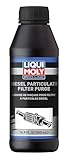
- Dissolves typical contamination in diesel particle filters that can rob the vehicle of its performance
- Effective for closed diesel particle filters on passenger and commercial diesel powered motor vehicles including Cummins and Drama diesel engines and Sprinter vans
- Returns the vehicle to optimal driving characteristics, engine performance and lowers fuel consumption
- Lower fuel consumption means better MPG and money saved
- Liquid Moly 20112 Diesel Particulate Filter Purge Fluid - 500 ml
5. Plan monitoring and maintenance
Require a list of sensors, alarms, data outputs and maintenance tasks. Typical questions include how differential pressure, temperatures, reagent level, dosing faults and catalyst or filter condition are detected; what happens during a fault; and whether the control system can record evidence needed for compliance reports. Obtain lifecycle assumptions for consumables, regeneration, cleaning, replacement and technician access.
6. Validate the installation
Before procurement, ask for the proposed test method, acceptance criteria and responsible certifying body. Verify that any claimed reduction is tied to a defined engine, load, fuel, exhaust condition and measurement protocol. The indexed DCD text contains no numerical reduction results, so percentage claims should not be treated as episode findings without supporting test documentation.
Rank #4

- For cleaning of diesel particle filter (GPF/DPF) as installed on vehicle
- Dissolves contaminants inside DPF units, restores vehicle performance and fuel consumption
- For professional repair shop use only.
- For use with DPF Pressurized Tank Spray Gun (part no.7946
Practical trade-offs to put in the request for proposal
| Evaluation area | What to request from the vendor or engineer |
|---|---|
| Pollutant performance | Pollutant-specific limits or measured results, test conditions and applicable certification. |
| Engine and load range | Supported generator makes, models, power ratings, exhaust temperatures and minimum operating load. |
| Backpressure | Maximum allowable backpressure, calculated pressure drop and alarm setpoints. |
| Regeneration or reagent | Regeneration method, required run profile, reagent type and storage, refill interval and cold-weather provisions. |
| Footprint and integration | Dimensions, weight, stack changes, structural supports, access clearances, controls and electrical loads. |
| Operations | Noise and heat implications, inspection schedule, cleaning, replacement parts, remote monitoring and emergency bypass behavior. |
| Compliance evidence | Jurisdiction-specific approvals, commissioning tests, recordkeeping requirements and permit documentation. |
What the Multronic discussion establishes—and what it does not
The episode establishes that Multronic is presented in a DCD Studio conversation about advanced emissions after-treatment for data-center diesel generators, with SCR, DPF and DOC named as the central technology categories. DCD frames these systems as tools to reduce pollutants and support regulatory compliance.
What’s actually slowing this PC down?
Pick the symptom - the matching free tool is one click away.
The indexed description does not establish a universal emissions-reduction percentage, a list of compatible engines, a specific certification, installation cost, operating cost, reagent consumption, maintenance interval or commercial purchasing arrangement. Those details must be obtained directly from Multronic and checked against the generator manufacturer and the authority having jurisdiction.
Questions to ask before approving a project
- Which exact generator models and engine ratings are covered by the proposed design?
- What pollutant limits and certification rules apply at the data-center site?
- What measured results are available for the same engine, fuel and load profile?
- How will the system behave during short weekly tests, low-load operation and a prolonged outage?
- What reagent, regeneration, cleaning and replacement work is required over the equipment life?
- What alarms, interlocks, bypass conditions and compliance records will the control system provide?
- Who is responsible for commissioning, permit support, operator training and ongoing service?
Frequently Asked Questions
Does the DCD Studio description provide emissions-reduction percentages?
No. The indexed description names SCR, DPF and DOC and says they reduce pollutants and support regulatory compliance, but it does not publish numerical results or test conditions.
Can a data center assume it needs SCR, DPF and DOC together?
No. The required combination depends on the generator, operating profile, pollutants regulated at the site and applicable certification. The episode does not state that all three are required for every installation.
Quick Recap
Product prices and availability are accurate as of the date/time indicated and are subject to change. Any price and availability information displayed on Amazon at the time of purchase will apply.
Recommended Free Tools

