
Do these 3 things before closing this tab:
1Scan for outdated or missing drivers - takes under a minute2Clear out junk files and repair common Windows errors3Fix the driver behind crashes, sound loss and screen glitchesiTechGuides is reader-supported. When you buy through links on our site, we may earn an affiliate commission. As an Amazon Associate I earn from qualifying purchases. Learn more
Buy the Creality K1 Max 3D printer if you need its 300 × 300 × 300 mm build volume, Ethernet, or expanded AI sensing. Choose the Creality K1C 3D printer if 220 × 220 × 250 mm is enough and you want a less expensive enclosed machine with clearly specified carbon-fiber filament support. Both are rated for 600 mm/s maximum speed and 20,000 mm/s² acceleration, so speed alone does not decide this comparison.
The short answer: K1 Max for size, K1C for value and specified abrasive-material support
The K1 Max and K1C are enclosed CoreXY FDM printers from the same product family. Their headline motion ratings are effectively tied, but their practical roles differ. The K1 Max has a substantially larger nominal build envelope, wired Ethernet, a higher rated power supply, and AI LiDAR-related sensing. The K1C occupies less space, costs less at Creality’s displayed prices, and explicitly lists PLA-CF, PA-CF, and PET-CF support together with an all-metal hotend and steel-tipped nozzle.
That makes the decision primarily a question of part size and material hardware rather than advertised speed. A large cosplay shell, prop, or prototype that must be printed in one piece points toward the K1 Max. A desktop workshop producing ordinary models, engineering parts within its envelope, or carbon-fiber-filled filament points toward the K1C.
Core specifications at a glance
| Specification | K1C | K1 Max |
|---|---|---|
| Printer type | Enclosed CoreXY FDM | Enclosed CoreXY FDM |
| Build volume | 220 × 220 × 250 mm | 300 × 300 × 300 mm |
| Maximum rated speed | 600 mm/s | 600 mm/s |
| Rated acceleration | 20,000 mm/s² | 20,000 mm/s² |
| Typical speed shown by Creality | 300 mm/s | 300 mm/s |
| Rated power | 350 W | 1,000 W |
| Nozzle and hotend listing | All-metal hotend with steel-tipped nozzle | Creality’s comparison lists a copper-nozzle entry; confirm the exact revision before abrasive use |
| Listed abrasive-material support | PLA-CF, PA-CF, PET-CF | Broader filament table, but the exact material and hardware combination should be verified for your revision |
| Camera and monitoring | 1080p AI camera, failure detection, remote monitoring | 1080p camera, failure detection, remote monitoring, plus AI LiDAR-related sensing |
| Network connection | Wi-Fi | Wi-Fi and RJ45 Ethernet |
| Displayed Creality price | $529 sale / $559 list | $799 sale / $899 list |
The prices are the figures displayed on Creality’s current comparison pages, not a guarantee of what a buyer will pay. Regional taxes, shipping, promotions, stock, and hardware revisions can change the final result. Check the price for your country immediately before ordering.
#1 Best Overall
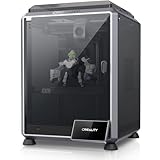
- 【CoreXY, 12X Faster Performance】The Creality K1C 3D Printer utilizes an advanced CoreXY system with 600mm/s printing speed and 20000mm/s² acceleration, offering up to 12 times faster performance than standard 3D printers while maintaining top-quality results.
- 【Enhanced Direct Extruder with Tri-metal Nozzle】Equipped with a clog-free direct extruder and a tri-metal Unicorn nozzle, the K1C handles high-temperature materials like carbon fiber filaments effortlessly, ensuring consistent extrusion and reliable operation with easy nozzle swaps.
- 【One-tap Auto Calibration with Reduced Vibration】With a single tap, the K1C auto-calibration system accurately levels the bed. Its dynamically balanced printhead fans minimize vibrations, reducing print imperfections like ringing or ghosting.
- 【AI Camera for Real-time Monitoring】The built-in AI camera enables continuous real-time monitoring, detecting foreign objects or malfunctions during printing. It also supports time-lapse photography, enhancing user control.
- 【Quiet Operation with Efficient Filtration】K1C features an effective air purification system using activated carbon to remove odors and particles. Switch to silent mode for reduced noise (≤45dB) during operation without disrupting work or rest.
Build volume: the difference that changes what you can print
K1C: 220 × 220 × 250 mm
The K1C’s 220 × 220 × 250 mm nominal envelope is suitable for most desktop models, brackets, housings, tools, and engineering parts designed around common small-printer dimensions. Its rectangular volume is approximately 12.1 litres when calculated as a simple geometric box, although real printable space is affected by part placement, bed margins, and the model’s shape.
A 250 mm height gives more vertical room than the 220 mm width and depth. Tall, narrow parts can therefore fit even when a broad object cannot. If your existing models are already split into sections for a smaller printer, measure the largest section—not the complete assembled object—to see whether the K1C removes that inconvenience.
K1 Max: 300 × 300 × 300 mm
The K1 Max provides a 300 mm cube, or roughly 27 litres of nominal geometric volume. Each horizontal dimension is 80 mm greater than the K1C’s, and the height is 50 mm greater. Those increases are not merely incremental: a model that is too wide for the K1C may fit on the K1 Max without changing its orientation or splitting it.
The larger envelope is particularly useful for cosplay helmets, large props, furniture-scale prototypes, and other pieces where seams would add finishing work or weaken the result. It also gives more room to arrange several smaller parts in one job, provided the required clearances and print settings still allow them.
How to decide whether you need the extra volume
- Measure the largest one-piece object you expect to print, including supports and any brim or skirt space you normally use.
- Compare its width, depth, and height independently with 220 × 220 × 250 mm. A part that exceeds any one of those dimensions cannot fit on the K1C without reorientation or splitting.
- Repeat the check against 300 × 300 × 300 mm for the K1 Max.
- Consider future projects rather than only today’s models. The K1 Max’s extra envelope has value when avoiding a split saves substantial assembly, sanding, or alignment work.
Do not buy the larger printer solely because its volume sounds more capable. If your parts consistently fit the K1C, the K1 Max’s additional capacity does not improve the stated speed rating or automatically improve surface quality.
Speed and motion: a tie on paper
Creality rates both printers for up to 600 mm/s and 20,000 mm/s² acceleration. The comparison material also shows 300 mm/s as the typical speed for each. That means the K1 Max does not justify its higher price through a faster headline rating.
Rank #2

- Multicolor 3D Printing: 4 × CFS for up to 16 colors. By hooking up as many as four CFS units together, you are able to print in the splendor of 16 colors. Saves the need for extra painting afterward. Also, K2 offers a build volume of 260 × 260 × 260 mm, able to cover the majority of user scenarios. (* K2 Combo includes K2 and one CFS unit)
- Ultra Quiet Printing: Silent Mode for a quieter printing experience. Annoyed by the buzzing noise? Not K2. By adopting step-servo motors and dynamically balanced fans. It is no louder than someone typing on a laptop PC
- Out-of-the-Box Experience: Pre-assembled for plug and play. You can use K2 right after unpacking and screen installation. Unlocks a wider selection of materials, including PLA/PETG/ABS/PLA-CF/PET
- Smart Auto Leveling & AI Camera: Faster leveling of only the target print area. The leveling sensor only probes and levels the bed area relevant to the desired print. Much faster and more precise. Close watch around the clock, Watch over spaghetti failure, idling, and so on in real-time
- Superior Print Quality: Sturdy frame and precise step-servo motor system. K2 uses 3 step-servo motors, both in the extruder and on the X/Y axis. They can adjust torque dynamically in less than a millisecond, taking the speed, extrusion consistency, print accuracy and noise control to the next level
Maximum speed is a ceiling, not a promise that every model will print at 600 mm/s. Actual speed is constrained by the filament, layer height, nozzle size, cooling, geometry, acceleration limits, and the quality target. Small features and sharp corners require frequent speed changes; a large nominal maximum may therefore have little effect on total time for detailed models.
Quick wins for a faster PC:
Clear out junk files and repair common Windows errorsFree Scan →Scan for outdated or missing drivers - takes under a minuteDriver Scan →Use the shared rating as a tie-breaker: choose based on volume, material capability, connectivity, monitoring, and price. Treat a claimed maximum as a specification to configure carefully rather than an expected speed for every job.
Carbon-fiber and other abrasive filaments
Why the K1C is the clearer choice for listed carbon-fiber materials
Creality explicitly lists PLA-CF, PA-CF, and PET-CF for the K1C. It also specifies an all-metal hotend and a steel-tipped nozzle. Those details matter because carbon-fiber-filled filaments are abrasive and can wear a conventional soft nozzle more quickly than unfilled PLA or PETG.
This does not mean every carbon-fiber spool will print without tuning. Nylon-based PA-CF can have demanding drying and adhesion requirements, and filled materials can respond differently to temperature, cooling, and layer settings. The important buying distinction is that the K1C’s published hardware and material list directly address these categories.
What the K1 Max listing means for abrasive use
The K1 Max comparison entry describes a copper nozzle, while also noting planned steel or all-metal changes. The broader filament table does not by itself establish that every K1 Max revision ships with the same hardened or steel wear surface. If abrasive filament is central to your work, confirm the nozzle and hotend fitted to the exact unit you are buying and replace or upgrade components when the manufacturer’s specification requires it.
The Tool Desk
Outbyte PC Repair FREEClear out junk files and repair common Windows errorsFree Scan →Outbyte Driver Updater FREEFix the driver behind crashes, sound loss and screen glitchesFind Drivers →Do not infer material compatibility from the printer’s enclosure or its 600 mm/s rating. A machine can be mechanically fast and enclosed yet still need a wear-resistant nozzle, suitable heat path, and material-specific handling before regular carbon-fiber printing.
Rank #3

- 【Creality OEM】The nozzle heat break is an all-metal integrated design for swift installation and easy replacement, no longer worry about leaking. Note: Only work for creality K1 C, K1 SE, K2 SE, K1(2024),K1 Max(2024), Ender 3 V3, Ender 3 V3 Plus.
- 【Supports High-speed Printing up to 600mm/s】With a 30% increase in the overall hot melt section, including a 28.5mm length large hot melt section and 32mm³/s high flow, this kit enables printing speeds of up to 600mm/s.
- 【Precision Detail】Tightly fit joints effectively prevent filament leakage during printing. With inner hole roughness Ra≤0.4, ensuring smooth filament feeding.
- 【All Metal Design】All-metal design boasts enhanced performance and high temperature resistance up to 300°C which support PLA, ABS, PETG, TPU, PP, PC, PLA-CF, PA-CF, PET-CF multiple filaments printing.
- 【After-sale Service】There are more than 20 engineers for after-sales service and provide 24/7 customer service with 1-year limited and lifetime technical assistance. Please contact us via “ask a question”directly to get the professional assistance.
Practical carbon-fiber checklist
- Confirm whether the spool is PLA-CF, PA-CF, or PET-CF; the base polymer changes drying and bed-adhesion behavior.
- Use the K1C’s listed steel-tipped nozzle as the baseline for the materials Creality names.
- For a K1 Max, verify the installed nozzle and any revision-specific material guidance before loading abrasive filament.
- Expect to tune temperature, cooling, first-layer adhesion, and flow for the specific brand and batch of filament.
- Inspect the nozzle periodically for wear; a worn orifice can change extrusion and dimensional accuracy.
Monitoring, cameras, and network connections
K1C monitoring
The K1C includes a 1080p AI camera, failure detection, and remote monitoring over Wi-Fi. This combination can alert you to certain visible print failures and lets you check progress without standing beside the machine. Camera-based detection is an aid, not a guarantee: a failure that is outside the camera’s view or visually ambiguous may not be identified.
K1 Max monitoring and AI LiDAR-related sensing
The K1 Max also has a 1080p camera, failure detection, and remote monitoring, then adds AI LiDAR-related sensing. That additional sensing is the main monitoring distinction in the comparison. It may be valuable when you want more automated checking, but it does not remove the need to prepare the bed correctly, verify the first layer, and supervise unfamiliar materials.
Wi-Fi versus Ethernet
The K1C lists Wi-Fi connectivity. The K1 Max lists both Wi-Fi and an RJ45 Ethernet connection. Ethernet is useful when the printer will live in a workshop with weak wireless coverage, a crowded radio environment, or a network policy that favors wired devices. If your printer is close to a reliable access point, the K1C’s Wi-Fi may be sufficient.
Choose the K1 Max for Ethernet because you need a dependable wired path, not because a cable connection changes the mechanical print rating. Network convenience is a workflow benefit rather than a direct quality upgrade.
Power rating and operating considerations
Creality lists the K1C at 350 W and the K1 Max at 1,000 W rated power. The figures describe the printers’ rated electrical capacity; they are not a promise that either machine continuously draws that amount throughout every print. Heating phases, ambient temperature, bed temperature, and motion demands affect actual consumption.
The K1 Max’s higher rating is consistent with its larger heated build area and larger machine class, but it also makes electrical planning more important. Use an outlet and power arrangement appropriate for the printer’s rating, avoid overloaded power strips, and follow the electrical requirements supplied with the unit for your region.
Rank #4

- 【Quality Assurance】100% original Creality heater block silicone sock for K1C/K2 SE/Ender 3 V3/3 V3 Plus/3 V3 KE/3 V3 SE/K1/K1 SE/K1 Max/CR-10 SE. Creality K1 SE silicone socks are made of heat-resistant, non-stick silicone material, much more durable
- 【Keep Clean】Not only can it effectively protect the Creality hotend from wear and tear, but also keep it clean and prolong its service life. Also clean the insulation around the nozzle to prevent burns
- 【Heat Insulation】Ender 3 V3 Plus silicone socks can accelerate the heating process, avoid heat dissipation at the heating end, stabilize the temperature at the heating end, and is not affected by any environment
- 【Package】3PCS Creality Ender 3 V3 KE silicone socks for daily replacement.Sock blocker is flexible, can be placed close to the home heater block, solid and not easy to fall off, easy to install
- 【After-sales Support】We pay great attention to the buyer’s user experience. Any issues or questions about our product please kindly contact us(seller) via “ask a question” cause our customer service will respond to you within 24 hours
Price and total purchase value
| Model | Displayed sale price | Displayed list price | Difference versus the other model |
|---|---|---|---|
| K1C | $529 | $559 | Lower by $270 at the displayed sale prices and $340 at the displayed list prices |
| K1 Max | $799 | $899 | Higher by $270 at the displayed sale prices and $340 at the displayed list prices |
The sale figures are promotional displays and can end without notice. Your delivered cost may include tax, shipping, import charges, replacement parts, or material. For an abrasive-material workflow, budget for suitable filament and eventual nozzle wear. For a large-format workflow, also account for the cost of splitting and finishing parts if you choose a smaller printer; that labor can outweigh the initial price difference on complex projects.
Recommended Free Tools
Which printer fits common workloads?
Choose the K1C for a compact general-purpose workshop
The K1C is the sensible default when most of your models fit inside 220 × 220 × 250 mm and you want to keep the purchase price lower. It is well matched to desktop workspaces, replacement parts, functional brackets, enclosures, organizers, prototypes, and general hobby models. Its published PLA-CF, PA-CF, and PET-CF support is a strong reason to select it when filled filament is part of the plan.
TechRadar selected the K1C as its best hobby 3D printer overall in 2025. That editorial recognition does not change the dimensional limits, but it supports the view that the K1C is aimed at broad hobby use rather than only at a specialist niche.
Choose the K1 Max for one-piece large models
The K1 Max is justified when the 300 mm cube solves a real modeling problem. Typical examples include cosplay helmets, large props, furniture-scale prototypes, and batches where the larger bed lets you avoid splitting or queueing many pieces. Its Ethernet port is also useful in a fixed workshop installation, while AI LiDAR-related sensing adds to its monitoring package.
If none of those benefits applies, the K1 Max’s extra cost buys capacity you may not use. Its shared 600 mm/s maximum and 20,000 mm/s² acceleration do not provide a standalone speed advantage over the K1C.
Free tools Windows power users keep installed
One-click scans. No signup required.
When neither model is an automatic fit
Reconsider both choices if your objects routinely exceed 300 mm in one dimension, require a different manufacturing process, or depend on a material and hardware combination not established for the printer revision you are considering. Likewise, if your priority is the quietest possible operation, a specific chamber temperature, or a particular slicer ecosystem, those requirements need separate verification beyond the comparison figures here.
Best Value

- 【Quick-Swap Integrated Design】: Specially designed for K1C, K1 SE, K2 SE, Ender 3 V3 SE, Ender 3 V3 KE, Ender 3 V3, Ender 3 V3 Plus, K1, and K1 Max; Creality 0.4mm K1C nozzle adopts an all-metal integrated design, facilitating quick disassembly and convenient replacement
- 【High-speed Printing】: The K1C nozzle has a larger nozzle chamber with a maximum flow rate of 30mm³/s and supports 600mm/s high-speed printing when printing at 240°C
- 【Upgraded Material】: The heat break is made of titanium alloy, which reduces heat conduction effectively; The K1 SE nozzle is composed of copper alloy and hardened steel, supporting the printing of various filaments such as PLA, ABS, PETG, TPU, PP, PC, PLA-CF, PA-CF, PET-CF, etc
- 【Precision Machining】: The joint of the k1C nozzle is tightly fitted, which can effectively prevent filament leakage during printing; The roughness of the inner hole Ra<0.4 to ensure smooth feeding. No burrs at the opening, and stable printing with reduced clogging
- 【Professional Support】: To ensure your pleasant shopping experience, Creality has a professional customer service team to solve your problems; If you have any problems, please contact us (seller) directly via "ask a question"
A decision process you can use before ordering
- Measure your largest parts. Record the maximum width, depth, and height of the models you actually intend to print in one piece.
- Apply the volume gate. If any dimension exceeds 220 × 220 × 250 mm, the K1C requires reorientation or splitting. If it exceeds 300 × 300 × 300 mm, neither printer can produce it as one piece.
- Identify the filament. If PLA-CF, PA-CF, or PET-CF is a core requirement, the K1C has the clearer published match. For the K1 Max, verify the nozzle and exact hardware revision.
- Choose your network path. Select the K1 Max if RJ45 Ethernet is important; otherwise Wi-Fi may meet your workflow.
- Value monitoring realistically. Decide whether the K1 Max’s AI LiDAR-related sensing is worth paying for in addition to the camera, failure detection, and remote monitoring both machines provide.
- Compare delivered prices. Check the live regional price, tax, shipping, stock, and warranty terms rather than relying on a temporary sale display.
- Reserve operating headroom. Leave room for filament storage, a safe electrical setup, replacement wear parts, and the physical clearance required to access the enclosed printer.
First-use checks that prevent avoidable failures
Regardless of model, treat the first several prints as setup and validation rather than production. Confirm that the printer is on a stable surface, that the enclosure can be opened safely, and that the selected material matches the nozzle and hotend guidance for your revision.
- Connect the printer to Wi-Fi, or use Ethernet on the K1 Max if that is your planned network path.
- Update firmware only through the manufacturer’s supported process and note the installed version, because firmware and hardware revisions can affect behavior.
- Run the printer’s available calibration and first-layer checks before attempting a large or expensive model.
- Watch the beginning of the first print even when remote monitoring is enabled; camera detection cannot replace physical confirmation of adhesion and extrusion.
- For carbon-fiber-filled filament, verify the steel-tipped or otherwise suitable wear-resistant nozzle before loading the spool.
- Keep the first large-format job conservative: use a known material and a model whose dimensions have been checked against the nominal build volume.
Common buying mistakes and how to avoid them
Buying on the 600 mm/s number alone
Both printers share the 600 mm/s maximum and 20,000 mm/s² acceleration rating. Paying more for the K1 Max will not automatically shorten every print. Choose it for size, Ethernet, or the expanded sensing package.
Assuming an enclosure guarantees carbon-fiber readiness
An enclosure helps contain the printer environment, but abrasive filament still requires suitable nozzle hardware and correct material handling. The K1C’s explicit material list and steel-tipped nozzle make the evidence clearer than the K1 Max’s copper-nozzle entry. Verify the exact K1 Max revision before committing to regular abrasive use.
Confusing nominal volume with usable part space
The published dimensions are the nominal build volumes. Model geometry, supports, brims, bed margins, and orientation can reduce the practical space available. Measure the complete job, not just the bounding box shown in a modeling program.
Treating a sale price as permanent
The displayed $529 K1C and $799 K1 Max prices are sale figures, while the displayed list prices are $559 and $899 respectively. Promotions, regional availability, and stock change. Recheck the live product page at checkout.
Ignoring revision differences
Firmware, hardware revisions, prices, and stock can change. Keep the model and revision information from the listing you purchase, then match replacement nozzles, filament guidance, and maintenance instructions to that specific unit.
Final recommendation
Buy the Creality K1C 3D printer when your parts fit 220 × 220 × 250 mm, you want the lower displayed price, and carbon-fiber-filled materials are important enough that the listed all-metal hotend and steel-tipped nozzle matter. It is the more efficient choice for most desktop workshops and general hobby projects.
Crashes, No Sound, or Screen Glitches?
Random freezes, missing sound and display glitches usually trace back to one bad driver. Find and replace yours safely.Free scan · under a minuteWindows Errors? Fix Them Before They Spread
Repair common Windows errors and clear accumulated junk for a smoother, more stable PC - no reinstall needed.Free scan · no reinstallBuy the Creality K1 Max 3D printer when 300 × 300 × 300 mm capacity prevents part splitting, when Ethernet is valuable in your workspace, or when its expanded AI monitoring package addresses a specific workflow need. Its higher price is justified by that additional capacity and connectivity, not by faster headline motion ratings.
Quick Recap
Product prices and availability are accurate as of the date/time indicated and are subject to change. Any price and availability information displayed on Amazon at the time of purchase will apply.

