
iTechGuides is reader-supported. When you buy through links on our site, we may earn an affiliate commission. As an Amazon Associate I earn from qualifying purchases. Learn more
Cloud migration outages often happen when a workload is treated as a server move instead of a coordinated change to dependencies, data, traffic, and recovery. Prevent the five failure modes below by testing the whole service—not just whether its new compute instances start—and by defining how to handle new writes before cutover.
1. Moving workloads without mapping their dependencies
A server can boot in the target cloud while the application remains unavailable because it cannot reach a database, identity provider, DNS resolver, external service, or another application tier. An inventory of servers alone will not reveal whether those connections work from the new environment.
Prevent it: Map application and system dependencies, user connectivity, and the order in which components must move. Check the network paths between on-premises and cloud systems, and account for bandwidth needed by both application traffic and replication. AWS’s pre-cutover guidance and Migration Lens recommendations both call for planning and validating these connections.
Crashes, No Sound, or Screen Glitches?
Random freezes, missing sound and display glitches usually trace back to one bad driver. Find and replace yours safely.Free scan · under a minuteWindows Errors? Fix Them Before They Spread
Repair common Windows errors and clear accumulated junk for a smoother, more stable PC - no reinstall needed.Free scan · no reinstallVerify it: From the target environment, exercise the actual paths to required services, test DNS resolution and user access, and run network performance and failure tests relevant to the workload. A green instance-health check is not evidence that its dependencies are reachable.
#1 Best Overall

- VERSATILE CABLE TESTING: Cable tester for data (RJ45) terminated cables and patch cords, ensuring comprehensive testing capabilities
- LARGE BACKLIT LCD: Backlit LCD display enables easy reading of pin-to-pin wiremap results, even in low-lit areas
- COMPREHENSIVE FAULT DETECTION: Test for Open, Short, Miswire, Split-Pair faults, Cross-over, and Shield, providing thorough fault detection
- INTUITIVE USER INTERFACE: User-friendly interface with three buttons and simple, easy-to-identify test responses, ensuring a smooth testing experience
- MULTIPLE TONE GENERATOR STYLES: Tone on a single wire, wire pair, or all 8 conductor wires using the multiple style tone generator (solid/warble); requires probe Cat. No. VDV500-123 (sold separately)
2. Treating replication as proof that the data is ready
A configured replication job can still be unhealthy, behind the source, or unfit for the consistency the application requires. If users begin writing to the target before the final synchronization is complete, the new environment may start with stale or inconsistent data.
Prevent it: Define the consistency requirement and acceptable replication lag for this workload and migration design. Monitor replication health and lag, and determine whether writes must be paused before the final synchronization. Microsoft’s Azure migration execution guidance describes confirming synchronization and health, monitoring lag, and—within its near-zero-downtime workflow—not proceeding until lag is zero. That is a workflow-specific instruction, not a universal threshold for every cloud migration.
Verify it: Confirm the replication state and final sync, then validate data integrity with a method suited to the system, such as checksums or hashes where applicable. Also test critical workload functions against the migrated data; replication status alone does not prove that records are correct or usable.
Recommended Free Tools
Rank #2
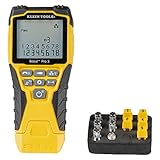
- VERSATILE CABLE TESTING: Cable tester tests voice (RJ11/12), data (RJ45), and video (coax F-connector) terminated cables, providing clear results for comprehensive testing on unenergized Ethernet cables (not designed to test PoE)
- EXTENDED CABLE LENGTH MEASUREMENT: Measure cable length up to 2000 feet (610 m), allowing for precise cable length determination
- COMPREHENSIVE FAULT DETECTION: Test for Open, Short, Miswire, or Split-Pair faults, ensuring thorough fault detection and identification
- BACKLIT LCD DISPLAY: Backlit LCD screen displays cable length, wiremap, cable ID, and test results, ensuring easy readability in various lighting conditions
- EFFICIENT CABLE TRACING: Trace cables, wire pairs, and individual conductor wires using the multiple style tone generator (requires analog probe Cat. No. VDV500-123, sold separately), simplifying cable tracing tasks
3. Treating cutover as one DNS edit
Cutover redirects users and services from existing endpoints to new resources. A service with multiple tiers or integration points may need coordinated changes to application and database endpoints, load balancers, and DNS. If only part of the system moves—or a new endpoint is reachable before it is functionally ready—users can encounter failures or mismatched tiers.
Prevent it: Document the order of traffic and endpoint changes, including which components must move together and who owns each change. The scope depends on the architecture and business requirements; AWS notes that tighter cutover windows generally make cutover more complex in its overview of the cutover phase.
Verify it: Before sending general user traffic to the target, check connectivity and DNS resolution from relevant client and service locations, and confirm that each tier points to its intended counterpart. After routing, run a representative end-to-end workflow rather than stopping at a successful DNS lookup.
Rank #3

- Multifunctional Network Cable Tester: TESMEN TLP-123A Supports RJ45 and RJ11, enabling rapid detection of line connectivity, short circuits, open circuits, miswiring, and cable shielding status. An essential tool for troubleshooting line faults and network maintenance, it effectively boosts your work efficiency
- Convenient and Efficient: Featuring one-button operation and a test speed adjustment gear on the main control unit for enhanced flexibility. Clear LED indicators provide intuitive test result displays, making it easy for both professionals and home users to operate
- Portable and Durable: Compact and lightweight design for easy portability. Constructed with high-quality plastic housing for robust structure, ensuring both durability and stability. Ideal for home wiring, IT equipment setup, electrical maintenance, and LAN DIY projects
- Detachable design: The main control unit and remote unit can be separated and used independently, allowing you to test both ends of long cables. This makes it ideal for wall-mounted ports, long-distance cabling, or structured cabling systems, perfect for homes, offices, or professional IT environments
- What you will get: 1 * TLP-123A Network Cable Tester, 1 * user manual, 2 * AAA batteries
4. Declaring success before end-to-end verification and monitoring
Infrastructure can appear healthy while users cannot authenticate, complete a transaction, access accurate data, or get acceptable performance. A server-status dashboard cannot establish that the business service works end to end.
Free tools Windows power users keep installed
One-click scans. No signup required.
Prevent it: Agree on workload-specific acceptance checks with application owners before migration. Include core user journeys, data correctness, performance, errors, and user access, with named owners who can confirm whether the service is fit to remain on the target.
Verify it: Run functional tests through the real service path and monitor performance, error rates, and user access after traffic moves. Microsoft’s Azure execution guidance recommends monitoring for the first 24–48 hours in the workflow it describes; treat that as provider-specific guidance, not a universal monitoring period. Keep observing for the period set by the workload’s recovery plan.
Rank #4

- Multifunctional NOYAFA NF-8508 Network Cable Tester: There are nine features to meet your needs. Continuity Testing, Cable Scan, Port Flash, Length Measurement, POE Power Supply Test, QC testing, Optical Power Meter, VFL and NVC function.It is perfectly suited for various engineering cabling projects, network troubleshooting, network equipment maintenance and testing scenarios. Its precise cable scanning and fault localization capabilities help you effortlessly pinpoint the root cause of issues.
- 7 WAVELENGTHS OPTICAL POWER METER: NF-8508 network cable tester can measure 7 standard wavelengths, 850/1300/1310/1490/1550/1625/1650, power detecting range(dBm): -70 ~ +10. Its power detection range spans from -70 dBm to +10 dBm, supporting FC/SC/ST connectors. It enables precise fiber optic power measurement, helping users efficiently assess fiber signal strength and ensure healthy fiber link operation. It effortlessly detects attenuation issues within fibers, thereby safeguarding fiber network stability.
- High Efficiency Visual Fault Locator: Easy identification of fiber breakpoints, poor connections, bending or cracking. Excellent for finding the right fiber to splice or quickly finding a break. Emmiting Energy: standard wavelenth: 650nm. Fast flashing, slow flashing, high precison.The built-in self-calibration ensures stable long-term performance, and Class IIIa laser (output<5mW) ensures safe daily operation.
- PORT FLASHING:The indicator light on the connection port in the NF-8508 device flashes to help accurately locate the cable. Displays port information, including operating speed, duplex mode, and negotiation settings. Port lights flash on the same screen to show the port's operating speed, making it easy to pinpoint lines and ports.
- PoE Testing and Cable Length Test: PoE testing can check cable mapping polarity and voltage of PoE network switches, withstand 60VDC. Automatically detects and switches between 10M/100M/1000M modes, Includes cable tracking, short circuit test, interruption of circuit test and etc The RJ45 cable tester can quickly measure the length of the cable with a range of 200m. Not only network cables, but also phone lines and BNC cables.
5. Calling rollback a traffic switch without planning for new writes
Before the target accepts writes, redirecting traffic to the source may be relatively straightforward. After users create or change data on the target, the source can be stale. Switching traffic back without reconciling those writes can lose transactions or leave two environments with conflicting records.
Prevent it: Set rollback checkpoints, define who can make the decision, and choose the data-handling strategy before cutover. Depending on the architecture, options described in AWS cutover guidance include fail-forward replication, dual writes, or tested backup and restore. Google Cloud also recommends a rollback strategy for each migration step, periodic review and testing, and a maximum execution time after which rollback begins in its migration-plan validation guidance.
Verify it: Rehearse the chosen recovery path, including what happens to writes made after cutover. Set explicit triggers and a decision-maker, and decide in advance whether the response is rollback or fix-forward. A traffic change by itself is not a data recovery plan.
Best Value

- Automatically runs all tests and checks for continuity, open, shorted and crossed wire pairs. Visible LED status display.
- Cable state testing (2-wire): Line DC detecting, anode and cathode determination,Ringing signal detecting open, short and cross circuit testing
- Cable Type: RJ11 Telephone cable and RJ45 LAN cable
- Connectors: Ethernet Cat 5, Ethernet Cat 5e, Ethernet Cat 6, Ethernet Cat 7, RJ11 6P and RJ45 8P
- Power Source: DC9V Battery Required (not included)
Choose a migration approach around the workload’s constraints
There is no universally safer method: the right plan depends on acceptable downtime, workload criticality, data consistency needs, dependency complexity, network capacity, replication readiness, and recovery design. Microsoft’s migration planning guidance contrasts downtime migration with near-zero-downtime migration as follows:
| Approach | Trade-off described in Microsoft guidance | Planning implication |
|---|---|---|
| Downtime migration | Simpler for the described use cases, but requires a service interruption. | Confirm the business can accept the outage window and that the sequence and recovery plan fit within it. |
| Near-zero-downtime migration | Minimizes disruption, but requires continuous replication and testing. | Prove replication health, lag handling, consistency, and the final synchronization process before relying on a short cutover. |
These are planning trade-offs, not a ranking of methods. The reviewed provider guidance does not establish how frequently any of these five mistakes causes outages, so they should not be read as a prevalence ranking.
Build a cutover runbook that can be rehearsed
A written plan turns the migration from a sequence of assumptions into a controlled change. AWS recommends a cutover plan and workbook, including rehearsal, in its pre-cutover guidance. Tailor the sequence to the architecture; not every workload needs the same write controls or routing steps.
- Before the window: Record the operation order, dependencies, connectivity checks, acceptance tests, contingencies, decision roles, and rollback method. Rehearse the plan and establish a maximum execution time for each step.
- At the change point: Confirm target readiness and replication state. Where consistency requires it, freeze or control writes, complete final synchronization, and then apply the planned routing changes.
- Validate the service: Exercise user-critical workflows and confirm data, connectivity, and service behavior against the agreed acceptance checks before declaring the migration successful.
- After routing: Monitor the agreed performance, error, and access indicators, and obtain confirmation from workload owners. Keep the source environment or other fallback available for the period specified in the workload’s recovery plan.
Damien Renner, Ernest Asare, Martin Fluck, Khurram Mahmood, and Mark Willis, authors of AWS’s cutover guide, state: “The ultimate goal of this guide is to help you minimize the disruptions and mitigate the risks associated with the cutover phase of a cloud migration.” That is the guide’s objective, not a measured claim about outage rates.
Quick Recap
Product prices and availability are accurate as of the date/time indicated and are subject to change. Any price and availability information displayed on Amazon at the time of purchase will apply.

