
iTechGuides is reader-supported. When you buy through links on our site, we may earn an affiliate commission. As an Amazon Associate I earn from qualifying purchases. Learn more
To catch broken LLM JSON before it reaches a downstream job, add an early CircleCI job that parses a saved response, checks it against the contract your application expects, and exits nonzero when either check fails. CircleCI’s own circleci config validate command is useful for checking CircleCI configuration, but it does not validate model response bodies.
The “three unrelated pipelines” framing is a scenario, not a documented incident: CircleCI says a project can have multiple pipelines and triggers, but its documentation does not establish three particular pipelines or a shared root cause. CircleCI’s pipeline documentation describes the platform model, not a specific incident.


What should the gate catch?
A reliable gate checks two different things in sequence: whether the response is valid JSON, and whether the parsed value satisfies the contract required by the next job. A payload can parse successfully and still be unusable—for example, a required property may be absent, a value may have the wrong type, or an enum may contain an unsupported value.
Recommended Free Tools
- Syntax: A real JSON parser can read the entire response.
- Structure: Required fields exist and have the expected types.
- Constraints: Enumerated values, bounds, and application-specific invariants hold.
Do not silently repair malformed output with regular expressions. If a repair or retry policy is appropriate for your application, keep it bounded and observable; the gate should still make the final outcome explicit.
Build a deterministic validation job
1. Use representative fixtures
Store representative model responses as fixtures and run validation against them in CI. This keeps the gate reproducible and avoids making a live model call on every build. Include valid examples and invalid cases drawn from failure modes your team has actually observed; do not infer a failure rate from a small or unmeasured fixture set.
2. Parse the whole response
Pass the fixture or generated response to a JSON parser. Treat a parse error as a failed check, and provide a concise diagnostic rather than forwarding invalid input to a consumer.
3. Validate the application contract
After parsing, check the properties the next step relies on: required keys, types, allowed values, numeric or string bounds, and any domain-specific relationships. Use a validator appropriate to your application and runtime; CircleCI’s configuration validator is not a substitute for response validation.
Outdated Drivers Are Slowing You Down
One free scan finds every outdated or missing driver and matches the right update for your exact hardware.Free scan · exact hardware matchWindows Errors? Fix Them Before They Spread
Repair common Windows errors and clear accumulated junk for a smoother, more stable PC - no reinstall needed.Free scan · no reinstall4. Make failure actionable
Have the validation process exit with a nonzero status when parsing or contract checks fail. Report a useful field path and the expected-versus-observed condition, while avoiding unnecessary exposure of sensitive payload content in logs.
5. Put the gate before consumers
Make the validation job a dependency of any job that consumes or publishes the generated data. Keep enough job and step information to diagnose the failure. CircleCI’s troubleshooting guide describes capturing commands, exit codes, status, timing, and step output. It also warns that presigned output URLs expire in minutes and require no authentication, so do not share them.
Keep CircleCI configuration checks separate
CircleCI documents circleci config validate [<path>] as a way to validate a pipeline configuration file. It defaults to .circleci/config.yml, accepts - to read standard input, and supports --json output with a valid boolean, compiled_yaml when valid, and an errors array when invalid. See the CircleCI CLI reference.
Rank #3
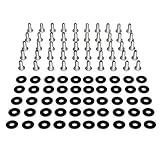
- Threaded hole hardware kit - 50 each #12-24 screws
- Fastens equipment to threaded hole rack mount rails
- Compatible with all #12-24 threaded hole racks
That command checks whether CircleCI can validate its pipeline configuration; it does not parse an arbitrary LLM response or check the application contract. Use it for the former and a parser plus application-level validation for the latter. The CLI reference also notes that public orb resolution does not require an API token, while private or namespaced orbs require a token and organization context.
Why the gate should run early
A validation job is most useful before the first dependent step. CircleCI notes that configuration errors can prevent a workflow from starting, and that rerunning a workflow may not resolve failures that occur before execution. This makes early, specific validation and clear diagnostics more useful than relying on a downstream failure to reveal that the payload was unusable. See CircleCI’s workflow documentation.
If your retention and security policies allow it, preserve the failing fixture or payload as an internal artifact for investigation. Avoid publishing it in a broadly accessible log or sharing an expiring output URL.
Rank #4

- Next-Gen Processing Power: Powered by the AMD Ryzen 7 8845HS processor (8 Cores, 16 Threads, Zen 4 architecture) and Radeon 780M graphics. Effortlessly handles fluid 4K/8K real-time media transcoding, multiple operating system virtualizations (PVE/ESXi), and simultaneous background tasks without a stutter.
- Secure Local AI & Privacy: Features an integrated Ryzen AI NPU delivering up to 38 TOPS of total processing power. Deploy 8B/14B Large Language Models (LLM) locally, run automated programming assistants, and enjoy lightning-fast AI photo recognition—all completely offline, keeping your sensitive data 100% secure.
- Pro-Studio Collaboration: Engineered with dual 2.5GbE network ports and optimized high-speed architecture. Eliminate transmission bottlenecks so multiple video editors, photographers, or 3D designers can collaborate, render, and share heavy assets directly from the NAS in real time.
- Massive Docker Ecosystem: Seamlessly deploy and run over 20+ Docker containers simultaneously. Perfect for hosting your home assistant, private web servers, automated downloaders, and personal databases with enterprise-level stability.
- Futuristic Heat Dissipation: Designed with an advanced cooling system tailored for continuous, high-load hardware operation. Enjoy high-speed read and write speeds across multiple drive bays while maintaining whisper-quiet operation in your home or studio.
Do not confuse JSON validation with release validation
CircleCI also documents a release-validation feature that can evaluate monitoring signals and trigger a rollback pipeline if validation fails during its evaluation window. That is a release-monitoring control, not a JSON parser or schema check. See the CircleCI configuration reference.
What “one root cause” can—and cannot—mean
Several pipelines may fail because each consumes output that violates the same application contract. In that case, validating the output at its boundary can prevent the bad payload from propagating. But the fact that CircleCI allows multiple pipelines does not establish that any particular set of three pipelines exists or that their failures share a cause. Diagnose each pipeline’s actual inputs, dependencies, and failure evidence rather than treating the headline scenario as proof.
Do these 3 things before closing this tab:
1Repair Windows errors before they cause bigger problems2Fix the driver behind crashes, sound loss and screen glitches3Clear out junk files and repair common Windows errorsQuick Recap
Product prices and availability are accurate as of the date/time indicated and are subject to change. Any price and availability information displayed on Amazon at the time of purchase will apply.

