
Free tools Windows power users keep installed
One-click scans. No signup required.
iTechGuides is reader-supported. When you buy through links on our site, we may earn an affiliate commission. As an Amazon Associate I earn from qualifying purchases. Learn more
The ESP32-2432S028R Cheap Yellow Display (CYD) combines an ESP32 with a 2.8-inch, 320 × 240 color LCD, resistive touchscreen, and microSD slot. That makes it a useful starting point for compact interfaces, local displays, and experiments. Here are seven project directions, from a home-control panel to an LVGL prototype; they are concepts, not claims that every build has been tested on this board.
What the Cheap Yellow Display can do
The name refers to a family of related boards, not one guaranteed hardware configuration. The common ESP32-2432S028R reference has a 2.8-inch 320 × 240 LCD, resistive touch panel, USB power/programming, and microSD slot. Community documentation for this variant also lists Wi-Fi and Bluetooth, an RGB LED, a light sensor, speaker-amplifier output, and exposed GPIO connections. See the Cheap Yellow Display community repository and its board documentation for the referenced configuration.
Community repository maintainer Brian Lough explains the nickname: “There is an ESP32 with a built in 320 x 240 2.8″ LCD display with a touch screen called the “ESP32-2432S028R”, since this doesn’t roll of the tongue, I propose it should be renamed the “Cheap Yellow Display” or CYD for short.” This is a community naming explanation, not a manufacturer specification.
Recommended Free Tools
Before following a wiring diagram or software setup, check the model printed on your board and identify its display and touch controllers. CYD-style variants can differ in controllers, pin maps, and onboard components, so instructions for one board may not transfer directly to another.
#1 Best Overall
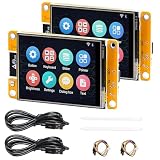
- 1.2.8" Smart Touch Screen Display for IoT Projects This ESP32 CYD 2.8-inch module features a 240×320 TFT LCD touch screen with ILI9341 driver, providing clear visuals and smooth interaction. Ideal for building smart control panels, IoT dashboards, home automation systems, and DIY electronics projects.
- 2.Powerful Dual-Core ESP32 Performance (240MHz) Built on the ESP32-D0WDQ6 dual-core processor, running up to 240MHz, this development board delivers stable performance for embedded systems, wireless communication, and real-time control applications with low power consumption.
- 3.WiFi + Bluetooth + Arduino Compatible for Easy Development Integrated 2.4GHz WiFi and Bluetooth dual-mode connectivity enables wireless communication, device control, and remote interaction. Fully compatible with Arduino IDE, making it easy to develop IoT devices, smart home systems, and wireless monitoring solutions.
- 4.2 Pack Value Kit + Rich Hardware Interfaces Comes as a 2-pack set for batch development and prototyping, supporting UART, SPI, I2C, PWM, ADC, and DAC interfaces. Built-in TF card slot allows data storage, logging, and project expansion for IoT applications.
- 5.Designed for Real IoT & Smart Applications Supports OV2640 / OV7670 camera modules for image capture and wireless transmission. Widely used in smart home systems, wireless monitoring, smart agriculture, environmental data collection, and remote parameter control applications.
Seven projects to consider
1. Touchscreen information dashboard
Put a clock, network status, and a few useful readings on one screen. Wi-Fi and the integrated display make this a natural compact dashboard concept, while touch can provide simple page or setting navigation. The data source and software implementation depend on what you want to monitor; the board documentation does not prescribe either.
2. Home-control panel
Build a touchscreen interface with large buttons and status indicators that communicates with a separately configured home-automation system. The CYD is the user interface, not a mains-load switch. Use suitable external control hardware where needed, and verify the board’s exact pins before connecting anything.
Rank #2

- ESP32 S3 Controller: Dual-core 32-bit microprocessor up to 240 MHz, 16 MB flash, 8 MB PSRAM, 512 KB SRAM, 384 KB ROM, 2.4 GHz Wi-Fi and Bluetooth 5 (LE), with USB-C code uploader
- Touch screen: 3.5 inch, 320x480 pixel, IPS type TFT wide viewing angle, fully laminated display (zero-air-gap screen), 4-wire SPI communication, up to 5-point capacitive touch screen
- Talk to AI (LLM): Ask anything in any field and it will chat with you like an expert (Note: Relies on free third-party AI services, requires registration and login)
- Ports and devices: Memory card slot, USB-C port, serial port, I2C port, I/O pin port, battery port, RGB LED, BOOT key, RESET key, microphone, speaker port (Comes with a speaker)
- Tutorial and code: Example projects for ESP32-S3 and LVGL GUI library, and connection with AI (The tutorial link can be found on the product box, no paper tutorial)
3. Offline photo viewer or media browser
Use the microSD slot as the starting point for browsing image files, with touch navigation between items. The board reference establishes the card slot and touchscreen, but does not establish image-library compatibility, supported file formats, or card requirements. Confirm those details for the chosen software and board before preparing media.
4. Sensor status screen
Connect a project-specific sensor through appropriate exposed pins and display current readings or a simple trend. Community project notes identify I2C-capable pins for the referenced board, but the correct wiring depends on the CYD variant and sensor. Check both pinouts before connecting modules.
Rank #3

- Controller: Adopts ESP32-WROOM-32 module, dual-core MCU, integrated Wi-Fi and Bluetooth, main frequency up to 240MHz, memory of 520KB SRAM and 448KB ROM, 4MB flash memory.
- Touch Screen: 2.8-inch LCD color screen, resolution of 240x320, supports 16-bit RGB 65K color display, rich colors, with resistive touch function.
- Multi-function: Contains LCD display, backlight control circuit, touch screen control circuit, speaker drive circuit, photosensitive circuit and RGB-LED control circuit.
- Rich expansion interface: Equipped with TF card interface, serial port interface, temperature and humidity sensor interface (DHT11 interface) and reserved IO interface.
- Convenient Development: Provides compatible with Arduino library functions and sample programs, supports one-click download of programs, and supports Arduino IDE, ESP IDE, Micropython and Mixly development.
5. Small touchscreen game
A simple puzzle, reaction test, or other interface-driven game can make use of the color screen and touch input. Keep the idea suited to a compact display and embedded board: the available sources do not provide performance benchmarks for particular games.
6. RGB LED and light-sensor control panel
Create a small interface to change the onboard RGB LED or show light-sensor values, if your board includes those components. The referenced board documentation lists them, but their presence and pin configuration should be confirmed on the specific unit.
Rank #4

- ESP32 WIFI&Bluetooth Development Board 2.8 inch LCD TFT Module 240*320 Smart Display Screen With Touch for Arduino
- ESP32-2432S028 development board is based on the company's ESP32-D0WDQ6 controller,dual-core CPU, clock frequency up to 240MHZ,integrates a wealth of resource peripherals,high-speed SDIO, SPI, UART and other functions, supports automatic download.
- Application: Home smart device image transmission, Wireless monitoring, Smart agriculture QR wireless recognition, Wireless positioning system signal, And other IoT applications
- Support interface (2Mbps) UART, SPI, I2C, PWM; Support TF card, maximum support 4G
- 520 KB SRAM, 32Mbit SPI Flash, 520KB internal RAM
7. LVGL interface prototype
Use a menu, button panel, or instrument-style screen to explore embedded user-interface design. A published example describes an ESP32-2432S028R demonstration using Arduino and LVGL 9.1; treat that version-specific setup as a starting reference rather than a current compatibility guarantee. See the LVGL demonstration and the community setup and example resources.
The Tool Desk
Outbyte Driver Updater FREEFix the driver behind crashes, sound loss and screen glitchesFind Drivers →Outbyte PC Repair FREERepair Windows errors before they cause bigger problemsFix Now →Choose a project by what you want to build
| Project direction | Main purpose | Extra hardware or setup |
|---|---|---|
| Information dashboard | Show useful live or local information | Choose a data source and implement its software connection |
| Home-control panel | Control or check a separate home-automation system | Separate system configuration; external control hardware if required |
| Photo or media browser | Browse local files on a screen | microSD card; confirm software compatibility and file requirements |
| Sensor status screen | Display readings and simple trends | Project-specific sensor and verified wiring |
| Touchscreen game | Make an interactive game | Game software tailored to the board |
| LED and light-sensor panel | Control or display onboard component behavior | Confirm the components and pin configuration on the board |
| LVGL prototype | Learn embedded interface design | Compatible display setup and UI software configuration |
There is no consistent difficulty or cost ranking established for these ideas. Think first about whether you want to display information, browse local files, control a separate system, play, or learn interface design; then account for any sensors, actuators, card storage, and wiring your chosen implementation requires.
Quick Recap
Best Value

- 2.8 Inch Resistive Touch Display: Each board combines a 240 × 320 TFT with resistive touch input for menus, sensor dashboards, controls and compact graphical interfaces
- ESP32 Dual-Core Platform: Built around an ESP32 module with dual-core processing up to 240 MHz, 4 MB Flash and 520 KB SRAM for embedded and IoT projects
- 2.4 GHz Wi-Fi + Bluetooth 4.2: Supports 802.11 b/g/n Wi-Fi plus Bluetooth 4.2 BR/EDR and BLE for wireless dashboards, monitoring and connected-device projects
- 4 MB Flash + 520 KB SRAM: Onboard memory supports embedded applications, while labeled expansion connections provide access to compatible SPI, UART, speaker and project peripherals
- 2-Pack with Accessories: Includes two ESP32 touch display modules, two acrylic protectors, two USB-C data cables, 2 stylus/tools and 2 installation-hardware sets
Check the exact board before wiring or ordering
- Read the model printed on the board and compare it with the tutorial’s target model.
- Verify the display controller, touch controller, and pin map rather than assuming all CYD variants are interchangeable.
- For a sensor or actuator project, check the board and module pinouts before connecting them.
- For a media project, confirm supported formats and card requirements in the software instructions; the board’s card slot alone does not establish compatibility.
Product prices and availability are accurate as of the date/time indicated and are subject to change. Any price and availability information displayed on Amazon at the time of purchase will apply.

