
iTechGuides is reader-supported. When you buy through links on our site, we may earn an affiliate commission. As an Amazon Associate I earn from qualifying purchases. Learn more
Cheap x86 mini PCs can be a better buy than a fully equipped Raspberry Pi when you need a general-purpose desktop or a small home server: many include memory, SSD storage, a case, and a power supply, and x86 compatibility can simplify software choices. But the Raspberry Pi is not obsolete. GPIO, compact embedded deployments, Power over Ethernet, and low-power or battery-powered projects remain strong reasons to choose one.
What “better value” actually means
A bare Raspberry Pi board is not the same purchase as a ready-to-use mini PC. For a fair comparison, count the parts needed for the job: power supply, storage, case, cooling, and any expansion hardware. A Pi build that adds an NVMe HAT and SSD may cost substantially more than its board-only price, while a mini PC’s included parts vary by model and exact configuration.
“Mini PC” is a category, not a fixed specification. Processor generation, RAM, storage, cooling, ports, and upgrade options differ across models and SKUs. Confirm what the specific listing includes rather than assuming that every inexpensive unit has the same capabilities.
Free tools Windows power users keep installed
One-click scans. No signup required.
There is no cited market-wide adoption statistic establishing that mini PCs are replacing Raspberry Pis. The evidence available is made up of dated product-price examples, an illustrative cost model, and individual reviewer tests—not proof of a broad shift in ownership.
#1 Best Overall

- 【AMD Ryzen 4300U True 4-Core CPU: Outperforms N95 & i3-10110U】KAMRUI P2 Mini PC is equipped with true 4-core AMD Ryzen 4300U processor built on advanced 7nm Zen2 architecture,This means you get consistent, unthrottled performance for hours on end, whether you’re running multiple browser tabs, streaming 4K content, or managing virtual machines. Compare that to Intel N95 (4 efficiency cores that throttle under load) or Intel i3-10110U (only 2 cores total), and the difference is night and day: The KAMRUI P2 AMD Ryzen 4300U (28W) is 40% faster than the Intel i3-10110U and 25% faster than the Intel N95 in multi-core tasks, ensuring smooth, lag-free performance even during heavy workloads.
- 【Integrated AMD Radeon Graphics: 2.5X Stronger for Tri 4K】The KAMRUI P2 AMD 4300U Mini PC have unlocked the full potential of the built-in AMD Radeon Vega 5 graphics with 28W power delivery, making it 2.5 times stronger than the Intel UHD graphics found in the N95 and i3-10110U. This means you can enjoy Tri 4K@60Hz displays without a single stutter, perfect for productivity setups, home theaters, or even light photo/video editing and casual gaming. While the Intel N95/i3-10110U struggle to run a single 4K display without lag, The KAMRUI AMD 4300U Mini PC handles Tri 4K effortlessly, turning your workspace into a high-efficiency hub or your living room into a premium entertainment center.
- 【Large Storage Capacity, Easy Expansion】KAMRUI Pinova P2 mini computers is equipped with 16GB LPDDR4 for faster multitasking and smooth application switching. 512GB M.2 SSD ensures fast startup, fast file transfers and plenty of storage space,eliminating slow loading times and ensuring fast responsiveness. the two storage slots (1x M.2 2280 SATA/NVMe PCIe3.0 slot, 1x M.2 2280 SATA slot) can be combined to provide up to 4TB of total storage(Not included). This gives you enough space for all your projects, media and data.
- 【4K Triple Display】KAMRUI Pinova P2 4300U mini desktop computers is equipped with HDMI2.0 ×1 +DP1.4 ×1+USB3.2 Gen2 Type-C ×1 interfaces for faster transmission, Triple 4K@60Hz Display, KAMRUI P2 mini computer is ideal for visual home entertainment, home office, conference rooms, etc. USB3.2 Gen2 Type-A port ×2 with a transfer speed of up to 10 Gbps (21 times faster than USB 2.0) for efficient data transfer. Ideal for seamless multitasking between spreadsheets, browsers and presentations, or for an immersive entertainment experience.
- 【USB3.2 Gen2 Type-C 10Gbps, Versatile connectivity】KAMRUI P2 mini desktop pc fast and versatile connectivity! The USB3.2 Gen2 Type-C port offers a data transfer rate of 10Gbps and simultaneously supports DisplayPort 1.4 video output. The P2 AMD Ryzen 4300U Mini PC is complemented by Gigabit LAN, WiFi and Bluetooth, so nothing stands in the way of a productive working environment.
How the two choices differ
| What matters | Cheap x86 mini PC | Raspberry Pi |
|---|---|---|
| Typical fit | General desktop use, heavier self-hosting, several services, and some virtual-machine workloads; results depend on the model and configuration. | Single-purpose, lighter server duties and embedded projects that fit the board’s resources. |
| Software | Often a convenient choice for standard x86 Windows or Linux applications and software without a suitable ARM build. Check individual application and container-image support. | Well suited to Pi-focused guides, GPIO integrations, and projects built around its software and maker ecosystem. |
| Memory and storage | Many models include RAM and an SSD; some offer internal NVMe or additional drive expansion. Verify the exact SKU. | Many builds use microSD storage by default. NVMe requires compatible add-on hardware and adds to the build cost. |
| Hardware access | Standard PC ports and model-dependent expansion; the mini PCs in this comparison do not have a native Pi-style GPIO header. | GPIO and the board form factor support sensors, electronics, and custom hardware. |
| Deployment and power | Useful when a ready-made PC is the priority and wall power is available. Measure the exact system for an always-on setup. | Can suit PoE, very compact installations, and battery-, solar-, or remote-power constraints. Actual draw depends on workload and peripherals. |
What the published price examples show
These examples illustrate how configurations and prices have varied; they are not current price quotes. The listed dates and included parts matter as much as the headline number.
| Example | Reported price and configuration | How to read it |
|---|---|---|
| Raspberry Pi 5 bundle | $246.95 in Jeff Geerling’s January 2026 comparison: 16GB Pi 5, 512GB SSD, 27W power supply, bumper case, and RTC battery. | A complete, accessorized build—not the price of a bare board. |
| GMKtec NucBox G3 Plus | $246.99 in the same January 2026 comparison. | A reported listing example, not a guarantee of today’s price or of every configuration’s contents. |
| Beelink S13 | $259 in Tom’s Hardware’s January 2026 report; the article also gave an earlier August 2025 example of $159. | Shows that a model’s cited listing price can change over time. |
| Acemagic Vista V1 | $217.54 in Tom’s Hardware’s January 2026 report; its earlier August 2025 example was $158. | Another dated listing comparison, not a general mini-PC price. |
| Geekom Air12 Lite | $199 in Tom’s Hardware’s January 2026 report for the cited N100 configuration with 8GB RAM and a 256GB SSD. | Keep the RAM and SSD configuration attached to the price. |
| Illustrative self-hosting build | Selfhosting.sh’s model, accessed October 2026, priced a Pi 5 8GB build with official PSU, NVMe HAT, 256GB SSD, case, and active cooler at about $147, versus about $155 for an N100 mini PC with 16GB RAM, 500GB SSD, PSU, and case. Its modeled three-year electricity costs at $0.12/kWh brought totals to $163 and $180, respectively. | This is that publisher’s calculation using its assumptions, not a universal quote or a forecast for every system. |
Raspberry Pi’s February 2, 2026 announcement said the 1GB Pi 4 variant was $35, the 1GB Pi 5 launched at $45 in December, and the Pi 400 remained a $60 all-in-one PC. Those were announced product prices, not assurances of current retail pricing. The announcement also said increases applied to Raspberry Pi 4/5 and Compute Module 4/5 products with 2GB or more of memory: $10 for 2GB, $15 for 4GB, $30 for 8GB, and $60 for 16GB. It said 1GB products were protected at that time and described the situation as temporary. Eben Upton wrote, “Price rises have accelerated as we enter 2026, and the cost of some parts has more than doubled over the last quarter.” Raspberry Pi’s February 2, 2026 announcement provides the date and context; check current regional listings before buying.
Tom’s Hardware’s January 2026 examples showed near price parity between one accessorized Pi bundle and one mini PC, while several sampled mini-PC listing prices were higher than earlier 2025 examples. That is evidence about those products and dates, not proof that the two categories always cost the same.
Recommended Free Tools
Performance and electricity depend on the exact system
In his testing, Jeff Geerling found the DDR4 N100 mini-PC configurations he tested ahead of the Pi 5 in raw performance; his NucBox G3 measured between 1.5 and 2 times as fast depending on the benchmark. He also noted that thermal behavior and power limits matter, and reported lower work-per-watt efficiency for the tested N150 than for the Pi 5. These results apply to his tested systems and benchmark suite, not every mini PC or workload. Geerling’s comparison discusses the individual tests and purchasing trade-offs.
For an always-on device, estimate electricity cost from the system’s measured idle or typical draw and your local electricity rate. Adapter wattage and processor TDP are not measurements of whole-system energy use. Geerling’s discussion of annual cost uses an assumed draw difference and electricity rate; actual results depend on the hardware, peripherals, workload, and local tariff. Efficiency matters especially when power is limited by a battery, solar setup, or remote PoE installation.
Rank #2
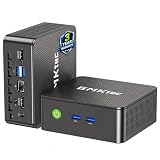
- WHY CHOOSE G3 ULTRA MINI PC PENTIUM GOLD 7505 - Choose the Intel Pentium Gold 7505 for snappier everyday responsiveness: It delivers up to 30% faster single-core performance than the Ryzen 5 3500U, making office apps and web browsing feel noticeably quicker, while its Intel UHD Graphics (48 EUs) provides 2.4x the GPU performance of the N100 & N150's 24-EU graphics, ensuring smoother 4K streaming and light photo editing.
- 16GB RAM MEMORY & 512GB STORAGE - GMKtec Nucbox G3 Ultra mini computer is prebuilt with 16GB LPDDR4 RAM at 3200 MT/s, you will enjoy a speedier experience with Built-in 512GB M.2 SATA Hard Drive. Our mini desktop pc boots up in seconds, work on multiple browser tabs, software applications and quickly transfers files. There is a primary slot and secondary expansion storage. Primary slot is M.2 2280 PCIE and secondary slot is M.2 2280 SATA.
- RICH INTERFACE - Nucbox pentium mini computer is equipped with 3* USB 3.2 Gen2 ports, up to 10Gbps/S, 1*USB 2.0, HDMI(4K@60Hz)*2, 3.5mm Audio Jack. Supports WiFi 6, and Gigabit Ethernet RJ45 2.5GbE network connectivity, Bluetooth 5.2. This Mini PC supports multiple device connection and can be used with servers, monitoring equipment, office equipment, displays, projectors, televisions, etc.
- 4K DUAL SCREEN DISPLAY - Mini desktop computer is equipped with upgraded Intel Graphics(max 1000MHz), supports 4K video playback and AV1 decoding, connect the pc with a projector as a home theatre, enjoy a variety of entertainments. Two HDMI 2.0 ports allows you to multi-task efficiently on two 4K@60Hz displays.
- UPGRADED COOLING FAN - The G3 Ultra has upgraded the cooling fan to reduce fan noise and thermals. We are using an upgraded thermal paste as well to help reduce heat on the CPU.
Choose by workload, not by the headline
Choose a mini PC for a general desktop or software compatibility
If you want a small computer to run ordinary desktop applications, standard x86 Windows or Linux software, or workloads that need more memory and storage, a mini PC may be the more straightforward purchase. Its included RAM and SSD can make the complete-system cost attractive. Check the exact processor, memory, storage, ports, and operating-system support, and confirm compatibility for the applications and container images you plan to use. ARM support varies; it is not accurate to assume that every relevant application or image is unavailable.
Choose a mini PC for heavier self-hosting or some virtualization
For multiple services, heavier self-hosting, or virtual machines, the extra memory, storage, and processor headroom of a particular mini PC may matter more than the board’s entry price. Match the machine to the services you will actually run, and check software architecture support and expansion limits. A mini PC is not automatically faster or better value simply because it uses x86.
Selfhosting.sh’s comparison likewise treats workload and software support as decisive factors in its N100-versus-Pi analysis. Its benchmark and compatibility figures are the publisher’s own analysis, not universal industry measurements. Read its configuration, cost-model, and workload assumptions alongside your own requirements.
Choose a Pi for GPIO, PoE, or a constrained installation
A Pi remains a natural fit when the project needs its GPIO header, Pi-specific guides or integrations, or a compact board that can be incorporated into custom hardware. Its PoE and low-power deployment options can be valuable for installations where space, cabling, or energy supply is constrained. Compare the complete hardware needed for the project, including any HATs or storage, rather than treating them as required for every Pi build.
For a first maker or education project, value includes the ecosystem
When the goal is learning electronics, following an established tutorial, or connecting sensors and components directly, the Pi ecosystem and GPIO may save time even if another computer offers more raw performance. A microcontroller can be a better fit for a dedicated control task, but it is not a general-purpose mini PC. Other single-board-computer families are options too, but support and software vary by model: RaspberryTips’ September 2026 alternatives guide notes more limited official OS support for the Radxa ROCK 5C and possible reliance on community images. Check the board revision, current price, and operating-system support before choosing an alternative.
Rank #3

- 12th Intel Alder Lake N95 Processor – The GMKtec G3 S Mini PC is powered by the 12th Gen Intel N95 processor with 4 cores, 4 threads, 6MB cache and a burst frequency up to 3.4GHz. Compared with N100/N5105/N5100/N5095, the N95 delivers up to 36% overall performance improvement. Perfect for routine tasks, office work, and home entertainment, this compact mini desktop is more convenient than traditional bulky PCs.
- 8GB RAM & 256GB SSD Storage – Pre-installed with 8GB DDR4 memory and a fast 256GB M.2 2242 SSD, the G3 S mini desktop offers quicker startup, smoother multitasking, and faster file transfers. Enjoy seamless performance whether you’re working on multiple applications, browsing, or streaming content.
- Rich Interfaces & Connectivity – The G3 S mini computer comes equipped with USB 3.2 (up to 10Gbps), dual HDMI 2.0 (4K@60Hz), and a 3.5mm audio jack. With support for WiFi 5, Bluetooth 5.0, and Gigabit Ethernet (RJ45 1000MbE), it connects easily with monitors, projectors, printers, office equipment, and other peripherals, making it versatile for both home and business use.
- Dual 4K Display Support – Featuring upgraded Intel UHD Graphics (up to 1000MHz), the G3 S supports 4K video playback and AV1 decoding for a smooth viewing experience. With dual HDMI outputs, you can connect two 4K@60Hz displays simultaneously, enabling efficient multitasking for work and entertainment.
- GMKTEC WARRANTY - GMKtec offers a 3-year limited warranty (1 year replacement + 2 years parts replacement) for each mini PC, starting from the date of the purchase effective on all sales starting Oct. 2026. All defects due to design and workmanship are covered. With a professional after sales team always ready to attend to your needs, you can simply relax and enjoy your mini PC
How to make a fair buying comparison
- Write down the job. Separate desktop use, self-hosting, GPIO work, education, and remote or battery-powered deployment; they reward different features.
- Price complete configurations. For the Pi, include only the parts your project requires, such as power, case, cooling, microSD or NVMe storage, and HATs. For a mini PC, verify included RAM, SSD, power supply, case, and warranty.
- Check software before hardware. Confirm that the operating system, application, container image, and any required peripheral support work on the intended architecture.
- Compare measured power if it will run continuously. Look for draw under the workload and at idle, then apply your electricity rate. For battery or solar use, consider the power source and deployment constraints directly.
- Check current local pricing and support. Prices in the cited comparisons are dated, and configurations or availability can change. Include warranty, seller reliability, and upgrade options in the decision.
Other options worth considering
A refurbished business micro PC is a separate option from a new low-cost mini PC. Jeff Geerling describes a supply of used business Tiny/Mini/Micro systems roughly three to five years old, which can offer expansion and value. Assess the specific machine’s condition, processor generation, power use, warranty, and seller reliability; used prices should not be treated as directly comparable to new-product listings.
What’s actually slowing this PC down?
Pick the symptom - the matching free tool is one click away.
Alternative single-board computers—including Orange Pi, Banana Pi, Odroid, Libre Computer, and Radxa boards—need model-by-model evaluation. Their software support, storage, networking, and community resources are not interchangeable with those of a Raspberry Pi. RaspberryTips’ alternatives guide describes several board families and their support trade-offs.
Verdict: the Pi is no longer the automatic choice
For a general desktop or a self-hosting build that benefits from x86 compatibility, included memory and SSD storage, or more compute headroom, a well-chosen mini PC can be the stronger complete-system purchase. For GPIO projects, Pi-centered learning, PoE, and compact low-power deployments, the Raspberry Pi still has practical advantages. Compare the exact machine and complete build for your task; the price examples and reviewer benchmarks do not establish that mini PCs have displaced the Pi.
Mini PC specifications vary enough that the model matters as much as the category. TechRadar’s 2026 mini-PC guide illustrates the range of configurations; use the exact listing and manufacturer details when making a purchase decision.
Quick Recap
Product prices and availability are accurate as of the date/time indicated and are subject to change. Any price and availability information displayed on Amazon at the time of purchase will apply.
The Tool Desk
Outbyte Driver Updater FREEFix the driver behind crashes, sound loss and screen glitchesFind Drivers →Outbyte PC Repair FREERepair Windows errors before they cause bigger problemsFix Now →
