
The Tool Desk
Outbyte PC Repair FREERepair Windows errors before they cause bigger problemsFix Now →Outbyte Driver Updater FREEFix the driver behind crashes, sound loss and screen glitchesFind Drivers →iTechGuides is reader-supported. When you buy through links on our site, we may earn an affiliate commission. As an Amazon Associate I earn from qualifying purchases. Learn more
Yes, but only when the game is designed to make one input carry more than one meaning. Timing, press duration, sequence, context, and alternate controls can turn a single button into a compact control language. That can support serious decision-making and layered mechanics, although it cannot provide the same simultaneous action bandwidth as a conventional gamepad.
The important distinction is between complexity and control count. A game may demand difficult timing, positioning, resource choices, or progression with very few physical controls. It struggles when success depends on independently moving, aiming, changing the camera, dodging, and activating several abilities at the same instant.
What “complex” means on a one-button device
For this question, a complex game is one with a meaningful decision load or layered mechanics, not simply one with many buttons. A game can be deep if it asks you to plan several moves ahead, manage limited resources, recognize patterns, combine actions, or adapt to changing states.
Crashes, No Sound, or Screen Glitches?
Random freezes, missing sound and display glitches usually trace back to one bad driver. Find and replace yours safely.Free scan · under a minuteWindows Errors? Fix Them Before They Spread
Repair common Windows errors and clear accumulated junk for a smoother, more stable PC - no reinstall needed.Free scan · no reinstallA one-button interface is a poor fit when the player must issue several unrelated commands at once with very little time to distinguish them. If movement, camera control, aiming, attack, dodge, inventory, and a special ability all need independent inputs during the same encounter, removing buttons creates ambiguity rather than interesting challenge.
#1 Best Overall

- 【Game Console with Linux Stylem】Comes with 64G TF Card Preloaded 5570 Classic Games,Support users to download games in relevant 15 kinds of games formats.
- 【supports 5G WIFI Bluetooth 2.4G Wireless Gamepad and Wired Gamepad Connection】 HDMI and TV output function makes the small screen become big screen in seconds, and the joystick connection supports multiplayer games, so you and your friends can enjoy the game together.
- 【3200 mAh Li-polymer battery and 3.5 INCHES OCA IPS screen】you can use for 6-7 hours, support fast charging with USB Type-C cable, With 3.5-inch IPS full viewing angle, zero distance OCA full-fit screen,the screen resolution is 640*480,Sharper picture quality and more saturated colours.
- 【Chip upgrade】with quad-core ARM Cortex-A53, Quad-core PowerVR SGX544MP GPU,makes have the characteristics of low power consumption and high performance. the Ram of the is LPDDR4 1GB, the larger the RAM running memory, the faster the system response time will be.
- 【Ideal gifts】Dimensions of Handled game :12.8cm*8.1cm *2.2cm,is a good size in the hand and is suitable for carrying aroundis a great gift for boyfriend, husband, brother, son, father and friends for birthday, Father's Day, Christmas, Valentines Day, Thanksgiving Day etc. Get lots of compliments on how it’s interesting or practical.
The useful test is whether the game’s actions can be serialized (performed one after another), made context-sensitive (the same input means different things in different states), or expressed through another channel such as a crank, touch gesture, tilt, or directional pad.
How one input carries several actions
A single physical button does not have to represent only one command. It can encode several commands by varying when, how long, or in what situation it is pressed. Kongregate’s description of one-button games uses this principle: every action uses one input, while timing and duration provide the difficulty.
| Technique | How the player signals it | What it is good for | Main trade-off |
|---|---|---|---|
| Timing | Press at a particular moment in a cycle or event | Jumps, parries, rhythm, stopping a moving cursor | Errors can feel unforgiving if the timing window is narrow |
| Duration | Tap briefly, hold, or release after a measured interval | Charging an attack, steering, selecting a strength, sprinting | Players must learn exactly when a hold starts and ends |
| Sequences | Press, then press again or combine a press with another channel | Combos, mode changes, confirmation followed by an action | Extra steps increase memory and input latency |
| Context | Use the same button while the character, menu, or target is in a different state | Talk, pick up, open, attack, or interact with the nearest valid object | The game must communicate what the next press will do |
| Alternate gestures | Double-tap, touch-and-hold, swipe, tilt, crank, or directional input | Separating commands without adding another face button | Gestures can be less discoverable or less comfortable |
Apple’s control guidance explicitly recommends combining functionality into one control and using variations such as a tap, double-tap, and touch-and-hold. It also gives combining related actions, such as walking and sprinting, as a legitimate pattern. Microsoft’s touch-control guidance describes assigning multiple actions to one control, including simultaneous-action mappings and “pull” actions for compound behavior. These are not merely accessibility workarounds; they are established ways to increase the information carried by a small interface.
Quick wins for a faster PC:
Fix the driver behind crashes, sound loss and screen glitchesFind Drivers →Clear out junk files and repair common Windows errorsFree Scan →Scan for outdated or missing drivers - takes under a minuteDriver Scan →Why a conventional gamepad feels easier
A modern handheld exposes a large input budget. Microsoft’s handheld guidance lists A, B, X, and Y buttons; left and right bumpers; left and right triggers; two thumbsticks; a d-pad; and menu and view buttons. A game can give each of those a stable assignment, so movement, camera, attack, jump, dodge, inventory, and menus remain available independently.
With one physical button, the game must multiplex those actions. The player is effectively learning a small language: a short press may confirm, a hold may charge, a press while moving may jump, and the same press near an object may interact. The challenge shifts from finger reach and simultaneous coordination to timing, state recognition, and remembering the rules.
Rank #2
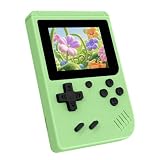
- 3.0 Inch Vivid IPS Disilay: This handheld gaming console comes with a 3.0 inches IPS screen, ensures your enjoys a crystal-clear gaming experience, making every detail come alive.While the vivid colors and sharp images create an immersive world for to explore.Whether on a road trip or just having fun at home, this screen will immerse in the game's world like never before.
- Pre-loaded Classics: This new style of handheld game console is designed to bring fun to young gamers, built-in different classic games. No matter what kind of games you want, you can find them in this retro game console. Let you play games without repetition every day and bring back your memory to the fun,enjoy family entertainment time.
- Friendly Design: This retro game console features an innovative ergonomic design, with a look and feel perfectly suited, making it even more comfortable for to use. Available in beautiful bright and natural colors, handheld video console combines nostalgia with modernity.
- Rechargeable and Uninterrupted Gaming: This video game console comes with a rechargeable battery, one charge is enough to support 5 hours of seamless gaming experience, Your little ones can free to enjoy their favorite games on the go, without worrying battery life.
- Portable & Easy to Use:Lightweight and compact, It fits easily in your pocket or backpack,perfect for travel or sharing with friends.c Plug in and play anywhere, making it the ideal companion for road trips, playdates, or just a rainy day indoors.With a user-friendly interface and intuitive controls, even can navigate through the game library with ease. No complicated setup required – just switch it on and play!It's the ultimate gift for any who who loves gaming!
| Control situation | Many-button handheld | One-button design |
|---|---|---|
| Two actions needed at once | Assign each action to a separate button or stick | Usually serialize them or use an additional channel |
| Camera and movement | Often independent on two sticks | Must be automatic, context-driven, or redesigned |
| Attack strength | Separate light and heavy buttons or an analog trigger | Press duration, release timing, or a state-based choice |
| Menus and inventory | Dedicated menu/view controls plus navigation | Long press, sequence, or a separate directional/gesture input |
| Learning burden | More controls to remember, but assignments stay stable | Fewer physical controls, but each may have several meanings |
Playdate is a constrained-input example, not literally a one-button console
Playdate is the clearest handheld example for this question, but calling it a one-button system would be inaccurate. Its official store describes a small yellow game system with a crank, and lists a d-pad plus A and B buttons. The manual explains that the crank folds out from the bottom and that the menu button can pause a game, open options, or return home.
That combination places Playdate between a literal one-button toy and a full modern gamepad. The d-pad supplies directional input, A and B provide discrete actions, and the crank adds an analog-like rotational channel. A developer can therefore reserve the crank for continuous or directional movement while using buttons for confirmation, attack, or jump.
Why the crank changes the design space
Rotation is not just another button press. Its direction, speed, angle, and stopping point can all carry information. A game can ask you to wind, steer, aim along an arc, reel, or adjust a value without consuming a face button. Because the crank is physically distinct, it can also separate two actions that would otherwise need timing or context to disambiguate.
The crank does not eliminate the need for good interface design. Players still need to know whether turning clockwise differs from counterclockwise, whether a partial turn has meaning, and what happens if the crank is left extended. A mechanic that depends on precise rotation should provide clear feedback and a fallback where possible.
Fallback mappings are a useful quality test
Playdate’s developer guidance says, “When possible, provide d-pad alternatives to crank controls.” Its example maps a single jump action to the A button, B button, up on the d-pad, or a crank turn. This illustrates a broader rule: a mechanic is more robust on a constrained device when equivalent actions can be expressed through more than one channel.
Rank #3

- 139 Exciting 32-Bit Games: Featuring 139 handpicked 32-bit video games,this new style of handheld game console is designed to bring fun to young gamers. Categorized into various genres like Casual, Puzzle and Sports, it doesn't take much thinking to pick your favorite game
- Bigger and More Vibrant 3.0" IPS Display: With its 3.0" IPS screen, this handheld video game offers vibrant graphics and a user-friendly interface that makes gameplay seamless and enjoyable. As a travel toy or at home, the vivid colors and sharp images will immerse children a crystal-clear gaming experience
- Innovative Design: Featuring an innovative ergonomic design, this game console is compact and lightweight, making it easy for small hands to hold and comfortable to play. The arcade-style joystick provides players with a precise control experience. Available in beautiful bright and natural colors, handheld video console combines nostalgia with modernity
- Rechargeable and Uninterrupted Gaming: Say goodbye to disposable batteries! Our mini handheld games come with rechargeable battery that can be easily recharged via a convenient USB-C cable, making it a great choice for gaming on the go
- Kid-friendly Game Guide: Detailed game guide in the user manual, which will help your baby master each game easily. As an ideal toy gift for birthdays, Christmas or Easter and other festivals, it will bring great surprise and joy to your little heart
Fallbacks help players who cannot comfortably use the crank, but they also improve discoverability and recovery. If a player misses the intended crank gesture, an ordinary button or directional input can still reveal what the action does. A game does not need four mappings for every command; the important actions should have a dependable route.
What Season One does and does not prove
Playdate Season One contains 24 original games. After setup, two new games are delivered every Monday Pacific Time for twelve weeks, for 24 games in total. That bundle demonstrates variety on a constrained device; it is not evidence that every included game is mechanically complex or that every player will prefer the controls.
Game structures that suit very few controls
The strongest candidates make decisions sequentially or let the game manage routine actions automatically.
- Timing and rhythm: The central question is when to press, not which of several buttons to reach. Difficulty can come from changing patterns, shorter windows, or layered rhythms.
- Puzzles: A single action can manipulate objects while the challenge comes from planning order, spatial relationships, and limited attempts.
- Turn-based systems: If the game pauses between decisions, the player has time to navigate a compact command language instead of issuing several inputs simultaneously.
- Resource and progression games: Choosing whether to spend, save, upgrade, or retreat can be complex even when each choice is confirmed with one button.
- Contextual adventure interactions: A nearby-object system can make one press mean talk, pick up, open, or use, provided the game clearly signals the current context.
- Automatic or assisted movement: When the game handles routine locomotion, the remaining input can focus on timing, direction changes, or tactical choices.
These patterns are not automatically simple. Their complexity lives in prediction, prioritization, and consequences rather than in the number of simultaneous commands.
Independent reader supportYour contribution helps us test, update, and keep practical guides available for everyone.Where one-button control breaks down
The weakest fit is a game that requires several independent, low-latency actions at once. A conventional action game may expect the player to move, rotate a camera, aim, fire, dodge, swap equipment, and trigger an ability during one encounter. If those commands are all collapsed into a button’s timing and context, the player spends effort decoding the interface instead of making the intended tactical decision.
Do these 3 things before closing this tab:
1Scan for outdated or missing drivers - takes under a minute2Repair Windows errors before they cause bigger problems3Fix the driver behind crashes, sound loss and screen glitchesRank #4

- 3.0 Inch Vivid IPS Disilay: This handheld gaming console comes with a 3.0 inches IPS screen, ensures your enjoys a crystal-clear gaming experience, making every detail come alive.While the vivid colors and sharp images create an immersive world for to explore.Whether on a road trip or just having fun at home, this screen will immerse in the game's world like never before.
- Pre-loaded Classics: This new style of handheld game console is designed to bring fun to young gamers, built-in different classic games. No matter what kind of games you want, you can find them in this retro game console. Let you play games without repetition every day and bring back your memory to the fun,enjoy family entertainment time.
- Friendly Design: This retro game console features an innovative ergonomic design, with a look and feel perfectly suited, making it even more comfortable for to use. Available in beautiful bright and natural colors, handheld video console combines nostalgia with modernity.
- Rechargeable and Uninterrupted Gaming: This video game console comes with a rechargeable battery, one charge is enough to support 5 hours of seamless gaming experience, Your little ones can free to enjoy their favorite games on the go, without worrying battery life.
- Portable & Easy to Use:Lightweight and compact, It fits easily in your pocket or backpack,perfect for travel or sharing with friends.c Plug in and play anywhere, making it the ideal companion for road trips, playdates, or just a rainy day indoors.With a user-friendly interface and intuitive controls, even can navigate through the game library with ease. No complicated setup required – just switch it on and play!It's the ultimate gift for any who who loves gaming!
- Independent camera and character control: Two continuous axes are difficult to replace without a stick, crank, or automatic camera.
- Many simultaneous abilities: A sequence or radial context menu can work, but it adds delay and memory demands.
- Fast inventory management: Cycling through many items with one control may be slow and error-prone.
- Precision aiming: If the game needs fine angular adjustment and immediate firing, a separate analog channel is usually necessary.
- Unclear context: When the same press can attack, talk, or pick up without a strong visual cue, mistakes feel like interface failures.
A constrained interface can still support a demanding version of a traditionally button-heavy genre, but the mechanics must be redesigned rather than merely remapped. Automatic targeting, pause-and-plan phases, fixed camera views, and generous input windows are design solutions, not compromises to hide.
How to evaluate a one-button game before you commit
- List the independent actions. Write down everything you must do during the busiest moment: movement, aiming, attack, defense, interaction, menu access, and so on.
- Mark simultaneous requirements. Circle actions that must happen at the same time. Several circled items indicate that you need a second channel, automation, or a slower game pace.
- Identify the encoding rule. Check whether the game distinguishes tap, hold, release timing, double-tap, sequence, and context. A control scheme is easier to learn when each distinction is consistent.
- Check alternate mappings. Look for d-pad, crank, touch, tilt, or button alternatives, especially for actions that otherwise depend on a gesture.
- Test the busiest minute, not the tutorial. Early sections can hide the real input burden. Try a late-stage encounter, a crowded menu, or a situation with several interactable objects.
- Measure recovery from mistakes. Confirm whether an accidental hold can be canceled, whether a missed timing window is recoverable, and whether the game explains the active context before accepting the next press.
- Decide whether the challenge is intentional. If difficulty comes from reading patterns and choosing well, the interface is probably doing useful work. If difficulty comes from guessing which meaning a press had, the mapping needs improvement.
Accessibility and comfort: what can and cannot be assumed
Fewer physical controls can reduce reach and finger travel, but it does not guarantee comfort or universal accessibility. Repeated tapping may cause fatigue; holding a button may be difficult for some players; crank rotation may be uncomfortable or impossible for others; and rapid sequences can create a different motor challenge from a conventional gamepad.
There is no controlled statistic establishing completion rates, comfort, or universal accessibility outcomes for one-button handhelds. Treat feasibility as game- and mapping-dependent. Look for remappable actions, adjustable timing windows, alternatives to crank or gesture input, pause functions, and clear state feedback rather than assuming that a smaller control set helps everyone.
Design checklist for developers
- Give every overloaded input a visible state cue before the press is made.
- Keep tap, hold, release, and double-tap meanings consistent across the game.
- Prefer automatic targeting or contextual selection when simultaneous aiming is not central to the game.
- Provide a d-pad or button alternative to a crank action whenever the mechanic allows it.
- Make menus usable without forcing the player to remember a long sequence.
- Allow pauses between decisions when a command has several steps.
- Use generous, configurable timing windows when precision is not the intended source of difficulty.
- Ensure that an input error can be canceled or recovered from without restarting an entire section.
Bottom line
A single-button handheld can play a complex game, but complexity must be expressed through timing, duration, context, sequencing, or an alternate input channel. It is best suited to games whose important decisions can be made one after another and whose controls teach a consistent language. It is least suited to games that demand several independent actions simultaneously.
What’s actually slowing this PC down?
Pick the symptom - the matching free tool is one click away.
Playdate demonstrates the middle ground: it is not a literal one-button console, because it has a d-pad, A and B buttons, a menu control, and a crank. Its design shows why constrained input can still support varied and demanding play when the hardware and software are built around the limitation.
Quick Recap
Product prices and availability are accurate as of the date/time indicated and are subject to change. Any price and availability information displayed on Amazon at the time of purchase will apply.

