
What’s actually slowing this PC down?
Pick the symptom - the matching free tool is one click away.
iTechGuides is reader-supported. When you buy through links on our site, we may earn an affiliate commission. As an Amazon Associate I earn from qualifying purchases. Learn more
Yes, NVIDIA says DGX Station systems can be linked for larger workloads, and it lists several large models as local-use examples. But the published specifications do not validate a particular two-cable setup or show that a model using LPDDR5X or a second station runs without a performance penalty. The key distinction is that 748 GB is a coherent address space spanning two physically different memory pools—not 748 GB of equally fast GPU memory.
What a DGX Station GB300 contains
NVIDIA describes DGX Station as a GB300 Grace Blackwell system: a Blackwell Ultra GPU connected to a 72-core Grace CPU through NVLink-C2C. Its development guide specifies up to 20 petaFLOPs of sparse FP4 AI compute. That is a manufacturer specification for sparse FP4, not a general measure of model-serving speed.
NVIDIA’s 2026 product specifications list the following memory and interconnect figures:
| Resource | Published specification | What it means for this setup |
|---|---|---|
| GPU memory | 252 GB HBM3e, up to 7.1 TB/s | The high-bandwidth GPU memory pool. |
| CPU memory | 496 GB LPDDR5X, up to 396 GB/s | Additional system memory, physically separate from HBM3e. |
| CPU-GPU link | NVLink-C2C at 900 GB/s | The connection specified between Grace and the GPU; it does not make both memory pools equally fast. |
| Networking | Two QSFP112 Ethernet ports, 400 Gb/s per port; ConnectX-8 networking up to 800 Gb/s | Provides the stated port and adapter capabilities. The specifications do not define a validated two-cable topology. |
| Total system power | 1,600 W | A published system specification, not a measured draw for a particular inference workload. |
These figures are manufacturer specifications, not independent measurements of a two-station inference cluster. The product page also lists optional RTX PRO Blackwell-generation GPUs, including RTX PRO 6000 Workstation Edition, RTX PRO 6000 Blackwell Max-Q, RTX PRO 4000 Blackwell SFF and RTX PRO 2000 Blackwell. Support depends on the system; confirm the configuration with its OEM.
#1 Best Overall

- Support for upto four 5K displays
- Four Mini DisplayPort 1.4 connectors with latching mechanism1
- DisplayPort with audio
- HDCP 2.2 support
- 3 Years warranty
Does 748 GB of coherent memory mean 748 GB at GPU speed?
No. The advertised 748 GB is the sum of 252 GB of HBM3e on the GPU and 496 GB of LPDDR5X on the CPU. NVIDIA describes them as one coherent memory space that the Grace CPU and GB300 GPU can address, but they remain separate physical pools with substantially different published bandwidths.
What coherent means in practice
Coherence concerns addressability and consistency, not uniform speed. In NVIDIA’s documented default Coherent Driver-based Memory Management mode, CPU memory allocated by the system is not migrated into GB300 GPU memory. NVIDIA also says GPU access to CPU memory is uncached and warns that transfers across the CPU/GPU boundary are limited by NVLink bandwidth.
For a model whose working set is larger than 252 GB, the LPDDR5X capacity may make local execution possible. Its performance will depend on which weights, activations and cache data are accessed from each pool, as well as how the inference software schedules those accesses. That is an architectural implication of the documented memory arrangement, not a benchmark result. NVIDIA recommends Unified Memory for ease of programming when a working set exceeds GPU memory; that recommendation is not a claim of zero latency or throughput cost.
Can two DGX Stations work on one model?
NVIDIA says ConnectX-8 can link multiple DGX Stations and describes connectivity of up to 800 Gb/s when a second station is paired with the first. Its development guide also says two systems can be linked for larger workloads. These are vendor capability statements; they do not specify how a particular model must be partitioned or establish its throughput, latency or scaling efficiency across two systems.
Whether a model can be split usefully depends on its architecture, precision, serving framework and configuration. Performance also depends on communication between systems, request concurrency and the placement of weights and the key-value (KV) cache. A network link’s rated speed alone does not show how much traffic a given workload generates or whether the link is a bottleneck.
What cable and topology should you use?
The published specifications identify two 400 Gb/s QSFP112 Ethernet ports per station and ConnectX-8 networking. They do not name a specific direct-attach copper (DAC) cable, cable length, passive or active type, switch arrangement, or tested two-cable topology. A 400G QSFP112 DAC is a plausible category to investigate based on the port form factor and stated rate, but it is not a confirmed part recommendation.
Rank #2
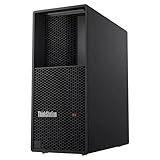
- Processor: Intel Core Ultra 9 285 vPro Processor (E-cores up to 4.60 GHz P-cores up to 5.40 GHz)
- Memory: 128 GB DDR5 Storage: 2 TB SSD M.2 2280 PCIe Gen4 Performance
- Graphic Card: NVIDIA RTX 4000 Ada Generation 20GB GDDR6 Warranty: 1 Year Lenovo Warranty
- Dimensions (H x W x D): 415mm x 180mm x 370mm / 16.3″ x 7.1″ x 14.6″ Weight: Starting at 13.61kg / 30.0lbs
- Confirm the exact system configuration with the OEM. Ask which ports are enabled and supported for station-to-station links.
- Request a validated topology. Confirm whether the intended connection is direct or switched and whether one or two links are supported for the target workload.
- Verify cable compatibility before ordering. Get the supported QSFP112 cable type and length from the OEM; do not infer that two cables are required or that they aggregate in a particular way.
- Validate the link after installation. Check that both systems recognize the intended interfaces and measure link utilization during the actual workload.
Which frontier models has NVIDIA named?
In a January 5, 2026 blog post, NVIDIA said DGX Station can run models with up to one trillion parameters and named Kimi-K2 Thinking, DeepSeek-V3.2, Mistral Large 3, Meta Llama 4 Maverick, Qwen3 and OpenAI gpt-oss-120b as local examples. Treat these as NVIDIA-reported examples, not a guarantee that every revision, precision, context length or concurrent workload will fit or perform acceptably on every configuration.
Quick wins for a faster PC:
Fix the driver behind crashes, sound loss and screen glitchesFind Drivers →Repair Windows errors before they cause bigger problemsFix Now →The cited examples do not provide a complete benchmark table covering model revisions, quantization, context lengths, token rates or concurrent requests. A model name or parameter count by itself cannot establish an inference speed or user experience.
Is there proof of “no offload penalty”?
No such result is established by the published material described here. NVIDIA documents a large coherent address space, CPU-GPU integration and networking between stations, and its June 2026 Windows announcement presents local token generation as a way to offload costs. Those capability and positioning claims are not a controlled performance or total-cost comparison for two GB300 stations connected by two 400G DACs.
A useful test of that claim would need to report, at minimum:
- Exact model revision, quantization and context length.
- Prompt and generation lengths, batch size and concurrent request count.
- Serving framework and version.
- Whether model weights and KV cache reside in HBM or access LPDDR5X.
- Whether inference runs on one station or is partitioned across two, plus the network topology and link utilization.
- Token throughput, latency percentiles, system power and utilization.
- The cloud or on-premises baseline and the deployment period used for a fully loaded cost comparison.
Without those conditions and results, “without the offload penalty” is an unverified claim, not a demonstrated property of this configuration.
Crashes, No Sound, or Screen Glitches?
Random freezes, missing sound and display glitches usually trace back to one bad driver. Find and replace yours safely.Free scan · under a minutePC Slower Than It Used to Be?
A free scan shows the junk files, broken settings and background clutter dragging Windows down - then fixes them in one click.Free scan · Windows 10 & 11Quick Recap
Product prices and availability are accurate as of the date/time indicated and are subject to change. Any price and availability information displayed on Amazon at the time of purchase will apply.

