
What’s actually slowing this PC down?
Pick the symptom - the matching free tool is one click away.
iTechGuides is reader-supported. When you buy through links on our site, we may earn an affiliate commission. As an Amazon Associate I earn from qualifying purchases. Learn more
Not on their own. Heat-tolerant corals and shading may reduce bleaching risk or help restoration in specific places, but the evidence does not show that they can save reefs worldwide. Shading reduces light reaching corals; it is not the same as cooling the ocean. The underlying pressure—warming seas—remains. So, can “super coral” and cooling the sea, save reefs from climate change? The best-supported answer is that these approaches may help locally, while cutting emissions remains central to reefs’ long-term outlook.
What does “super coral” mean?
“Super coral” is a popular label, not a formal species or standardized product. In a Hawai‘i restoration project, researchers identified coral colonies that appeared relatively heat-tolerant in laboratory stress tests, with the aim of learning whether selected colonies could contribute to more resilient restoration plots. NOAA describes the work as an experiment, not proof that the corals have made reefs resilient at large scale. NOAA’s project account includes colonies rehabilitated in a nursery, including “corals of opportunity” that had detached after storms or other disturbances.
For that project, researchers tested small coral samples by raising the water temperature gradually from 24.5°C to 32.5°C over about a month. Colonies showed a range of bleaching responses. Those temperatures and responses describe this project’s testing conditions; they are not a universal threshold for when corals bleach. Partners planned controlled outplanting plots to compare selected colonies, random nursery colonies, and controls. The stated aim was to give reefs the best chance of performing under future conditions, not a demonstrated reef-scale outcome.
Free tools Windows power users keep installed
One-click scans. No signup required.
Can shading cool the sea or prevent bleaching?
No: shading blocks some incoming light, whereas cooling the sea would lower water temperature. The cited shading studies are not evidence of a way to cool whole seas. They suggest instead that reducing light can lessen bleaching under particular heat-stress conditions.
#1 Best Overall
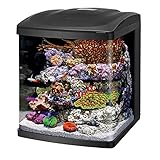
- EVERYTHING YOU NEED - Feature a compact and customizable filtration chamber that is already built-in to the back of the aquarium – easy to setup and maintain.
- GREAT FEATURES – Includes quiet submersible pump, dual intakes and adjustable return nozzle. Compatible with all existing BioCube accessories. Fish, corals, substrate and décor are sold separately.
- SLEEK and MODERN – Biocubes feature a rounded edge design and is the perfect innovative all-inclusive aquarium for all needs..
- VIBRANT LED LIGHTING - Low-profile hood contains vibrant LED lighting that is capable of sustaining and growing healthy, vibrant corals and live plants.
- MAXIMIZE BEAUTY - 24-hour timer which makes it easy to control the three independent light channels for maximum beauty: bright white, sparkling blue and color enhancing LEDs.
In a 2017 aquarium experiment in American Samoa, researchers studied three Indo-Pacific species: Acropora muricata, Pocillopora damicornis, and Porites cylindrica. They compared no shade with 50% and 75% shade during cumulative thermal stress. Shaded corals showed less bleaching, and unshaded corals had a larger growth decline than corals in either shade treatment. The 75% shade treatment offered more protection in that experiment, where intense light was a plausible contributing factor. The study record reports that protection was effective through Degree Heating Week (DHW) 4 and continued to provide some protection through DHW 8, but did not erase the effects of accumulating heat.
A separate field-platform study in Tutuila found that shaded corals darkened and returned to similar color after shade removal. The authors described those findings as preliminary and needing confirmation. Reduced bleaching or a return of color is not, by itself, evidence that a reef ecosystem has recovered. Neither study establishes that shading works for all species, sites, or heat events, or that it can offset ocean warming at reef-wide scale.
Rank #2

- 🐠 EVERYTHING YOU NEED - Feature a compact and customizable filtration chamber that is already built-in to the back of the aquarium – easy to setup and maintain
- 🐠 GREAT FEATURES – Includes quiet submersible pump, dual intakes and adjustable return nozzle. Compatible with all existing BioCube accessories. Fish, corals, substrate and décor are sold separately.
- 🐠 SLEEK & MODERN – Biocubes feature a rounded edge design and is the perfect innovative all-inclusive aquarium for all needs!
- 🐠 VIBRANT LED LIGHTING - Low-profile hood contains vibrant LED lighting that is capable of sustaining and growing healthy, vibrant corals and live plants.
- 🐠 MAXIMIZE BEAUTY - 24-hour timer which makes it easy to control the three independent light channels for maximum beauty: bright white, sparkling blue and color enhancing LEDs.
How do biological approaches compare with shading?
These interventions work through different routes and have been tested against different endpoints. A reduction in bleaching in an experiment cannot be treated as equivalent to a lasting increase in coral cover or reef-building capacity.
| Approach | What it changes | Evidence and measured outcome | What it does not establish |
|---|---|---|---|
| Selecting heat-tolerant colonies | Which colonies are tested or used in local restoration. | NOAA’s Hawai‘i project used laboratory stress tests and planned controlled outplanting plots; the project account describes an experimental restoration effort. | That selected colonies will improve reef-wide resilience or succeed across other locations and species. |
| Selective breeding or assisted evolution | Coral traits or symbiont relationships, with the goal of increasing thermal tolerance. | Studies report heritable heat tolerance in a studied population and model possible benefits from adaptation. | That gains will keep pace with projected warming or apply broadly across coral species and field conditions. |
| Physical shading | Incoming light, not seawater temperature. | American Samoa experiments found less bleaching in three species under 50% or 75% shade during cumulative heat stress. | That shade cools the ocean, removes accumulated heat stress, or restores an entire reef. |
Can breeding or assisted evolution keep pace with warming?
There is evidence that heat tolerance can be increased in some experimental contexts, but the size and durability of the benefit matter. A 2024 selective-breeding study found narrow-sense heritability estimates of 0.2–0.3 for heat tolerance in the population it studied. Based on variability in that population, the authors estimated a theoretical gain of up to 1°C-week within one generation. However, selecting parents for tolerance to short stress did not improve offspring survival under long heat exposure. These findings should not be generalized to every coral species or reef setting. The study illustrates why a gain measured under one stress duration may not carry over to another.
Rank #3

- Excellent Acrylic Material : KABASI coral feeder is made of quality arylic and rubber material, absolutely safe for fish and corals, and it has a long life and is not easily broken, easy to clean.
- Accurate Dispensing : As a high-brightness acrylic tube body, you can see a clear feeding amount.The SPS HPS Coral Feeder ensures that you know exactly how much you are feeding corals or other fish to avoid overfeeding.
- Multi-Purpose : The coral feeder is mainly used in marine reef tanks for coral consumption, can also be used to add liquid fertilizer to the freshwater plant pool. And can also be used to eradicate debris and excess debris from those hard to reach areas of the aquarium.
- Easy to Use : Our coral feeder is long enough to reach deep aquariums without wetting your hands. And with an improved second-generation tip, the soft rubber suction does not harm corals and fish.
- Reminder : Before each use, please ensure that the long straw has been cleaned thoroughly; When feeding coral or other fish, turn off the circulation pump; When used in hot water, the temperature of the liquid should not exceed 176℉
A 2026 review describes assisted evolution as an effort to accelerate natural adaptation and improve coral thermal tolerance, while warning that current experimental gains are unlikely to keep pace with projected temperatures. Its authors call for larger, multi-institution research hubs and long-term work across coral generations. The review presents assisted evolution as a research avenue, not a substitute for addressing the warming pressure that reefs face.
What do global models say about adaptation and reef survival?
Models indicate that adaptation could improve some outcomes without guaranteeing that reefs avoid major losses. In a 2021 global ecological-evolutionary model, symbiont shuffling toward more heat-tolerant taxa delayed coral-cover declines more effectively than symbiont evolution. The modeled increase in symbiont optimal thermal tolerance ranged from 0.3°C to 1.8°C across the study’s reef locations and RCP scenarios. Under high-emissions scenarios, stronger warming rates outpaced adaptive processes. These are model results for specified mechanisms and scenarios, not measured gains across all corals. The study distinguishes adaptation that slows decline from adaptation sufficient to stop it.
Rank #4

- Contains one (1) API REEF MASTER TEST KIT Reef Aquarium Water Test Kit 1-Count, including 7 bottle of testing solution, 2 color cards and 4 test tubes with cap
- Helps prevent invisible water problems that can be harmful to fish and cause fish loss
- Accurately monitors 4 most vital water parameters levels in reef aquariums: Calcium, carbonate water hardness, phosphate and nitrate
- Designed for use in reef aquariums only
- Use for weekly monitoring and when water or fish problems appear
A separate 2023 global model projected that, by 2050, 19%–35% of modeled reefs could maintain positive net calcium carbonate production if symbionts evolved greater thermal tolerance, depending on the emissions scenario. Without modeled symbiont adaptive capacity, the projected share was 9%–13%. Under the modeled high-emissions scenario, adaptation was insufficient to halt the global transition toward net reef erosion by 2050. These percentages are projections under specified assumptions, not observations or guarantees about individual reefs. The study record explains the modeled comparison.
Recommended Free Tools
Why does local heat history matter?
Reefs do not all experience the same thermal conditions, so claims about resilience need a location and a time frame. NOAA Coral Reef Watch’s Thermal History Version 3.7 reports six themes of sea-surface-temperature metrics for reef-containing locations and adjacent waters, using CoralTemp data spanning 1985–2025. The metrics can help ground a local discussion in the area’s thermal history rather than treating one restoration or shading result as universal. Product versions and coverage can change; check the current documentation when using the data. NOAA Coral Reef Watch’s Thermal History documentation describes the product.
Best Value
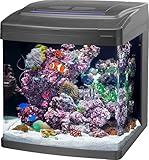
- ALL-IN-ONE SYSTEM: Everything you need for quick and easy setup. Includes a sleek and modern hood, white and blue LED lights, filter, quiet pump, dual intakes, adjustable nozzle and more.
- SMART LIGHTING: Control your aquarium from anywhere with the Aqueon BlueIQ app to toggle between white and blue LED, a programmable 24/7 schedule, feeding reminders and more.
- PERFECT FOR ALL LEVELS: Designed for both newcomers and seasoned aquarium keepers. Perfect for freshwater or saltwater environments.
- OPTIMAL GROWTH ZONES: Produces light and current within three distinct BioZones, providing the perfect light spectrum and intensity to sustain and grow different types of corals.
- PAIRS WITH BIOCUBE ACCESSORIES: Explore a range of BioCube accessories like the BioCube Protein Skimmer for advanced filtration or the Algae Cleaning Magnet and Pad for simple maintenance. Discover more options to enhance and tailor your ecosystem.
What should readers conclude?
Heat-tolerant colonies, breeding, symbiont adaptation, and shading may each help in defined contexts. But their evidence differs in scale and endpoint: laboratory heat response, bleaching and growth under experimental shade, or modeled future reef production are not interchangeable measures of reef survival. The evidence supports conditional optimism about local interventions—not a claim that “super coral” or cooling the sea can save reefs globally. The most consequential limit is that none of these approaches removes the underlying warming pressure.
Quick Recap
Product prices and availability are accurate as of the date/time indicated and are subject to change. Any price and availability information displayed on Amazon at the time of purchase will apply.

