
iTechGuides is reader-supported. When you buy through links on our site, we may earn an affiliate commission. As an Amazon Associate I earn from qualifying purchases. Learn more
Makeup can affect facial-matching accuracy in experiments, but current evidence does not show that an ordinary makeup tutorial reliably defeats facial-recognition systems. The underlying claim about Richa Chadha’s specific “tutorial” could not be verified from the sources available here, so it would be misleading to say which steps it gets right or wrong. The key distinction is between changing a system’s score under tested conditions and reliably evading a deployed system.
What does it mean to “beat” facial recognition?
The phrase can describe several different outcomes: a system may fail to match two images of the same person, incorrectly match different people, or fail to identify someone in a search of a larger image collection. Those outcomes are not interchangeable. Facial-recognition technology is used both to verify a claimed identity and to identify a person from an image, as the U.S. Government Accountability Office (GAO) explains in its July 13, 2020 report.
A result in a one-to-one comparison does not establish that makeup prevents one-to-many identification, much less that it works across different cameras, algorithms, lighting, poses, and image quality. Whether a system makes a correct match depends on the task, the images, and the system’s decision threshold.
What’s actually slowing this PC down?
Pick the symptom - the matching free tool is one click away.
What research says about makeup and face matching
Early studies found makeup can change matching results
A 2012 IEEE conference paper, “Can facial cosmetics affect the matching accuracy of face recognition systems?”, compared images of subjects with and without makeup in two databases. It reported that cosmetics could compromise matching accuracy, while explicitly describing the findings as early. The study supports the narrower claim that makeup can affect automated matching under tested conditions; it does not establish a dependable way to evade current systems. Read the paper’s abstract.
#1 Best Overall
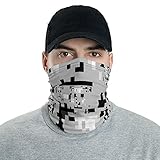
- Fabric weight: 6.19 oz/yd² (210 g/m²)
- Breathable fabric, washable and reusable
- Printed on one side, reverse side is left blank
- MADE TO ORDER
- Inspired by the art project Project Hyperface (no affiliation). WE DO NOT GUARANTEE the effectiveness of this pattern against artificial intelligence algorithms.
Expression and full makeup had a combined effect in one experiment
A 2020 study examined makeup alongside mood and expression variation using the Radboud Faces database and the Psychological Image Collection at Stirling (PICS). The researchers evaluated similarity scores from dlib, Verilook, and VGGFace. In those experiments, each factor alone produced an equal error rate (EER) below 1%; the combined condition of full makeup and expression variation produced an EER of 4.68%. The authors found the combined influence had a larger effect than either factor alone. Read the study.
EER is a benchmark calculated from a particular experiment, not the percentage of real-world systems a person can fool. These figures do not show that makeup alone caused a 4.68% failure rate, nor that the same result applies to other algorithms, deployment settings, or identification searches. The available evidence provides no population-level statistic for how often makeup defeats deployed facial-recognition systems.
Ordinary makeup is not the same as adversarial makeup
Researchers have also investigated makeup designed specifically to interfere with facial recognition. The 2023 CVPR paper CLIP2Protect describes text-guided adversarial makeup as part of a facial-privacy approach and reports evaluations involving black-box recognition models and online commercial APIs. That is evidence of a research direction—not proof that normal cosmetics, or a short consumer tutorial, will reliably work across systems. Read the paper.
Recommended Free Tools
Dataset work likewise demonstrates research interest rather than consumer effectiveness. IDIAP’s AIM dataset was created for experiments related to makeup-based presentation attacks. Its grayscale version was released in 2019, and an RGB version was added in 2024. See the AIM dataset page. Neither a specialized adversarial technique nor a dataset for studying attacks validates a particular look or application method as reliable protection.
What can—and can’t—be concluded about Richa Chadha’s tutorial
The sources available for this article do not verify the original tutorial, its demonstration conditions, or any statements attributed to Chadha. That means there is no sound basis here to assess its specific steps or declare that it does—or does not—work. The broader evidence supports only a qualified point: makeup can affect matching performance in some experiments. It does not substantiate a claim that Chadha’s tutorial defeats facial-recognition systems.
Rank #2

- Material: Natural cotton fleece.Size: About 2.1 * 2.3 cm/ 0.8 * 0.9 inch(L*W). Apply on any skin type.
- The facial mask is a dry compressed facial mask and no facial products are embedded in the paper, apply for DIY skin care. You need add additional facial product (such as beauty liquid,eggs, milk, honey) when you use, according to personal needs.
- Absorbent and skin-friendly, disposable, having facial skin care by yourself or beauty salon.
- Natural non-woven fiber-- No chemical composition. non-irritating, Natural, no stimulation mask sheet,safe, comfortable for facial application . Suitable for all people, easy compressed disposable Facial for home DIY facial skin care.
- 100pcs in one package. Each mask sheet is individually packaged, easy to carry; meet international health standards, great for travel.
The 2016 study on human face perception found that, in its experiments, people recognized no-makeup and light-makeup faces more accurately than heavy-makeup faces. That finding concerns human observers, not automated biometric systems, so it cannot validate or refute a face-recognition evasion method. Read the study.
Independent reader supportYour contribution helps us test, update, and keep practical guides available for everyone.How to judge claims about makeup and recognition
Before treating a demonstration or percentage as evidence of reliable evasion, check whether it answers the same question you care about. Useful details include:
- Task: Was the test one-to-one verification or one-to-many identification?
- Makeup: Was it light, full, or deliberately designed as an adversarial pattern?
- Other changes: Did expression, lighting, pose, or image quality also vary?
- System and images: Which algorithm or service was tested, and on what dataset or camera images?
- Outcome: Was the result a false non-match, a false match, EER, or identification accuracy?
Percentages from studies should not be compared unless their tasks, data, systems, and metrics are sufficiently aligned. A single successful demonstration also cannot establish consistent performance across systems and conditions.
Makeup is only one part of the accuracy and privacy debate
GAO’s 2020 report discusses concerns beyond makeup. It notes demographic performance differences identified in National Institute of Standards and Technology testing, as well as privacy issues such as loss of anonymity and use without consent. These are broader accuracy and governance concerns; they are not evidence that makeup reliably prevents recognition. Read GAO’s report.
Quick Recap
Product prices and availability are accurate as of the date/time indicated and are subject to change. Any price and availability information displayed on Amazon at the time of purchase will apply.

