
iTechGuides is reader-supported. When you buy through links on our site, we may earn an affiliate commission. As an Amazon Associate I earn from qualifying purchases. Learn more
In Constant Itis’s reported simulation, an external associative memory preserved a cue-response behavior after the original network was reset and replaced with a fresh equivalent network. The author reports accuracy of 0.84 before replacement and 0.86 afterward when the saved memory was carried over. That is a result from a small toy simulation—not evidence that a real fruit-fly brain learned, survived destruction, or transferred memories.
What the experiment tested
The narrow question was whether learned behavioral influence could persist outside a network and shape behavior in a fresh equivalent network after the original network’s state was erased. “Brain” and “connectome” are evocative terms here, but the tested substrate was a small fixed recurrent network used as a stand-in, not a reconstructed fruit-fly connectome.
The network had sensory inputs, a hidden middle layer, and descending motor outputs. It was wired once and not rewired. The task presented one of a few cues, and the network had to select one of a few actions according to a fixed but initially unknown correct mapping. Correct choices were rewarded; incorrect choices were punished.
In the author’s description, the external memory wrote when a salience threshold was met, completed patterns from similar cues, strengthened memories accessed together, and decayed over time. Its key architectural constraint was that it could bias network state but could not directly select the action. The claimed mechanism, therefore, was influence on the network’s response—not an external lookup table simply issuing the answer.
#1 Best Overall

- Memory Building Play: This memory game turns colorful fruit pictures into a fun matching game that helps kids practice visual recognition, concentration
- Easy To Learn: Players take turns flipping 2 pieces and keep the pair when the fruit pictures match, making this board game simple for kids and engaging for adults
- 54 Piece Fruit Theme: Bright fruit designs add color and variety to every round while this educational toy encourages visual recognition, memory recall, focus, and fine motor skills
- Play Together Anywhere: A versatile kids board game for family game nights, playdates, kindergarten activities, classrooms, gatherings, and travel entertainment without screens
- Learning Gift For Kids: This educational toy combines puzzle games, brain games, and social play in one engaging challenge, making it a thoughtful choice for birthdays and holidays
How large was the reported run?
Constant Itis reports six cues, three actions, 600 training episodes, 300 evaluation trials, and one fixed seed. Accuracy means the fraction of choices matching the task’s correct mapping; the author gives chance performance as 0.33. These are the author’s setup details and reported results, not an independent audit of the code or run.
How the four configurations compared
The author reports the following approximate task accuracies. Because the run used one seed and a small task, the figures describe this setup only; they are not population-level estimates or a general ranking of learning methods.
Rank #2
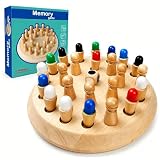
- Kids Memory Game Set: Includes 24 colored chess pieces, 2 dices (1 for daily use + 1 spare), and 1 chessboard. Players must remember the color and position of pieces, and pick out the matching color when rolling the dice, effectively improving children’s memory. Compact size for outdoor play and travel.
- High-Quality Safe Material: Made of natural solid wood with smooth edges and surfaces to protect kids’ hands. Finished with non-toxic water-based paint, bright in color, burr-free and odorless, ensuring safe and healthy play for children.
- Brain Training for Kids & Elderly: Simple rules make it suitable for all ages. Boosts kids’ concentration, memory, hand-eye coordination and color cognition. Helps the elderly keep brains active, exercise thinking and delay brain aging.
- Parent-Child Interactive Board Game: A fun Montessori toy for family bonding. Allows parents and children to play together, enhancing interaction, communication and emotional connection during leisure time.
- Perfect Gift Idea: Exquisite and educational memory chess set, ideal as a birthday gift, Christmas gift or daily surprise for children, seniors, family and friends.
| Configuration | Reported accuracy | What the author says it represents |
|---|---|---|
| Fixed network alone | ~0.70 | Static performance from favorable initial preferences on that seed, not learning. |
| Fixed network plus plasticity | ~0.47 | Plasticity without external associative memory. |
| Fixed network plus external memory | ~1.00 | The only condition the author says showed steady improvement in this task. |
| Plasticity plus external memory | ~0.88 | Adding plasticity produced a lower reported result than external memory alone. |
The comparison is notable because the fixed network’s ~0.70 could look like successful performance if viewed only at the end. The author attributes it to an initially favorable bias, whereas the external-memory condition was interpreted as improving through experience. The report does not establish why the combined plasticity-and-memory condition scored below memory alone, nor whether that ordering would hold across other seeds or tasks.
What happened after the reset?
The reset comparison asks whether experience had been preserved in a form that could affect a replacement substrate. The author reports that plasticity performance fell from 0.44 before wiping state and plastic weight changes to 0.20 afterward. For the external-memory system, the original scored 0.84; a fresh equivalent substrate supplied only with the saved memory scored 0.86.
Rank #3

- ENHANCED MEMORY SKILL: This game boosts the memory, focus, and matching skills of preschoolers - making learning a fun-filled journey
- VIBRANT IMAGES: Comes with 32 vivid and engaging images of everyday items that children can easily recognize
- SIMPLE INSTRUCTIONS: Easy-to-follow instructions ensure that your child can start playing in less than five minutes
- QUALITY MATERIAL: Trusted by generations, Ravensburger assures quality and safety in each of its games
- IDEAL GIFT: Makes for a perfect gift that combines fun and learning for kids of all ages
This contrast is consistent with the author’s explanation: plasticity’s behavioral effect was encoded in weight changes that were erased, while associative state was stored outside the network and could be used by a fresh equivalent network. The close before-and-after scores are the author’s reported measurements, not independent verification or proof that memories can transfer between different kinds of systems.
What the result does—and does not—show
What it supports within this simulation
- In the reported cue-response task, external associative state was associated with higher accuracy than the fixed-network and plasticity-only configurations.
- In the reset comparison, a fresh equivalent network with the saved external memory performed similarly to the original system, according to the author.
- The network’s weights and its external memory were distinct storage locations in the described design; resetting the former did not require erasing the latter.
What it does not establish
- It does not show that a real fruit-fly connectome learned: the experiment used a small recurrent-network stand-in.
- It does not demonstrate biological memory transfer or real dopaminergic learning. Salience was engineered from reward and novelty rather than derived from biological dopamine activity.
- It does not establish transfer to a different substrate class. The replacement was described as a fresh equivalent substrate.
- It does not establish general performance across architectures, seeds, embodied environments, or more complex tasks. The report describes one architecture, one seed, and a simple cue-to-action task.
- The reported numbers have not been independently verified here; they should be read as the author’s account, not as results from an independent study.
Constant Itis characterizes the claim narrowly: “What I have shown is narrower: external associative state can preserve learned behavioral influence across destruction and replacement of the substrate that originally experienced it.” The qualification matters: “substrate” in this experiment means the simulated stand-in network, and the demonstrated replacement was equivalent rather than a different substrate class.
Rank #4

- Enhance Memory Skills: Boost memory with our Alzheimer's activities for seniors set, featuring 24 wooden pieces in 6 vibrant colors, a dice, and a sturdy wooden board
- Fun & Challenging Gameplay: Roll the dice to match colors and improve memory retention by recalling piece placements on the 6.6 x 6.6 inch board - a delightful way to train memory skills
- Safe & Durable Design: Crafted from high-quality wood, our 1.6 inch pieces and board are safe for seniors and adults, offering a reliable choice for memory training that's built to last
- Versatile & Engaging: Ideal for dementia patients and adults alike, this memory game provides entertainment and mental stimulation, perfect for solo play or family bonding activities
- Customizable Difficulty: Adjust the number of pieces for varying levels of challenge, making it an excellent choice for nursing homes and assisted living facilities to keep minds active and engaged
Can you reproduce the run?
The author points to a code repository and gives this reproduction route:
Do these 3 things before closing this tab:
1Repair Windows errors before they cause bigger problems2Scan for outdated or missing drivers - takes under a minute3Clear out junk files and repair common Windows errorsgit clone https://github.com/constant-itis/flymem && cd flymem && python3 flymem.pyThis is the author’s stated route to the code, not evidence that the reported results have been independently reproduced. The figures above should remain attributed to Constant Itis unless a separate verification is available.
Quick Recap
Best Value

- THRILLING MEMORY SHOWDOWN: A lightning-fast challenge where your brain is on the clock! You get 60 seconds to study a picture and memorise its details. When time’s up, use your memory to shout out what you remember and discard your letter cards. Every round is a high-pressure, laugh-out-loud race to victory!
- INCLUDES: 75 Letter Cards, 20 Picture Cards (1000+ Objects), 1 Sand Timer, and an Instruction Manual.
- HOW TO PLAY: One player acts as the watchdog and flips open a picture for everyone to see and the countdown begins. The other players have 60 seconds to take it all in. When time’s up, they race to ditch their letter cards by shouting out what they remember seeing. Be the first to get rid of all your letters to win the round — win the most rounds to win the game!
- FAST-PACED, HIGH-ENERGY FUN: Learn in minutes, play in seconds! No setup, no complicated rules — just flip, remember, shout, and slam your letters down. Every round feels fresh and fun.
- ENDLESSLY REPLAYABLE: Packed with 1000+ tiny hidden objects and constantly changing letter cards, you’ll spot something new every single time. No two rounds ever play the same — the unpredictability keeps everyone hooked!
Product prices and availability are accurate as of the date/time indicated and are subject to change. Any price and availability information displayed on Amazon at the time of purchase will apply.

