
Quick wins for a faster PC:
Repair Windows errors before they cause bigger problemsFix Now →Fix the driver behind crashes, sound loss and screen glitchesFind Drivers →Clear out junk files and repair common Windows errorsFree Scan →iTechGuides is reader-supported. When you buy through links on our site, we may earn an affiliate commission. As an Amazon Associate I earn from qualifying purchases. Learn more
Clot-boosting nanoparticles have helped control bleeding in rodent and pig experiments, but they are not an established treatment for people. These experimental, intravenously delivered polymer particles are designed to help platelets form a clot at an injury; larger-animal studies have also raised concerns about infusion reactions and clots in uninjured tissue.
How are the nanoparticles meant to help form a clot?
The particles are designed to act as synthetic platelet bridges. Their surfaces carry RGD motifs—short sequences of the amino acids arginine, glycine and aspartic acid—that bind activated platelets. By bringing platelets together at an injury, the particles are intended to support aggregation and help a clot form faster. The proposed mechanism does not mean the particles have been shown to work only at an injury site.
| # | Preview | Product | Price | |
|---|---|---|---|---|
| 1 |
|
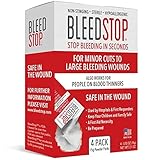
BleedStop™ First Aid Powder for Blood Clotting, Trauma Kit, Blood Thinner Patients, Camping... | $14.99 | Buy on Amazon |
In a 2016 Chemistry World report, research lead Erin Lavik described the particles as helping to “augment the interaction” and form bridges that speed clotting. That is the intended mechanism, not evidence of a proven human treatment.
What have animal studies found?
The results vary by formulation, animal model and measured outcome. Early rodent findings were encouraging, while pig studies brought important tolerability and off-target-clotting concerns into view.
#1 Best Overall
- BLEEDSTOP IS THE ONLY BRAND NAME BLOOD COAGULANT IN ALL WALGREENS, AND CVS . BleedStop is also available in all RiteAid stores. No other product works as well as BleedStop.
- STOPS BLEEDING UPON CONTACT: BleedStop powder is quick, safe and easy to use on moderate to severe wounds, lacerations, cuts, scrapes and nosebleeds (for nosebleeds see BleedStop Nosebleed Strip product available on ), making it one of the most essential supplies for every day first-aid, such as kitchen cuts and protecting your children. Also a necessity for rigorous outdoor activities such as camping, hiking and cycling, among others where moderate to severe bleeding wounds can occur.
- WORKS FOR PEOPLE ON BLOOD THINNERS TOO: Are you taking blood thinners regularly Be assured that BleedStop first-aid powder will work to control bleeding for you too.
- SAFE and NON STINGING: While BleedStop is used by doctors and in emergency rooms across the country, it can be safely applied on everyone, including kids, whenever needed as it's a non-stinging formula.
- HOW TO USE: Simply pour a layer thick enough to cover the entire surface of the wound/laceration before applying firm pressure over the bleeding site using sterile gauze or bandage. BleedStop powder is safe on to leave it on the wound, so it's not necessary to wash it off before bandaging. Please seek emergency medical treatment if bleeding doesn't stop after a prolonged period of time.
| Study and formulation | Model and reported finding | What the result does—and does not—show |
|---|---|---|
| 2010 report on RGD-functionalized synthetic platelets | In a rat major-trauma model, the study authors reported that intravenous particles halved bleeding time. At the tested dose, particles cleared within 24 hours; no complications were observed during the experiment’s seven-day follow-up. | This is a result from a specific rodent experiment, not a human efficacy or safety finding. |
| 2016 PLA-based nanospheres with PEG and RGD-motif variants | In a rat liver-injury model, researchers reported reduced bleeding and improved acute survival over a one-hour observation period. They also reported that the tested formulation remained stable after one week at 50 °C. | The survival outcome is limited to the reported one-hour period and rat model. Heat stability is a formulation property, not proof of clinical readiness. |
| 2018 second-generation particles with altered surface charge | In a pig liver-injury experiment, first-generation particles and controls caused marked vasodilation and exsanguination, including at low doses. The modified second-generation particles avoided a complement response at low and moderate doses, but a response remained at the highest doses. Bleeding cessation was reported within 10 minutes, while signs of vasodilation persisted. | The bleeding result is from a porcine experiment and does not mean human bleeding can be stopped in 10 minutes. Dose-dependent infusion effects remained relevant. |
| 2022 PEGylated polyester nanoparticles | In porcine polytrauma and naïve-animal studies, hard thrombi were found in uninjured tissues in a subset of animals in both the haemostatic and control nanoparticle groups. The authors reported that the thrombi correlated with changes in IL-6, interferon-alpha, lymphocytes and neutrophils. | The finding raises concern about clotting away from an injury. The reported abstract does not provide a simple whole-study incidence figure. |
Why do the pig studies matter?
Rodents can show whether a formulation has a biological effect, but that alone cannot settle whether an intravenously infused particle is tolerable in a larger animal. The pig experiments revealed that the response depended on formulation and dose: early particles were associated with vasodilation and worsening blood loss, and surface-charge changes reduced—but did not eliminate—complement responses at the highest tested doses.
The later finding of hard thrombi in uninjured tissues adds a separate concern. A therapy intended to support clotting at an injury must be assessed not just for bleeding control, but also for whether it triggers clot formation elsewhere. The 2022 report’s observation in both nanoparticle groups means the result should not be simplified into a claim that only the haemostatic formulation caused those thrombi.
Independent reader supportYour contribution helps us test, update, and keep practical guides available for everyone.Are synthetic platelets available to treat people?
The studies described here are preclinical animal research. The sources reviewed do not establish human efficacy, a named clinical trial, regulatory authorization or current commercial availability for this nanoparticle technology. A result in rats or pigs cannot establish that a treatment is safe or effective for trauma patients.
Do these 3 things before closing this tab:
1Clear out junk files and repair common Windows errors2Fix the driver behind crashes, sound loss and screen glitches3Repair Windows errors before they cause bigger problemsLavik said in the 2016 report that the lack of products to control internal bleeding had motivated the work. That statement reflects the motivation described at the time; it is not a current inventory of trauma-care options. These experimental particles should not be confused with consumer wound dressings or haemostatic gauze, which are different products and do not represent this intravenous nanoparticle approach.
How should the results be judged?
The useful comparison is between research formulations and experiments, not between products available to patients. A meaningful assessment needs to keep several dimensions together:
- Bleeding outcome: distinguish bleeding time, blood loss and cessation of bleeding rather than treating them as interchangeable endpoints.
- Model: note whether a result came from rat trauma, rat liver injury, pig liver injury, porcine polytrauma or infusion into naïve animals.
- Dose and infusion response: account for complement response, vasodilation and any worsening of blood loss, including whether effects changed with dose.
- Clot location: assess support for clotting at the injury alongside evidence of thrombi in uninjured tissues.
- Formulation properties: keep storage stability separate from evidence of safety or effectiveness in people.
On that basis, the animal findings show a plausible approach with reported bleeding-control effects, alongside unresolved translation and safety questions. They do not establish a treatment for human haemorrhage.
Quick Recap
Product prices and availability are accurate as of the date/time indicated and are subject to change. Any price and availability information displayed on Amazon at the time of purchase will apply.

