
PC Slower Than It Used to Be?
A free scan shows the junk files, broken settings and background clutter dragging Windows down - then fixes them in one click.Free scan · Windows 10 & 11Crashes, No Sound, or Screen Glitches?
Random freezes, missing sound and display glitches usually trace back to one bad driver. Find and replace yours safely.Free scan · under a minuteiTechGuides is reader-supported. When you buy through links on our site, we may earn an affiliate commission. As an Amazon Associate I earn from qualifying purchases. Learn more
Building memory for an AI agent sounds like a storage problem. It is really a problem of judgment: what to keep, what to change, what to forget, and what to bring back at the right moment. The realization behind “I am the fly” is that memory does not merely preserve an agent’s past. It makes a designer part of the system that decides which past the agent gets to use.
Memory is more than a transcript
When I set out to build memory for agents, the word itself suggested a container: put information in, retrieve it later. But continuity across tasks depends on more than retaining a conversation. An agent may need a fact, a record of something it tried, a current working state, or an understanding of how one event led to another. Those are different kinds of information, and they do not all deserve the same treatment.


A 2025 survey, “Memory in the Age of AI Agents,” distinguishes memory forms such as token-level, parametric, and latent memory from memory functions such as factual, experiential, and working memory. It also treats agent memory as related to, but distinct from, ordinary LLM memory, retrieval-augmented generation (RAG), and context engineering. That distinction matters: fitting more text into a prompt or retrieving passages from a knowledge base can help, but neither by itself answers how an agent should maintain useful continuity as its interactions change.
Recommended Free Tools
The hard part is not simply making something retrievable. It is deciding what a past interaction means now. A note can become stale. An observation can be mistaken for a fact. A successful procedure in one setting can fail in another. Memory is a policy about the past as much as it is a record of it.
#1 Best Overall
What kind of continuity does the agent need?
EvoMemBench, a study by Yuyao Wang and coauthors, gives a useful way to think about the design space. It separates memory by scope—within an episode or across episodes—and by purpose—knowledge-oriented or execution-oriented. “Episode” here means a bounded task or interaction; the distinction asks whether a system needs continuity inside that task, across later tasks, or both.
| Memory dimension | What it is meant to support | Where it may fit |
|---|---|---|
| In-episode | Continuity within a bounded task or interaction | Tasks where relevant state and decisions must remain available before the episode ends |
| Cross-episode | Continuity across separate tasks or interactions | Tasks where earlier information or experience may matter later |
| Knowledge-oriented | Recall of facts or other information | Knowledge-heavy tasks that depend on finding relevant information |
| Execution-oriented | Reuse of procedures or experience | Tasks where prior action sequences may help, provided the stored experience matches the new task |
These are dimensions, not mutually exclusive product categories. An agent may need both knowledge and experience, and both short-range and long-range continuity. The important question is which capability the target task actually requires. Wang and coauthors compared 15 representative memory methods with long-context baselines and found that long context remained competitive. Memory helped most when context was insufficient or tasks were difficult; retrieval-oriented methods did well on knowledge-heavy tasks, while procedural or long-term memory could help execution when prior experience matched the target. As the authors put it, “No single memory form works consistently across all settings.”
That finding complicates the comfortable assumption that a dedicated memory system is automatically better than giving an agent more context. The useful comparison is not “memory versus no memory” in the abstract. It is whether a particular design improves the workload it is meant to serve, compared with a long-context baseline that can also see the relevant history.
Rank #2

- Thoughtful Gifts Choice: With its personalized design, this notebook is a nice gifts for friends, family, or yourself, suitable for birthdays, holidays, and special occasions.
- Optimal Size & Quality: Measuring 6.3" x 8" (A5), it features 160 pages of smooth 80gsm cream paper that protects your eyesight and enhances your writing experience.
- Great Design: The double-wire spiral binding allows easy page flipping, while the sturdy 2mm thick black hard cover keeps your notes secure and intact.
- Versatile Usage: Compact and portable, this notebook fits easily in bags, making it ideal for office, school, home, or travel.
- Creative Freedom: Horizontal lines lnner pages provide endless possibilities for writing, sketching, and expressing your creativity.
Retrieval can find a memory and still miss the point
Similarity search offers an appealing shortcut: store records, compare a new query with them, then return the closest matches. But a close match is not necessarily the right explanation. Similarity can retrieve two passages that mention the same entities while missing how an earlier action caused a later result, or which objective made that result matter.
Zhao and coauthors make this problem central to AMA-Bench, a benchmark for long-horizon agent memory. Its trajectories include states, actions, observations, and tool outputs—not dialogue alone. The authors report that tested memory systems can lose causal and objective information and rely heavily on lossy similarity-based retrieval. Their AMA-Agent approach combines causality-graph construction with tool-augmented retrieval, an effort to preserve relationships that a list of semantically similar snippets can obscure.
On AMA-Bench, Zhao et al. report 57.22% accuracy for AMA-Agent, 11.16 percentage points above the strongest baseline they report. Those are results on that benchmark, not a general measure of how accurately agents remember in everyday deployments. The more durable lesson is about representation: when a task depends on why an event happened or what an agent was trying to accomplish, storing isolated statements may discard the structure needed to reason later.
Keeping memory current requires an explicit policy
Once a system retains information over time, it must decide whether a new item should be added, whether an existing one should change, or whether neither should happen. That is a memory-management problem, not a minor implementation detail. Keeping every entry can accumulate contradictions and irrelevant history; replacing entries too freely can erase useful context.
Memory-R1, described by Yan and coauthors, makes those choices explicit. Its learned Memory Manager selects among ADD, UPDATE, DELETE, and NOOP, while a separate Answer Agent chooses relevant entries and reasons over them. The authors report training with 152 QA pairs and generalization across three benchmarks—LoCoMo, MSC, and LongMemEval—and model sizes from 3B to 14B. Those are the paper’s experimental claims; the 152 examples are not evidence that the same amount of training would suffice for an arbitrary application.
Hindsight, an ACL 2026 system demonstration by Latimer and coauthors, takes another approach to organizing memory. It separates information into four logical networks: world, experience, observation, and opinion. Its operations are retain, recall, and reflect. The described pipeline combines vector search, keyword matching, graph traversal, and temporal filtering, backed by PostgreSQL with pgvector. These are distinct design choices, not proof that one architecture is right for every agent. They illustrate how a system can make categories and operations explicit rather than treating memory as one undifferentiated pile.
Rank #4
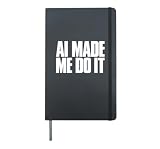
- This design is a public service announcement for modern responsibility management. A bold funny AI quote typography for tech humor, coder vibes, prompt lovers, and anyone blaming artificial intelligence for their questionable choices.
- Perfect for programmers, developers, designers, students, coworkers, IT teams, data nerds, and AI fans for birthdays, Christmas, graduations, office parties, and tech events.
- Hardcover journal with 240 line-ruled pages (120 sheets)
- Built-in elastic closure and ribbon bookmark
- Includes an expandable inner storage pocket and a pen holder
Both examples make the designer’s role harder to ignore. Decisions about updates, deletion, categories, time, and retrieval shape what the agent can later treat as relevant. I may call the result the agent’s memory, but the boundaries of that memory reflect choices made by people who build and operate it.
Memory makes the builder part of the loop
That is how I understand the fly in the title: not as a technical term, and not as a claim that a machine remembers as a person does. It is an image for the awkward position of building a system that carries its history forward. I am not outside the loop merely because the records belong to an agent. I help determine what gets carried forward, what gets revised, and what disappears from view.
The Tool Desk
Outbyte Driver Updater FREEFix the driver behind crashes, sound loss and screen glitchesFind Drivers →Outbyte PC Repair FREERepair Windows errors before they cause bigger problemsFix Now →The metaphor also resists an easy success story. Persistent memory can make an agent more coherent, but coherence is not the same as correctness. A remembered assumption can outlive the evidence for it. A successful past procedure can be applied in a new context where it no longer fits. And a retrieved item can look relevant while failing to preserve the cause, objective, or timing that would make it useful.
Best Value

- AI MEETING ASSISTANT: Integrates AI-based Transcription & Multidimensional Automatic Summarisation. Capture meeting audio anytime offline, store locally, then unlock AI transcription, summary and cloud sync once connected. Capture every conversation with real-time voice-to-text transcription and automatically generate organized meeting notes. The built-in AI assistant helps summarize key points, extract action items, answer questions, search information, and build your personal knowledge base to streamline office workflows.
- FULL COLOR PAPER-LIKE WRITING EXPERIENCE : Enjoy a natural writing experience with an 8.4-inch next-generation soft-color eye-care paper-like screen adopts low-blue-light light source and AG anti-glare technology, which can filter 99.36% of harmful blue light, and a 4096-level pressure-sensitive electromagnetic pen. Convert handwritten notes into editable digital text with one tap, enhanced by AI handwriting recognition supporting 66 languages. Electromagnetic input technology enables handwritten notes with a paper-like writing experience.
- MULTILINGUAL TRANSCRIPTION AND REAL-TIME TRANSLATION: Break language barriers with support for real-time transcription and translation in 48 languages. The system interface supports 7 languages, including English, Simplified Chinese, Traditional Chinese, Japanese, Korean, French, and Spanish. Ideal for international meetings, business communication, language learning, and global collaboration.
- ULTRA-LIGHTWEIGHT OFFICE NOTEBOOK TABLET FOR WORK & STUDY: Weighing only 320g.Up to 25 days of battery life, this portable AI digital notebook is designed for professionals, students, and travelers. Easily carry it to meetings, classrooms, business trips, and daily commutes. Unlike traditional tablets, it focuses on distraction-free meetings, classes, recording, and knowledge organization.AINOTE Supports PDF, DOC, EPUB, MOBI, TXT and other common file formats.
- SECURE LOCAL & CLOUD STORAGE: Protect your private notes and business information with secure 64GB local device storage, password protection, and encrypted audio transmission. Your files stay accessible offline via built-in local storage, with cloud storage to back up your key documents. Built for professionals who need a reliable AI workspace to manage sensitive documents, meeting records, and personal knowledge securely.
There is an operational side to that responsibility. In an opinion article published on 6 October 2026, TechRadar Pro’s Tobie Morgan Hitchcock argues that persistent agent memory creates data-management concerns that affect cost and accuracy as agents act and update state. The article quotes AWS estimates of about $40 per month for a text-based proof of concept at roughly 100 interactions per day and about $840 per month for an agent-based proof of concept at roughly the same volume. These are scenario estimates reported by an opinion article, not universal prices or a general AWS price schedule. The point for a builder is not to treat either figure as a forecast for a different system, but to include the cost of maintaining state in the design conversation.
Independent reader supportYour contribution helps us test, update, and keep practical guides available for everyone.Test the memory against the work, not the promise
A memory architecture should earn its complexity on the target task. A useful evaluation asks whether it helps the agent preserve the kind of continuity the work needs, and whether it improves on a long-context baseline under comparable conditions. It should also test the system’s treatment of change: can it update a fact, distinguish an observation from an opinion, avoid reusing a mismatched procedure, and retrieve the context that explains an outcome?
- Identify the scope: Is the needed continuity within one episode, across episodes, or both?
- Identify the function: Does the task need facts, prior experience, current working state, or a combination?
- Inspect the update policy: Can the system add, revise, delete, or leave an entry unchanged when appropriate?
- Check what retrieval preserves: Does it surface only similar text, or also the causal, objective, and temporal relationships the task needs?
- Compare with long context: On the actual workload, does memory improve performance enough to justify its management and operational costs?
EvoMemBench’s results caution against treating any one memory form as a universal upgrade. AMA-Bench highlights the risk of losing relationships inside a long trajectory. Memory-R1 and Hindsight show different ways to make management and organization explicit. Together, they suggest that “give the agent memory” is not a complete design brief. The real brief is to define what continuity means, decide how history should change, and test whether those choices help the agent do the work without confusing a stored past for a reliable one.
Free tools Windows power users keep installed
One-click scans. No signup required.
Quick Recap
Product prices and availability are accurate as of the date/time indicated and are subject to change. Any price and availability information displayed on Amazon at the time of purchase will apply.

