
The Tool Desk
Outbyte PC Repair FREERepair Windows errors before they cause bigger problemsFix Now →Outbyte Driver Updater FREEScan for outdated or missing drivers - takes under a minuteDriver Scan →iTechGuides is reader-supported. When you buy through links on our site, we may earn an affiliate commission. As an Amazon Associate I earn from qualifying purchases. Learn more
A broken link checker API can automate link audits by accepting a page, a batch of URLs, or—in some systems—a crawl target, then returning status information for review. The useful result is not simply a list marked “broken”: redirects, inaccessible hosts, fragment errors, blocked requests, and temporary failures can require different responses.
What a broken link checker API does
An API lets another system submit links for checking and consume the results programmatically. A typical maintenance workflow is to collect URLs from a site or content system, send them to a checker, receive or retrieve diagnostics, and create a review queue for the links that need attention.
Input scope varies. A service might check one submitted URL, accept a list of URLs, or discover links by recursively crawling a page or site section. These are different capabilities: a list-based check only covers the URLs you submit, while a crawl depends on scope controls and the pages the checker can reach.
The W3C Link Checker is one example of a tool that reads HTML or XHTML documents and CSS stylesheets, extracts links, checks whether links and fragments are dereferenceable, and warns about HTTP redirects. Its documentation says it can recursively check part of a website: W3C Link Checker documentation.
#1 Best Overall

- 【USB Cable Performance Testing】Test USB cable continuity, functionality (charging, data transfer, high-speed signal), and measure internal resistance for power efficiency. Verify ground wire connection to outer shell for cable integrity, safety, and shielding.
- 【Type-C eMarker Chip Reading】Reads eMarker chip parameters in Type-C cables, providing detailed performance information (e.g., maximum current, voltage, data transfer rates) to help users fully understand cable capabilities and ensure safe, efficient device usage.
- 【High-Definition Color Display】 The USB cable checker features a 2.4-inch high-definition color display. With the left white button, you can easily switch between function pages to view real-time detailed status of the cable, including internal resistance, power delivery efficiency, and cable quality. This helps you quickly identify inferior cables.
- 【Wide Compatibility】The usb tester can accurately identify and verify USB cable versions, including USB 2.0 and USB 3.2. It integrates PD 3.0 and PD 3.1 protocol detection functions, enabling quick verification of whether the cable supports the latest PD 3.0/3.1 standards, ensuring the cable meets high-power charging and fast data transfer requirements.
- 【Multiple Power Supply Options】The black button on the left can flexibly switch the power supply mode, and support the use of AAA battery or Type C 5V to stably supply power to the USB tester
Interpret results before calling a link dead
A failed check is a signal to investigate, not always proof that the destination has permanently disappeared. Build separate handling for the kinds of results your checker returns, and preserve its diagnostics so a person can make the right correction.
- Successful response: The checker reached the destination. This does not by itself confirm that the page is useful or that it contains the expected information.
- Redirect: The URL forwards elsewhere. Review whether the destination is appropriate, then update the source link when a stable replacement is available. A redirect is not the same as a dead destination.
- Unreachable host or request error: The destination may be down, unavailable to the checker, or affected by a network or access restriction. Retry or verify it separately before removing the link.
- Fragment failure: The page may load while the requested section identifier does not resolve. Check the fragment and the destination page’s current anchors.
- Warning or blocked request: The checker may not be able to verify the target under its request conditions. Treat that as unconfirmed rather than automatically labeling the link dead.
Classifications and diagnostic detail differ by checker. Decide which states should trigger an automatic ticket, which should be retried, and which need manual review.
Rank #2
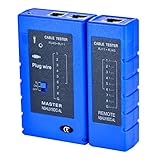
- 100% new network tester, with LED lights and micro-power supply interface.
- Keep your network running smoothly by testing your cables to uncover problematic shorts, open wires, crossing pairs and other wiring mishaps.
- Use for testing your homemade Ethernet patch cables to make sure they are in working order prior to connecting to your devices.Tests RJ45 cables, RJ11 telephone cables and network cables.
- Easy to read LED display indicates problems.Hand-held for portability.
- Requires one 9-volt battery (not included).Battery is advised to change if any weak light appears.Or through the micro-port power work.
Design the API workflow
A practical integration has three stages: submit work, collect completion and results, then route findings. The GOV.UK Link Checker API documentation illustrates an individual check with GET /check, a submitted set with POST /batch, batch retrieval with GET /batch/:id, and a webhook when a batch completes. Its documentation also warns that it may be out of date, so treat this as an example workflow—not a guarantee of a current API contract: GOV.UK Link Checker API documentation.
Recommended Free Tools
- Choose the input. Submit a single URI for an on-demand check, a curated list for scheduled checks, or a crawl target if the service supports recursive discovery.
- Record the job. For asynchronous batches, retain the returned identifier and associate it with the site, scan time, and submitted URLs.
- Wait for completion. Poll the documented retrieval endpoint or receive a completion webhook, depending on the service contract. Implement retries and verify webhook authenticity if supported.
- Store diagnostics. Keep the reported status, check time, errors, warnings, redirect destination, and any problem summary or suggested fix the service actually returns.
- Route for correction. Link each finding to its source page or content record, classify it for review, and let an editor or site owner approve changes where the right replacement is not obvious.
The GOV.UK page describes fields including status, checked time, errors, warnings, danger, problem summary, and suggested fix. Because that page explicitly says it may be out of date and was last updated 18 March 2025, verify field names, request formats, authentication, limits, and service status against the live specification before building an integration.
Rank #3

- 4-IN-1 MULTI-CABLE TESTING TOOL: Tests RJ45 Ethernet, RJ11 telephone, USB, and BNC coaxial cables, providing versatile diagnostics for networking, telecom, security, and AV installations
- DETECTS COMMON CABLE FAULTS: Quickly identifies open circuits, short circuits, crossed wires, reversed pairs, miswires, and shielding faults, helping reduce troubleshooting time
- COMPATIBLE WITH STP & UTP NETWORK CABLES: Designed for testing Cat5, Cat5e, Cat6, STP, UTP, LAN, Ethernet, and telephone wiring for professional and DIY applications
- REMOTE TESTING FUNCTION: Includes a detachable remote unit for testing installed cable runs through walls, patch panels, offices, server rooms, and structured cabling systems
- EASY-TO-READ LED STATUS INDICATORS: Sequential LED lights display cable continuity and wiring configuration, allowing quick and accurate fault identification
Set safe crawl scope and request pacing
Recursive checks can generate requests across many pages and servers. Limit a scan to the site section you own, set an appropriate depth or URL boundary, and review the checker’s request pacing, robots handling, and service limits before scheduling it.
The W3C Link Checker documentation says its online and command-line forms honor robots exclusion rules, and both pause at least one second between requests to each server to avoid abuse and congestion. The online/CGI form also limits the number of documents in a recursive check. These details apply to the documented W3C checker; do not assume another API uses the same safeguards or limits. See the W3C Link Checker documentation.
Rank #4

- ACCURATELY CHECK CABLES & PORTS: The comprehensive cable tester for network professionals allows you to accurately check pin configurations for Ethernet cables, USB cables (with TC-NTUF sold separately), BNC cables, and patch panel ports.
- CABLE TESTING DISTANCE: Tests over cables lengths of up to 300 meters (984 ft.)
- PIN TESTING: The network cable testers identifies proper, severed, short circuit, and cross connected pins.
- LOCAL & REMOTE TESTING: A transmitter unit facilitates loop testing and a receiver unit allows for cable testing in locations away from the transmitter unit
- TRANSMITTER INTERFACE: 2 x test ports, Manual test button, Auto test button, Power/tone switch, LED indicators.
Choose the right kind of checker
Before integrating a tool, compare its capabilities against the workflow you need. The available evidence describes distinct tool types, not a measured accuracy or performance comparison.
- Hosted API: Fits a backend or scheduled process when the service supports the input scope, result format, and completion model you need. Confirm current documentation and operational status before depending on it.
- Online checker: Useful for a manual inspection, but check whether it supports the site scope and volume required for recurring audits.
- Command-line or self-hosted software: Can be run within your own maintenance process, but requires local setup and operation. LinkChecker is documented as free, GPL-licensed software, and its documentation lists Python 3.10 or later as a requirement: LinkChecker documentation.
The W3C Link Checker and the W3C API are separate offerings. The Link Checker validates links; the W3C API is a public, read-only JSON API for W3C data, not an API for checking broken links. See the W3C API overview and W3C validators and tools.
Quick Recap
Best Value
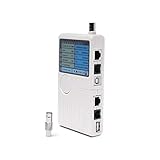
- Includes: 1 universal network, telephone, coaxial, BNC, and USB tester (battery operated).
- How It Works: Accurately test the 5 most commonly used hardware and device installation cables: RJ45, RJ11, BNC, Coaxial, and USB.
- Works With: USB, cable modems, satellite receivers, radio systems, cell phone wireless extenders, CCTV, security, audio, HD TVs, off-air antennas, CATV providers, and many other RCA, BNC, SMA, F-pin, and RF systems.
- Features: Simple-to-read LED display, one-push tester button, an audible result notifier, and a detachable module for testing similar dual remote points.
- Smooth Connection: Solid internal materials and construction eliminate interference while providing clear audio, video, data, USB, and other signals.
What to verify before relying on an API
- Whether it accepts individual URLs, URL batches, crawl targets, or some combination.
- Whether results distinguish redirects, errors, warnings, and fragment problems, and include enough detail to locate the source link.
- Whether work completes synchronously, through polling, or through a webhook.
- How it handles crawl boundaries, recursion depth, robots rules, request pacing, and rate or batch limits.
- Whether the API specification and service status are current, and what authentication, retention, and error-recovery behavior apply.
Product prices and availability are accurate as of the date/time indicated and are subject to change. Any price and availability information displayed on Amazon at the time of purchase will apply.

