
iTechGuides is reader-supported. When you buy through links on our site, we may earn an affiliate commission. As an Amazon Associate I earn from qualifying purchases. Learn more
There is no universal best boat anchor. A fluke (Danforth-style) anchor is compact and efficient in sand or hard mud; plow and scoop anchors handle changing bottoms and can reset after a direction change; claw anchors are broad-use options; grapnels catch rock and submerged structure; and mushroom anchors are mainly for moorings or very small craft in soft bottoms. Choose for your boat’s displacement and windage, the bottom you expect to encounter, the weather and duration of the anchorage, and the rode and storage system you can use safely.
Start with the bottom, not the catalog
An anchor holds by either burying in the bottom or snagging an object. Sand, mud, clay, grass, rock, roots and mixed bottoms therefore reward different geometries. A false set can feel secure at first, then release when wind or current reverses. After setting, check the boat against fixed bearings ashore and continue monitoring it as conditions change.
Boat length by itself is not a sizing rule. Displacement, freeboard and windage, expected weather, depth, exposure, anchoring duration, and the available bow hardware all affect the choice. Use the anchor maker’s current sizing chart for the exact model, then increase size when the boat is unusually heavy or wind-catching, or when the anchorage is exposed.
What’s actually slowing this PC down?
Pick the symptom - the matching free tool is one click away.
Anchor types at a glance
| Type | Best fit | Important limitations | Typical stowage implication |
|---|---|---|---|
| Fluke (Danforth-style) | Sand and hard mud; high holding power for its weight | Less reliable in deep mud, grass or rock; can foul on its stock or flukes and may pull free after a direction reversal | Folds or lies flat in a locker |
| Plow or scoop | Mixed bottoms, including sand, mud and some vegetation; useful when reset ability matters | Bulkier in a locker; performance varies by model and bottom | Usually favors a bow roller or bowsprit |
| Claw | Broad range of common conditions; quick setting and resetting; can catch on rock | Can struggle on very hard clay or heavy grass | Generally suited to a bow roller or windlass |
| Grapnel | Small craft on rocky or structured bottoms where tines can catch rock or submerged timber | Holds by snagging rather than burying and can become fouled | Compact, but retrieval may be difficult if it hooks structure |
| Mushroom | Permanent moorings and buoys when properly sized; some very small craft in very soft bottoms | Small models have minimal holding power and are unsuitable for overnight or storm anchoring | Simple shape, but not a substitute for a general-purpose anchor |
How each design behaves
Fluke or Danforth-style anchors
Two broad flukes and a projecting stock drive this design into sand and firm mud. It offers strong holding power for relatively little weight and stores flat, making it attractive on boats with limited locker space. The same geometry is a weakness in deep mud, vegetation and rock: the flukes may not penetrate, may collect weeds, or may snag without burying. A wind shift can pull a shallowly set fluke anchor out rather than turn it into a new set.
#1 Best Overall

- KEEP YOUR BOAT SECURE IN CHALLENGING BOTTOMS: 15 lb weight and integrated flukes help the Navy Anchor dig into sand and mud for dependable holding power.
- RECOVER ANCHORS WITH LESS EFFORT: Reverse-action shank design helps free and retrieve a fouled Navy Anchor more easily when conditions become challenging.
- PROTECT YOUR VESSEL FROM DAMAGE: Black PVC-coated finish helps resist rust while reducing scratches and scuffs on boat surfaces.
- ATTACH LINES QUICKLY AND CONFIDENTLY: Large eye opening allows easy connection to anchor rope, chain, or rode for convenient setup.
- RELY ON DURABLE MARINE CONSTRUCTION: Solid cast iron construction provides strength, durability, and reliable performance for boating applications.
Use a fluke anchor when the bottom is known to be sand or hard mud and compact storage matters. Treat a Danforth manufacturer’s chart as model-specific. For example, Danforth lists its S600 at 9 pounds for boats 17–27 feet long and states 600 pounds of holding power under its assumptions of normal wind, average current and at least 5:1 scope. That is a published specification and recommendation, not an independent comparative test or a guarantee in every bottom.
Plow and scoop anchors
Plow and scoop profiles are shaped to penetrate and remain buried as the pull changes. They are commonly selected for boats that visit sand, mud and some vegetated or mixed bottoms, and they are valued for the ability to reset after a wind or current shift. Their three-dimensional shape is less convenient in a flat locker, so a bow roller or bowsprit is often the practical mounting solution.
Do not assume every plow or scoop performs identically. The model’s geometry, the bottom’s density and the amount of scope determine whether it digs in. Follow the maker’s chart and installation instructions for the particular anchor.
Claw anchors
Claw anchors are rounded, multi-pronged designs intended to set quickly across many ordinary conditions. They can be a useful all-purpose alternative and may catch on a rocky bottom. Very hard clay and thick grass remain difficult: the claw may skate, fail to penetrate, or collect vegetation before it develops reliable holding.
Rank #2

- Fits 8-16 ft Boats: This 5 lb boat anchor kit is perfect for pontoons, fishing boats, dinghies, and other vessels in the 8 to 16 ft range. It's a reliable choice for lake days, offshore fishing, or coastal cruising
- All-in-One Boat Anchor Kit: Includes a 5 lb galvanized fluke anchor, 6.5 ft steel chain, 2 D-ring shackles, and 100 ft of nylon rope; everything you need to secure your boat without extra purchases
- Strong Holding in Sand or Mud: The fluke anchor is designed to dig deep into sand or mud, while the weighted chain enhances grip. Keeps your boat stable even in strong currents or windy conditions
- Rust-Resistant Galvanized Steel: Made with hot-dipped galvanized steel, this boat anchor kit resists rust, corrosion, and wear—ideal for both saltwater and freshwater use over long periods
- Durable and Flexible Nylon Rope: The included 100 ft nylon rope offers excellent stretch resistance and tensile strength. It’s soft to handle yet tough enough for secure anchoring in changing conditions
Their shape normally works best with a bow roller or windlass rather than a narrow locker. Confirm that the roller captures the anchor securely and that the windlass is rated for the complete rode.
Grapnel anchors
A grapnel uses several tines to hook rock, wreckage, roots or submerged timber. That makes it useful for small craft fishing or positioning near structure where a burying anchor cannot penetrate. It is not a smooth-bottom anchor: a tine can catch permanently, and retrieval may require changing the pull direction or accepting that the anchor is expendable. Because its holding comes from a snag, never treat a grapnel’s initial catch as proof of a storm-secure set.
Mushroom anchors
A mushroom’s broad, rounded head can settle into very soft sediment and is commonly used for moorings and buoys when sized for the installation. Small portable mushrooms have little holding power compared with a buried fluke, plow or scoop. They should not be relied on for overnight anchoring or storms, even on a calm-looking day.
The Tool Desk
Outbyte PC Repair FREERepair Windows errors before they cause bigger problemsFix Now →Outbyte Driver Updater FREEScan for outdated or missing drivers - takes under a minuteDriver Scan →Match the anchor to the bottom you actually use
| Bottom or situation | Designs with the clearest fit | Checks before relying on the set |
|---|---|---|
| Clean sand | Fluke; plow or scoop | Back down gradually until the anchor digs and the boat stops moving relative to shore |
| Hard mud | Fluke; plow or scoop | Ensure the flukes or blade have penetrated rather than skated across the surface |
| Deep or very soft mud | Model-specific plow or scoop; a fluke may be difficult to bury | Allow adequate scope and verify position over time, because a soft bottom can produce a misleading initial hold |
| Grass or heavy vegetation | Some plow or scoop models; claw performance depends on density | Inspect for weed fouling and confirm that the anchor has reached soil below the vegetation |
| Rock or submerged structure | Grapnel for small craft; claw may catch rock | Plan retrieval and recognize that snagging is not the same as burying |
| Permanent mooring in soft sediment | Properly sized mushroom | Use the mooring designer’s sizing and installation requirements, not a small portable model |
| Unknown or changing bottoms | Plow, scoop or claw as appropriate, plus a second contrasting style | Carry two different anchor styles when space and weight permit |
For a boat that regularly encounters different bottoms, West Marine’s guide recommends carrying two different anchor styles. A practical pair is a primary plow or scoop for mixed conditions plus a flat fluke anchor for sand or hard mud, provided both fit the boat’s bow hardware and the manufacturer’s charts.
Rank #3

- Hold Your Boat Firmly in Place: This anchor combines the features of a traditional mushroom anchor with flukes for better bottom penetration; it’s one of our must-have boat accessories
- Durable & Works in a Variety of Waters: Designed for protected inland waters, the SeaSense River Anchor works effectively in strong currents and tidal waters, as well as sand, mud or weed bottoms; it’s made of one piece cast iron with black vinyl coating to help protect the gel coat
- Ideal for Pontoons & Bass Boats: These anchors can hold a small boat, kayak, jet ski, canoe and other small watercraft; take this equipment with you on the river, lake and beyond
- Save Time & Money, Have More Fun: Whether you’re a weekend boater or an experienced buyer, we keep your needs at the forefront of everything we do; every one of our products and parts is designed to work quickly and reduce costs
- Quality Marine Products That Make Sense: At SeaSense, we’ve been providing innovative marine and trailer products since 1984; we’ve rigorously tested and improved our catalog for decades to help deliver the best on-the-water experience possible
Size for load, not just length
Anchor charts usually organize recommendations by boat length and weight, but length is only a proxy for the forces acting on the ground tackle. A tall cabin, enclosure or flybridge catches more wind than a low open boat of the same length. A heavily loaded boat has greater displacement, and an exposed anchorage or long stay increases the consequences of a marginal set.
West Marine’s June 8, 2026 guide describes modern anchors as producing approximately 10 to 200 times their own weight in holding power. That is a broad guide range, not a guarantee for a particular model, bottom or deployment. The same guide cites more than 5,000 pounds of load from a 21-pound Fortress FX37 in anchor tests conducted in 2006; the date and test context matter, and the result should not be generalized to every anchor.
Discover Boating likewise advises choosing larger equipment when a boat is heavier or catches more wind than is typical for its length. In an exposed anchorage, heavy weather or high-windage configuration, size up within the maker’s recommendations rather than relying on a minimum chart entry.
Scope controls the pull angle
Scope is the length of rode paid out divided by the vertical distance from the bow chock to the bottom. More scope lowers the angle at the anchor, helping a burying anchor stay engaged.
Rank #4
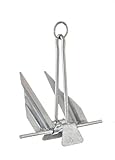
- Penetrates deep in a variety of seafloor compositions
- Slip ring shank makes it simple to retrieve stuck anchor
- Recommended for boats 15-19 feet in length
- Fluke Length: 9-1/16 inch
- Stock Width: 12-5/8 inch
| Situation | West Marine guide recommendation |
|---|---|
| Calm, protected conditions | At least 5:1 scope |
| Open or overnight anchoring, or winds above 15 knots | 7:1 scope |
| Storm or exposed conditions, when swinging room permits | 10:1 scope |
These ratios are guidance, not permission to anchor where there is insufficient swinging room. Check nearby boats, shoals and channel limits before paying out additional rode. West Marine also notes that when wind speed doubles, force on the boat and ground tackle increases fourfold; that is why a set that is adequate in a quiet afternoon can become marginal overnight.
Independent reader supportYour contribution helps us test, update, and keep practical guides available for everyone.Choose a compatible rode and attachment
A rope-and-chain rode combines easier handling with chain’s weight and abrasion resistance. Chain helps keep the pull lower and resists chafe near the bottom. West Marine recommends a chain leader at least one boat length for a rope-chain combination. All-chain rodes are heavier and generally call for a windlass capable of handling their weight.
- Verify that the anchor eye, shackle, swivel if used, chain, rope, cleat and bow roller or windlass are compatible.
- Use components with appropriate working-load ratings and inspect for bent pins, corrosion, seized links and chafe.
- Ensure the anchor can be launched and recovered without striking the hull or fouling the roller.
- Secure the bitter end to a strong attachment point inside the boat; do not rely on a locker lid or a light drain fitting.
Deploy, set and monitor the anchor
- Choose the anchoring spot after checking depth, swinging room, bottom information and nearby traffic. Calculate the required scope from the bow chock to the bottom.
- Bring the bow into the wind or current as conditions require and lower the anchor over the bow. Do not throw it, which can tangle the rode or land the anchor on its side.
- Pay out the planned chain and rode while the boat moves back. Keep hands and feet clear of the rode and never wrap it around a person.
- When the intended scope is out, let the boat straighten the rode. Back down steadily rather than applying an abrupt engine burst.
- Check the set against fixed bearings ashore, a depth reference and the boat’s GPS position. A stationary compass bearing and consistent position are stronger evidence than tension alone.
- Recheck after a wind or current change and periodically during the stay. A direction reversal can expose a weak set, especially with a fluke anchor.
If the boat continues to move, first determine whether the anchor is dragging, the rode is fouled, or the position check is misleading. Recover and reset in a clearer patch, increase scope when safe, or change to the anchor style better suited to that bottom. If conditions exceed the equipment’s intended use, leave the anchorage rather than trying to compensate with engine power.
A practical selection process
- List your real bottoms. Separate regular sand or hard mud use from grass, rock, clay and unknown areas.
- Choose the holding mechanism. Select a burying design for penetrable bottoms; select a grapnel only when controlled snagging on structure is the goal.
- Check the boat and hardware. Match the model’s chart to displacement, length, windage and the bow roller, locker or windlass.
- Plan for the worst credible stay. Increase size and scope for exposure, overnight use, high windage or forecast deterioration.
- Add redundancy where practical. Two different anchor styles cover more bottoms than two identical anchors, but total weight, storage and retrieval must remain manageable.
- Practice before an emergency. Learn the deployment path, mark the rode, test the windlass or cleat and rehearse a controlled recovery in daylight.
What the published numbers do—and do not—prove
Anchor performance figures are highly conditional. The Danforth statement, “Boat size recommendations are provided based on normal wind conditions, average currents, and a minimum 5:1 scope ratio,” describes the assumptions behind its sizing table. West Marine’s holding-power ranges and cited 2006 test result are useful context, but they are not a universal ranking of anchors. Bottom composition, scope, rode, loading direction and deployment quality can change the result.
For a purchase decision, start with the exact manufacturer chart, confirm the anchor fits your boat’s hardware, and then choose the design that matches the bottom and the conditions you can realistically monitor. A correctly sized anchor that is set and checked properly is safer than a theoretically stronger model that cannot be stowed, deployed or reset on your boat.
Quick Recap
Product prices and availability are accurate as of the date/time indicated and are subject to change. Any price and availability information displayed on Amazon at the time of purchase will apply.

