
iTechGuides is reader-supported. When you buy through links on our site, we may earn an affiliate commission. As an Amazon Associate I earn from qualifying purchases. Learn more
The simplest dependable route is to keep your original PlayStation 2 and connect it through a PS2-to-HDMI converter that explicitly supports your console’s SCPH model and video modes. If you are especially sensitive to flicker or jagged motion, put a dedicated retro scaler between the PS2 and the television. A backward-compatible original PlayStation 3 can also play many PS2-format discs, but only specific models do so. For the most flexible picture and save options, PCSX2 can read your discs or your own disc dumps, provided you have a suitable computer and a BIOS dumped from a PS2 you own.
This guide explains what each route actually requires, how to set it up, what can go wrong, and which choice fits a disc-first collection.
Choose the route that matches your priorities
Modern televisions normally accept digital HDMI video, while an original PS2 outputs legacy analog video. The console therefore needs an adapter or scaler before it can feed the TV. Your decision is mainly about preserving the original console, improving image processing, or moving the games to a computer.
Quick wins for a faster PC:
Clear out junk files and repair common Windows errorsFree Scan →Fix the driver behind crashes, sound loss and screen glitchesFind Drivers →| Route | Physical-disc workflow | TV connection | Best for | Main trade-offs |
|---|---|---|---|---|
| Original PS2 plus HDMI adapter | Yes | Adapter to HDMI | Lowest-friction setup and original hardware behavior | Adapter quality varies; basic units may leave deinterlacing to the TV; model and signal support must be checked |
| Original PS2 plus dedicated scaler | Yes | Scaler to HDMI | Cleaner handling of interlaced PS2 output and more image controls | More hardware and configuration; a current universal price is not established here |
| Backward-compatible original PS3 | Yes, on supported models | Native HDMI or component output | One HDMI-capable console that can run supported PS2-format discs | Exact model compatibility is critical; used consoles differ in condition |
| PCSX2 | Direct disc or personal disc dump | Computer HDMI output | Resolution scaling, convenient saves, and flexible configuration | Needs a capable computer, a PS2 BIOS, and possibly an optical drive; performance varies by game |
For most owners who want to put their existing discs in a console and start playing, choose the first route. Move to a scaler when the television’s processing produces distracting artifacts. Consider a compatible PS3 only after verifying its exact model. Choose PCSX2 when computer-based features matter more than keeping the original console in the signal chain.
#1 Best Overall

- WORKS WITH PS2 & PS1 — PHAT AND SLIM — Connect your PS2 (both original Phat and Slim models) or PS1 directly to any modern HDTV, monitor, or projector via HDMI. No drivers required. Just plug in and play your classic game library on your modern display within minutes.
- WHAT TO EXPECT FROM THE PICTURE — This adapter converts your PS2/PS1's analog AV signal to HDMI so it works on modern TVs. The PS2 hardware outputs a standard-definition signal (480p max) — the adapter upscales this to 720p for a cleaner look, but cannot go beyond the console's own limits. Great for retro gaming; not a 4K upgrade.
- 4:3 / 16:9 ASPECT RATIO SWITCH — One button to toggle between classic 4:3 and widescreen 16:9 display. Supports 480p and 720p resolution output. Low-latency signal processing for responsive, lag-free gameplay — ideal for action and rhythm games where timing matters.
- POWER REQUIRED — PLEASE READ BEFORE BUYING — This adapter requires an external DC 5V/1A USB power source to operate. A USB cable is included; a USB power adapter is NOT included. Use any standard phone charger or plug into your TV's USB port. No power = no signal output.
- IMPORTANT — PS2 AND PS1 ONLY — Works exclusively via the PS2/PS1 AV output port. Does NOT support PS3, PS4, or PS5. Does NOT work with HDMI capture cards, splitters, or passthrough devices — connect directly from console to TV. Not compatible with BlackMagic brand displays.
What a modern TV needs from an original PS2
A PS2 does not produce HDMI directly. Its analog component-style output must be converted to a digital HDMI signal that the television recognizes. The converter is not merely a plug-shape adapter: it must accept the PS2’s actual timing and resolution, then create an HDMI-compatible output.
Understand the signal modes
The cited adapter documentation lists support for 480i, 576i, and 480p and identifies particular families of original PS2 models. Those figures are product-specific, not a guarantee for every converter. A listing that says “works with PS2” without naming supported SCPH families or signal modes leaves an important compatibility question unanswered.
- 480i: an interlaced standard-definition mode used by many games.
- 576i: the corresponding standard-definition mode used by some regional systems and software.
- 480p: a progressive mode available in titles and settings that support it.
Interlaced output is where inexpensive conversion can look least consistent. The TV or converter has to deinterlace alternating fields. Poor processing can produce combing around moving objects, flicker on fine detail, softness, or uneven frame pacing. Those symptoms do not necessarily mean the console or disc is defective.
The Tool Desk
Outbyte PC Repair FREEClear out junk files and repair common Windows errorsFree Scan →Outbyte Driver Updater FREEFix the driver behind crashes, sound loss and screen glitchesFind Drivers →Check your console before buying
- Read the SCPH model number from the console label or underside.
- Write down whether the console is an original large model or a later slim revision; do not assume one adapter specification covers both.
- Check the converter’s own compatibility list for that exact model family.
- Confirm that its supported input modes include the modes your games use, especially 480i, 576i, or 480p as applicable to your collection.
- Confirm that your television or monitor accepts the converter’s HDMI output. A device that accepts the analog input can still fail if the display rejects the resulting HDMI timing.
Route 1: connect the original PS2 with an HDMI adapter
This is the shortest path from a disc shelf to a modern TV. It retains the PS2’s optical drive, controllers, memory cards, game compatibility, and original software behavior. The adapter performs the analog-to-HDMI conversion, while the TV displays the resulting digital signal.
What to prepare
- The original PS2 and its power cable.
- A PS2-compatible HDMI converter whose documentation names your SCPH family.
- An HDMI cable and an open HDMI input on the TV.
- The appropriate PS2 video cable or the converter’s integrated connector, depending on the product design.
- A controller and memory card for testing.
Set the PS2 video output correctly
The cited converter manual instructs users to set the PS2 video output to YPbPr/YCbCr before connecting the adapter. On the PS2, this setting is found in the system configuration menu under the component-video output choice. The exact wording can vary by console software language, so select the component setting that corresponds to YPbPr/YCbCr rather than an RGB option when the converter documentation calls for it.
Rank #2

- 🎮HD LINK🎮Convert and upscale the analog RGB signals to digital HDMI signals for modern HDTVs/monitors/projectors, which makes the HD link cable compatible with classic PS1, PS One, Fat PS2, Slim PS2
- 🎮EASY TO USE🎮Plug and play with well-prepared cables. Detachable design, so high-end or extended HDMI cables can be used
- 🎮AWESOME IMAGE🎮Provide the best upscaled signal processing with great precision, colors, resolution and details at this price
- 🎮ASPECT RATIO SWITCH & LOW LATENCY🎮Support 4:3 and 16:9 with a toggle switch & unnoticeable lag when playing games
- 🎮ONE-YEAR WARRANTY🎮Offer the free replacement without asking and helpful customer service
Connection procedure
- Turn off the PS2 and the television.
- Connect the converter to the PS2’s video output, following the converter’s connector orientation.
- Connect an HDMI cable from the converter to the television.
- Power on the TV and select the HDMI input used by the converter.
- Power on the PS2 without a disc if you need to reach system configuration.
- Set the video output to YPbPr/YCbCr as specified by the converter manual.
- Insert a known-good disc, start the console, and allow the TV a few seconds to lock onto the signal.
If the picture appears but is monochrome, unstable, or absent, turn the system off and recheck the component-video setting, connector seating, and the converter’s model and mode support. Do not use a converter whose documentation omits your SCPH family merely because its plug fits.
What image quality to expect
An adapter can make the PS2 usable on HDMI, but it does not create high-resolution game assets. The source remains standard-definition video. A basic converter may pass an interlaced signal and let the television perform the deinterlacing, so two TVs can produce noticeably different results with the same console and adapter. This route prioritizes simplicity and authenticity over fine control of the image-processing chain.
Route 2: use a dedicated retro scaler for better interlaced handling
A dedicated scaler is the quality-focused version of the original-console setup. The RetroTINK-5X technical reference documents several deinterlacing methods relevant to PS2 signals. That makes a scaler appropriate when you notice flicker, combing, or inconsistent processing from a generic converter or from the TV itself.
When the extra box is worthwhile
- Moving objects show horizontal “teeth” or comb-like edges.
- Thin text or menus flicker more than expected.
- The TV repeatedly loses sync when a game changes video mode.
- You want to choose how interlaced material is deinterlaced instead of accepting the TV’s automatic decision.
- You use more than one retro console and want a central video-processing device.
Typical signal path
- Connect the PS2 to the scaler using the scaler’s supported analog input and the correct PS2 cable.
- Connect the scaler’s HDMI output to the television or an HDMI receiver.
- Choose the scaler input and an appropriate deinterlacing mode for the PS2 signal.
- Use the scaler’s status or information screen to verify that the incoming mode is being recognized.
- Adjust aspect-ratio and image options only after the signal is stable; changing several processing options at once makes troubleshooting harder.
A scaler improves conversion and control; it does not repair a damaged disc, failing optical drive, or defective console. Nor does the available documentation establish a universal “best” scaler or a current price. Treat the scaler as a signal-processing upgrade, not a promise of identical results in every game.
Route 3: play PS2 discs on a backward-compatible original PS3
A backward-compatible original PS3 can consolidate HDMI output and PS2-disc playback in one machine. Sony’s playable-disc manual identifies the PS3 system models that can play most PlayStation 2 format discs. That capability is limited to those specified original models; it should not be generalized to every PS3 Slim or Super Slim.
Rank #3

- Avoid Black Screen – Easy Setup Required: Make sure to set your PS2 output to YPbPr/YCbCr (component mode) before using this HDMI converter. Search “How to set up PS2 to HDMI adapter” online to avoid black screen or “out of range” errors..
- Wide Compatibility – Works with HDTVs & Monitors: This PS2 to HDMI adapter supports all standard PS2 display modes (480i, 480p, 576i) and connects seamlessly to HDTVs, HDMI monitors, projectors, and more for a great gaming experience.
- High-Definition Video & Audio Output: Enjoy crystal-clear digital video and audio via HDMI with perfect sync. This converter only supports YPbPr/YCbCr signals (component), delivering lossless quality for your classic PS2 games. (Note: CVBS signals are not supported.)
- Designed for Original PS2 Consoles Only: Our converteronly compatible with PS2 console models (10000/ 30000/ 50000/ 70000 series). Not for PS2 90000 consoles. If your PS2 has been hardware- or software-modified, the PS2 HDMI adapter may not function correctly, potentially resulting in a black screen or loss of signal.
- Plug & Play with USB Power Supply: No drivers needed. Simply connect the converter between your PS2 and display, with no complex drivers required, this PS2 to HDMI converter ensures a straightforward installation for a seamless gaming experience.
How to verify a used PS3
- Get the complete model identifier from the seller, not just a description such as “fat PS3” or “backward compatible.”
- Compare that identifier with the model table in Sony’s playable-disc documentation.
- Ask whether the optical drive has been tested with an actual PS2-format disc, not only a Blu-ray movie or PS3 game.
- Check that the console outputs a stable image over HDMI and that the controller, storage, and disc-eject mechanisms work.
- Confirm the regional and physical condition details that matter to your own collection before paying; used hardware condition is not uniform.
The model check is the decisive step. A PS3 that looks identical to a supported unit can lack the required PS2 compatibility, and a listing’s use of the word “Slim” or “original” is not enough evidence.
Connect and configure the PS3
- Connect the PS3 directly to the TV with an HDMI cable, or use a component AV cable if that is the connection your display supports.
- Select the corresponding input on the TV.
- Insert the PS2-format disc and launch it from the PS3’s game menu.
- Use the PS3 game-settings options if you want to adjust the treatment of standard-definition content.
Sony’s game-settings manual states: “Because the video content of PlayStation®2 and PlayStation® format software is recorded in SD resolution, the content can be upscaled.” It also says that an HD-compatible TV must be connected through an HDMI or component AV cable for that output path. Upscaling changes the output size; it does not turn the original game assets into native HD artwork.
Why this route is not a universal replacement for a PS2
It adds a model-compatibility decision and used-hardware risk. If the exact PS3 model is unsupported, the console will not become compatible because it has HDMI. If a particular title, accessory, or peripheral depends on original PS2 behavior, test that specific setup rather than assuming that support for “most” PS2-format discs covers every case.
Route 4: use PCSX2 with a disc or your own dump
PCSX2 is the flexible computer route. Its official documentation says it can play games directly from a disc, while recommending disc dumps because they offer major practical advantages. PS2 game discs are identified as unencrypted DVDs and CDs, so a standard optical drive can read them. If your computer has no internal drive, PCSX2’s guide recommends using an external USB optical drive.
What PCSX2 requires
- A computer running Windows, macOS, or Linux.
- Enough CPU and GPU performance for the particular game. PCSX2’s requirements page warns that hardware needs vary drastically by title and that demanding games require stronger components.
- An optical drive if you plan to read discs directly or create your own dumps.
- A PS2 BIOS dumped from a PS2 you legitimately own. PCSX2 states that it cannot play games without a BIOS and that no open-source alternative exists.
- Your own original discs or disc dumps, consistent with the laws that apply where you live.
- An HDMI connection from the computer to the TV, or a compatible display connection through your computer hardware.
Direct-disc setup
- Install PCSX2 from its official distribution for your operating system.
- Connect an internal or external optical drive and insert the PS2 disc.
- Open PCSX2 and select the optical drive as the game source.
- Configure the BIOS using the dump from your own PS2.
- Start the game and check that the chosen renderer and internal resolution are stable for that title.
- Connect the computer to the TV and select the computer’s HDMI input.
Direct playback keeps the physical-disc step but can be less convenient than a dump: the drive must remain connected, loading depends on the optical hardware, and changing discs means handling the original media each time.
Rank #4
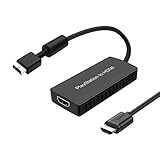
- PS2 Adapter: Convert PlayStation1/2/3 signal to HDMI signal (sony playstation game console connection to HDTV)
- No need to install drivers, portable, flexible, plug and play.
- PS2 to HDMI Converter: Support HDMI 16:9/ 4:3 output switch.
- NOTE: Compatible with PlayStation1/2/3 only.(Note: It's just a converter, you also can play PS1 games on PS2)
- RGB signal mode display. Video signal transfer only, can't improve the video quality.
Dump-based setup
- Connect a compatible optical drive to the computer.
- Use a disc-dumping method supported by PCSX2’s documentation to create a backup file from your own PS2 disc.
- Store the dump on a reliable drive and keep the original disc as the source and backup.
- In PCSX2, add the folder containing the dump to the game library or select the file directly.
- Launch the game, then adjust internal resolution and other enhancements per title rather than assuming one setting suits the entire collection.
PCSX2’s recommendation to dump discs is about convenience and consistency, not permission to acquire copyrighted images from unverified sources. A BIOS dump and game dump should come from hardware and discs you are entitled to use.
What PCSX2 changes
You can render at a higher internal resolution, use computer-based save management, and change configuration per game. Those features can make a large collection easier to organize and can reduce dependence on the television’s scaling. They also introduce variables absent from a stock console: emulator settings, graphics drivers, game-specific performance, and the computer’s available power.
Picture quality: adapter, scaler, PS3, or PC
| Image-processing question | Original PS2 plus adapter | Dedicated scaler | Supported original PS3 | PCSX2 |
|---|---|---|---|---|
| Who handles interlaced video? | Often the adapter or TV; behavior depends on the product | Scaler provides selectable deinterlacing methods documented for PS2 signals | PS3 hardware processes and upscales SD software output | Computer renderer handles the image after emulation |
| Can output resolution be increased? | Limited by the converter’s output design | Yes, within the scaler’s modes | SD content can be upscaled according to Sony’s settings documentation | Internal resolution can be configured, subject to game and computer performance |
| Original console behavior | Highest; the PS2 runs the game directly | Highest; only the video path changes | Not identical to using the PS2; compatibility depends on model and title | Emulated; behavior and speed depend on configuration |
| Physical disc handling | Insert disc into PS2 | Insert disc into PS2 | Insert supported disc into PS3 | Use a disc or a personal dump |
There is no single “best picture” independent of priorities. A scaler gives the most deliberate treatment of the original analog signal. PCSX2 offers the greatest resolution and configuration flexibility. A direct adapter is the least complicated way to retain the PS2 itself.
Independent reader supportYour contribution helps us test, update, and keep practical guides available for everyone.Troubleshoot the problems you are most likely to see
No picture or “no signal”
- Verify that the TV is on the HDMI input actually used by the converter, scaler, PS3, or computer.
- Power-cycle both the source and display so the HDMI handshake starts again.
- For an original PS2 adapter, confirm the console’s YPbPr/YCbCr setting and reseat every connector.
- Check that the converter lists your exact SCPH family and the incoming 480i, 576i, or 480p mode.
- Try a different HDMI input or cable to isolate a display-path problem.
Black-and-white or badly tinted image
This usually indicates a mismatch between the PS2’s selected output format and what the adapter expects. Revisit the component-video setting required by the converter manual, then reconnect with the PS2 powered off.
Flicker, combing, or unstable motion
These are typical signs that interlaced output is being handled poorly. Test a different deinterlacing mode on a dedicated scaler if you have one. If you are using a basic converter, compare the result on another TV or move to a scaler whose documentation specifically addresses PS2 interlaced signals.
Best Value

- Composite to HDMI Converter: Converts analog AV composite (Yellow, White, Red) input to HDMI 720P/1080P (60HZ) output, displayed on smart TV, Projector or HD Display, which bring back your old and cherish memories.
- Plug to Play: This HDMI Converter no extra drivers need, just plug and play,easy to use. Please hook up the USB Power Cable (included) to 5V power source during use. Note: The Video Converters only support converts AV to HDMI, can't converts HDMI to AV.
- Widely Used: This composite to hdmi adapter is widely applied to PS1, PS2, PS3, Xbox, N64, Wii, STB, VHS, VCR, DVD Players and other devices with standard composite AV input. Note: It can only be used when PS2 is set to RGB output.
- Wide Compatibility: This Video Audio Converter Adapter supports source formats of PAL, NTSC3.58, NTSC4.43, SECAM, PAL/M, PAL/N standard TV. Provide advanced signal processing with great precision, colors, resolutions, and details. Important Note: This converter can't improve video quality!
- Attention & Package: Please ensure to connect this av hdmi converter to power source to make it work. Package include: 1*AV to HDMI Adaptor, 1*USB Power Cable(adapter not included), 1*User Manual.
A PS3 will not start a PS2 disc
First verify the exact PS3 model against Sony’s compatibility table. HDMI output alone does not establish PS2-disc support. If the model is listed, test another known-good PS2 disc and check the optical drive; if it is not listed, use an original PS2, a supported console, or PCSX2 instead.
PCSX2 is slow or has graphical glitches
Check the title-specific performance requirement rather than judging the computer by its general age or specification. Reduce demanding rendering settings, confirm that the intended graphics device is selected, and test the game at its default configuration before adding enhancements. If the optical drive cannot read the disc reliably, create a dump with another compatible drive or use a verified personal dump.
PCSX2 reports that no BIOS is available
PCSX2 cannot run without a BIOS. Provide a dump from a PS2 you own; downloading a substitute BIOS does not solve the documented requirement and may create legal problems.
Recommended Free Tools
Practical decision guide
Choose an HDMI adapter when
- You want the fewest moving parts.
- You already own a working PS2 and want to keep using its controllers and memory cards.
- You accept that the TV or a basic converter may perform the deinterlacing.
- Your adapter’s documentation explicitly covers your SCPH family and signal modes.
Choose a dedicated scaler when
- Flicker, combing, or inconsistent TV processing is visible.
- You want control over deinterlacing and other image-processing choices.
- You are willing to configure an additional device and pay more than for a basic converter.
Choose a backward-compatible original PS3 when
- You find a console whose exact model appears in Sony’s supported table.
- You want native HDMI output without adding a separate PS2 video converter.
- You can verify the optical drive and test the specific discs that matter to you.
Choose PCSX2 when
- You want higher internal rendering resolutions, flexible saves, and per-game configuration.
- You have a computer that meets the demands of your particular games.
- You can provide a legally dumped PS2 BIOS and use your own discs or disc dumps.
- You are comfortable troubleshooting software, drivers, and game-specific settings.
Protect the collection while you choose
Keep original discs in clean cases, handle them by the edges, and avoid using a damaged disc as your only source for a dump. If you move to PCSX2, retain the original media and make a second copy of important personal dumps on separate storage. For console play, test a small selection of discs before committing to a new video path: include a game that starts in standard interlaced mode, one that changes resolution, and the titles you play most often.
Record the exact PS2 SCPH model, converter or scaler model, TV input, and settings that produce a stable picture. That small inventory makes it easier to recover after replacing a cable, television, or adapter and prevents you from buying hardware based only on a connector that happens to fit.
Bottom line
For a disc-first collection, start with the original PS2 and a converter documented for your exact SCPH family and 480i, 576i, or 480p needs. Upgrade that signal path with a dedicated scaler if interlaced artifacts or poor TV processing bother you. Treat a backward-compatible original PS3 as a carefully verified model-specific option, not a feature shared by every PS3. Use PCSX2 when computer flexibility and higher-resolution rendering outweigh the desire to keep playback entirely on original hardware.
Quick Recap
Product prices and availability are accurate as of the date/time indicated and are subject to change. Any price and availability information displayed on Amazon at the time of purchase will apply.

