
PC Slower Than It Used to Be?
A free scan shows the junk files, broken settings and background clutter dragging Windows down - then fixes them in one click.Free scan · Windows 10 & 11Outdated Drivers Are Slowing You Down
One free scan finds every outdated or missing driver and matches the right update for your exact hardware.Free scan · exact hardware matchiTechGuides is reader-supported. When you buy through links on our site, we may earn an affiliate commission. As an Amazon Associate I earn from qualifying purchases. Learn more
The Dell UltraSharp U3225QE is the best USB-C monitor for connectivity in 2026 because it combines a 4K 120Hz display with Thunderbolt 4, up to 140W Power Delivery, 2.5GbE Ethernet, a USB hub, KVM-related connectivity, and display daisy chaining. For a lower-cost office setup, the BenQ GW2786TC delivers the essential one-cable experience at 65W. The ViewSonic ColorPro VP16-OLED is the specialist choice for travel and portable second-screen use.
USB-C is only the shape of the connector, however. Before buying, verify three separate capabilities: video through DisplayPort Alternate Mode or Thunderbolt, enough USB Power Delivery for your laptop, and the downstream ports or networking you actually need. A USB-C port without video support cannot replace a conventional display connection.
At a glance
| Monitor | Best for | Display | Laptop charging | Connectivity highlights | Main compromise |
|---|---|---|---|---|---|
| Dell UltraSharp U3225QE | Premium desktop docking | 31.5-inch 4K, 120Hz | Up to 140W EPR | Thunderbolt 4, 2.5GbE, USB hub, KVM-related ports, daisy chaining | Expensive; no built-in speakers |
| BenQ GW2786TC | Affordable office setup | 27-inch 1080p, 100Hz | 65W | USB-C video/data, hub, DisplayPort MST daisy chaining | Low pixel density; no Adaptive Sync |
| ViewSonic ColorPro VP16-OLED | Portable second screen | 15.6-inch 1080p OLED, 60Hz | 40W two-way power | Two USB-C ports, DisplayPort Alt Mode, micro-HDMI, integrated stand | No desktop-class hub or Ethernet |
Prices, stock, retailer availability, and regional package contents change frequently. Treat current prices as a checkout-time detail rather than a permanent part of the ranking.
What’s actually slowing this PC down?
Pick the symptom - the matching free tool is one click away.
1. Dell UltraSharp U3225QE: best overall for connectivity
The Dell UltraSharp U3225QE is the most complete choice when the monitor is meant to function as the center of a laptop workstation. It is a 31.5-inch 3840×2160 IPS Black display with a 120Hz refresh rate, 99% DCI-P3 coverage, 100% sRGB coverage, and a typical 3,000:1 contrast ratio.
Its real advantage is the port selection. The monitor provides a Thunderbolt 4 upstream connection with up to 140W EPR Power Delivery, a Thunderbolt 4 downstream port for expansion or daisy chaining, a separate USB-C upstream connection associated with KVM use, multiple USB-A and USB-C downstream ports, DisplayPort input and output, HDMI, and 2.5GbE Ethernet. In a compatible setup, one laptop cable can carry the display signal, charge the laptop, connect peripherals, and provide wired network access.
#1 Best Overall

- 【Designed for Comfortable All-Day Productivity】 Enhance your workflow with a 24-inch IPS eye care monitor built for home office, study, and daily tasks, featuring BenQ Eye-Care technologies to reduce eye strain during extended screen time.
- 【USB-C One-Cable Convenience】 Connect your laptop or MacBook with a single USB-C cable for video, data, and power delivery, reducing cable clutter and simplifying your workspace
- 【Smooth 144Hz for Better Work Experience】 Enjoy smoother scrolling, reduced motion blur, and more responsive multitasking compared to standard 60Hz monitors—perfect for long work sessions and Gaming!
- 【Built for Business & Office Deployment】 Designed for corporate offices, remote teams, and large-scale workstation setups. Reliable performance and consistent display quality make it ideal for IT deployment and bulk purchasing
- 【Energy Efficient & Certified Sustainability】 Reduce energy consumption and lower operating costs—an efficient choice for businesses and users running monitors for extended hours
That combination makes the Dell UltraSharp U3225QE the strongest premium recommendation for people who want a monitor to replace much of a desktop dock. It is especially attractive for a laptop that supports Thunderbolt and for desks that use wired Ethernet, several USB peripherals, or a second monitor.
What it does best
- High-bandwidth single-cable setup: Thunderbolt 4 handles the display connection and expansion duties more flexibly than a basic USB-C monitor.
- High-power charging: Up to 140W EPR gives it more headroom than the 65W to 90W charging commonly found on USB-C displays.
- Networking: Integrated 2.5GbE is useful for a desk where Wi-Fi is unreliable or where fast local-network transfers matter.
- Expansion: USB-A and USB-C downstream ports, DisplayPort output, and Thunderbolt downstream connectivity reduce the need for a separate hub.
- Display quality: 4K resolution and 120Hz make it substantially more suitable for detailed text work, creative applications, and general desktop use than a 27-inch 1080p panel.
Limitations
The U3225QE is expensive, and it does not include built-in speakers. IPS Black improves contrast over ordinary IPS panels, but it still does not produce the deep blacks of a good VA or OLED display. Its 140W specification also does not guarantee that every laptop will charge at 140W: the laptop must support the relevant USB Power Delivery profile, and the cable and system implementation must support the required mode.
Choose it if: you want the most capable desktop connectivity and are willing to pay for Thunderbolt, Ethernet, high-power charging, and a 4K 120Hz panel.
Skip it if: you only need a basic office display, your laptop cannot use Thunderbolt or high-power USB-C charging, or you already own a good dock and do not need integrated networking.
2. BenQ GW2786TC: best budget one-cable office monitor
The BenQ GW2786TC preserves the core USB-C monitor experience without the cost and complexity of Thunderbolt. It is a 27-inch Full HD monitor with a 100Hz refresh rate, 99% sRGB coverage, ergonomic adjustment, USB-C video and data, a built-in hub, and 65W Power Delivery.
For an office laptop, the basic workflow is straightforward: connect one full-featured USB-C cable and get video, charging, and access to compatible peripherals through the monitor. The display also supports DisplayPort-out MST daisy chaining, allowing a compatible computer and monitor arrangement to drive an additional display.
Recommended Free Tools
The BenQ GW2786TC is the sensible value recommendation for users who want a clean desk and do not need Thunderbolt speeds, Ethernet, 4K resolution, or high-wattage charging. It is a particularly reasonable match for many thin-and-light laptops whose normal chargers are rated around 65W or less.
The important trade-off: 1080p at 27 inches
Full HD is usable for email, web applications, documents, and video calls, but 1920×1080 spread across 27 inches produces noticeably less-sharp text than a 4K monitor. Readers who spend all day with small fonts, spreadsheets, code, or high-resolution photos will generally benefit from a denser display.
The GW2786TC also lacks Adaptive Sync, so it is not the best choice for gaming. Its 100Hz refresh rate can make scrolling feel smoother than 60Hz, but it does not turn the monitor into a gaming-focused display.
Rank #2

- Full HD Portable Monitor - MNN 15.6inch portable laptop monitor with 1920*1080 resolution, advanced IPS glossy screen support 178° full viewing angle, it renders accurate and bright color, draws you into the video or game with lifelike colors and amazing detail.It can effectively reduce blue light radiation damage, no flickering, eye-care, and make it easier to watch for a long time.A second monitor for working from home.
- Double Type-C Port -For Plug & Play, the MNN monitor provides 2 Full Feature Type-C ports. Only One USB Type-C Cable is required to connect to the power supply & display signal transmission. NOTE: Your device should support thunderbolt 3.0 or USB 3.1 Type C DP ALT-MODE.which supports multiple connect ways to your laptops, PC, Phones, Macbooks, PS5/PS4, Xbox, and Switch.
- Lightweight Ultra Slim for Travel - As a portable external monitor,MNN portable laptop monitor easily accommodate to every suitcase and backpack and stress-free when you are holding it for a long time. They are truly portable computer monitors for travelers, students, gamers,engineers, and everyone.
- Give consideration to work and games - through multiple display modes [Copy Mode/Extended Mode/Second Screen Mode/Portrait Mode], we can bring you a clear second screen in the meeting, and expand the screen anytime and anywhere to improve work efficiency and improve the quality of life. Adjusting to HDR mode can upgrade the image to a new level, providing you with brighter highlights,deeper and more realistic colors, more realistic images, and amazing viewing/gaming experience.
- Powerful Smart Cover - MNN portable external monitor can work in both landscape and portrait mode, can be used as a gaming monitor, screen extender for laptop or phone. Comes with a scratch-proof smart cover made of durable PU leather exterior, doubles as a stand, provides comprehensive protection for this portable computer monitor.
Choose it if: you want USB-C video, a basic hub, and 65W laptop charging at a lower price, and you are comfortable with 1080p.
Do these 3 things before closing this tab:
1Fix the driver behind crashes, sound loss and screen glitches2Repair Windows errors before they cause bigger problems3Scan for outdated or missing drivers - takes under a minuteSkip it if: sharp text is a priority, you need Ethernet or Thunderbolt, you use a demanding workstation laptop, or you want gaming features such as Adaptive Sync.
3. ViewSonic ColorPro VP16-OLED: best portable USB-C monitor
The ViewSonic ColorPro VP16-OLED is designed around mobility rather than desktop docking. It has a 15.6-inch Full HD OLED panel, typical brightness of 400 cd/m², a 60Hz refresh rate, a typical 1ms response time, and Pantone Validation. Its built-in height-adjustable stand includes a tripod mount, making it more practical than a portable panel that merely props up against a laptop.
Two USB-C ports support DisplayPort Alternate Mode and 40W two-way power. A micro-HDMI input provides a fallback when the host device cannot send video over USB-C. ViewSonic includes cables, and the monitor can support pass-through charging when paired with an appropriate power source and compatible setup.
For photographers, field editors, presenters, travelers, and anyone who needs a genuinely usable second screen in a laptop bag, the ViewSonic ColorPro VP16-OLED is the best fit among these three. Having two USB-C inputs is useful because it gives the user more flexibility about which port carries video or power.
What it cannot replace
This is not a portable Thunderbolt dock. It has no full-size USB hub, Ethernet, or desktop-class downstream expansion. The 1080p resolution is reasonable at 15.6 inches, but it is still not a 4K creator monitor. The glossy OLED surface may reflect bright office lighting, and the built-in speakers are weak. At 60Hz, it is also less suited to users who specifically want a high-refresh desktop experience.
Choose it if: portability, OLED image quality, flexible USB-C inputs, and a built-in adjustable stand matter more than hub ports.
Skip it if: you need Ethernet, several USB accessories, a large screen, high refresh, or a monitor that can serve as your primary desktop dock.
How to choose a USB-C monitor without being misled by the port
1. Confirm that the laptop’s USB-C port carries video
USB-C does not inherently mean video output. The laptop port must support DisplayPort Alternate Mode, or the computer must support video over Thunderbolt. If it supports only USB data and charging, plugging it into a USB-C monitor will not produce a display signal.
Rank #3

- VERSATILE FULL HD IPS DISPLAY: This 24 inch computer monitor combines 1080p resolution, a 120Hz refresh rate, 1ms response time, and 300-nit brightness for fluid everyday work, streaming, study, and home office use.
- USB C CONNECTIVITY: USB C, HDMI, and VGA give this 24 inch monitor flexible connections for compatible laptops, PCs, and Macs while helping simplify a modern home office, school, business, or study setup.
- VARIABLE REFRESH RATE: Adaptive display technology helps this 120Hz monitor reduce tearing and provide smoother movement during scrolling, video playback, multimedia, and compatible casual gaming.
- FRAMELESS DESIGN AND EYE CARE: Thin bezels and Eye Care features make this desktop monitor practical for single- or multi-display workspaces and more comfortable for extended productivity, research, and viewing sessions.
- BUILT-IN AUDIO: Dual speakers add convenient sound to this PC monitor, supporting meetings, videos, training, and multimedia without separate desktop speakers while remaining compatible with laptop, PC, and Mac systems.
Check the laptop’s technical specifications or manual for terms such as DisplayPort Alt Mode, DP over USB-C, USB4 with display support, or Thunderbolt. Do not rely solely on the connector’s shape or on a small port icon whose meaning varies by manufacturer.
2. Match Power Delivery to the laptop’s charger
Compare the monitor’s maximum output with the wattage printed on the laptop’s normal charger. A 65W monitor is often appropriate for a thin-and-light office laptop. A 90W or 140W-capable monitor offers more headroom, but demanding gaming and workstation laptops may still need their original power adapter, especially under sustained CPU or GPU load.
The advertised maximum is not a universal promise. The laptop must accept the relevant USB-C Power Delivery profile, and the monitor, cable, and host system must negotiate it correctly. A laptop that requires a proprietary high-wattage adapter may charge slowly, maintain its battery level, or discharge while under heavy load even when connected to a high-output monitor.
3. Distinguish upstream and downstream USB-C ports
Upstream is the port that connects the computer to the monitor and normally carries the laptop’s video, data, and charging connection. Downstream ports are intended for accessories such as storage, keyboards, phones, or other peripherals. A downstream USB-C port may supply power or data but may not accept video from a laptop.
Free tools Windows power users keep installed
One-click scans. No signup required.
Read the port diagram rather than assuming that every USB-C socket has identical capabilities. The Dell’s Thunderbolt and USB-C upstream connections, for example, serve different roles from its downstream hub ports. The ViewSonic’s two USB-C ports are specifically useful for flexible video and power arrangements, while the BenQ’s office-oriented design focuses on a simpler USB-C connection and hub.
4. Check the complete daisy-chain setup
Daisy chaining is not guaranteed merely because a monitor has DisplayPort output. The monitor must support the required MST or Thunderbolt feature, the computer must support the topology, and the cables and displays must have compatible inputs and outputs.
The BenQ uses DisplayPort MST for expansion. Some Apple systems have different requirements and may require Thunderbolt for particular daisy-chain configurations. Check the exact computer model and operating system before buying a display specifically for multi-monitor chaining.
5. Use a cable rated for the job
A USB-C cable can physically fit while lacking the bandwidth, data speed, or power capability your setup needs. A low-spec cable can reduce the available refresh rate, disable or slow the monitor hub, prevent a 4K signal, or limit charging.
For a Thunderbolt monitor, use a certified Thunderbolt 4 cable when the system requires Thunderbolt 4 performance. For a basic USB-C monitor, use a full-featured USB-C cable that explicitly supports video, the required data speed, and the required power level. Do not assume that a cable advertised only for phone charging supports DisplayPort video or high-wattage charging.
Rank #4
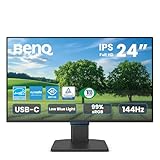
- 【Designed for Comfortable All-Day Productivity】 Enhance your workflow with a 24-inch IPS eye care monitor built for home office, study, and daily tasks, featuring BenQ Eye-Care technologies to reduce eye strain during extended screen time.
- 【USB-C One-Cable Convenience】 Connect your laptop or MacBook with a single USB-C cable for video, data, reducing cable clutter and simplifying your workspace
- 【Smooth 144Hz for Better Work Experience】 Enjoy smoother scrolling, reduced motion blur, and more responsive multitasking compared to standard 60Hz monitors—perfect for long work sessions and Gaming!
- 【Built for Business & Office Deployment】 Designed for corporate offices, remote teams, and large-scale workstation setups. Reliable performance and consistent display quality make it ideal for IT deployment and bulk purchasing
- 【Energy Efficient & Certified Sustainability】 Reduce energy consumption and lower operating costs—an efficient choice for businesses and users running monitors for extended hours
Which of the three should you buy?
- Buy the Dell U3225QE if connectivity is the priority and you want a premium 4K desktop monitor that can provide Thunderbolt expansion, wired networking, peripherals, and high-power charging from one connection.
- Buy the BenQ GW2786TC if you want the least expensive practical route to USB-C video, 65W charging, and a basic office hub. Accept the reduced text sharpness of 1080p at 27 inches.
- Buy the ViewSonic VP16-OLED if you need a portable second screen with an integrated adjustable stand, OLED image quality, two USB-C ports, and a micro-HDMI fallback. Do not buy it expecting desktop-dock functionality.
Common USB-C monitor problems and fixes
The monitor shows “No signal”
- Confirm that the laptop’s USB-C port supports DisplayPort Alternate Mode or Thunderbolt video.
- Connect to the monitor’s designated upstream or video-capable USB-C port.
- Try the supplied or a known full-featured cable.
- Select the correct input on the monitor’s on-screen menu.
- Test the laptop with another compatible display to separate a laptop setting problem from a monitor or cable problem.
The laptop connects but does not charge
Check whether the cable is connected to the monitor’s charging upstream port, compare the monitor’s PD rating with the laptop’s charger, and inspect the laptop manufacturer’s charging requirements. Some laptops accept USB-C data and video but charge only through a particular USB-C port. A high-output monitor cannot override a laptop’s hardware or firmware limits.
The monitor charges but the USB hub does not work
Charging alone does not prove that the data path is active. Make sure the laptop is connected to the monitor’s upstream USB-C or Thunderbolt port rather than a downstream accessory port. Then try a cable with the required data capability and check whether the operating system detects the monitor’s USB hub.
The refresh rate is lower than expected
Check the laptop’s graphics output, the monitor input, the cable rating, and the selected resolution. High resolution and high refresh rate require more bandwidth than ordinary office video. A cable or adapter that works at 1080p may not support 4K at 120Hz, and a computer may impose its own output limit even when the monitor can refresh faster.
The Tool Desk
Outbyte Driver Updater FREEFix the driver behind crashes, sound loss and screen glitchesFind Drivers →Outbyte PC Repair FREEClear out junk files and repair common Windows errorsFree Scan →About pricing and availability
The ranking is based on capability and use case, not a fixed sale price. Monitor pricing, inventory, retailer listings, and included cables can change, and package contents may differ by region. Check the manufacturer or retailer listing immediately before purchase, especially for the premium Dell model and the portable ViewSonic display.
Frequently Asked Questions
Is every USB-C monitor compatible with every USB-C laptop?
No. The laptop’s USB-C or Thunderbolt port must support DisplayPort Alternate Mode or Thunderbolt video. The monitor, cable, and laptop must also agree on the required Power Delivery and bandwidth modes.
Can a USB-C monitor replace a laptop charger?
Sometimes. The monitor must provide enough Power Delivery for the laptop, and the laptop must accept charging through that port. A 65W display is often suitable for thin-and-light laptops, while demanding gaming and workstation models may still require their original charger.
Is 1080p enough for a 27-inch office monitor?
It is workable for general office tasks, but text is less sharp than on a 4K display of similar size. The BenQ GW2786TC is a value choice for users who accept that trade-off; people who read small text or work with spreadsheets and code should consider a denser panel.
Can these monitors run two displays from one laptop?
The Dell supports Thunderbolt and DisplayPort expansion, and the BenQ supports DisplayPort MST daisy chaining, but the laptop must support the required multi-display topology. Apple computers can have different daisy-chain requirements, so verify the exact model before purchase.
Do I need a Thunderbolt cable for every USB-C monitor?
No. A basic USB-C monitor may need only a full-featured USB-C cable supporting video, data, and the required power level. A Thunderbolt 4 cable is appropriate when the monitor and laptop rely on Thunderbolt 4 features or bandwidth.
The Bottom Line
The best USB-C monitor is not the one with the most USB-C sockets; it is the one whose video mode, charging output, hub, network, and cable requirements match your laptop. Choose the Dell UltraSharp U3225QE for the most capable desktop connectivity, the BenQ GW2786TC for affordable one-cable office work, and the ViewSonic ColorPro VP16-OLED for a portable second screen.
Quick Recap
Product prices and availability are accurate as of the date/time indicated and are subject to change. Any price and availability information displayed on Amazon at the time of purchase will apply.
Quick wins for a faster PC:
Repair Windows errors before they cause bigger problemsFix Now →Fix the driver behind crashes, sound loss and screen glitchesFind Drivers →
