
iTechGuides is reader-supported. When you buy through links on our site, we may earn an affiliate commission. As an Amazon Associate I earn from qualifying purchases. Learn more
For most wooden-stake work, use a sharp knife for shaping the point and maintain its edge with a diamond stone or whetstone. A hand plane is better when the stake is clamped and you want straight, repeatable facets. A slow-speed bench grinder is the fastest choice for chipped, rounded or badly altered edges, but it must be used with light passes and frequent cooling to prevent heat damage. Finish any powered grinding on a stone and remove the burr before cutting wood.
Which tool should you choose?
The right tool depends on the condition of the cutting edge, the stake size and how many stakes you need to prepare. A knife gives the most direct control because it cuts the stake itself. A plane iron removes stock from a supported workpiece in straight passes, producing broad, flat facets. A bench grinder removes steel rapidly so it is suited to repairing damaged edges or changing a bevel, not to routine touch-ups.
| Tool and abrasive | Best use | Advantages | Limitations |
|---|---|---|---|
| Knife with diamond stone or whetstone | Pointing stakes and maintaining an edge | Portable, inexpensive, tactile feedback and precise control for small batches | Slow for major repairs; freehand bevel angles can vary |
| Hand plane or plane iron with honing guide | Creating flat facets on a securely held stake | Straight, repeatable cuts and consistent bevel support from the guide | Needs rigid workholding and a properly sharpened iron |
| Slow-speed bench grinder followed by a stone | Chips, rounded edges, major bevel changes and repeated repairs | Fast metal removal and quick primary-bevel work | Heat can destroy temper; requires guards, tool rest, eye protection and cooling |
For a sound edge that only feels dull, do not start on a grinder. Honing on the correct stone removes little metal and preserves the existing geometry. Move to a coarse diamond medium or grinder only when a nick, rounded edge or changed bevel cannot be corrected efficiently by honing.
Do these 3 things before closing this tab:
1Scan for outdated or missing drivers - takes under a minute2Repair Windows errors before they cause bigger problems3Fix the driver behind crashes, sound loss and screen glitchesWhat “sharp” means for a stake tool
A stake point is made by removing wood along one or more bevels. The edge must be keen enough to sever fibers instead of crushing them, but the exact bevel angle depends on the blade and the cut. Norton gives approximately 25 degrees as a practical grinding reference for a plane blade, while also noting that there is no universal angle. Follow the blade maker’s specification and the intended cut rather than treating 25 degrees as a mandatory setting.
#1 Best Overall

- FAST, Durable and Heavy-Duty: Industrial monocrystalline diamonds are electroplated onto a stainless steel base of 0.35 inch thickness. Up to 5 times faster sharpening than oil stone, water stone
- DUAL GRIT: Coarse 325 grit (45 micron) for quick edge setting; Extra fine 1200 grit (12 micron) for honing. Sharpen and Hone HARD Material including High Speed Steel, Carbide, Ceramic & Cubic Boron Nitride. Sharpen dry. No messy oil or water needed.
- Super FLAT Surface: SHARPAL exclusive MirrorFlat technology guarantees long-lasting even contact with knives or tools, while oil stone and water stone easily wear down with uneven surface
- Superior Bonus Pack: Includes storage box with non-slip rubber pad that can be used as a stone base while sharpening; With Sharpening Angle Guide integrated with 4 universal angles-14°, 17°, 20°, 25° and instruction manual inside of packaging
- 3 YEARS of Commitment and Superior After-Sale Service: SHARPAL, headquartered in California, USA, with branches in Germany and Australia, provides easy and effective sharpening solutions. All products undergo rigorous testing to ensure top-tier performance and durability.
Routine honing versus repair
- Routine honing: The edge is intact but no longer slices cleanly. Use a fine diamond stone or whetstone with a stable angle.
- Minor damage: A small nick or rolled section needs a coarser diamond surface or brief grinding to reach fresh steel.
- Major damage: A chipped, rounded or badly altered bevel requires controlled stock removal, normally on a slow-speed grinder, then progressive honing.
Lee Valley describes a honing guide as a way to maintain a consistent bevel and gives a rule of thumb that a bevel may need regrinding after roughly 10–15 honings. That is manufacturer guidance, not a stake-specific durability test; inspect the edge rather than counting honings mechanically.
Knife sharpening for pointed stakes
A knife is the practical hand tool when you are cutting the point directly, especially for a few stakes or work away from a bench. It lets you feel grain changes and stop before removing too much material. A fixed-blade carving, utility or outdoor knife can work if its edge is sound and its handle gives secure control. The knife should be sharp before it touches the stake; a dull edge encourages forceful, unpredictable cuts.
How to sharpen the knife by hand
- Identify the existing bevel. Hold the edge under a strong light and look for the shiny strip that shows the bevel. Match that angle instead of inventing a new one. If the manufacturer specifies an angle, use it.
- Select the lubricant. Use water on a waterstone and the lubricant specified for an oilstone. Diamond plates commonly work dry or with the maker’s recommended fluid. Do not mix oil and water systems, because the wrong lubricant can clog or damage the surface.
- Set a repeatable angle. Keep the spine at a fixed height for every stroke. A honing guide can help on blades it fits, although many knives are sharpened freehand because of their shape.
- Work the coarse side only when needed. If the edge is merely dull, begin with a medium or fine surface. Use a coarse diamond surface for a nick or rolled edge and stop as soon as the damaged section reaches the apex.
- Raise a continuous burr. Make controlled strokes along the full edge until you can feel a small burr on the opposite side. Use light pressure; pressing harder can round the bevel.
- Repeat on the other side. Match the number and length of strokes, then reduce pressure on finer grits. The final passes should alternate sides to minimize the burr.
- Deburr and test. Draw the edge lightly through a folded piece of paper or make a controlled cut in scrap wood. A clean slice with little force is a better test than shaving hair, which does not predict performance in stake wood.
Cutting the stake safely
Clamp the stake or brace it against a stable stop so it cannot roll. Keep your supporting hand behind the edge and cut away from your body. Short, shallow paring cuts are easier to control than a single forceful push. Follow the grain where possible; reversing direction into lifting grain can tear fibers and cause the knife to jump. Rotate the stake as you work so the point remains centered, and leave a small flat or blunt tip if the stake will be driven with a hammer.
Free tools Windows power users keep installed
One-click scans. No signup required.
Rank #2

- Convenience & Durability:Diamond sharpening plates are far more durable and easily to maintain than whetstones because they won't be cratered and do not need to be flattened
- Double-sided Grit Design:Easily tackle both coarse and fine sharpening jobs with just one sharpening stone
- Cutting-edge technology:Steel plates are precisely machined and electroplated with monocrystalline diamonds, which gives them a far longer lifespan than its counterparts
- Precision & quality control:We keep our quality control standard high only to offer our customers the fastest and smoothest sharpening experience
- Universal Application:Diamond sharpeners can be applied to honing a wide range of straight edged tools such as chisels and planer blades
Using a hand plane and plane iron
A plane does not sharpen the stake by itself; it shapes a securely supported stake with a straight iron. This distinction matters. The workpiece must be held firmly at a comfortable height, and the plane iron must be sharper than the wood-cutting task demands if you want clean facets rather than torn grain.
When a plane is the better choice
- Use it for long stakes where broad, flat facets are easier to make with repeated straight passes.
- Choose it when several stakes need matching geometry and a stop or jig can hold each one in the same position.
- Prefer it when your design calls for a polygonal point rather than a roughly whittled cone.
Sharpening and setting the plane iron
- Remove the iron and inspect it. Check for a chip, rounded nose or uneven bevel. Clean resin and dirt before sharpening.
- Repair the primary bevel. If damage reaches the edge, use a grinder or coarse diamond medium briefly. Norton’s approximately 25-degree plane-blade reference is a starting point only; use the maker’s specification when available.
- Use a honing guide. Set the guide so the existing bevel lies flat on the stone. A guide reduces rocking and keeps the bevel consistent across the blade.
- Hone through finer stages. Remove the coarse scratches on a medium stone, then refine on a fine waterstone or diamond surface. Keep the iron flat and use lubricant appropriate to the stone.
- Flatten the back near the edge. Polish only the area needed to remove the burr; extensive back flattening wastes time and metal.
- Deburr and set the cap iron. A clean back and correctly positioned cap iron help the plane take a controlled shaving rather than tear out fibers.
- Set a shallow cut and test. On scrap, advance the iron gradually until it produces a continuous shaving. Retract it if the plane snags or leaves chatter.
Plane the stake with its grain direction in mind. Clamp the workpiece close to the cutting area, support the far end, and use a stop so a forward stroke cannot push the stake away. Plane one facet, rotate to the next, and check symmetry with a straightedge or visual reference. Do not hold a loose stake in one hand while pushing a plane with the other.
Bench grinders: fast repairs with a narrow safety margin
A slow-speed bench grinder is appropriate when an edge has chips, a rounded profile or a bevel that must be changed across a substantial width. It removes steel far faster than a stone, which makes it efficient for repeated work but unforgiving. USDA Forest Service guidance identifies a manually operated sand-stone wheel that runs through or receives dripping water as the best all-round grinding tool. High-speed electric grinding can build heat, destroy temper, weaken the blade and cause chipping.
Rank #3
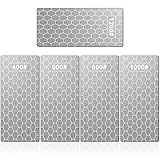
- Unique Honeycomb Design:The sharpening stone set with unique honeycomb design ensures that the dust generated during the grinding process will not affect the sharpening. The diamond sharpening stone has a non-slip base to ensure that it will not slip during use and easily tackle both coarse and fine sharpening jobs.
- Reliable Material:The knife sharpening stone is made of diamond material, with honeycomb surface is safe and reliable, not easy to break or fade, with fine resistance to abrasion and corrosion.Due to the high hardness of the material and the low loss during use, our sharpening stone kit can be used for a long time.
- Easy to Operate:You just need to place the knife on the sharpening stone and move it back and forth several times while maintaining an angle of about 15°. You can always adding water or honing oil on it while sharpening, which make the lubricating effect of grinding will be great.Use with no pressure
- Universal Application:The diamond sharpening stone is very suitable for honing household kitchen knives, wood chisels, jade, seals, tool steels, seal cutting tools, ceramic knives, and chamfering of glass tiles.Whether it is household props or outdoor tools, you can use our whetstones to sharpen it and make it easier to use.
- Package Include:You will receive 5 pieces of diamond sharpening stones in different grits, including 400 grit, 600 grit, 800 grit, 1000 grit and 1200 grit.The size of the sharpening stone is about 15 cm/ 5.91 inches in length, 6.3 cm/ 2.48 inches in width, and 0.1 cm/ 0.04 inches in height.Lightweight, small and practical.
Prepare the grinder
- Install the manufacturer’s wheel guard and keep the tool rest adjusted close to the wheel.
- Wear eye protection; use additional face protection when the grinder manufacturer recommends it.
- Keep a container of clean cooling water within reach, but follow the grinder and wheel maker’s instructions about liquid near the machine.
- Use the wheel’s intended grinding face. Do not grind on the flat side of a standard wheel, because it can damage the wheel or create a dangerous failure.
- Dress or replace a glazed, cracked or out-of-round wheel according to the manufacturer’s procedure.
Grind without overheating the edge
- Mark the bevel. A permanent marker on the existing bevel shows where the wheel is contacting and helps prevent an accidental angle change.
- Use light passes. Present the blade to the wheel gently and remove only a small amount each pass. Never force the edge into the abrasive.
- Keep the blade moving. Sweep across the wheel rather than dwelling in one spot, which spreads heat and avoids a hollow or uneven bevel.
- Cool frequently. Dip the blade in water as soon as it becomes noticeably warm, before it is hot enough to discolor. Dry it before returning to the wheel if the grinder instructions require that.
- Stop before the final apex. Leave a small amount for the stone. Grinding to a paper-thin edge makes overheating and accidental nicks more likely.
- Inspect under good light. Confirm that the chip or rounded section is gone and that the bevel is even on both sides where applicable.
For thin woodcarving edges, Tormek explicitly advises never using a dry grinding bench grinder or belt grinder. The same heat principle applies to knife and plane edges: if the steel is too hot to touch safely, the pass was too long or too aggressive. A blue or straw-colored area can indicate temper damage; stop, let the blade cool and remove the affected steel with a controlled regrind if necessary.
The Tool Desk
Outbyte Driver Updater FREEFix the driver behind crashes, sound loss and screen glitchesFind Drivers →Outbyte PC Repair FREERepair Windows errors before they cause bigger problemsFix Now →Finish every repair on a stone
Grinding establishes the shape but leaves coarse scratches and a burr. Hone the bevel on a diamond stone or whetstone until the grinding marks from the previous stage are gone. Use progressively finer surfaces only as far as the intended wood cut requires; excessive polishing adds time without making a stake point stronger.
- Start on a coarse or medium stone that matches the grinder’s scratch pattern.
- Maintain the established bevel angle and use lubricant suited to that stone.
- Alternate sides near the end of the process to reduce the burr.
- Make a few light finishing strokes on a fine surface.
- Strop on leather if desired, keeping the edge angle low enough not to round the apex.
After honing, inspect the edge for a continuous, even line. A wire burr that remains attached will fold during the first cut and make the tool seem dull. Remove it before testing on scrap.
Rank #4

- FAST, Durable and Heavy-Duty: Industrial monocrystalline diamonds are electroplated onto a stainless steel base of 0.33 inch thickness. Up to 5 times faster sharpening than oil stone, water stone
- DUAL GRIT: Coarse 325 grit (45 micron) for quick edge setting; Extra fine 1200 grit (12 micron) for honing. Sharpen and Hone ALL HARD Material including High Speed Steel, Carbide, Ceramic & Cubic Boron Nitride. Sharpen dry. No messy oil or water needed
- Super FLAT Surface: SHARPAL exclusive MirrorFlat technology guarantees long-lasting even contact with knives or tools, while oil stone and water stone easily wear down with uneven surface
- Superior Bonus Pack: Includes storage box with non-slip rubber pad that can be used as a stone base while sharpening; With Sharpening Angle Guide integrated with 4 universal angles-14, 17, 20, 25 and instruction manual inside of packaging
- Quality Commitment and Superior After-Sale Service: SHARPAL, headquartered in California, USA, with branches in Germany and Australia, provides easy and effective sharpening solutions. All products undergo rigorous testing to ensure top-tier performance and durability
Comparison by the decisions that matter
| Decision factor | Knife and stone | Plane iron and honing guide | Slow-speed grinder plus stone |
|---|---|---|---|
| Edge condition | Best for sound edges and small touch-ups; coarse stone handles minor damage | Best for maintaining a plane iron and correcting small defects | Best for chips, rounded edges and major bevel changes |
| Bevel control | Good with practice; a guide may not fit every knife | High when the honing guide and iron are set correctly | Dependent on hand control and tool-rest setup; finish on a stone for precision |
| Metal-removal speed | Low to moderate | Low to moderate | High |
| Heat risk | Very low | Very low | High without light passes and cooling |
| Portability | High | Low to moderate | Low |
| Learning curve | Moderate because angle and pressure are often freehand | Moderate; the guide simplifies sharpening but planing requires setup | High because wheel contact, guards and heat control all matter |
| Workholding | Stake must be clamped or securely braced during cutting | Rigid support and a stop are essential | Blade is hand-held at the rest; stake is not on the grinder |
| Total equipment cost | No published figure; usually the least equipment | No published figure; requires a plane, iron, guide and stones | No published figure; requires grinder, wheel, guards, cooling setup and finishing stones |
No authoritative source establishes stake-specific speed, cost, durability or edge-life statistics, so these factors should be judged from your workload and existing equipment rather than a claimed universal number.
Independent reader supportYour contribution helps us test, update, and keep practical guides available for everyone.A practical workflow for a batch of stakes
- Sort the blades. Separate sound edges for honing from chipped or rounded edges that need repair.
- Secure the wood. Clamp each stake or use a stop and support that prevents rolling and keeps hands behind the cutting edge.
- Choose the shaping tool. Use a knife for flexible, direct pointing; use a plane for repeatable flat facets on a supported stake.
- Repair only damaged steel. Grind briefly on a slow-speed machine or use a coarse diamond surface, cooling often.
- Hone. Refine the bevel on the appropriate stone, remove the burr and strop if useful.
- Shape one test stake. Check point symmetry, surface tear-out and the force required. Adjust the bevel or cutting method before processing the rest.
- Inspect the finished batch. Reject points with loose splinters, off-center geometry or edges that force you to push hard.
Common mistakes and fixes
Starting with the grinder because the edge feels dull
A grinder removes more steel than necessary and introduces heat. Start with a medium or fine stone when the edge is intact; reserve grinding for visible damage or a required bevel change.
PC Slower Than It Used to Be?
A free scan shows the junk files, broken settings and background clutter dragging Windows down - then fixes them in one click.Free scan · Windows 10 & 11Crashes, No Sound, or Screen Glitches?
Random freezes, missing sound and display glitches usually trace back to one bad driver. Find and replace yours safely.Free scan · under a minuteHolding the stake in the air
An unsupported stake can rotate into the edge. Clamp it, brace it against a stop or use a dedicated fixture, and keep the non-cutting hand behind the blade path.
Best Value

- 4-IN-1 SHARPENING SYSTEM – Combines #400 coarse diamond, #600 medium diamond, #8000 fine ceramic, plus a steel grinding slot. Quickly repair damaged blades, restore daily sharpness, and achieve a mirror-polished edge – all in one compact tool. No need for multiple stones.
- PRECISION ANGLE GUIDE (14°/17°/20°) – Includes a 3‑in‑1 angle guide block that locks in the correct sharpening angle. Beginners can sharpen like a pro without guessing, while experts enjoy consistent, symmetrical edges. Ideal for Japanese knives (15°), Western chef knives (20°), and hunting knives (20–25°).
- FAST SHARPENING ON ANY STEEL – Industrial‑grade diamond and fine ceramic abrasives cut through high‑hardness steels with ease. The diamond layer sharpens 3–5× faster than conventional stones.
- NON‑SLIP & SAFE DESIGN – V‑shaped plastic base with drainage holes keeps the stone firmly in place. The stable design prevents slipping during use, reducing the risk of accidents. Easy to clean – just rinse with water or oil and air dry.
- WIDE COMPATIBILITY & 1‑YEAR WARRANTY – Works on kitchen knives (cleaver, chef, bread, boning), hunting/folding knives, scissors, axes, chisels, and pruning shears. Not for ceramic or glass blades. Backed by a 1‑year warranty against defects.
Using the wrong stone lubricant
Waterstones, oilstones and diamond products have different requirements. Follow the stone maker’s instructions; incompatible lubricant can clog a surface or leave the edge contaminated.
Pressing hard on a stone
Heavy pressure rounds the bevel and accelerates stone wear. Use the minimum pressure that maintains contact, then lighten it as the edge becomes refined.
Leaving the burr in place
A burr can make an edge feel sharp for a few cuts and then fold. Alternate light strokes, polish the back near the edge and test on scrap to verify that it is gone.
What’s actually slowing this PC down?
Pick the symptom - the matching free tool is one click away.
Grinding on the wheel’s side
Standard bench-grinder wheels are designed for peripheral grinding. Side loading can damage the wheel. Use the face specified by the manufacturer and keep the rest correctly adjusted.
Using a dry high-speed grinder on a thin edge
Thin edges heat quickly. USDA guidance warns that high-speed electric grinding can ruin temper, and Tormek warns against dry grinding for woodcarving tools. Use a slow-speed, properly guarded setup, make brief passes and cool the blade often; if that equipment is unavailable, repair the edge on a coarse diamond medium instead.
Equipment checklist
- Knife or hand plane matched to the stake profile
- Diamond sharpening stone or whetstone in suitable grits
- Honing guide for plane irons and compatible blades
- Slow-speed bench grinder for substantial repairs
- Correct wheel guard and adjustable tool rest
- Cooling water and a way to dry the blade safely
- Clamps, bench stop or fixture for securing stakes
- Eye protection and, where appropriate, face protection
- Scrap wood for a final cutting test
Bottom line
For routine stake work, a sharp knife maintained on a diamond stone or whetstone is the most versatile and controllable setup. Add a plane and honing guide when you need straight, repeatable facets on a supported workpiece. Keep a slow-speed bench grinder for damaged edges and major reshaping, use light passes with frequent cooling, and always complete the edge on a stone before cutting wood.
Quick Recap
Product prices and availability are accurate as of the date/time indicated and are subject to change. Any price and availability information displayed on Amazon at the time of purchase will apply.
Recommended Free Tools

