
Free tools Windows power users keep installed
One-click scans. No signup required.
iTechGuides is reader-supported. When you buy through links on our site, we may earn an affiliate commission. As an Amazon Associate I earn from qualifying purchases. Learn more
For responsive four-player Smash 64 or Smash Remix on a PC, start with an accurate emulator at a locked, stable full-speed rate, enable the 8 MB Expansion Pak mode, use wired controllers on direct USB connections, and assign each device to its own simulated controller port. Use Generic USB Input for most modern pads and unsupported adapters, the Raphnetraw N64 Adapter plugin for compatible N64 hardware, and the GameCube Adapter plugin for compatible GameCube adapters. Leave netplay-delay imitation off for same-machine play.
There is no authoritative universal millisecond figure for this setup. Perceived latency changes with the emulator build, renderer, frame pacing, controller and adapter path, operating system, and display. The settings below remove avoidable delay and give you a repeatable way to find problems.
The low-latency baseline
Apply these settings before changing individual graphics or controller options. They establish a known-good local configuration without pretending that one renderer or one adapter is fastest on every PC.
| Area | Recommended setting | Why it matters |
|---|---|---|
| Emulator | Use an accurate, actively maintained N64 emulator; both Mupen64Plus and Project64 are identified as suitable by the Smash Remix download guidance. | Accuracy and consistent timing are more important than a feature that adds visual work. |
| Memory expansion | Enable 8 MB Expansion Pak mode. | Smash Remix requires this mode; without it, the game may fail to start or behave incorrectly. |
| Controller connection | Prefer wired controllers and a direct USB path. | It removes radio, battery and extra intermediary variables while troubleshooting. |
| Input plugin | Generic USB Input for modern USB pads, wireless receivers and unsupported N64-to-USB adapters; Raphnetraw N64 Adapter for supported N64 hardware; GameCube Adapter for compatible GameCube adapters. | The plugin must expose the device and its buttons reliably to the emulator. |
| Local ports | Configure one simulated controller for each player and verify the device assigned to every port. | A wrong assignment looks like input lag but is actually a routing error. |
| Rendering | Keep the simplest stable renderer and conservative visual options while testing. | The documentation exposes rendering and frame-skip controls but does not certify one universal lowest-lag renderer. |
| Netplay delay imitation | Off for same-machine multiplayer. | Smash Remix documents this option for imitating online delay, not for local play. |
Choose between Project64 and Mupen64Plus
Neither emulator can be declared the universal lowest-latency choice from the available official documentation. Select the one that gives your PC a stable full-speed rate and the cleanest input-plugin path for your controllers. If you are deciding between them, compare the following practical factors rather than a single latency claim.
#1 Best Overall
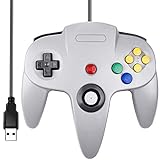
- Plug & Play: Standard USB controller; no drivers needed for compatible devices
- Compatible with Windows PC, macOS, Linux and Raspberry Pi
- Iconic original M-shaped configuration, featuring 10 action buttons, a precision analog Control Stick, and an 8-way D-pad.
- The 3D analog stick provides nuanced control for precise movements and enhanced gameplay comfort.
- Features a 6-foot (1.8 m) cable for comfortable gameplay.
| Comparison axis | What to check | Decision rule |
|---|---|---|
| Input-plugin compatibility | Can the emulator use Generic USB Input, the Raphnetraw N64 Adapter path, or the GameCube Adapter plugin required by your hardware? | Choose the emulator that recognizes your controller without an extra translation layer or unreliable mapping. |
| Full-speed frame pacing | Does the game remain at a steady full-speed rate during a four-player match, including effects and busy stages? | Prefer steady pacing over a higher-looking frame rate that repeatedly stalls. |
| Four-port setup | Can you assign and verify four independent simulated controllers? | Mupen64Plus documents separate settings for four simulated controllers; use that explicit per-port control when it suits your setup. |
| Online workflow | Do you also need the emulator’s documented client/server netplay process? | Consider the emulator with the clearer workflow for your group, but keep its online buffering separate from local latency decisions. |
| Troubleshooting controls | Can you temporarily use pause, frame advance or speed controls to diagnose a problem? | Use those controls only for diagnosis, never as part of a match configuration. |
Install one emulator first and establish a clean baseline before comparing the other. Changing emulator, renderer, controller plugin and display mode at the same time makes it impossible to identify which change helped.
Enable the 8 MB Expansion Pak mode
Smash Remix requires the N64’s 8 MB Expansion Pak mode. In the emulator’s game or console settings, select the 8 MB Expansion Pak option before launching the game. The Smash Remix download guidance treats this as a requirement, not an optional enhancement.
- Close the game if it is running.
- Open the emulator’s console, game or memory settings.
- Set the memory expansion to 8 MB Expansion Pak.
- Save the setting for the Smash 64 or Smash Remix profile.
- Launch the game and confirm it reaches the title screen before configuring four players.
If the game refuses to boot, crashes during loading or behaves inconsistently, check this setting before changing graphics or controller options. A memory-mode error cannot be repaired by a lower-latency input plugin.
Quick wins for a faster PC:
Clear out junk files and repair common Windows errorsFree Scan →Scan for outdated or missing drivers - takes under a minuteDriver Scan →Use the controller path that matches your hardware
Modern USB controllers
Use Generic USB Input for a modern USB controller. A wired pad is the preferred first test because it avoids wireless radio scheduling and battery state as variables. Plug it directly into the PC rather than through a hub while you establish the baseline. Wireless controllers can work through the same generic input path, but they add another possible source of intermittent delay or dropped input.
Original-style N64 controllers
For an N64 controller connected through supported hardware, select the Raphnetraw N64 Adapter plugin named in the Smash Remix setup guidance. The adapter and plugin should expose the stick, digital buttons, triggers and start button as one device that can be assigned to a simulated port.
Other N64-to-USB adapters
If your N64-to-USB adapter is not directly supported by the named plugin, choose Generic USB Input and map every control manually. Do not assume that an adapter’s printed button labels match the emulator’s logical names: test the physical A, B, start, shoulder, trigger, stick directions and C buttons one at a time.
GameCube controllers
Use the GameCube Adapter plugin when your adapter is compatible with that path. If it is not detected, fall back to Generic USB Input only when the adapter presents itself to the operating system as a normal controller.
Rank #2

- Use the generic standard USB port, if your program or application accepts USB controller input, it can be used natively without drivers or patches, JUST PLUG AND PLAY!
- Supported Operating system: Windows 98, ME, Vista, 2000, 2003, XP, 7, 8, 8.1, 10; Linux UBUNTU, Linux Mint, Android Linux (via an USB OTG cable); Mac OS X and beyond; Retrogaming operating systems: RetroPie, Recalbox, Happi Game Center, Lakka, ChameleonPi, Piplay.
- Supported Device (With USB storage device): PC, Notebook Computer, Laptop Computer; Android Smartphone: connect via an USB OTG cable; Raspberry Pi (RPI, Raspberry pie): Raspberry Pi 1 Model B, Model A, Raspberry Pi 1 Model B+, Raspberry Pi Zero, Raspberry Pi 2, Raspberry Pi 3 Model B, Raspberry Pi 3, Retro Pie. --- Note: NOT SUPPORT Android TV BOX.
- Supported Game Emulators: Current: Project64, 1964, MAME (MESS), Mupen64Plus, Sixtyforce, CEN64; Historical: Project Unreality, Corn, UltraHLE, Nemu64.
- Super sensitive buttons for precision control. Third party controller, not original Nintendo 64 controller. But it works phenomenal with the Raspberry Pi game emulation and so on. Cord is approx 5.9 ft. Long.
Configure four local controller ports
Four-player problems are usually assignment problems, not mysterious latency. Mupen64Plus documents separate configuration sections for four simulated controllers, including the device, whether the controller is plugged in, and the plugin settings. Use the equivalent per-port controls in Project64 or another emulator.
- Connect only the first controller and open the emulator’s controller configuration.
- Select simulated controller 1, mark it plugged in, choose the correct input plugin and select the intended device.
- Map the controls, then test every button and the analog stick in the configuration screen.
- Connect the second controller and repeat the process for simulated controller 2. Do not leave the device selector on an automatic value if two identical pads are connected and the emulator can distinguish them explicitly.
- Repeat for controllers 3 and 4, enabling each port only after its device and mappings are verified.
- Start a local match and have each player press a unique button. Confirm that player 1 moves player 1, player 2 moves player 2, and so on.
- Save the profile after all four ports work. Reopen the configuration once to ensure the assignments persist after a restart.
Keep one physical device assigned to one simulated port. Assigning the same device to two ports, or leaving an unused port enabled with a keyboard mapping, can create duplicate moves that look like missed or delayed inputs.
Keep frame pacing steady before chasing visual quality
Input is processed inside the emulator’s update loop. A game that repeatedly falls behind, catches up or skips frames can feel less responsive even when the controller signal arrives immediately. First make the game run at a stable full-speed rate; only then add visual enhancements.
Start with conservative rendering
Use the simplest renderer and default resolution that remain stable on your PC. Disable optional enhancements while testing, then add them one at a time. The cited emulator documentation exposes rendering and frame-skip controls, but it does not certify a universal lowest-lag renderer, so a setting that is fast on one graphics driver may be worse on another.
Treat frame skip as a recovery tool
Do not use frame skipping to hide a persistent performance problem in a competitive match. If the emulator offers a frame-skip control, leave it at its normal or disabled value for the baseline. A skipped frame can preserve nominal speed while making animation and input timing uneven. Investigate the cause of slowdowns instead: lower optional effects, close competing workloads and check whether the PC is maintaining full speed.
Separate emulator speed from display latency
A stable emulator does not guarantee a fast display. Use the display’s lowest-latency game mode when available, avoid unnecessary video processing, and keep the output at a mode the PC can sustain without repeated refresh-rate changes. These display adjustments are independent of the controller plugin, so test them after the emulator itself is stable.
Do not imitate netplay delay in local matches
Smash Remix includes a delay option intended to imitate online conditions. Leave it disabled when all players are using controllers connected to the same PC. Adding simulated delay cannot improve local synchronization; it only makes every player’s actions feel later.
Rank #3

- Use the generic standard USB port, if your program or application accepts USB controller input, it can be used natively without drivers or patches, JUST PLUG AND PLAY!
- Supported Operating system: Windows 98, ME, Vista, 2000, 2003, XP, 7, 8, 8.1, 10; Linux UBUNTU, Linux Mint, Android Linux (via an USB OTG cable); Mac OS X and beyond; Retrogaming operating systems: RetroPie, Recalbox, Happi Game Center, Lakka, ChameleonPi, Piplay.
- Supported Device (With USB storage device): PC, Notebook Computer, Laptop Computer; Android Smartphone: connect via an USB OTG cable; Raspberry Pi (RPI, Raspberry pie): Raspberry Pi 1 Model B, Model A, Raspberry Pi 1 Model B+, Raspberry Pi Zero, Raspberry Pi 2, Raspberry Pi 3 Model B, Raspberry Pi 3, Retro Pie. --- Note: NOT SUPPORT Android TV BOX.
- Supported Game Emulators: Current: Project64, 1964, MAME (MESS), Mupen64Plus, Sixtyforce, CEN64; Historical: Project Unreality, Corn, UltraHLE, Nemu64.
- Super sensitive buttons for precision control. Third party controller, not original Nintendo 64 controller. But it works phenomenal with the Raspberry Pi game emulation and so on. Cord is approx 5.9 ft. Long.
For diagnosis, Mupen64Plus exposes keyboard or core controls such as pause, frame advance and speed adjustment. These are useful for isolating a rendering or timing problem, but they should not be bound to an active match workflow or pressed accidentally during play.
Recommended Free Tools
Understand why online latency advice is different
Local multiplayer sends four controller streams into one emulator instance. There is no network round trip between players, so online buffering guidance does not directly describe local input delay.
Mupen64Plus netplay uses a client/server model: TCP handles registration and synchronization, UDP carries input data, and the server maintains buffers and detects desynchronization. Smash Remix’s server list reports a ping value as the connection latency between you and the server; lower is better. After a desynchronization, its guide recommends that the host use Drop and Start to restart the game.
| Situation | Main latency variables | Correct response |
|---|---|---|
| Same-PC local play | Controller path, USB or wireless behavior, emulator timing, frame pacing and display processing. | Use wired direct connections, stable full speed, correct port assignments and no netplay-delay imitation. |
| Online netplay | Connection ping, UDP input delivery, server buffers, synchronization and desynchronization recovery. | Choose a lower-ping server when possible and follow the documented host restart procedure after a desync. |
Troubleshoot by symptom
Every controller feels delayed
- Confirm that the emulator is running at stable full speed rather than repeatedly slowing down.
- Turn off the netplay-delay imitation option.
- Return the renderer and visual options to a conservative baseline.
- Test one wired controller directly connected to the PC. If that feels normal, add the other controllers one at a time.
- Check the display’s game or low-processing mode.
Only one player is delayed or unresponsive
- Open the per-port configuration and verify that the intended device is selected for that simulated controller.
- Confirm that the port is marked plugged in and uses the correct plugin.
- Remap the physical controls manually, especially with a generic N64-to-USB adapter.
- Disconnect other pads temporarily to rule out duplicate device assignments.
Inputs appear on the wrong player’s character
Reassign ports in numerical order with only one controller connected at a time, then reconnect the remaining devices. Automatic device ordering can change when identical controllers are unplugged or reinserted.
The game will not boot or crashes during loading
Verify that 8 MB Expansion Pak mode is enabled. This is a Smash Remix requirement and should be checked before changing input or graphics settings.
Outdated Drivers Are Slowing You Down
One free scan finds every outdated or missing driver and matches the right update for your exact hardware.Free scan · exact hardware matchPC Slower Than It Used to Be?
A free scan shows the junk files, broken settings and background clutter dragging Windows down - then fixes them in one click.Free scan · Windows 10 & 11The game runs fast but feels uneven
- Watch for intermittent frame-time spikes rather than only the average speed indicator.
- Disable optional visual enhancements and frame skipping.
- Close background workloads that compete for CPU or GPU time.
- Keep the display refresh and emulator output in a mode the PC can sustain consistently.
Buttons work but the analog stick is wrong
In Generic USB Input, map each axis direction manually and test the stick at full range. An adapter may report the horizontal, vertical or sign direction differently from the emulator’s default template.
Validate the setup without inventing a latency number
No authoritative source cited for this configuration publishes a universal millisecond input-latency result. Instead of treating an unverified number as a target, use a repeatable comparison:
- Use the same stage, display mode and emulator build for every test.
- Begin with one wired controller and the conservative renderer.
- Confirm stable full-speed behavior during movement, shields, grabs and several simultaneous effects.
- Add controllers one at a time, checking that frame pacing remains stable after each addition.
- Compare one change at a time: renderer, display mode, controller connection or mapping.
- Keep the configuration that feels immediate and remains consistent, not the one that occasionally feels faster but produces stutter or missed inputs.
This method identifies the source of a problem without claiming that a result measured on one operating system, display or adapter applies to every PC.
Quick Recap
Final four-player checklist
- Accurate emulator selected: Mupen64Plus or Project64, whichever is stable with your hardware.
- 8 MB Expansion Pak mode enabled for Smash Remix.
- Wired controllers and direct USB paths used for the initial test.
- Correct plugin selected: Generic USB Input, Raphnetraw N64 Adapter or GameCube Adapter as appropriate.
- Each of the four simulated ports is plugged in, mapped and assigned to the intended device.
- Game remains at stable full speed with conservative visual settings.
- Frame skipping and netplay-delay imitation are not being used to mask problems.
- Display processing is minimized and one-variable testing has identified any remaining bottleneck.
Product prices and availability are accurate as of the date/time indicated and are subject to change. Any price and availability information displayed on Amazon at the time of purchase will apply.

