
Recommended Free Tools
iTechGuides is reader-supported. When you buy through links on our site, we may earn an affiliate commission. As an Amazon Associate I earn from qualifying purchases. Learn more
The best first step is usually not buying a new phone. On the device you already own, turn off nonessential notifications, set limits or focus periods for attention-hungry apps, schedule nighttime do-not-disturb, and establish phone-free times and places. If those changes are not enough, a minimalist phone can remove whole categories of apps—but it also gives up convenience. A physical phone basket or lockbox can support a household rule, although the container itself has not been shown to reduce use.
This guide compares those options by distraction access, essential functions, setup effort, family and carrier fit, and ongoing cost. It also explains what current child-development guidance does—and does not—say about screen-time limits.
Which option should you try first?
Use the least disruptive intervention that addresses your actual problem. Someone who loses time to alerts may need notification controls; someone who repeatedly reinstalls social apps may need a separate, limited phone; a family that argues about devices at dinner may need a shared charging location.
| Option | Access to distracting apps | What you retain | Setup effort | Family or carrier fit | Cost information |
|---|---|---|---|---|---|
| Existing smartphone settings | Configurable: hide, limit, block or remove selected apps | All normal phone functions, including work and accessibility tools | Low to moderate; review settings and routines regularly | Works with your current device and carrier; controls vary by operating-system version | No new hardware cost |
| Minimalist phone such as Light Phone III | Manufacturer says its toolbox excludes social media, news, advertising and email | Calls, texts and selected utilities such as music, podcasts, directions and calendar; the current list can change | Moderate; migrate contacts, test essential services and check network support | Depends on country, carrier, SIM and required features | Current price and service charges are not stated here; verify before buying |
| Phone basket, charging station or lockbox | Physical access is unavailable during the agreed period | Nothing while the phone is stored; normal functions resume when retrieved | Low, but everyone must follow the location and timing rule | Useful for households, classrooms or bedrooms; does not solve an individual’s settings or carrier needs | Product cost varies; no proven independent screen-time effect |
No device has been established as a guaranteed screen-time treatment. The strongest evidence in this area supports deliberate settings, routines, communication and attention to whether media is displacing sleep, movement, school, work or relationships.
#1 Best Overall
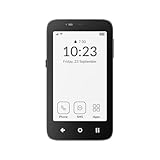
- Focus Without Distraction – Step away from digital noise with Mudita Kompakt, a minimalist dumb phone designed for mindfulness and calm. Its 4.3" E Ink display delivers a paper-like, glare-free view that stays clear in sunlight, keeping you focused on what matters
- Designed for Digital Freedom – MuditaOS K keeps only essential tools—no ads, tracking, or endless scrolling. When you need a full break, Offline+ Mode disables GSM, Wi-Fi, Bluetooth, camera, and microphones for privacy and total peace of mind
- Simple Control & Seamless Connectivity – Manage your device with Mudita Center on Windows, macOS, or Linux to back up data and organize contacts privately. Enjoy reliable 4G LTE, VoLTE, and Wi-Fi calling across North America with the unlocked model optimized for regional networks
- Power That Lasts for Days – The 3300 mAh battery delivers up to six days of standby time. USB-C and wireless charging keep it ready with minimal effort. Access weather, notes, calendar, recorder, meditation timer, and offline maps for everyday simplicity
- Built for Mindful Living – Unlock securely with a fingerprint or PIN, capture memories with the 8 MP camera and dual LED flash, and enjoy music through Bluetooth or the 3.5 mm jack. Read EPUB or PDF files for a focused, streaming-free experience
Make your current smartphone less distracting
Start here if you need maps, banking, two-factor authentication, workplace apps or accessibility features. Menu names differ by operating-system version, so use the labels below as a map and confirm the current instructions in your phone’s documentation.
1. Inventory the interruptions
- Open your notification settings and list every app allowed to alert you.
- Keep alerts that are genuinely time-sensitive, such as calls from family, calendar reminders or security warnings.
- Disable badges, sounds and lock-screen banners for feeds, shopping, games, promotions and other nonurgent apps.
- For messaging, consider allowing alerts from people while silencing group or automated threads.
Notification reduction is often more effective than changing the display because it prevents the phone from initiating a checking session. Review the list after a week: if an alert repeatedly causes an unplanned session, remove it or move it into a scheduled summary.
2. Set limits or focus periods
On an iPhone, the usual path is Settings > Screen Time. On many Android phones, it is Settings > Digital Wellbeing & parental controls. Available controls and names vary by version. Set a daily limit for the specific apps that consume your time rather than imposing an unrealistic limit on every app.
- Use a short limit for social feeds, short-form video and games.
- Schedule a focus mode for work, study, meals or exercise, allowing only the people and apps needed for that period.
- Use a break reminder or break nudge where your phone offers one.
- Remove an app, sign out, or use its web version if a soft limit is too easy to dismiss.
Do not treat a displayed limit as a medical prescription. It is a feedback and friction tool. If you routinely override it, change the environment or the app’s availability instead of repeatedly setting a smaller number.
3. Protect the last hour before sleep
- Schedule nighttime do-not-disturb to begin before your intended bedtime and end after your usual wake-up time.
- Allow calls from designated emergency contacts if that is important for your household.
- Charge the phone outside the bedroom, or place it in a fixed location that requires you to stand up to retrieve it.
- Use a separate alarm if reaching for the phone immediately on waking triggers unwanted checking.
The American Academy of Pediatrics (AAP) identifies nighttime do-not-disturb, notification limits and keeping devices out of bedrooms as practical family strategies. Its Center of Excellence page, updated May 22, 2025, says, “Unfortunately, there isn’t enough evidence demonstrating a benefit from specific screen time limitation guidelines.” Read the AAP guidance.
4. Remove the highest-friction offenders
Identify the one or two apps that create the longest unplanned sessions. Delete them, log out, remove saved passwords and disable automatic reinstallation. Keep an intentional alternative—music, a downloaded book, a notes app or a camera—so the phone remains useful without presenting an endless feed.
Rank #2

- Focus Without Distraction – Step away from digital noise with Mudita Kompakt, a minimalist dumb phone designed for mindfulness and calm. Its 4.3" E Ink display delivers a paper-like, glare-free view that stays clear in sunlight, keeping you focused on what matters
- Designed for Digital Freedom – MuditaOS K keeps only essential tools—no ads, tracking, or endless scrolling. When you need a full break, Offline+ Mode disables GSM, Wi-Fi, Bluetooth, camera, and microphones for privacy and total peace of mind
- Simple Control & Seamless Connectivity – Manage your device with Mudita Center on Windows, macOS, or Linux to back up data and organize contacts privately. Enjoy reliable 4G LTE, VoLTE, and Wi-Fi calling across North America with the unlocked model optimized for regional networks
- Power That Lasts for Days – The 3300 mAh battery delivers up to six days of standby time. USB-C and wireless charging keep it ready with minimal effort. Access weather, notes, calendar, recorder, meditation timer, and offline maps for everyday simplicity
- Built for Mindful Living – Unlock securely with a fingerprint or PIN, capture memories with the 8 MP camera and dual LED flash, and enjoy music through Bluetooth or the 3.5 mm jack. Read EPUB or PDF files for a focused, streaming-free experience
5. Measure the outcome that matters
After seven days, check whether you sleep better, complete work more easily, spend more time with other people or feel less compelled to check. Screen-time totals alone can mislead: a long navigation session and a long social-media session are not equivalent. Keep the controls that improve your daily life and revise those that create unnecessary friction.
Build household rules that a device can support
For families, a purchase is less important than an agreed routine. The AAP’s January 20, 2026 policy statement describes children’s digital lives as an ecosystem of devices, apps, games, social media and other media. It points to screen-free times and places, sleep protection, parental controls and preserving other activities as family strategies. It does not prescribe one universal number of hours for every child.
Choose specific times and places
- Keep phones away from the dining table during meals.
- Make bedrooms device-free overnight, with a shared charging station outside the room.
- Set a homework or family-activity period when only agreed-upon tools are available.
- Define exceptions in advance, such as an on-call parent, medical monitoring or a scheduled video call.
A rule is easier to follow when the physical location is obvious. A basket, charging shelf or lockbox can make the boundary visible. The supporting evidence is for the routine, not for the container as an independently proven intervention.
Set controls together with a child
AAP first-phone guidance recommends considering responsibility and readiness, setting controls and limits jointly, reviewing what works and modeling the habits adults expect. Discuss which apps are allowed, when the phone is charged, how location sharing works, what happens when a limit is reached and how a child can ask for an exception.
Use the AAP Family Media Plan resource to record priorities and revisit them after a change in school schedule, sport, sleep or family circumstance. A written plan avoids turning every limit into a fresh argument.
Model the rule
Adults should follow the same meal and bedtime boundaries when practical. A child is more likely to accept a device-free dinner if adults are not checking notifications under the table. Explain when an exception is necessary rather than silently exempting yourself.
Rank #3
![Light Phone II [Light Gray] 4G Volte Phone, Minimalist Phone for Calling & Texting, Bluetooth, WiFi, Personal Hotspot…](https://m.media-amazon.com/images/I/31Id1+oPeSL._SL160_.jpg)
- The Light Phone II is currently compatible with certain carriers in the US. Compatible carriers include: LIGHT, AT&T, T-MOBILE, VERIZON (except prepaid plans and Numbershare), TING, MINT, US MOBILE. It will not work with carriers that are not listed.
- Standalone minimalist phone that can be used to call and text. Group texting is supported
- The Light Phone II is built around a user-customizable menu of tools. All of the tools are custom-designed for our LightOS to ensure a thoughtful, and private user experience. Available tools currently include an alarm, a calculator, directions, a simple music player, notes/voice memo, calendar and a podcasts tool. The phone also supports hotspot tethering. We'll continue to release other utility-oriented tools, which will be available with software updates.
When a minimalist phone makes sense
A limited phone is appropriate when the problem is access to particular categories of apps and you are willing to trade convenience for fewer temptations. It is not a screen-free solution: the device still has a display, menus and utilities.
Light Phone III: documented capabilities
The manufacturer describes Light Phone III as a communication device with a customizable toolbox. Its current tool list includes core communication functions and optional utilities such as music, podcasts, directions and calendar, while excluding social media, news, advertising and email. Those are manufacturer claims about product design, not an independent study showing reduced screen time.
The specification page lists a 3.92-inch AMOLED display, 5G/LTE connectivity, GPS, Bluetooth, NFC and 128 GB of storage. The manufacturer’s display information says the III is black and white except while using the camera. It is therefore a limited-function phone, not a no-screen phone.
The Tool Desk
Outbyte PC Repair FREEClear out junk files and repair common Windows errorsFree Scan →Outbyte Driver Updater FREEFix the driver behind crashes, sound loss and screen glitchesFind Drivers →| Light Phone III consideration | What the published information establishes | What you must verify |
|---|---|---|
| Distraction profile | No social media, news, advertising or email in the listed toolbox | Whether a newly added tool changes the experience and whether your own habits shift to the remaining functions |
| Useful replacements | Music, podcasts, directions, calendar and other tools are listed as available or optional | Current availability, regional restrictions and whether a tool meets your specific need |
| Hardware | 3.92-inch AMOLED; black-and-white interface except during camera use; 5G/LTE, GPS, Bluetooth, NFC and 128 GB storage | Battery performance, accessory requirements and compatibility with your network |
| Software status | The company changelog includes updates as recent as September 15, 2026 | Current software version and whether a needed feature is stable on your date of purchase |
| Carrier setup | The introduction guide warns that a new Verizon SIM cannot yet be activated through its described setup flow; an active SIM may be activated elsewhere and inserted | Your country, carrier, SIM type, number transfer process and emergency-calling requirements |
Check the published specifications, current tool-availability list and setup guide immediately before ordering. Feature availability and carrier support are time-sensitive. The software changelog shows why a static review can become outdated.
What you give up
- Access to the full smartphone app ecosystem, including many banking, authentication, work and transport apps.
- Instant access to email and news if those are part of your workflow.
- The convenience of a large color screen for reading, photos and complex forms.
- Certainty that every desired tool will remain available or work in every region.
What you may retain
- Voice calls and text communication.
- Selected navigation, calendar, music and podcast functions, subject to the current tool list.
- Modern cellular connectivity and hardware features listed by the manufacturer.
- A deliberately smaller set of reasons to unlock the phone.
Prepare before switching
- List every phone-dependent task you perform in a normal week: authentication, payments, transit, work, school, health monitoring and emergency contacts.
- Find a non-phone method for each task, such as a hardware security key, physical card, computer login or separate navigation device.
- Confirm carrier bands, SIM requirements, number-porting rules and emergency service in your region.
- Export contacts and important information before changing devices.
- Keep your old smartphone available during the transition until essential tasks work reliably.
How to choose between settings, a limited phone and a storage aid
Choose existing-phone controls when convenience is nonnegotiable
This is the right fit if you need specialized apps, frequent navigation, work accounts or accessibility features. It also lets you target one behavior without disrupting everything else. The trade-off is that the distracting apps remain technically available, so success depends on your willingness to maintain limits.
Choose a minimalist phone when access itself is the problem
Consider a limited phone if you have already tried notification and app controls, know which functions you must retain and accept that some tasks will move to a computer or another device. It works best when the user—not a parent or employer—chooses the trade-off and has a plan for two-factor authentication and emergencies.
Rank #4
![Tracfone, TCL FLIP 3, SIM Card Included Flip Phone (Locked to Carrier) | 16GB, Stone Gray, 5MP Video Capable Camera, Locked [Sim Card Included - Separate Purchase Not Necessary]](https://m.media-amazon.com/images/I/31w5fHyjtJL._SL160_.jpg)
- Carrier: This phone is locked to Tracfone, which means this device can only be used on the Tracfone wireless network. A Tracfone plan is required to activate this device. Activating is easy, upon receipt go to Tracfone Website and select “Activate” and follow the prompts.
- 📱 Classic Flip Design & Dual Displays: Features a pocket-friendly flip design with a large internal display for easy reading and navigation, plus a convenient external preview screen to check time, incoming caller ID, and notifications at a glance without opening the phone. Sim Card Included - Separate Purchase Not Necessary
- 📶 Reliable 4G LTE Connectivity & VoLTE: Powered by 4G LTE network speeds for crystal-clear HD voice calls, reliable text messaging, and dependable nationwide coverage across America's top networks.
- ⌨️ Tactile Keypad & Loud Speakerphone: Designed with large, easy-to-press buttons for comfortable dialing, intuitive menu navigation, and a powerful speakerphone for hands-free conversations.
- 🔋 All-Day Battery: Stay connected with a long-lasting battery designed for extended talk and standby time. Wi-Fi Note: Wi-Fi is locked until device is activated. Note: Network-locked to TracFone for 365 days from activation.To find the no-contract Tracfone plan for you, visit the Tracfone Store Link located below the product title
Choose a storage aid when the rule is shared
A basket or charging station is useful when several people need the same device-free meal, meeting or bedtime. It is inexpensive compared with changing phones, but it cannot prevent private use before storage or replace a clear agreement about exceptions.
Do these 3 things before closing this tab:
1Scan for outdated or missing drivers - takes under a minute2Clear out junk files and repair common Windows errors3Fix the driver behind crashes, sound loss and screen glitchesCommon failure modes and fixes
“I set a limit and immediately override it.”
Move from a soft limit to friction: delete the app, sign out, remove its password from the phone, or use a focus mode controlled by a trusted family member. Replace the habit with a specific offline activity rather than leaving an empty gap.
“Do-not-disturb blocks an important call.”
Review allowed contacts and repeat-call settings. Test the schedule with a family member before relying on it overnight, and keep a stated emergency path.
“The family rule works for a week, then disappears.”
Put the charging location in a high-traffic area, define one person responsible for starting the routine and review the plan at a set weekly time. Adjust the rule when school, work or medical needs change instead of abandoning it.
“A limited phone leaves me stranded without an app.”
Do a one-week dependency audit before switching. Carry a payment card, record important numbers, arrange an authentication alternative and confirm navigation coverage. If a critical task has no workable substitute, keep the smartphone and tighten its settings instead.
Free tools Windows power users keep installed
One-click scans. No signup required.
“Less screen time did not improve how I feel.”
Do not assume that screen duration alone explains a mental-health change. The World Health Organization Regional Office for Europe’s May 23, 2025 policy brief says evidence on technology and young people’s well-being is mixed and that “The relationship between technology use and mental health is bidirectional: increased screen time potentially exacerbates mental health issues, which in turn may drive further technology use.” Consider sleep, stress, isolation, content, relationships and professional support where appropriate. Read the WHO Europe brief.
A practical 14-day plan
- Day 1: Record when and why you unlock the phone, without trying to change behavior.
- Day 2: Disable nonessential notifications and remove lock-screen previews.
- Day 3: Set a focus period for your highest-risk time of day.
- Day 4: Set nighttime do-not-disturb and move charging outside the bedroom.
- Days 5–7: Delete or sign out of the single most distracting app; use an offline replacement.
- Day 8: Review sleep, work, family time and stress—not just the usage total.
- Days 9–10: If the main problem persists, test a household basket or charging station during one agreed period.
- Days 11–12: Make a list of smartphone-dependent tasks and possible substitutes.
- Days 13–14: Decide whether settings are sufficient, whether the household routine needs adjustment, or whether a limited phone is worth its trade-offs.
For children, complete this process collaboratively and revisit controls after observing real use. For adults, write down the specific outcome you want—sleeping through the night, finishing work or being present at meals—so the device serves that goal rather than becoming the goal itself.
Quick Recap
Product prices and availability are accurate as of the date/time indicated and are subject to change. Any price and availability information displayed on Amazon at the time of purchase will apply.

