
iTechGuides is reader-supported. When you buy through links on our site, we may earn an affiliate commission. As an Amazon Associate I earn from qualifying purchases. Learn more
The best outdoor speaker depends on whether you want to carry it outside, mount it permanently, or spread sound across an entire yard. For most renters and casual patio listeners, start with a battery-powered Bluetooth speaker such as the JBL Charge 6, LG xboom Bounce, or compact Tribit PocketGo. For a permanently covered patio, the Polk Atrium 4 is a sensible installed starting point. For a large lawn or whole-yard music, use several landscape or surface-mounted speakers rather than one extremely loud box.
There is one important distinction behind every recommendation on this page: an IP67 or IP68 portable speaker is not automatically designed to live outdoors year-round. Sonos, for example, rates the Sonos Play IP67 but still recommends storing it indoors, while its Outdoor by Sonance speakers are purpose-built for permanent exposure. (Sonos explains the difference here.)
Editorial note: the current research supports a carefully sourced 2026 buying guide, not a claim that iTechGuides personally performed backyard measurements on every model below. The recommendations are therefore best-fit buying choices, with manufacturer specifications and independent testing clearly identified rather than presented as in-house test victories.
Quick wins for a faster PC:
Fix the driver behind crashes, sound loss and screen glitchesFind Drivers →Repair Windows errors before they cause bigger problemsFix Now →Quick recommendations
| Best for | Recommended starting point | Type | Power | Weather information | Main drawback |
|---|---|---|---|---|---|
| Most small or medium patios | Polk Atrium 4 | Passive pair | Amplifier and speaker wire required | Polk all-weather design and environmental endurance testing | Limited deep bass; needs an amplifier |
| Compact portable all-rounder | JBL Charge 6 | Battery Bluetooth speaker | Internal battery; USB-C | IP68 | Chunkier than many speakers in its class; newer JBL pairing system may not work with older models |
| Value, ruggedness, and long claimed battery life | LG xboom Bounce | Battery Bluetooth speaker | Internal, replaceable battery | IP67; LG lists seven controlled MIL-STD-810H test methods | 30-hour claim depends on 50% volume, Bluetooth, Voice Enhance, and lighting off |
| Large backyard parties | JBL Boombox 4 | Large battery speaker | Internal battery | IP68 | Heavy and expensive compared with ordinary portable speakers |
| Cheap, pocketable outdoor audio | Tribit PocketGo | Small battery speaker | Internal battery; USB-C | IP68; claimed floatability | Its 7-watt output is not appropriate for a large party |
| Poolside casual listening | Ultimate Ears WONDERBOOM 4 | Compact battery speaker | Internal battery | IP67 and floats, according to RTINGS’ reviewed specifications | Limited deep bass and no app EQ |
| Sonos households | Sonos Play | Portable Wi-Fi/Bluetooth speaker | Internal battery; USB-C | IP67, but Sonos recommends indoor storage | Outdoor Wi-Fi coverage and charging-base limitations |
| Permanent premium installation | Sonos Outdoor by Sonance with Sonos Amp | Passive installed pair | Sonos Amp and speaker cable | IP66; designed for humidity, salt spray, heat, UV, and freezing temperatures | About $1,798 for the listed speaker pair and Amp before wire or installation |
Prices and availability change. The portable recommendations above are not interchangeable with the installed systems: a $29.99 pocket speaker, a $199 passive pair, and a $1,798 Sonos combination solve three different problems.
First choose the system type
Outdoor audio is not one product category. It includes battery speakers, powered speaker pairs, passive surface-mount speakers, landscape systems, and Wi-Fi ecosystem products. Choosing the wrong type is more frustrating than choosing the wrong brand.
Portable Bluetooth speakers
A portable Bluetooth speaker has its own amplifier and battery. It is the simplest choice for a patio table, pool deck, camping trip, beach, or rental home. You can put it where people are gathering, connect a phone, and bring it inside afterward.
#1 Best Overall
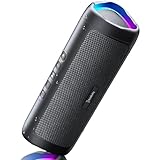
- [Immersive Sound Experience & Dual Connectivity] Experience unparalleled sound quality with this wireless Bluetooth speaker's 2 drivers and advanced technology that delivers powerful, well-balanced sound with minimal distortion. Connect two speakers together to create an immersive stereo sound experience and fill any room with powerful sound. Perfect for gaming, music, and movie playback
- [Tough & Weather-Resistant] Engineered to handle rough use and adverse weather conditions, this speaker features a durable design and an IPX5 rating for protection against water splashes and spills. It's an ideal choice for outdoor events, and is perfect for use at parties, at the pool, on the beach, while camping or hiking, and more
- [Long-lasting Playtime & Extended Bluetooth Connectivity] Experience extended playtime with up to 24 hours(50% Vol and light off) per charge and extended wireless range with Bluetooth 5.3, reaching up to 100 feet from your device. The multicolor lights on the speaker can also be turned off with a simple button press to save the battery and adapt to your needs. Keep in mind that the actual playtime can vary depending on volume level, audio content, and usage
- [Vibrant Light Effects] Bring a new level of excitement to your party with the dynamic multi-color light show that syncs to the beat of the music, you can easily customize the light effects to suit your preference by simply pressing the Light button. Make any gathering more memorable with these visually stunning light effects that will elevate the atmosphere
- [Everything You Need] The package includes 1 waterproof Bluetooth speaker (Item Dimensions D x W x H: 7.87"D x 2.76"W x 2.81"H, Weight: 1.28lb), 1 Type-C charging cable, and a quick start guide, all backed by lifetime technical support. The built-in microphone allows for hands-free phone calls and you can also play music from other devices using the AUX jack (not included). It's a perfect gift for men and women. It is also suitable as white elephant gifts for adult, stocking stuffers for men and women, Christmas gifts,birthday gifts, mothers day gifts,fathers day gifts,Valentine's Day,mens gifts,and various anniversary gifts for him.
The trade-offs are charging, uneven coverage in a large yard, and the temptation to leave the unit outdoors because it has an IP rating. Crutchfield cautions that portable Bluetooth speakers are not all intended for permanent outdoor exposure.
Passive surface-mount speakers
Passive speakers contain no amplifier. They need speaker cable connected to a receiver, stereo amplifier, or smart amplifier such as the Sonos Amp. They are normally mounted under an eave, on a wall, fence, or patio structure and are best when you have one main outdoor listening area.
The Polk Atrium 4, Yamaha NS-AW150, Klipsch AW-650, and Sonos Outdoor by Sonance are examples of this category. They do not need charging, but the amplifier and electrical connections still need to remain in a suitable protected location.
Powered outdoor Bluetooth pairs
A powered pair has an amplifier built into one speaker and usually connects to an outlet. It is easier than selecting a receiver and passive speakers, but it is not a battery-powered solution. Crutchfield lists the OSD BTP-650 as an example of a self-powered outdoor Bluetooth pair. This type can be useful on a covered patio with a convenient protected receptacle.
Landscape, rock, bollard, and stake speakers
Landscape systems are designed to distribute sound across a yard. They normally use several speakers connected by buried or protected cable and an amplifier. Rock, bollard, and stake models can be less visually intrusive than wall-mounted cabinets, but installation is more involved.
Several small stake speakers usually produce better background coverage than one speaker at extreme volume. They may still need an outdoor subwoofer if you expect convincing low bass. Crutchfield’s landscape-speaker guide explains the coverage and subwoofer trade-offs.
Wi-Fi and ecosystem speakers
Wi-Fi speakers are useful when you already use Sonos, AirPlay 2, Spotify Connect, or another multiroom platform. They can synchronize outdoor and indoor playback and generally offer better app control than Bluetooth-only speakers. They also depend on reliable network coverage outdoors unless they provide Bluetooth as a fallback.
Best installed outdoor speakers
Polk Atrium 4: the practical starting point for a patio
The Polk Atrium 4 is a strong fit for a small or medium covered patio when you already have, or are willing to buy, an amplifier. Polk lists a 4.5-inch polypropylene woofer, a ¾-inch anodized aluminum dome tweeter, recommended amplifier power of 10–80 watts per channel, and its Speed-Lock mounting system. The current U.S. product page lists $199 per pair, though retail pricing can differ.
Its compact cabinet and ordinary two-speaker layout make it easier to install discreetly than a large high-output model. Expect clear general-purpose music and speech, but do not expect the deep outdoor bass of a larger cabinet or a system with a subwoofer. The $199 price is for the speakers, not a complete system: add an amplifier, cable, brackets if needed, and possibly installation.
Outdated Drivers Are Slowing You Down
One free scan finds every outdated or missing driver and matches the right update for your exact hardware.Free scan · exact hardware matchWindows Errors? Fix Them Before They Spread
Repair common Windows errors and clear accumulated junk for a smoother, more stable PC - no reinstall needed.Free scan · no reinstallChoose it if: you want permanent patio speakers without building a large landscape system.
Do not choose it if: you need high-volume party bass or have no way to provide amplification.
Yamaha NS-AW150: a smaller, straightforward installed pair
The Yamaha NS-AW150 is a compact passive pair with a 5-inch woofer and ½-inch PEI dome tweeter. Yamaha lists 35 watts nominal input, 120 watts maximum input, 6-ohm impedance, and a 55 Hz–40 kHz frequency-response specification.
It is a candidate for a modest patio or deck where low cost and a relatively small enclosure matter more than maximum output. Yamaha’s current specifications page does not provide an IP rating, so it is more accurate to describe it using Yamaha’s own weather-resistance language rather than assigning it an invented waterproof rating. Mount it in a reasonably sheltered position and follow the installation instructions.
Klipsch AW-650: high-output, bass-forward surface mounting
The Klipsch AW-650 is the more imposing option. It uses a 6.5-inch woofer and 1-inch titanium-dome tweeter. Klipsch’s technical sheet lists 95 dB sensitivity, 8-ohm nominal impedance, 85 watts power handling, and 340 watts peak power. Each enclosure is approximately 15 by 9.5 by 11 inches and weighs about 9 pounds.
Free tools Windows power users keep installed
One-click scans. No signup required.
The high sensitivity and large woofer make it a candidate for louder music and stronger bass from a conventional amplifier. Its UV-resistant ABS enclosure and rust-resistant grille are useful outdoor features, but Klipsch’s current product information does not present a conventional IP rating. Do not translate the enclosure materials into an IP claim.
Choose it if: you want a substantial wall-mounted speaker and have an amplifier with appropriate power.
Watch out for: its size, visibility, and the need to mount it to something stronger than flimsy siding or a weak fence panel.
Sonos Outdoor by Sonance: the premium permanent system
The Sonos Outdoor by Sonance is a passive pair designed for a more permanent installation. Sonos lists an IP66 rating, 8-ohm nominal impedance, 89 dB sensitivity, 55 Hz–20 kHz frequency response, and up to 130 watts power handling. Sonos says the speakers are engineered for humidity, water, salt spray, heat, UV exposure, and freezing temperatures.
They are not wireless by themselves. You need an amplifier, speaker cable, mounting, and a suitable installation plan. The natural ecosystem match is the Sonos Amp, which Sonos lists at 125 watts per channel at 8 ohms and $799. With the $999 listed price for the Outdoor by Sonance pair, the speaker-and-Amp combination is about $1,798 before wire, conduit, brackets beyond the supplied hardware, labor, or an outdoor subwoofer.
Do these 3 things before closing this tab:
1Scan for outdated or missing drivers - takes under a minute2Repair Windows errors before they cause bigger problems3Fix the driver behind crashes, sound loss and screen glitchesSonos warns against connecting speakers below 4 ohms and provides specific wiring guidance. For the Outdoor by Sonance installation, Sonos’ manual gives examples including 18-gauge cable up to 100 feet and 16-gauge cable up to 150 feet. Follow the exact manual for the planned run rather than treating those figures as universal rules.
Choose it if: you want permanent outdoor audio controlled alongside an existing Sonos system and are comfortable with the installation cost.
Do not choose it if: you simply want music beside a pool this weekend.
Landscape systems: the correct answer for a large lawn
A large yard is usually better served by multiple distributed speakers than by one large cabinet. Surface-mounted speakers create a listening hotspot: nearby listeners hear high volume while distant listeners hear less detail. Landscape speakers can be spaced around the area so the system runs at a more comfortable level throughout the yard.
Plan around walkways, irrigation, drainage, mowing, planting beds, and seating. A distributed system generally needs an amplifier, direct-burial or conduit-protected cable, several speakers, and sometimes a subwoofer. The total price and installation difficulty can exceed the cost of a large portable speaker, but the result is more consistent background music and less need to blast one location.
For a single cabinet that must serve a large party area, consider a large portable speaker such as the JBL Boombox 4. For music across a whole lawn, choose distribution instead.
Best portable outdoor speakers
JBL Charge 6: the compact all-rounder to shortlist first
The JBL Charge 6 is a strong starting point for buyers who want one portable speaker for patios, pool decks, travel, and everyday listening. JBL lists 40 watts of power, IP68 protection, USB-C charging, USB output for charging another device, Bluetooth, Auracast, and app support. JBL’s specification sheet lists up to 28 hours with Playtime Boost; What Hi-Fi distinguishes roughly 20 hours of normal playback from the 28-hour Playtime Boost figure.
That distinction matters: maximum battery claims are normally made at a particular volume and feature configuration. The Charge 6 is more convenient than a large party speaker, but it is not the smallest speaker in its category. What Hi-Fi also reports that its newer pairing system is not compatible with older JBL linking systems, so check compatibility before assuming an existing JBL fleet will join it.
Best fit: a homeowner who wants strong general-purpose sound, charging convenience, and serious water protection without moving a giant speaker.
What’s actually slowing this PC down?
Pick the symptom - the matching free tool is one click away.
JBL Boombox 4: for the biggest portable party sound
The JBL Boombox 4 is the current 2026 large-format JBL candidate, and it should be considered separately from the older Boombox 3. RTINGS names the Boombox 4 its current best outdoor speaker in its July 2026 guide, describing deep bass, high output, an IP68 rating, a handle, and more than 40 hours in its own battery testing.
JBL’s own documentation lists up to 28 hours, plus up to 6 additional hours with Playtime Boost. Report those as different test contexts rather than choosing one number as universally true. The Boombox 4 also supports Auracast multi-speaker connections.
Best fit: a party area, open deck, or large gathering where maximum portable output matters more than compact size.
Trade-off: it is heavy enough that many owners will move it only when necessary. A large speaker can also create a loud zone near the cabinet without evenly covering a whole lawn.
Rank #2

- Big Bass You Can Feel, Outdoors or In: soundcore Boom 2 delivers deep, punchy bass you can feel. As an outdoor bluetooth speaker, it features a dedicated subwoofer and BassUp 2.0 technology to deliver deeper, harder-hitting bass — helping fill open spaces like campsites, patios, and backyards with powerful sound.
- Clear, Balanced Sound at Any Volume: soundcore Boom 2 combines crisp highs, detailed mids, and rich bass in one powerful outdoor bluetooth speaker. Smart tuning keeps the sound clear and balanced, whether you’re relaxing with friends or turning things up.
- All‑Day Playtime, Plus Backup Power: Take soundcore Boom 2 on all-day adventures with up to 24 hours of playtime on a single charge. When phones start running low, the built-in power bank keeps them going — and when the speaker itself needs a top-up, fast charging gets it back quickly. Perfect for trips where outlets aren't an option. (Playtime varies by volume level and audio content.)
- Waterproof, Floatable, and Ready for Anything: Built for life outside, soundcore Boom 2 is an outdoor bluetooth speaker with an IPX7 waterproof rating and a floatable design. Bring it to the pool, the beach, or out in the rain—no worries, just uninterrupted music.
- Customize the Sound, Set the Vibe: Adjust your audio with the customizable Pro EQ in the Soundcore app for a sound that fits your preferences. Built‑in RGB lights add a splash of color to match the mood—whether it’s a beach hang, a late‑night bonfire, or a chill backyard moment.
LG xboom Bounce: value and ruggedness
The LG xboom Bounce is listed by LG at $149.99, subject to promotions. It has an IP67 rating, Bluetooth 5.4, Auracast, app EQ, voice-assistant support, multipoint, and a replaceable battery. LG claims up to 30 hours, but its stated test conditions are 50% volume, Bluetooth and Voice Enhance mode, and lighting off.
Recommended Free Tools
LG also says the speaker passed seven specified MIL-STD-810H durability tests. That is more informative than simply saying military-grade, but controlled durability testing does not guarantee years of exposure to every climate. The xboom Bounce is a good value candidate if battery endurance, app adjustment, and rugged construction matter more than a premium multiroom ecosystem.
Best fit: pool decks, patios, and travel where you want a mid-sized speaker with a long claimed runtime.
Remember: LG says not to charge it while wet.
Sonos Play: best fit for a Sonos household
The Sonos Play costs $299 on Sonos’ U.S. store and supports Wi-Fi 6, Bluetooth 5.3, AirPlay 2, Spotify Connect, the Sonos app, automatic Trueplay, and up to 24 hours of playback. It also supports USB-C line-in and power-bank functions according to Sonos’ product information.
Its advantage is not simply sound from one box. It can join a Sonos system over Wi-Fi, which makes indoor/outdoor grouping convenient when the home network reaches the patio. Bluetooth is more useful away from the house, but it does not provide the same multiroom behavior.
The crucial limitation is storage. Sonos rates the speaker IP67 but recommends bringing it indoors. Its charging base is not weather-resistant, so do not leave the base on an exposed patio and assume the speaker is safe because the speaker itself has an IP rating.
Tribit PocketGo: cheap and genuinely pocketable
The Tribit PocketGo is listed at $29.99 and weighs 220 grams. Tribit lists 7-watt output, IP68 protection, claimed floatability, Bluetooth 6.0, app EQ, true wireless stereo pairing, USB-C, and TF-card playback. Its claimed battery life is up to 20 hours at 50% volume.
This is an attractive choice for a picnic table, campsite, bathroom, or poolside use where portability matters more than room-filling sound. Its size limits bass and maximum output. Do not treat an IP68 pocket speaker as a substitute for a medium-yard party speaker.
Ultimate Ears WONDERBOOM 4: compact poolside listening
RTINGS lists the Ultimate Ears WONDERBOOM 4 as an IP67 speaker that floats, with more than 13 hours of battery life. Its compact shape and floatability make it a practical poolside candidate.
The Tool Desk
Outbyte PC Repair FREERepair Windows errors before they cause bigger problemsFix Now →Outbyte Driver Updater FREEScan for outdated or missing drivers - takes under a minuteDriver Scan →The limitations are equally important: RTINGS notes limited deep bass and no app-based EQ. Choose it for casual listening and physical simplicity, not for large parties or bass-heavy music.
Ultimate Ears EPICBOOM: a large alternative
The Ultimate Ears EPICBOOM is another large portable candidate. RTINGS reports an IP67 rating, strong low-bass output, adaptive EQ, graphic EQ, and approximately 15 hours of battery life. Its large form factor can create a broader listening experience than a small portable speaker, but its battery endurance is less compelling than the JBL Boombox 4’s reported result.
Best outdoor speaker by use case
| Your situation | Best type | Short recommendation |
|---|---|---|
| Small patio or deck | Portable speaker or compact passive pair | Use JBL Charge 6 or LG xboom Bounce for no installation; choose Polk Atrium 4 if you want a permanent setup. |
| Covered patio with an amplifier | Passive surface-mount pair | Polk Atrium 4 for a discreet setup; Klipsch AW-650 for more output and bass. |
| Poolside use | IP67/IP68 battery speaker | Ultimate Ears WONDERBOOM 4 for compact floating use, or JBL Charge 6 for more capability. Never charge while wet. |
| Large lawn | Distributed landscape system | Use multiple speakers at moderate volume. One Boombox 4 is easier, but will not deliver even coverage everywhere. |
| Large party near one seating area | Large portable speaker | JBL Boombox 4 or Ultimate Ears EPICBOOM, accepting the size and weight. |
| Quiet background music and conversation | Several distributed speakers or a modest portable speaker | Prefer even coverage over maximum volume; landscape speakers or a pair of smaller surface mounts work well. |
| Whole-home and outdoor audio | Wi-Fi ecosystem | Sonos Play for portable use, or Sonos Outdoor by Sonance with Sonos Amp for permanent installation. |
| Renter or no outdoor outlet | Portable Bluetooth | Tribit PocketGo for minimum cost and size; LG xboom Bounce or JBL Charge 6 for fuller sound. |
| Bass without wiring | Large portable speaker | JBL Boombox 4 or EPICBOOM. Outdoor bass is still less reinforced than indoor bass. |
| Permanent year-round exposure | Purpose-designed installed speakers | Use an installed outdoor or landscape system. Do not infer permanent-storage approval from IP67 or IP68 alone. |
Weatherproof, waterproof, and IP ratings explained
Water-resistant or weather-resistant is a general product claim. IP-rated means the product was tested against defined ingress conditions. Permanent outdoor use is a separate question involving UV exposure, salt spray, temperature swings, humidity, freezing, insects, mounting, and long-term aging.
The first digit in an IP code concerns solid-particle protection such as dust. The second concerns water. An IPX7 rating gives a water rating but no stated dust rating. IP67 and IP68 are not durability scores, and IP68 conditions can vary by manufacturer.
What’s actually slowing this PC down?
Pick the symptom - the matching free tool is one click away.
| Rating | Practical meaning | What it does not prove |
|---|---|---|
| IPX4 | Protection against splashing water | Immersion, dust sealing, or permanent exposure |
| IP54 | Limited dust protection and water splashes | Pool immersion or heavy water jets |
| IP66 | Dust-tight and protected against powerful water jets | Immersion; it is not automatically a permanent-outdoor certification |
| IP67 | Dust-tight and temporary immersion protection under stated test conditions | UV resistance, salt-water resistance, freezing, or wet charging |
| IP68 | Dust-tight and deeper or longer immersion protection, with conditions set by the manufacturer | Safe charging while wet or permission to remain outdoors indefinitely |
For example, LG describes IP67 testing as up to 1 meter for 30 minutes under controlled fresh-water conditions, and Sonos gives the same type of description for Sonos Play. JBL’s Boombox 4 is IP68, but JBL’s quick-start documentation still says the charging area must be dry and warns against charging while wet. IP protection applies to the product under its specified conditions; it does not make an exposed USB connector safe in rain.
How many speakers does a yard need?
There is no honest universal square-footage number. Coverage depends on ambient noise, listener distance, speaker sensitivity, mounting height, aiming, dispersion, wind, walls, fences, foliage, hard surfaces, desired volume, and how much bass you expect.
- Small patio: one portable speaker or one small installed pair is usually enough.
- Covered patio: a pair of surface-mounted speakers aimed toward listeners creates a stable listening area.
- Medium backyard: use a larger surface-mounted pair or several landscape speakers.
- Large lawn: distribute several speakers and consider a subwoofer rather than relying on one cabinet.
- Pool or party zone: prioritize stable placement, physical controls, high output, and an appropriate IP rating.
One large portable speaker is cheaper and simpler, and it usually produces stronger bass and higher maximum volume. Several smaller installed speakers provide more even volume and make it easier to keep music at a level where people can still talk. Traditional surface-mounted speakers create a listening hotspot, while landscape systems are intended to spread sound more evenly. (See Crutchfield’s coverage guidance.)
What good outdoor sound actually means
Outdoor listening removes the walls and nearby surfaces that can reinforce bass indoors. A speaker that sounds full in a living room may sound thin in an open yard. The useful questions are:
- Are voices and vocals intelligible at a distance?
- Does bass remain audible without becoming boomy?
- Does treble become harsh at higher volume?
- How quickly does the speaker compress or distort near maximum output?
- Does the tonal balance remain consistent when listeners move to the side or behind the speaker?
- Can people hold a conversation near the listening area?
- Does the speaker work for podcasts and spoken word as well as bass-heavy music?
Do not rank a model on one favorite song. A vocal recording exposes clarity, dense rock exposes compression and harshness, electronic or hip-hop exposes bass limitations, classical exposes congestion, and a podcast reveals whether speech remains easy to understand outdoors.
Why watts do not tell you which speaker is louder
Wattage alone is a poor way to compare outdoor audio. For passive speakers, consider sensitivity, nominal impedance, recommended amplifier power, woofer size, placement, number of speakers, and whether the amplifier can safely drive the load.
For example, Klipsch lists the AW-650 at 95 dB sensitivity, 8-ohm nominal impedance, and 85 watts power handling. Sonos lists Outdoor by Sonance at 89 dB sensitivity, 8-ohm nominal impedance, and up to 130 watts power handling. Those numbers describe different parts of a system and should not be reduced to a simple claim that the 130-watt model is louder.
Portable-speaker output numbers are even less standardized. Brands may quote RMS, peak, battery-mode, AC-mode, or combined-driver power. Compare independent maximum-output tests where available, or use listening results measured at a disclosed distance and volume rather than treating a larger watt number as proof.
Battery-life claims need context
Manufacturer battery figures are usually maximum claims measured under controlled conditions. Runtime changes with volume, EQ, lighting, Bluetooth or Wi-Fi use, temperature, music content, power-bank use, and battery age.
- Tribit’s PocketGo 20-hour claim is tested at 50% volume.
- LG’s xboom Bounce up-to-30-hour claim assumes 50% volume, Bluetooth, Voice Enhance mode, and lighting off.
- JBL Charge 6 is commonly described as 20 hours normally and up to 28 hours with Playtime Boost.
- Sonos Play lists up to 24 hours of continuous playback.
- RTINGS reports more than 40 hours in its own testing for JBL Boombox 4, which is a separate result from JBL’s published maximum claim.
A useful review should report both the manufacturer’s figure and a repeatable measured runtime at a specified volume. If you routinely listen at 75% volume with lighting enabled, do not plan around a 50% volume, lights-off maximum.
Bluetooth versus Wi-Fi outdoors
Choose Bluetooth when simplicity matters
Bluetooth is best when the phone is nearby, several guests may want to take the speaker away from the house, or you need audio where there is no Wi-Fi. Its common limitations are shorter range around walls and structures, one primary streaming device at a time, and model-specific multipoint or party-link behavior.
Choose Wi-Fi when you want multiroom audio
Wi-Fi is better for synchronized indoor/outdoor playback and app-based control. It requires a reliable network at the speaker location and may involve accounts, firmware, and ecosystem restrictions. A Wi-Fi speaker that falls back to Bluetooth may lose grouping and some control features when it leaves network range.
Sonos Play supports both Wi-Fi 6 and Bluetooth 5.3, along with AirPlay 2 and Spotify Connect. That makes it a good crossover product for a Sonos household, but it does not eliminate the need for reliable outdoor Wi-Fi if you want Sonos grouping.
Rank #3

- Outdoor-Proof Speaker: Portable design with IPX7 waterproof protection to safeguard against splashes, waves, and water vapor. Get incredible sounds at home, on camping trips, or for outdoor adventures.
- 24H Non-Stop Music: With Anker's world-renowned power management technology and a 5,200mAh Li-ion battery, the soundcore 2 speaker delivers a full day of great sound.
- Powerful Sound: The speaker features 12W power with enhanced bass from dual neodymium drivers. An advanced digital signal processor ensures pounding bass and zero distortion at any volume.
- Intense Bass: Our exclusive BassUp technology and a patented spiral bass port boost low-end frequencies to make the beats hit even harder. The soundcore 2 speaker delivers vibrant audio for home theater nights, beach parties, and sitting around a campfire.
- Grab, Go, Listen: A classic design refined with simple controls and effortless portability. Easy to use and take anywhere, and supports wireless stereo pairing.
Installation guidance for wired outdoor speakers
- Choose the listening area first. Aim speakers toward people rather than directly at a property line or a neighbor’s windows.
- Mount securely. Check that the wall, eave, post, or structure can carry the speaker and bracket. Do not assume a weak fence panel or thin siding can support a large cabinet.
- Use the right cable. Use outdoor-rated speaker cable for exposed runs and direct-burial-rated cable for buried runs. Conduit provides additional protection from lawn equipment, animals, gardening tools, and future digging.
- Protect cable entries. Seal penetrations appropriately, avoid low points where water can collect, and leave enough slack for bracket adjustment and maintenance.
- Keep electronics protected. The amplifier should remain indoors or inside an enclosure specifically designed for the environment. Outdoor speaker cabinets do not make an indoor amplifier weatherproof.
- Check amplifier loading. Confirm nominal impedance, channel count, zone capability, and the amplifier’s minimum safe load before connecting multiple speakers.
- Plan for drainage and servicing. Do not bury connections in a puddle or place landscape speakers where irrigation constantly sprays them.
For long cable runs, follow the speaker and amplifier manuals. Sonos provides example wire gauges for Outdoor by Sonance, including 18-gauge wire up to 100 feet and 16-gauge wire up to 150 feet. That is product-specific guidance, not a universal rule for every outdoor system.
Electrical safety around patios and pools
For powered speakers, amplifiers, and extension cords, use an outdoor-rated weatherproof receptacle and GFCI protection. Use outdoor-rated cords appropriate for the load, keep connectors out of puddles, and never leave an indoor power strip outdoors.
The CPSC recommends weatherproof outlet covers and GFCI protection. OSHA advises using three-wire, hard- or extra-hard-service extension cords and protecting connectors from moisture. Pool-area electrical work has additional requirements; consult applicable local codes and a qualified electrician rather than improvising around water.
The Tool Desk
Outbyte Driver Updater FREEScan for outdated or missing drivers - takes under a minuteDriver Scan →Outbyte PC Repair FREEClear out junk files and repair common Windows errorsFree Scan →Most importantly, do not charge a portable speaker while it is wet. JBL and LG explicitly warn against wet charging, and Sonos says its charging base is not weather-resistant.
Solar outdoor speakers: useful only under the right conditions
Solar operation sounds attractive when there is no outlet, but it is not automatically maintenance-free. Before buying a solar model, verify the panel’s exposure, charging performance in shade, battery reserve after cloudy days, whether solar charging works during playback, and whether the speaker can also be brought indoors for USB charging.
No solar model in the supplied 2026 research has enough independently verified information to receive a best-buy recommendation here. If solar is essential, treat it as a system-design requirement and look for documented real-world charging results rather than assuming a small panel can maintain playback all day.
How a genuine backyard test should be conducted
A title claiming backyard testing requires more than repeating specifications or another publication’s listening impressions. A credible test record should include:
Before listening
- Model and hardware revision, firmware, app version, and test date.
- Purchase or loan status and the actual U.S. price paid or current list price.
- Yard dimensions, layout, weather, ambient noise, speaker height, orientation, and listener distances.
- For passive models, amplifier model, settings, cable length, impedance configuration, and mounting method.
Listening material
Use the same licensed or legally obtained vocal, acoustic, rock, bass-heavy, classical, podcast, background, and high-volume tracks for every model. Evaluate vocal clarity, bass weight, treble harshness, compression, distortion, and consistency away from the front axis.
Portable-speaker locations
Test on a patio table, grass or another flat surface, near a wall, and in an open area. Listen at 5, 15, and 30 feet where practical, from front, side, and rear angles, and at seated and standing height. Record whether the speaker becomes thin, muddy, harsh, or excessively loud near the cabinet.
Battery procedure
- Charge to 100%.
- Record whether lighting is enabled, the EQ mode, and the source connection.
- Run the same playlist at fixed levels such as 50% and 75%.
- Keep the phone or source distance consistent.
- Record runtime until automatic shutdown and repeat where possible.
- Report measured runtime separately from the manufacturer’s maximum claim.
Weather observations
Do not exceed the manufacturer’s instructions or stage unsafe immersion tests. Observe port-cover fit, control usability when splashed, drying time, charging behavior after moisture, and whether the manufacturer permits permanent outdoor exposure. Do not claim a speaker survived a season outdoors unless it actually remained outdoors for a documented period.
Installed-speaker procedure
Use the same amplifier or equivalent amplification, check impedance, document mounting height and angle, and compare a central listening hotspot with distributed positions. Evaluate normal conversation volume and party volume, along with bracket adjustment, terminal access, cable entry, and installation time. State whether testing occurred under an eave or in full exposure.
Free tools Windows power users keep installed
One-click scans. No signup required.
Complete-system cost matters
Passive-speaker prices are not complete-system prices. A $199 pair may still require an amplifier, speaker cable, conduit, mounting hardware, and labor. The Sonos Outdoor by Sonance example is especially clear: $999 for the speaker pair plus a $799 Sonos Amp is about $1,798 before cable or installation.
| Approach | What the advertised speaker price may exclude | Best financial case |
|---|---|---|
| Portable Bluetooth | Usually only a charging cable or optional replacement battery | Lowest total cost and no installation |
| Passive surface pair | Amplifier, cable, conduit, mounting, and labor | Good long-term value if an existing receiver is available |
| Powered pair | Outdoor-rated power connection and possibly an extension or electrician | Easier than a separate receiver, but still tied to an outlet |
| Landscape system | Multiple speakers, buried cable, amplifier, subwoofer, trenching, and labor | Best coverage across a large yard |
| Sonos permanent system | Sonos Amp, cable, installation, and optional subwoofer | Premium whole-home integration and permanent exposure design |
Models worth comparing in a full 2026 test bench
Current coverage is changing quickly. RTINGS’ July 2026 guide highlights JBL Boombox 4, while Tom’s Guide’s June guide still includes the older JBL Boombox 3. That does not automatically make the older model bad; it means buyers should check price, availability, and whether the older model’s savings outweigh the newer model’s features.
A broader test bench could also include Bose SoundLink Max, Sony ULT Field 5 or ULT Field 7, Definitive Technology AW-650, Polk Atrium 8 SDI, and other large party or single-speaker-stereo models. The current research does not provide enough verified, comparable specifications or firsthand measurements for those products to receive a definitive award in this guide. A serious review should test them under the same yard geometry and battery protocol rather than filling gaps with generic claims.
Bottom line: match the speaker to the installation you actually want
Buy the JBL Charge 6 when you want a capable portable speaker that can handle poolside and patio use without the size of a party box. Choose the LG xboom Bounce when its price, replaceable battery, EQ, and long controlled-test claim are more useful to you. Pick the Tribit PocketGo for inexpensive pocketable audio, or the Ultimate Ears WONDERBOOM 4 for compact floating poolside listening.
Recommended Free Tools
For a permanent patio, the Polk Atrium 4 is the sensible starting point if you have an amplifier and modest bass expectations. Choose the Klipsch AW-650 for a larger, louder, bass-forward installed speaker. For premium Sonos integration and genuine permanent outdoor design, use Sonos Outdoor by Sonance with Sonos Amp.
For a large lawn, stop looking for one speaker that supposedly covers everything. A properly planned multi-speaker landscape system will normally deliver more even, less aggressive sound. And regardless of the IP number, bring portable speakers indoors when they are not in use and never charge them while wet.
Frequently Asked Questions
Can an IP67 or IP68 outdoor speaker stay outside all year?
Not automatically. IP67 and IP68 describe defined ingress tests, not complete protection from UV, salt, freezing temperatures, insects, long-term humidity, or wet charging. Sonos rates Sonos Play IP67 but recommends indoor storage. For permanent exposure, choose speakers specifically designed for outdoor installation, such as a purpose-built passive or landscape system.
Is IP67 enough for a pool?
IP67 is generally suitable for splashes and temporary immersion under the manufacturer’s stated conditions, making it appropriate for many poolside portable speakers. A floating model such as the Ultimate Ears WONDERBOOM 4 adds practical protection against accidental drops. Keep charging ports dry and follow the manufacturer’s instructions.
Windows Errors? Fix Them Before They Spread
Repair common Windows errors and clear accumulated junk for a smoother, more stable PC - no reinstall needed.Free scan · no reinstallOutdated Drivers Are Slowing You Down
One free scan finds every outdated or missing driver and matches the right update for your exact hardware.Free scan · exact hardware matchDo wired outdoor speakers need an amplifier?
Passive outdoor speakers do. They require an amplifier or receiver, speaker cable, and a compatible impedance load. A powered outdoor pair includes an amplifier in one speaker, while a portable Bluetooth speaker has its own amplifier and battery.
Can I use indoor speaker wire outside?
Use cable rated for the environment. Outdoor-rated cable is appropriate for exposed runs, and direct-burial-rated cable should be used for buried runs. Conduit adds protection from lawn equipment, animals, gardening tools, and future digging. Follow the speaker and amplifier manuals for wire gauge and maximum run length.
How many outdoor speakers do I need for a large backyard?
There is no universal number because coverage depends on yard layout, noise, listening distance, mounting, sensitivity, and desired volume. A small patio may need one portable speaker or one pair. A large lawn usually benefits from several distributed landscape speakers, often with a subwoofer if deep bass matters.
Can I connect Sonos Outdoor by Sonance directly to Wi-Fi?
No. Sonos Outdoor by Sonance is a passive speaker pair. It needs an amplifier and speaker wire. Sonos Amp is the ecosystem-compatible option and can group the outdoor speakers with other Sonos products.
Quick wins for a faster PC:
Scan for outdated or missing drivers - takes under a minuteDriver Scan →Repair Windows errors before they cause bigger problemsFix Now →Fix the driver behind crashes, sound loss and screen glitchesFind Drivers →Is one large speaker better than two smaller speakers?
One large speaker is easier to install and often produces stronger bass and maximum volume near one location. Two or more smaller installed speakers usually provide more even coverage and let you play music at a lower, more conversation-friendly level. For a large lawn, distribution normally beats one loud cabinet.
Can I charge a waterproof speaker in the rain?
No. Waterproof or IP-rated does not mean safe to charge while wet. JBL and LG warn against wet charging, and Sonos says its charging base is not weather-resistant. Dry the speaker and charging port completely before connecting power.
What is the best outdoor speaker for neighbors and quiet listening?
Use a modest portable speaker close to the seating area or several distributed installed speakers at low volume. Avoid aiming a high-output speaker toward a property line. Even coverage is better than one speaker running loudly to reach distant listeners.
Do outdoor speakers need GFCI protection?
Mains-powered speakers, amplifiers, and outdoor outlets should use appropriate outdoor-rated electrical equipment and GFCI protection. Keep connectors out of puddles and use suitable outdoor extension cords. Pool-area installations have additional code requirements, so consult a qualified electrician.
The Bottom Line
There is no single best outdoor speaker for every yard. Choose a portable Bluetooth model for zero installation, a passive or powered pair for a defined patio, and a distributed landscape system for whole-yard coverage. The most important buying mistake to avoid is treating an IP67 or IP68 rating as permission to leave a battery speaker outside permanently or charge it while wet.
Quick Recap
Product prices and availability are accurate as of the date/time indicated and are subject to change. Any price and availability information displayed on Amazon at the time of purchase will apply.

