
Do these 3 things before closing this tab:
1Scan for outdated or missing drivers - takes under a minute2Clear out junk files and repair common Windows errors3Fix the driver behind crashes, sound loss and screen glitchesiTechGuides is reader-supported. When you buy through links on our site, we may earn an affiliate commission. As an Amazon Associate I earn from qualifying purchases. Learn more
For most Jellyfin users, the best NAS hardware for 4K transcoding is an Intel system with Quick Sync Video (QSV), enough RAM for the rest of the NAS workload, and an operating system that exposes the GPU to Jellyfin. The four-bay TerraMaster F4-425 is the more flexible enclosure for a growing library; the two-bay F2-425 uses the same Intel Celeron N5095 class and is a sensible smaller build. Both datasheets specify hardware transcoding up to 4K (4096 × 2160) at 60 FPS for several codecs, but those figures are enclosure specifications, not independent Jellyfin stream benchmarks.
Do not buy on a “4K” label alone. Confirm that the exact processor has an integrated GPU, that your NAS operating system supports a current Jellyfin package or container, and that Jellyfin can access the Intel render device (usually through /dev/dri) or a discrete GPU. Jellyfin warns that CPU-only transcoding is very demanding and does not recommend a NAS without a GPU for this workload.
What a Jellyfin 4K transcode actually requires
Jellyfin does not transcode merely because a video is 4K. A compatible client can often direct-play the original file, leaving the NAS to read the data and send it over the network. Transcoding starts when the client cannot decode the video or audio, the bitrate is too high for the connection, subtitles have to be burned into the picture, or HDR/Dolby Vision needs conversion for an SDR display.
The pipeline can involve several separate operations:
#1 Best Overall

- Powerful Performance: Equipped with an Intel x86 quad-core processor and 4GB RAM, the F4-425 network attached storage effortlessly handles 4K transcoding and multitasking. The 2.5GbE port ensures ultra-fast file transfers and supports multi-user concurrent access
- Home Multimedia Hub: The F4-425 media server supports hardware-level 4K H.265 decoding, compatible with Plex, Emby, and Jellyfin for smooth HD video playback, with DLNA for seamless multi-device streaming. The Photos app features AI smart album and efficiently organizes millions of photos
- TNAS Mobile Full Control: Initialize setup for your F4-425 NAS storage via the TNAS Mobile app without a PC. The mobile app supports automatic photo and video backups, plus real-time local/remote synchronization, all managed through a single client
- Ultra-Quiet & User-Friendly: The F4-425 NAS server operates at just 21dB(A), suitable for quiet environments like bedrooms. Its tool-free Push-Lock design HDD trays enable to install HDDs in 10 seconds
- Massive Storage & Security: The F4-425 4-bay NAS supports up to 120TB storage (4 x 30TB for each bay), 50+ independent user accounts, and flexible TRAID / TRAID+ arrays, 30% more storage space than traditional RAID while ensuring data redundancy. SPC module and CloudSync (compatible with Google Drive, OneDrive, Dropbox) enable seamless cross-platform synchronization and uninterrupted data access. Additionally, TerraSync enables two-way sync between the F4-425 and PCs/Macs
- Decoding the source video, such as HEVC/H.265.
- Deinterlacing interlaced material.
- Scaling 4K to 1080p or another output size.
- Tone-mapping HDR or Dolby Vision to SDR.
- Burning image-based or otherwise incompatible subtitles into every frame.
- Encoding the result into a codec and bitrate the client accepts.
A NAS that accelerates only one part of that pipeline can still fall back to the CPU for another part. For that reason, “supports 4K hardware transcoding” is a starting point, not a promise of a particular number of simultaneous users.
Best NAS choices for a Jellyfin 4K build
| NAS | Processor and video specification | Best fit | Important qualification |
|---|---|---|---|
| TerraMaster F4-425 | Intel Celeron N5095; hardware transcoding for H.264, H.265, MPEG-4 and VC-1; maximum 4K (4096 × 2160) at 60 FPS | Families, larger libraries and users who want four drive bays | Verify Jellyfin package or container support, GPU device access and drivers on the exact NAS OS. The 4K/60 figure comes from the 2025 datasheet, not a Jellyfin benchmark. |
| TerraMaster F2-425 | Intel Celeron N5095 class; hardware transcoding up to 4K (4096 × 2160) at 60 FPS | Smaller libraries, two-drive storage and lower expansion needs | It has less capacity and expansion headroom than the four-bay model. Confirm the same Jellyfin and GPU-access requirements before purchase. |
These are enclosure candidates rather than guaranteed stream-count solutions. The N5095 includes Intel integrated graphics, which is the key reason these models are plausible for Jellyfin. Your result still depends on the codec mix, HDR processing, subtitles, output resolution, storage layout, network and the NAS software environment.
Why the four-bay F4-425 is the safer default
Four bays give you more ways to balance capacity, redundancy and future growth. You can start with fewer drives, add capacity later if the NAS supports expansion, or use a RAID layout that tolerates a drive failure while retaining useful space. More bays also let you separate a media volume from other data without immediately replacing every disk.
The Tool Desk
Outbyte Driver Updater FREEScan for outdated or missing drivers - takes under a minuteDriver Scan →Outbyte PC Repair FREERepair Windows errors before they cause bigger problemsFix Now →Choose the F4-425 when you expect a growing 4K collection, several household users, downloads and metadata services, or a need for more flexible RAID planning. The extra bays do not make its GPU faster; they provide storage and expansion headroom around the same N5095-class video engine.
When the two-bay F2-425 makes sense
The F2-425 is appropriate when your library is modest, you already keep a second copy elsewhere, or the lower bay count better fits your budget, space and noise limits. Two disks can provide a mirrored arrangement, but that sacrifices roughly half of raw capacity and leaves less room for growth. If you later need more storage, replacing both disks with larger ones is usually the practical path.
Choose the video engine before the enclosure
Jellyfin supports several acceleration methods: Intel Quick Sync Video, NVIDIA NVDEC/NVENC, AMD AMF, VA-API, Apple VideoToolbox and Rockchip RKMPP. On a NAS, the practical choice is usually Intel integrated graphics or a supported NVIDIA GPU, because both have mature hardware decode and encode paths and are documented by Jellyfin.
Intel Quick Sync Video
Intel QSV is the most convenient route for a compact NAS because the GPU is built into the processor. It avoids the power, cooling, physical-space and driver complexity of a discrete card. Jellyfin’s Intel guidance says newer Intel integrated GPUs can handle multiple 4K HDR HEVC 10-bit transcodes, but it does not give one universal stream-count guarantee for every processor or NAS.
What’s actually slowing this PC down?
Pick the symptom - the matching free tool is one click away.
Rank #2

- High-Performance Hardware for Effortless Multitasking: Driven by an Intel N305 8-core CPU and 8GB memory, the F4-425 Pro network attached storage handles multiple tasks simultaneously with ease. Dual 5GbE ports deliver link-aggregated speeds up to 1020 MB/s, while three M.2 NVMe slots with Hyper Cache acceleration maximize disk array performance for video editing, virtualization, and more.
- Revolutionary TOS 7 AI OS with OpenClaw Ready: TOS 7 is a groundbreaking AI-native NAS operating system integrating the OpenClaw AI agent at the system core. This AI NAS replaces complex menu navigation with natural language commands, processes AI tasks locally by default, and opens 500+ APIs for custom workflows
- Online Office Editing, Global Search & All-New TNAS Mobile App: TOS 7 supports online editing of Word, Excel, and PPT files without downloading, plus a new global search that instantly locates any file across all folders and volumes - 10x faster than before. The all-new TNAS Mobile app lets you manage, access, and share files from your phone with ease. This NAS enclosure has never been more productive
- 4K Multimedia Server for the Whole Family: With hardware 4K decoding and native support for Plex, Emby, and Jellyfin, this multimedia server streams your media library to smart TVs, phones, tablets, and streaming sticks. The TerraMaster Photos app automatically organizes family memories with AI-powered smart categorization
- Flexible TRAID Storage & Online Expansion: Beyond traditional RAID 0/1/5/6/10, the exclusive TRAID technology on this 4-bay NAS supports mixed-capacity drives to maximize usable space and enables online array expansion without interrupting services or migrating data
Check the exact CPU model, not just the product family. Intel processors ending in F lack integrated graphics and therefore cannot provide QSV. A NAS built around an F-series chip needs another supported GPU for hardware transcoding.
NVIDIA NVDEC and NVENC
NVIDIA provides a discrete-GPU alternative. Jellyfin documents NVENC/NVDEC for headless servers on Windows and Linux and describes hardware HDR/Dolby Vision tone-mapping support on supported NVIDIA GPUs. Compatibility varies by generation and model, so check NVIDIA’s codec matrix for the exact card before buying. Low-end or mobile parts may lack the required decode or encode capabilities.
A discrete GPU can be useful when you need more processing headroom than an integrated GPU offers, but a NAS must have the slot, power delivery, cooling and software support to use it. The operating system also needs a compatible driver, and the container or package must be allowed to access the GPU device.
AMD, Apple and Rockchip options
Jellyfin lists AMD AMF, Apple VideoToolbox and Rockchip RKMPP among supported methods. Their suitability depends heavily on the exact SoC, operating system and driver stack. Do not assume that a platform’s general media capability translates into a straightforward NAS installation; verify Jellyfin support and device access for the specific model and software version.
Crashes, No Sound, or Screen Glitches?
Random freezes, missing sound and display glitches usually trace back to one bad driver. Find and replace yours safely.Free scan · under a minuteWindows Errors? Fix Them Before They Spread
Repair common Windows errors and clear accumulated junk for a smoother, more stable PC - no reinstall needed.Free scan · no reinstallHow many 4K streams can one of these NAS units handle?
There is no defensible universal number from the available specifications. The TerraMaster datasheets state a maximum hardware-transcoding resolution of 4096 × 2160 at 60 FPS, but they do not state how many simultaneous Jellyfin sessions that produces. Jellyfin’s documentation likewise describes capability by GPU generation and workload rather than promising one stream count for every NAS.
Stream capacity changes with the workload:
- A direct-play HEVC file may consume little CPU because no video conversion occurs.
- A 4K HEVC 10-bit file converted to 1080p H.264 requires decode, scale and encode.
- HDR-to-SDR tone-mapping adds another intensive stage.
- Subtitle burn-in can force substantial processing and may reduce hardware acceleration.
- Multiple audio conversions, metadata jobs, downloads and file indexing compete for CPU, memory and storage I/O.
- High-bitrate files can saturate a network link even when the GPU has spare capacity.
Treat “multiple 4K transcodes” as a capability to validate, not a purchasing guarantee. The only reliable stream count for your setup comes from testing your own files and client devices.
A practical capacity test
- Install the current Jellyfin server package or container supported by your NAS operating system.
- Enable the correct hardware-acceleration method in Jellyfin’s dashboard and grant access to the Intel render device or NVIDIA GPU.
- Choose a representative 4K HEVC 10-bit HDR file, including the audio and subtitle formats your household normally uses.
- Start one conversion to the target client resolution and watch Jellyfin’s playback information, server CPU usage, GPU usage and temperatures.
- Add another identical session, then repeat until playback stutters, frames are dropped, the GPU engine is saturated or the NAS becomes unresponsive.
- Repeat the test with subtitles enabled and with HDR-to-SDR tone-mapping if those are normal use cases.
Record the client, source bitrate, output resolution, subtitle mode, tone-mapping state and number of concurrent sessions. That record is more useful than a generic “supports four streams” claim because it describes the exact workload your NAS can sustain.
Rank #3

- Powerful Hardware for Demanding Tasks: Driven by a low-power 7W Intel N350 8-core CPU and 16GB DDR5 memory, the F4-425 Pro network attached storage handles demanding tasks with ease. Dual 5GbE ports deliver link-aggregated bandwidth of 10Gb and transfer speeds of up to 1020MB/s, while three M.2 NVMe slots with Hyper Cache acceleration maximize disk array performance for video editing, virtualization, and more
- Revolutionary TOS 7 AI OS with OpenClaw Ready: TOS 7 is a groundbreaking AI-native NAS operating system integrating the OpenClaw AI agent at the system core. This AI NAS replaces complex menu navigation with natural language commands, processes AI tasks locally by default, and opens 500+ APIs for custom workflows
- Online Office Editing, Global Search & All-New TNAS Mobile App: TOS 7 supports online editing of Word, Excel, and PPT files without downloading, plus a new global search that instantly locates any file across all folders and volumes - 10x faster than before. The all-new TNAS Mobile app lets you manage, access, and share files from your phone with ease. This NAS enclosure has never been more productive
- 4K Multimedia Server for the Whole Family: With hardware 4K decoding and native support for Plex, Emby, and Jellyfin, this multimedia server streams your media library to smart TVs, phones, tablets, and streaming sticks. The TerraMaster Photos app automatically organizes family memories with AI-powered smart categorization
- Flexible TRAID Storage & Online Expansion: Beyond traditional RAID 0/1/5/6/10, the exclusive TRAID technology on this 4-bay NAS supports mixed-capacity drives to maximize usable space and enables online array expansion without interrupting services or migrating data
4K codecs, HDR and storage formats
Jellyfin’s NVIDIA documentation identifies HEVC/H.265 as the preferred format for storing 4K 10-bit, HDR and Dolby Vision video. HEVC generally preserves high image quality at lower bitrates than older codecs, but every playback device must be able to decode it for direct play. Older televisions, browsers, streaming sticks and phones may trigger a transcode.
Keep the original HEVC files when your clients support them. Converting an entire library to make one incompatible client happy costs time, storage and image quality. Instead, use a client capable of direct play where possible, or let the NAS create a lower-bitrate version when necessary.
HDR and Dolby Vision tone-mapping
HDR content can look washed out or excessively dark when sent to an SDR display without tone-mapping. Jellyfin can use hardware tone-mapping on supported NVIDIA GPUs, while Intel support depends on the generation and software path. Verify the exact combination before assuming that an Intel NAS will tone-map every HDR or Dolby Vision file in hardware.
Dolby Vision is particularly variable because files can contain different profiles and compatibility layers. A client that cannot interpret the profile may require conversion even when it can decode ordinary HEVC. Test the actual files you own rather than relying on the “Dolby Vision” label alone.
Subtitles are a hidden transcoding trigger
Text subtitles that the client can render are usually inexpensive. Image-based subtitles, unusual fonts or a client that lacks the required subtitle format can force Jellyfin to burn subtitles into the video. Burning them in means the server must render every subtitle frame as part of the video pipeline, often increasing CPU and GPU load.
For the best chance of direct play, use a client with broad subtitle support, prefer text-based subtitle formats when available, and avoid enabling automatic burn-in unless it is necessary.
NAS operating-system and installation requirements
Hardware acceleration is useful only when the NAS software can expose it. Jellyfin warns that prebuilt NAS appliances can make third-party installation challenging. Before purchasing, confirm all of the following for the exact model and operating-system version:
Rank #4

- Powerful 4-Bay NAS with Triple M.2 Expansion & Premium Build: Powered by the Intel N95 Quad-Core CPU (up to 3.4GHz) and 8GB memory, the F4-425 Plus NAS delivers high-efficiency performance for demanding users. Its innovative triple M.2 SSD design supports SSD cache or independent storage pools. All housed in a durable aluminum-alloy chassis with tool-less Push-Lock HDD trays for easy drive installation and long-term reliability.
- Meet TOS 7 – The First AI-Native NAS Operating System, with OpenClaw AI Agent ready to download from the App Center. This 4-bay NAS breaks free from traditional complexity, delivering a fundamental shift from a passive NAS enclosure to an active AI-powered assistant. OpenClaw's natural language interface lets you command your NAS in plain language — no CLI, no menus, no learning curve. TOS 7's one-stop AI platform orchestrates intelligent workflows across storage, backup, and media; while predictive management proactively handles data protection, semantic search, and smart organization. Just tell TOS 7 what you need — it understands, executes, and adapts.
- 4K Multimedia Server for the Whole Family: With hardware 4K decoding and native support for Plex, Emby, and Jellyfin, this multimedia server streams your media library to smart TVs, phones, tablets, and streaming sticks. The TerraMaster Photos app automatically organizes family memories with AI-powered smart categorization.
- Dual 5GbE LAN Ports up to 1020MB/s: Featuring dual 5GbE network interfaces, the F4-425 Plus network attached storage supports link aggregation and SMB Multichannel, achieving up to 1020 MB/s sequential read/write speeds. Ideal for video editors, creative teams, and small business offices that require fast and reliable data access.
- Massive 152TB Storage with TRAID Protection & Data Drive Mounting: The F4-425 Plus NAS server supports up to 152TB total capacity (4× HDD + 3× M.2 SSD). TerraMaster's exclusive TRAID technology optimizes capacity while providing strong data protection. Plus, easily integrate your existing storage: first install TOS 7 on a new drive, then hot-plug your existing data drive for instant access without formatting – keeping all your files secure and untouched. Housed in a durable aluminum-alloy chassis, the F4-425 Plus is built to last.
- A current Jellyfin package, supported container image or a documented installation method.
- Permission to pass Intel’s render device, commonly
/dev/dri, into the Jellyfin container or service. - For NVIDIA, a compatible driver, runtime and GPU passthrough method.
- Administrative access to add the Jellyfin service account to the required video or render groups.
- Persistent storage for the Jellyfin database, cache, metadata and transcode directory.
- Settings that prevent the NAS from suspending the disks or terminating the container during playback.
If the appliance’s app store offers only an old Jellyfin build, or if it hides the GPU device from containers, the theoretically capable processor may behave like a CPU-only server. Confirm these details before buying rather than discovering the limitation after populating the drives.
Typical Intel container checks
On a Linux-based NAS, verify that the host sees a render node such as /dev/dri/renderD128. The Jellyfin container must receive that device and the service account must have permission to use it. In Jellyfin’s dashboard, select the Intel or VA-API/QSV path appropriate to the installation, then play a file that requires conversion and inspect the playback details to confirm hardware decoding and encoding.
Exact menu names and container settings vary by NAS operating-system release. Use the current documentation for your NAS and Jellyfin version rather than copying a configuration intended for a different appliance.
Independent reader supportYour contribution helps us test, update, and keep practical guides available for everyone.Drive bays, RAID and capacity planning
Drive count affects the reliability and growth of the media server more than its video-engine capability. A four-bay NAS gives you more usable-capacity choices and a simpler path to expansion; a two-bay unit is easier to place and can be less expensive but reaches its capacity ceiling sooner.
| Planning priority | Two-bay approach | Four-bay approach |
|---|---|---|
| Redundancy | Mirrored pair is straightforward but uses about half of raw capacity | More RAID layouts and greater flexibility when replacing or adding drives |
| Library growth | Often requires replacing both disks to grow | More room to add drives or migrate to a larger layout, subject to the NAS RAID implementation |
| Noise and power | Fewer disks can reduce vibration, heat and idle consumption | Additional disks increase heat, noise and power use |
| Backup needs | Still requires a separate backup; RAID is not a backup | Still requires a separate backup; RAID is not a backup |
Calculate capacity from the actual bitrate and number of titles you expect, then reserve space for metadata, downloads, temporary transcodes and filesystem overhead. A 4K library can grow quickly, especially when you retain remuxes or multiple versions. Use NAS-rated disks with matching or compatible capacities, and plan a second copy of irreplaceable media and personal files.
Network and client choices can eliminate transcoding
A fast NAS cannot compensate for a client or network that cannot sustain the source bitrate. Wired Ethernet is generally more predictable than Wi-Fi for high-bitrate 4K. Check the actual link speed between the NAS, router or switch and playback device, and account for other traffic such as backups.
Free tools Windows power users keep installed
One-click scans. No signup required.
Choose playback clients that can direct-play HEVC, 10-bit video, HDR formats and your preferred audio and subtitle types. Direct play reduces server load, lowers power use and avoids quality loss from a second encode. If household devices vary widely, keep one or two reliable clients for the television locations where 4K playback matters most.
Best Value
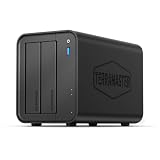
- Powerful Performance: Equipped with an Intel x86 quad-core processor and 4GB RAM, the F2-425 network attached storage effortlessly handles 4K transcoding and multitasking. The 2.5GbE port ensures ultra-fast file transfers and supports multi-user concurrent access
- Home Multimedia Hub: The F2-425 media server supports hardware-level 4K H.265 decoding, compatible with Plex, Emby, and Jellyfin for smooth HD video playback, with DLNA for seamless multi-device streaming. The Photos app features AI smart album and efficiently organizes millions of photos
- TNAS Mobile Full Control: Initialize setup for your F2-425 NAS storage via the TNAS Mobile app without a PC. The mobile app supports automatic photo and video backups, plus real-time local/remote synchronization, all managed through a single client
- Ultra-Quiet & User-Friendly: The F2-425 NAS server operates at just 19dB(A), suitable for quiet environments like bedrooms. Its tool-free Push-Lock design HDD trays enable to install HDDs in 10 seconds
- Massive Storage & Security: The F2-425 2-bay NAS supports up to 60TB storage (2 x 30TB for each bay), 50+ independent user accounts, and flexible TRAID arrays, saving 30% more storage space than traditional RAID while ensuring data redundancy. SPC security module and CloudSync (supporting Google Drive, OneDrive, Dropbox) guarantee worry-free data protection. Additionally, TerraSync enables two-way sync between the F2-425 and PCs/Macs
Common buying mistakes and fixes
Buying a CPU without integrated graphics
An Intel model ending in “F” lacks the iGPU required for Quick Sync. Fix: verify the complete processor model before ordering, or budget for a supported discrete GPU.
Assuming the NAS vendor’s 4K number is a Jellyfin benchmark
A specification such as 4096 × 2160 at 60 FPS describes the hardware-transcoding ceiling under the vendor’s stated conditions. It does not identify codec combinations, HDR behavior, subtitle handling or simultaneous Jellyfin sessions. Fix: use the figure to shortlist hardware, then test your workload.
Ignoring container permissions
Jellyfin may silently fall back to software transcoding if it cannot open the render device or GPU. Fix: pass through the device, assign the required group permissions and confirm hardware activity during playback.
Choosing bays without considering backups
RAID protects availability after some disk failures but does not protect against deletion, ransomware, theft or a failed enclosure. Fix: maintain a separate backup and include its cost in the project.
Testing only an easy file
A single 1080p H.264 file proves little about 4K HEVC HDR, Dolby Vision or subtitle burn-in. Fix: test the hardest files you actually intend to watch.
Running every service on the same small NAS
Downloads, photo indexing, surveillance recording, office files and virtual machines can consume the headroom Jellyfin needs. Fix: measure CPU, memory, GPU and disk activity under the combined workload, and disable or move nonessential jobs during viewing.
A decision framework
- List your clients. Mark which televisions, browsers and mobile devices can direct-play HEVC, HDR, Dolby Vision, audio formats and subtitles.
- Estimate the worst normal transcode. Include the highest-bitrate 4K file, HDR-to-SDR conversion, subtitle burn-in and the number of people likely to watch at once.
- Select the video engine. Prefer Intel QSV for a compact, low-complexity NAS; consider NVIDIA when you need a supported discrete GPU and verified tone-mapping or codec capability.
- Select the bay count. Choose the F4-425 when capacity and expansion matter; choose the F2-425 for a smaller two-drive library with a clear backup plan.
- Validate the software path. Confirm Jellyfin installation, drivers, device passthrough, permissions and a writable transcode directory for the exact NAS OS.
- Budget the complete system. Include NAS-rated drives, backup storage, networking upgrades, power and any GPU or cooling requirements.
- Run a representative test. Measure concurrent sessions with your real files before treating the system as ready for the whole household.
Bottom line
The TerraMaster F4-425 is the strongest general-purpose choice in this shortlist because its four bays provide more capacity and expansion flexibility while its Intel Celeron N5095-class platform supplies an integrated video engine suitable for a Jellyfin build. The F2-425 is the better fit when two bays are enough and you accept less storage headroom. Neither model comes with a guaranteed number of simultaneous 4K Jellyfin streams: verify the NAS operating system’s GPU access and test HEVC, HDR, Dolby Vision and subtitle workloads that match your household.
Quick wins for a faster PC:
Clear out junk files and repair common Windows errorsFree Scan →Scan for outdated or missing drivers - takes under a minuteDriver Scan →Repair Windows errors before they cause bigger problemsFix Now →Quick Recap
Product prices and availability are accurate as of the date/time indicated and are subject to change. Any price and availability information displayed on Amazon at the time of purchase will apply.

