
Do these 3 things before closing this tab:
1Scan for outdated or missing drivers - takes under a minute2Repair Windows errors before they cause bigger problems3Fix the driver behind crashes, sound loss and screen glitchesiTechGuides is reader-supported. When you buy through links on our site, we may earn an affiliate commission. As an Amazon Associate I earn from qualifying purchases. Learn more
The best surround-sound gaming headset is not determined by a logo on the ear cup. It must work with your console or PC, accept the spatial renderer you want to use, fit comfortably for your sessions, and provide the microphone and connection features you need. Windows Sonic, Dolby Atmos for Headphones and DTS Headphone:X are software or platform technologies; a headset alone does not guarantee more accurate positional audio.
Official product pages document compatibility and features, but they do not provide a controlled, head-to-head listening test. The practical approach is therefore to match a headset and renderer to your platform rather than declare one model universally “best.”
Start with the platform, not the headset box
“Surround sound” on a gaming headset normally means virtual spatial audio. The game sends multichannel or object-based audio to a renderer, and the renderer converts it into two headphone channels using timing, level and frequency cues. Your left and right drivers then reproduce that processed signal. You are not getting separate physical speakers for every channel around your head.
What’s actually slowing this PC down?
Pick the symptom - the matching free tool is one click away.
That distinction matters because the renderer can be supplied by Windows, Xbox or an application. Microsoft identifies Windows Sonic as a Windows spatial-sound option and points users to Dolby Access and DTS Sound Unbound for other choices in its Windows instructions. A headset can be electrically compatible yet still fail to deliver the mode you want if the operating system, console, game or license does not support it.
#1 Best Overall

- 15-25kKhz Frequency Response.Headphones fit type:Over-Ear.Note : If the size of the earbud tips does not match the size of your ear canals or the headset is not worn properly in your ears, you may not obtain the correct sound qualities or call performance. Change the earbud tips to ones that fit more snugly in your ear
- Designed for comfort – Exceptionally comfortable memory foam ear cushions and padded leatherette headband help keep you focused on gaming.Supreme audio quality – Large 53mm drivers provide high-quality audio. Hear in-game details better and get the in-game advantage on your opponents
- 7.1 Virtual Surround Sound – Truly immerse yourself in your games with hardware-driven virtual 7.1 surround sound for precisely located audio
- Passive noise cancellation – The closed ear cup design blocks out outside distractions to keep you in the game
- Built to last – The solid, durable aluminum frame is built to withstand the blows of daily use
Before comparing models, answer three questions:
- Which device will you use most: Windows PC, Xbox console, or both?
- Which renderer do you intend to use: Windows Sonic, Dolby Atmos for Headphones, DTS Headphone:X, or the game’s own binaural mode?
- Do you need wireless console pairing, Bluetooth for a phone, a wired fallback, or a particular chat setup?
Only after those answers should you compare comfort, microphone design and sound tuning.
How the main spatial-audio options differ
Windows Sonic
Windows Sonic is Microsoft’s built-in spatial-sound option for Windows. It is also available on Xbox at no additional cost according to SteelSeries’ support documentation for the Arctis 9X. Because it is integrated into the platform, it is the simplest starting point when you want spatial audio without buying another license. Availability and exact terms can vary by device, account and region, so verify the current setting on your system.
Dolby Atmos for Headphones
Dolby Atmos for Headphones is a licensed renderer that can be selected through Dolby Access on supported systems. The headset does not need a special “Atmos driver”; it needs a normal compatible headphone connection while the platform and Dolby software perform the processing. A headset listing that says it supports Atmos generally means the headset can reproduce the processed signal, not that the headset itself includes a perpetual license.
Quick wins for a faster PC:
Scan for outdated or missing drivers - takes under a minuteDriver Scan →Repair Windows errors before they cause bigger problemsFix Now →Fix the driver behind crashes, sound loss and screen glitchesFind Drivers →DTS Headphone:X
DTS describes DTS Headphone:X as a multi-platform option for PC and Xbox. Its FAQ also explains that Microsoft Spatial Sound can carry surround and elevation cues. As with Atmos, check whether your particular setup requires DTS Sound Unbound and a separate purchase or activation.
Microsoft Spatial Sound and game-specific modes
Microsoft Spatial Sound is the platform framework that can carry surround and elevation information. A game may output ordinary stereo, discrete surround, object-based audio or its own binaural mix. If the game has a headphone, binaural or HRTF option, test it with the platform renderer enabled and disabled; two spatial processors stacked together can sound distant, hollow or phasey.
Compatibility checklist by platform
| Use case | What must be compatible | Questions to check before buying |
|---|---|---|
| Windows PC | USB, 3.5-mm or wireless connection; Windows spatial-sound setting; optional Dolby Access or DTS Sound Unbound app | Does the headset appear as the intended playback device? Can its USB or wireless software coexist with your chat application? Is the desired renderer licensed? |
| Xbox console | Xbox-compatible wireless protocol, controller 3.5-mm connection or USB path supported by the console; Xbox headset-format setting | Does the exact model, not just the product family, support Xbox? Is Windows Sonic available at no charge, and do Atmos or DTS modes require separate licenses? |
| PC and Xbox | A connection method that works on both systems, plus any required platform-specific app or license | Can you switch without re-pairing every time? Does Bluetooth work only for mobile or PC rather than console game audio? Is a wired cable included as a fallback? |
| PC, console and mobile | Console connection plus Bluetooth or another mobile-compatible link | Can game audio and phone chat be mixed simultaneously? Which radio is active on each platform, and does enabling one disable the other? |
Do not infer compatibility from a similar model name. Wireless versions, regional editions and revisions can use different radios, firmware and licenses.
Rank #2

- Immersive 7.1 Surround Sound: This gaming headset delivering stereo surround sound for realistic audio. Whether you're in a high-speed FPS battle or losing yourself RPG adventures, this Ps5 headset provides crisp treble, punchy bass, and precise directional cues, giving you a competitive edge
- Great Humanized Design: Comfortable and breathable permeability protein over-ear pads perfectly on your head, adjustable headband distributes pressure evenly, you’ll enjoy lasting comfort during hours of gaming and suitable for all gaming players of all ages
- Sensitivity Noise-Cancelling Microphone: 360° omnidirectionally rotatable sensitive microphone, premium noise cancellation, sound localisation, your voice comes through loud and natural, ensuring your teammates catch every callout, even in chaotic battle scenes.
- Universal Compatibility: This gaming headphone support for PC, Ps5, Ps4, Xbox one, Xbox Series X/S, Switch, Laptop, Mobile Phone and other devices with 3.5mm jack.Note 1: When you use headset on your PC, be sure to connect the "1-to-2 3.5mm audio jack splitter cable" (Red-Mic, Green-audio). (Please note you need an extra Microsoft Adapter when connect with an old version Xbox One controller)
- Cool style gaming experience: Colorful RGB lights create a gorgeous gaming atmosphere, adding excitement to every match. Heightening immersion for FPS, MOBA, and action titles. These eye-catching lights give your setup a gamer-ready look while maintaining focus on performance. (*Note: The USB connector is for LED lighting only)
Official examples and what their specifications actually prove
Xbox Wireless Headset
Microsoft’s product listing names Windows Sonic, Dolby Atmos and DTS Headphone:X as supported spatial-audio options. That makes it a concrete example for Xbox and Windows buyers who want several renderer choices. It does not prove that any one of those modes sounds best, nor that every feature applies identically in every country or software configuration.
An Xbox Wire announcement dated October 22, 2024 adds that the headset supports Dolby Atmos, pairs directly with Xbox consoles and uses Bluetooth 5.3 for PC and mobile devices. Read the announcement for the stated connection details. Bluetooth 5.3 should not be interpreted as a guarantee of Xbox Bluetooth game-audio support; the console connection and the mobile/PC Bluetooth connection are separate use cases.
SteelSeries Arctis 9X
The manufacturer’s Arctis 9X support page states that this model supports Windows Sonic on Xbox. That is evidence for this specific headset and platform. It is not evidence that every Arctis model, later revision or similarly named headset has the same spatial-audio support.
These examples illustrate how to read a specification sheet: identify the exact platform and renderer named, then verify the connection and license requirements for your own region. They are not a performance ranking. No controlled listening measurements in the cited official material establish which model has the most precise imaging, widest stage or highest sound quality.
How to compare headsets when sound rankings are unavailable
1. Confirm the physical connection
For a wired headset, check whether your device uses a single four-pole 3.5-mm jack, separate headphone and microphone jacks, USB-A or USB-C. A console controller may accept 3.5-mm audio while a PC’s front-panel jack may need an adapter. USB headsets contain their own digital-to-analog converter and may expose a different playback device to Windows, which can affect where spatial processing is applied.
For wireless models, distinguish console wireless, a 2.4-GHz USB dongle and Bluetooth. Direct Xbox wireless pairing is not interchangeable with ordinary Bluetooth. A headset can offer Bluetooth for a phone and still require a proprietary radio or cable for Xbox game audio. Look for simultaneous Bluetooth and game-audio mixing only if the specification explicitly says it is supported.
Rank #3
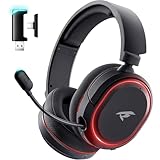
- 🎵【7.1 Surround Sound & Aesthetic Decorative Light】 UG-08S PC gaming headset can provide you with a cinema 3D stereo surround sound experience, designed specifically for gamers and audiophiles and multi-platform Compatibility. Long-press the 'M' key to activate 7.1 surround sound and dynamic driver reproduces deep bass and clear highs. Which allows you to hear every detail in the game with pin-drop clarity from up to 40 feet away. Such as teammates' voices, footsteps, direction, and more. Double-click the M key to activate the ambient light, then single-click the M key to switch between two modes: steady light and gradient. Valorise wireless pc headset will bring a cooler gaming atmosphere.
- 🔋【Extraordinary 100-Hour Battery Life & Support Use While Charging 】Valorise PS5 headset has a sustainable game time of 45-100Hrs. 100-hour playtime via bluetooth mode, turn off RGB lights and microphone. 45-hour playtime via 2.4GHz dongle mode, turn on RGB lights and microphone. With a low battery alert for timely recharging, our wireless PS5 headset supports simultaneous charging and use. Even if it runs out of battery, 3.5mm headphone jack is still available for console gaming using. Full-recharge in just 2-3Hrs.
- ⚡【2.4GHz Wireless & Bluetooth 5.4 & 3.5 mm】 Experience the Valorise Wireless Gaming Headset, designed with wide compatibility for gaming devices like PS5, PS4, PC, Mac, phone, pad, Nintendo Switch. One step to setup the wireless headset by plugging in USB & Type-C 2.4G transmitter(ultra-low latency ≤5ms). Which has better freedom and more stable data transmission than traditional wired gaming headsets. Switch to bluetooth mode with a simple 3-tap for mobile devices like phones, tablets and Switch. For those preferring a wired setup, connect to various gaming devices via a standard 3.5mm cable.
- 🎙️【Retractable ENC Noise-Canceling Microphone & One-touch Mute】Equipped with a 360° omnidirectional Noise-Canceling microphone. Our wireless headset can accurately calculate the speaker's direction, preserving the target voice while eliminating background noise for improved call quality. Gaming headsets with mic ensure your voice are relayed in high-definition clarity to your teammates, even in the heat of battle. Meanwhile, the retractable microphone combines the advantages of various types of microphones: ultra-low latency, high sound reproduction, concealability, and portability, the perfect gift for gamers and music enthusiasts.
- 🎧【Ergonomic Memory Sponge Cushions & Passive noise cancellation 】Combine soft lightweight memory sponge cushions and breathable fabric, complemented by the flexibility of rotating ear cups and adjustable angles. Valorise pc gaming headset are designed to perfectly fit the shape of your head, providing a customized fit. Breathable fabric minimizes sweat and heat, experience long-lasting, comfortable wear without squeezing your head. With ear cups designed to envelop your ears, effectively isolates environmental noise, enjoy passive noise cancellation without the need for active noise cancelling.
2. Check the renderer and license
Write down the exact mode you want before purchasing. Windows Sonic is available at no additional cost on Xbox, while SteelSeries notes that Dolby Atmos for Headphones and DTS Headphone:X require separate licenses. The statement is about the licensing arrangement described for the Arctis 9X; current terms can change by device, store and region. Confirm whether a trial, bundled code or account purchase applies to your setup.
3. Treat comfort as a session-length requirement
Comfort cannot be inferred from a surround badge. Check the headset’s mass, clamp, ear-cup opening, pad material and headband adjustment against your own use. Glasses, larger ears, heat sensitivity and a tight clamp can matter more over a three-hour campaign than a small difference in frequency response. If you cannot try the headset, favor a retailer with a clear return policy and keep the packaging until you have completed a long, uninterrupted session.
4. Match the microphone to your chat habits
For occasional party chat, a flip-to-mute boom and a physical mute indicator may be enough. Streamers and team players should check microphone placement, sidetone control, noise-gate behavior and whether the microphone is active over both wireless and wired connections. Platform chat and PC applications can select different input devices, so verify the input in the console privacy settings or the application’s audio menu.
The Tool Desk
Outbyte Driver Updater FREEScan for outdated or missing drivers - takes under a minuteDriver Scan →Outbyte PC Repair FREERepair Windows errors before they cause bigger problemsFix Now →5. Look for controls you can reach without leaving a game
Independent game/chat balance, a master-volume wheel, microphone mute and a hardware profile button reduce the need to open software. Software EQ and surround toggles are useful on PC, but they may not be available when the same headset is connected to a console. A wired fallback is valuable when the battery is empty or wireless interference appears.
6. Decide whether you want a neutral or processed sound
Spatial rendering changes the signal. Some players prefer a neutral stereo presentation and use the game’s binaural mode; others prefer the additional elevation and room cues from a platform renderer. Bass-heavy tuning can make explosions exciting but can mask quiet footsteps. Because the official pages cited here contain no comparative listening tests, use returnable purchases, game demos and your own familiar tracks rather than assuming a marketing label predicts positional accuracy.
Set up spatial audio on Windows
Menu names can change slightly between Windows releases, but the workflow is consistent:
Rank #4
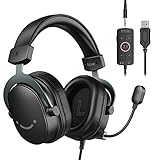
- [Immerse in Soundscapes] Dive into a soundscape with 7.1 surround sound that makes audio details come to life. The FIFINE H9 gaming headset envelop you in a immersive gaming aura that transcends reality. 50mm driver reverberates every explosion, gunfire and environmental sound in intense gaming through your wired gaming headset. This headset for gaming pull you to get more achievement and improve the accuracy of FPS and ARPG.
- [Unleash Various Compatibility] Offer this headset for gamers that fits all their devices. The Wired Gaming headset with 3.5mm and USB connector is effortlessly connected to a wide range of gaming device. USB headphones with mic plug and play compatible with PS4/PS5 or Switch Docked Mode, while 3.5mm jack works and performs greatly on XBOX contoller, game console controllers or phone/tablet. The gaming headphones gives a seamless transition among ARPG, FPS and more gaming realms.
- [Provide Relaxing Comfort] Softly lightweight touch on the earmuffs cushion and adjustable headband release heaviness. This PS5 headset satisfies long-lasting comfort during immersive gaming sessions. The USB headphone fits your head to provide passive noise cancellation. You will hear the enemy footsteps from the next room in FPS, rather than ambient noise around your gaming zone. The breathability of Xbox headset with 3.5mm jack prevent sweating in pre-long intense sessions and no fatigue.
- [Capture Bright Clarity] Plug the detachable microphone, and team up with friends and family with the streaming PC headset for immediate strategic chatting to dominate the gaming arena. Microphone with sensitivity of -42dB timely captures your voice during intense situation to deliver uninterrupted feedback to your teammates. Gamer headset with mic creates a higher level of cooperation in multi-player game, or resonates with victory in RTS.
- [Reach Fingertips Control Easily] No more software installation for functionality, intuitive USB CONTROL BOX of the computer headset allows you to adjust the volume of MICROPHONE & HEADPHONES along side with MUTE SWITCH, without losing concentration on your gaming battlefield. Braided headset cable with a total length of 10ft can be accessed to the back of the PC host without difficulty. (Turn up the mic volume and push the mute switch to “mic on” via the USB control box when testing the mic.)
- Connect the headset and select it as the active output device in Windows Sound settings.
- Open the device’s spatial-sound control. In current Windows interfaces this is available from the Sound settings for the selected output, or from the speaker icon’s sound menu.
- Select Windows Sonic for Headphones if you want Microsoft’s built-in option. If you have installed Dolby Access or DTS Sound Unbound and hold the required license, select the corresponding renderer instead.
- In the game, choose its headphone, binaural or spatial-audio output mode. Avoid enabling two competing virtual-surround modes unless the game documentation specifically recommends it.
- Run the game’s channel test or a known audio scene. Check front, rear and elevation cues at low volume before adjusting EQ.
Microsoft’s support page documents Windows Sonic and the Dolby Access and DTS Sound Unbound alternatives. If a renderer is missing, confirm that the headset is the selected output, install the relevant app from its official store and check the license status for your account and region.
Free tools Windows power users keep installed
One-click scans. No signup required.
Set up spatial audio on Xbox
- Connect the headset using its supported Xbox wireless link, controller jack or other documented Xbox connection.
- Open the console’s audio settings and locate the headset-format or spatial-audio selector. Choose Windows Sonic, Dolby Atmos for Headphones or DTS Headphone:X according to the licenses and apps available to your account.
- In the game’s audio menu, choose headphones or the recommended binaural mode. If the game offers its own surround toggle, test it separately rather than assuming every option should be enabled.
- Join a party and verify microphone input, sidetone and game/chat balance. A headset can play game audio correctly while its microphone is assigned to another device.
- Save a short gameplay clip or use a training area to check directional cues. If voices appear behind you when they are in front, disable extra processing and retest.
Windows Sonic is the no-additional-cost option described by SteelSeries for Xbox. Atmos and DTS may require separate licenses; the console can show a mode as selectable only after the required app or purchase is associated with your account.
Troubleshoot common surround-sound problems
The spatial option is missing
- Confirm that the headset is the active playback device, not a monitor, controller speaker or an old USB device.
- Reconnect the headset after installing the renderer app, then reopen the audio settings.
- Check whether the mode is supported on your edition of Windows or Xbox, and whether a license is required.
Audio sounds hollow or echoes
- Turn off the game’s virtual-surround or HRTF mode temporarily and test the platform renderer alone.
- Disable a headset’s own surround toggle if the headset software is processing the signal in addition to Windows or Xbox.
- Reset EQ to a flat or default profile before judging imaging.
Front and rear cues are difficult to distinguish
- Lower excessive bass and disable voice-chat ducking that may be masking quiet sounds.
- Run the game’s calibration or channel test from a quiet room.
- Try the same scene in stereo, Windows Sonic, Atmos and DTS when available. Keep the mode that gives you the clearest repeatable orientation, not the one with the largest echo.
Wireless audio drops out
- Move the USB radio or console away from metal, external hard drives and crowded USB hubs.
- Charge the headset fully and update firmware only through the manufacturer’s official application.
- Test Bluetooth and proprietary wireless separately; Bluetooth may be intended for PC or mobile rather than Xbox game audio.
Chat works but game audio does not, or vice versa
- Verify that the game output and chat output are assigned to the same headset where appropriate.
- Check the console’s game/chat balance and the PC application’s exclusive-mode or communication-device settings.
- For a 3.5-mm connection, inspect the plug standard and use the correct headset splitter if the PC has separate microphone and headphone sockets.
Which type of headset fits each buyer?
| Your priority | What to prioritize | Trade-off to accept |
|---|---|---|
| Xbox-first spatial audio | Explicit Xbox compatibility, direct console pairing and a documented headset-format option | Some wireless models reserve Bluetooth for PC or mobile, so a phone connection may not replace Xbox wireless |
| Windows PC with renderer choice | USB or 3.5-mm compatibility plus support for Windows Sonic, Dolby Access or DTS Sound Unbound | Paid Atmos or DTS licenses can add cost and account-management steps |
| Competitive positional play | Comfortable fit, clear midrange, reliable imaging in your chosen renderer and a microphone that does not require constant adjustment | A dramatic bass profile or heavy processing may be less useful than a clean, controlled presentation |
| Long single-player sessions | Low clamp pressure, breathable pads, stable headband and simple volume/mute controls | The lightest design may have fewer physical controls or a smaller battery |
| Shared PC and console use | Multi-platform connection, quick switching and a wired fallback | Some features, profiles or spatial modes work only through the PC software |
| Frequent party chat | Flip-to-mute or hardware mute, sidetone and independent game/chat control | More controls and radios can increase weight, software complexity or battery drain |
How to interpret “amazing audio quality” claims
Audio quality has several separate dimensions: tonal balance, distortion, detail retrieval, imaging, soundstage, microphone clarity and latency. Spatial audio mainly addresses the rendering of direction and elevation; it does not automatically improve every one of those dimensions. A headset with excellent stereo drivers can sound worse when an unsuitable renderer is enabled, while a modest headset can provide useful positional information with the right fit and software.
Ask for evidence that matches the claim. An official compatibility statement can establish that a headset works with Windows Sonic, Atmos or DTS. It cannot establish which model has the best footsteps, the widest stage or the most natural height cues. Those judgments require controlled listening tests or trustworthy independent reviews, none of which are supplied by the official pages cited here.
A practical buying sequence
- List your devices. Write down every platform you will use in the next year, including whether PC means USB, 3.5-mm or Bluetooth.
- Choose one primary renderer. Start with Windows Sonic if you want the built-in, no-additional-cost path on Xbox; consider Atmos or DTS only after checking the license and app requirements.
- Filter by connection. Eliminate models that cannot pair directly with your console or that lack the mobile/PC link you actually need.
- Filter by fit and controls. Compare adjustment range, pad dimensions, weight, mute control, game/chat balance and battery claims for your session length.
- Verify the exact model page. Confirm the platform, firmware, included cables, renderer names and regional availability. Do not generalize from a different revision.
- Test before committing. Use a familiar game, disable extra processing, then compare the available modes at equal volume. Keep the setting that gives you stable directional cues without fatigue.
This sequence prevents a common mistake: buying a headset because it advertises “7.1” or “surround,” then discovering that the console cannot use its software, the preferred renderer needs another license, or the fit becomes uncomfortable after an hour.
Bottom line for choosing a surround-sound gaming headset
Choose the headset with confirmed compatibility for your main platform and the renderer you actually plan to use. The Xbox Wireless Headset is a documented example with Windows Sonic, Dolby Atmos and DTS Headphone:X support, direct Xbox pairing and Bluetooth 5.3 for PC and mobile; the Arctis 9X is documented as supporting Windows Sonic on Xbox. Neither source establishes a universal sound-quality winner. Your final choice should come from the connection, license, comfort, chat and control checklist, followed by a real test in the games you play.
Quick Recap
Product prices and availability are accurate as of the date/time indicated and are subject to change. Any price and availability information displayed on Amazon at the time of purchase will apply.

