
iTechGuides is reader-supported. When you buy through links on our site, we may earn an affiliate commission. As an Amazon Associate I earn from qualifying purchases. Learn more
The best camera backpacks with side access let you retrieve a camera while wearing the pack, but they do not all open the padded camera compartment. The Peak Design Everyday Backpack 30L is the best hybrid choice, the Lowepro ProTactic BP 350 AW III offers more dedicated protection, and the Shimoda Explore V2 is stronger for serious hiking.
Side access is valuable when you need a camera quickly in a crowded street, airport, event, trail, or sudden shower. The useful distinction is whether a zipper opens directly into the camera compartment, opens only part of a camera insert, or merely reaches a bottle or tripod pocket.
Key takeaways
- The Peak Design Everyday Backpack 30L is the best general-purpose hybrid for urban photographers who want left- and right-side camera access, flexible organization, and a discreet everyday appearance.
- The Lowepro ProTactic BP 350 AW III has four access points, 17L of total volume, 15L of camera volume, a 14-inch MacBook Pro compartment, and an official empty weight of 2.3 kg (5.07 lb).
- The Shimoda Explore V2 30L or 35L is the better hiking-oriented choice because its removable Core Units and trail-style harness separate camera organization from long-distance carrying.
- Side access is a convenience feature rather than a security system, waterproofing guarantee, or substitute for a properly fitted load-bearing harness.
- Capacity labels are not interchangeable: a bag’s real usefulness depends on body size, lens dimensions, battery grips, attached plates, dividers, and how much personal gear remains.
What counts as genuine side access?
Genuine side access means a side door reaches the padded camera compartment while the backpack remains on your body or is swung around to your front. A side pocket for a water bottle, tripod, jacket, or accessories does not count as camera side access.
| Access type | What the zipper reaches | Does it qualify? | What to check |
|---|---|---|---|
| Dedicated side camera door | The built-in padded camera compartment | Yes | Opening width, hand preference, lens clearance, and whether the door reaches the whole compartment |
| Side-opening camera cube | A removable padded Core Unit or camera insert | Yes, with qualifications | Whether the insert is included and whether it must be removed before gear is reachable |
| Partial side zipper | Only an upper or lower section of the camera area | Sometimes | Which divider section is accessible and whether the target camera sits there |
| Exterior side pocket | Personal items, bottle, tripod, or accessories | No | Do not mistake exterior storage for access to camera gear |
| Rear camera opening | The full padded compartment through the back panel | No, but relevant | Rear access can improve crowd security but normally requires removing or rotating the pack |
Side access solves a specific problem: reaching one camera or lens without putting the backpack on the ground. Side access does not make a heavy backpack comfortable, prevent theft, expose the entire camera compartment, or guarantee that a large body, battery grip, long lens, or attached quick-release plate will clear the opening.
#1 Best Overall

- SHOCK-ABSORBING & ULTRA-ORGANIZED INTERIOR: Enjoy ultimate flexibility! The interior of waterproof camera backpack features thick, padded dividers that act as excellent shock absorbers against bumps and drops. With 6 adjustable dividers (including a vibrant orange quick-grab panel) and 3 elastic security straps, you can create a cushioned, perfectly customized space for all your camera, lenses, controller and drones, ensuring everything stays secure and protected.
- ANTI-THEFT & QUICK-ACCESS OPENING: Never miss a shot. Our tactical camera bag offers a quick-access entry point to your main camera compartment, allowing you to grab DSLR camera, SD cards and batteries in seconds. The discreet & secure zipper design is also anti-theft, keeping your valuable equipment safe in crowded environments. It’s the smartest camera bags for photographers on the move.
- HIGH-CAPACITY ORGANIZATION: This large camera backpacks for photographers is a storage powerhouse. The MOLLE system offers external expansion. Organize your life with: a dedicated 15.6" laptop compartment; two front slip pockets for quick-grab items like lens cloths; two front zipper pockets for phone and keys; a hidden anti-theft back pocket for passports/wallets; two internal mesh pockets for cables; and a side elastic pocket for a water bottle or tripod.
- SUPERIOR PROTECTION FOR GEAR: Professional photography backpack case is made of premium waterproof fabric and equipped with a dedicated, full-coverage rain cover for ultimate protection in rain or snow, ensuring your gear stays perfectly dry in any weather.This waterproof camera backpack(size:17.7*7.87*12.79in) is ready for all your outdoor adventures.
- VERSATILE CAMERA BAG BACKPACK: RAINSMORE photography bag is coupled with a breathable, padded back panel,ensuring all-day comfort, perfect for outdoor photography, hiking, travel, or fieldwork. This durable camera bag case also includes a luggage strap that seamlessly slides over your suitcase handle, making airport and travel transit effortless.
Which camera backpacks have real side camera access?
The following comparison separates confirmed camera-compartment access from insert-dependent or configuration-dependent designs. The table is a buying map, not a claim that every bag provides the same extraction speed.
| Backpack | Side door into camera compartment | Side doors | Top access | Rear access | Insert required? | Camera compartment | Usable while worn? | Left/right operation |
|---|---|---|---|---|---|---|---|---|
| Peak Design Everyday Backpack 30L | Yes | Dual side access | MagLatch top access | Not the primary access method | No; built-in configurable dividers | Integrated padded camera section with flexible dividers | Yes, by loosening one strap and swinging the pack | Yes; dual doors |
| Lowepro ProTactic BP 350 AW III | Yes | Dual side doors | Yes | Yes, full back access | No | Dedicated structured camera compartment | Yes, using either side | Yes; Lowepro specifically highlights left- and right-handed access |
| Lowepro ProTactic BP 450 AW II | Yes | Side access reported in comparison coverage | Yes | Yes | No | Larger dedicated professional camera layout | Yes, subject to load and fit | Side access is available; exact ergonomics depend on configuration |
| Shimoda Explore V2 30L/35L | Yes, through the camera Core Unit system | Side access reported | Configuration-dependent | Yes | Yes; Core Unit | Removable camera unit selected by the buyer | Yes, but access depends on pack and unit setup | Configuration-dependent |
| WANDRD PRVKE | Insert-dependent | Not equivalent to dual dedicated camera doors | Yes | Configuration-dependent | Usually yes for a camera-ready setup | Camera cube or insert rather than a fully dedicated camera bag | Possible, but access can be less direct | Configuration-dependent |
| F-Stop Kashmir 2 AIR/Tilopa | Camera-unit-dependent | Configuration-dependent | Configuration-dependent | Pack and unit-dependent | Yes; Internal Camera Unit | Modular camera unit inside an outdoor pack | Designed for outdoor carry; access depends on unit placement | Configuration-dependent |
The Lowepro ProTactic BP 350 AW III specifications explicitly identify four access points: dual side doors, top access, and full back access. Peak Design describes the Everyday Backpack 30L as having dual side access through weatherproof UltraZips plus MagLatch top access.
Which bag is best overall?
The Peak Design Everyday Backpack 30L is the best overall choice for photographers who want one bag for camera equipment, commuting, travel, and everyday items. The backpack combines dual side camera access with a clean urban design, flexible dividers, and top access for personal gear.
Peak Design listed the U.S. 30L model at $299.95 when observed on August 16, 2026. The price is a dated observation rather than a permanent price: the same product page showed color-specific availability differences, and an Ocean 30L variant was observed at $239.96 on sale instead of $299.95. Check the selected color and size before buying.
The 30L model suits a small-to-moderate mirrorless kit, a two-body travel kit with careful divider arrangement, a laptop or tablet, and personal items. The hybrid layout is more adaptable than a tightly partitioned professional camera bag, but that flexibility also means less dedicated structure around bulky equipment.
Who should buy the Peak Design Everyday Backpack 30L?
- Urban photographers who need quick access on either side.
- Travelers who carry camera gear alongside clothing, chargers, and a jacket.
- Commuters who want a backpack that does not look exclusively like a camera bag.
- Creators with a moderate mirrorless kit rather than multiple large telephoto lenses.
Who should skip it?
Skip the Peak Design Everyday Backpack 30L if maximum impact protection, a rigid dedicated camera layout, or a long-distance hiking harness matters more than lifestyle flexibility. A heavily loaded bag can also be awkward to swing around, and side access becomes less convenient when the personal compartment is packed tightly.
Is the Lowepro ProTactic BP 350 AW III better for protection?
The Lowepro ProTactic BP 350 AW III is the better choice when dedicated camera protection and multiple access routes matter more than low empty weight or understated styling.
Quick wins for a faster PC:
Repair Windows errors before they cause bigger problemsFix Now →Scan for outdated or missing drivers - takes under a minuteDriver Scan →Lowepro lists 17L total volume, including 15L of camera volume, an empty weight of 2.3 kg (5.07 lb), and a laptop compartment for up to a 14-inch MacBook Pro. The backpack includes an All Weather Cover and uses a structured camera organization system. These specifications are listed on the official ProTactic BP 350 AW III product page.
The BP 350 AW III’s dual side doors are useful for both left- and right-handed photographers. Full back access provides another route when the bag is off the body, while top access handles fast access to selected equipment or personal items. The ActivZone harness, sternum strap, removable padded waist belt, molded EVA back panel, and lumbar support give the bag more carrying structure than a typical padded lifestyle backpack.
The trade-off is significant: 5.07 lb is a substantial starting weight for a 17L backpack. A small mirrorless kit may be better served by a lighter hybrid pack, while an event photographer carrying expensive bodies, flashes, and lenses may consider the protection worthwhile.
Which backpack is best for hiking and outdoor photography?
The Shimoda Explore V2 30L or 35L is the strongest recommendation for serious hiking and outdoor travel because the system combines a trail-oriented harness, waist-belt support, removable camera Core Units, side and rear access, and space for outdoor equipment.
Recommended Free Tools
Secondary coverage describes the Explore V2 35L as suitable for roughly one or two bodies, several lenses, a drone kit, a tripod, and a 16-inch laptop, but the exact result depends on the selected Core Unit and packing configuration. The Explore V2 comparison coverage identifies its rear and side access, modular Core Unit approach, trail-style harness, tripod attachment, and 16-inch laptop sleeve.
Rank #2

- 【Precise 15L Capacity Organization】 Measuring 16.1x11.0x5.7 inches and weighing 3.2 lbs, providing a compact footprint avoiding bulky appearances. Reorganizing the interior dividers accommodates 2 DSLR cameras and 6 lenses, or 1 camera, 5 lenses, and a handheld stabilizer, fulfilling rigorous equipment payloads for outdoor landscape photographers.
- 【Quick Side Access & Laptop Storage】 Incorporating a dedicated side-opening panel reaching the main compartment, enabling rapid gear retrieval without removing the backpack. Featuring a dedicated rear sleeve securing a 15.6 inch laptop, isolating digital workstations from heavy optical elements, facilitating immediate on-site photo editing workflows for event creators.
- 【Impact Absorption & Protection】 Constructed with thickened internal padding surrounding the main compartment, absorbing kinetic energy to secure sensitive optical components during transit. Utilizing customizable dividers creating independent slots, preventing friction between lenses and camera bodies, adapting to diverse gear configurations for urban explorers.
- 【Ergonomic Weight Distribution】 Utilizing a rear padded air mesh panel distributing the 3.2 lbs base weight evenly across the back, increasing airflow to minimize sweat accumulation. Integrating an exterior side pocket paired with adjustable compression straps holding a travel tripod, freeing up hands for active terrain navigation during extended wilderness expeditions.
- 【Weather Resistance Integration】 Crafted from high-density nylon boasting anti-tear properties, resisting physical abrasion during outdoor environments. Including a supplementary waterproof rain cover shielding internal equipment from unexpected downpours and environmental dust, maintaining operational readiness during severe weather mountain hikes or damp forest trails.
Shimoda’s design separates the backpack shell from the camera insert. That arrangement is useful when the same harness must carry camera equipment, clothing, food, and hiking accessories, but the purchase must be evaluated as a complete system. A backpack shell without the right Core Unit is not a ready-to-use camera backpack.
The Explore V2 is a better long-trail tool than a fashionable commuter pack, but it is less compelling for buyers who want a slim city profile or the lowest upfront cost. Verify the exact Explore V2 size, Core Unit, dimensions, and current price before ordering because the configuration changes capacity and total cost.
What is the best side-access backpack for a large professional kit?
The Lowepro ProTactic BP 450 AW II is the more suitable side-access alternative for a larger DSLR or mirrorless kit with professional zooms, flashes, accessories, and telephoto lenses.
Comparison coverage identifies the BP 450 AW II as a larger, roughly 25L-class backpack with side access, laptop storage, and extensive modular attachment points. The B&H comparison page is useful for its relative positioning, but the exact current official product page and price were not reliably verified in the supplied research.
The BP 450 AW II makes more sense for a full-size body or two bodies, a 24–70mm f/2.8, a 70–200mm f/2.8, additional lenses, and professional accessories. The larger structure also brings more bulk and weight. Photographers with a small mirrorless kit should not buy the BP 450 simply because a larger capacity number sounds safer.
For exceptionally long lenses such as a 100–400mm or 200–600mm, check the internal dimensions and the chosen divider arrangement. A lens may fit only with the lens detached, the hood reversed, or the camera body stored separately.
What is the best hybrid travel alternative?
The WANDRD PRVKE is best treated as a travel-first lifestyle backpack that can carry a moderate camera kit through an insert, not as a direct equivalent to a dedicated Lowepro or Shimoda camera system.
Do these 3 things before closing this tab:
1Repair Windows errors before they cause bigger problems2Scan for outdated or missing drivers - takes under a minute3Clear out junk files and repair common Windows errorsThe PRVKE suits creators who carry clothing, electronics, chargers, and personal items alongside one body and a few lenses. The camera insert is central to the buying decision: the usable camera capacity, directness of access, and complete purchase price depend on the selected configuration.
Choose the PRVKE when travel organization and appearance are more important than a rigid camera compartment. Choose the Lowepro ProTactic BP 350 AW III when fast, repeatable camera extraction and structured protection are the priority.
Which modular outdoor alternative should you consider?
The F-Stop Kashmir 2 AIR or Tilopa is worth considering when the carrying system and modular Internal Camera Unit matter more than immediate out-of-the-box simplicity.
Pack Hacker identifies the Kashmir 2 AIR as a hiking-oriented camera backpack, while Digital Camera World describes the Tilopa as an outdoor photography backpack. The Kashmir 2 AIR coverage and Tilopa coverage support their outdoor positioning.
What’s actually slowing this PC down?
Pick the symptom - the matching free tool is one click away.
F-Stop access depends heavily on the selected Internal Camera Unit and how the unit is positioned inside the pack. The final purchase price can also change materially after adding the camera unit and accessories. F-Stop is therefore a system choice for outdoor photographers, not a simple one-size camera backpack purchase.
Rank #3

- REAL STRUCTURAL UPGRADE: The 15L PBL-V1 suits lighter daily travel, while the 20.5L ARK PBL V2 steps up for heavier kits and longer shoots. It adds a fiber-rod frame, high-density rebound padding, wider 7 inces side access, improved shoulder fit, waist cushioning, a luggage sleeve, and an armored anti-slip base for users moving beyond soft everyday carry.
- QUICKER GRAB, LESS FUMBLING: High-strength fiber rods reinforce the side opening so it holds a clean 7in rectangular shape, even when the upper compartment is loaded. Pull out a DSLR or mirrorless body with grip and telephoto lens more smoothly, with less squeezing or zipper scrape, whether you are working a wedding, street shoot, client set, or outdoor location.
- FRAME-STABLE PROTECTION — STANDS UP EMPTY OR FULL: The ARK PBL V2 replaces soft pearl foam with high-density rebound padding through the bag body, plus fiber support at key stress points. It helps resist sagging and caving in, protects expensive camera and drone gear, and keeps a structured professional profile on set, in client meetings, or during travel transitions.
- MODULAR DIY SYSTEM — BUILT AROUND YOUR SHOOTING STYLE: A top hook-and-loop panel lets you add patches, while shoulder strap anchor points support standard camera quick-release clips. A D-ring hip connector allows an optional stabilizer belt, and 9 removable dividers adapt the main compartment for 2 cameras, up to 9 lenses, drone batteries, filters, cables, or irregular gear.
- ARMORED BASE, SMART STORAGE & ALL-DAY CARRY: The full-coverage anti-slip PU leather base helps guard against wet ground, gravel, concrete, and daily abrasion better than small rubber feet. Inside are a 16in laptop sleeve, 8.3in tablet sleeve, battery and memory card pocket, hidden mesh zip pocket, expandable top space, 9 dividers, rain cover, and a carry system rated for up to 22lb.
How should you match a side-access backpack to your camera kit?
Match the backpack to the equipment you actually carry, not to a manufacturer claim that a bag holds a certain number of lenses. Lens diameter, lens length, battery grips, quick-release plates, camera straps, and divider placement determine whether the camera can be removed smoothly.
| Sample kit | Typical contents | Best starting options | Main warning |
|---|---|---|---|
| Small mirrorless kit | One body, attached standard zoom or prime, one or two small lenses, batteries, cards, charger, and personal items | Peak Design Everyday 20L, Peak Design Everyday 30L, compact WANDRD configuration, or a smaller Lowepro | Do not pay the weight penalty of a large professional pack unless protection demands it |
| Two-body travel kit | Two mirrorless bodies, three to five lenses, batteries, tablet or laptop, jacket, water bottle, and personal items | Peak Design Everyday 30L, Shimoda Explore V2 30L/35L, or Lowepro BP 350 AW III depending on lens dimensions | Camera volume competes directly with personal storage; test the packed configuration |
| Professional telephoto kit | One or two full-size bodies, 24–70mm f/2.8, 70–200mm f/2.8, additional lenses or flash, grip, and accessories | Lowepro BP 450 AW II, a larger Shimoda system, or F-Stop Tilopa with a suitable camera unit | Large bodies and lenses may not clear a side opening even when they fit inside the compartment |
Manufacturers’ “holds two bodies and six lenses” statements are not directly comparable. A claimed load may assume small lenses, no battery grip, no attached lens, or almost no remaining room for clothing and electronics.
How comfortable are side-access camera backpacks?
Comfort depends on load transfer, empty weight, adjustment range, ventilation, and whether the waist belt actually carries weight rather than merely stabilizing the bag.
Free tools Windows power users keep installed
One-click scans. No signup required.
| Design type | Strength | Weakness | Best use |
|---|---|---|---|
| Padded lifestyle hybrid | Light, discreet, adaptable personal storage | Usually less load-bearing structure and less ventilation | Commuting, city walks, moderate travel loads |
| Dedicated structured camera pack | Stable dividers, stronger padding, predictable camera organization | Can be heavy before equipment is added | Events, professional work, equipment-heavy day trips |
| Hiking camera system | Harness, waist-belt support, adjustability, and separation of camera unit from outdoor load | More configuration decisions and potentially higher complete-system cost | Long trails, landscape work, outdoor travel |
A waist belt does not automatically make a bag comfortable. The belt must fit the wearer, remain usable while the pack is swung around, and transfer a meaningful portion of the load to the hips. For long hikes, a real load-bearing harness is preferable to a lifestyle backpack with thick shoulder padding.
The BP 350 AW III illustrates the protection-versus-weight trade-off clearly. Lowepro’s official empty weight is 5.07 lb before a camera, lenses, laptop, water, or jacket is added. The official Lowepro specification also lists its dual-density ActivZone harness, sternum strap, removable padded waist belt, molded EVA back panel, and lumbar support.
How weather-resistant should a camera backpack be?
Weather resistance, water resistance, a weatherproof zipper, and a rain cover are different protections; none should automatically be described as waterproof or safe for submersion.
Peak Design describes the Everyday Backpack’s UltraZips as weatherproof. That claim supports better resistance during ordinary rain, but it does not establish an immersion rating. The Peak Design product information should therefore be read as weather-resistance information, not a promise that water cannot reach the camera.
PC Slower Than It Used to Be?
A free scan shows the junk files, broken settings and background clutter dragging Windows down - then fixes them in one click.Free scan · Windows 10 & 11Outdated Drivers Are Slowing You Down
One free scan finds every outdated or missing driver and matches the right update for your exact hardware.Free scan · exact hardware matchLowepro includes an All Weather Cover with the BP 350 AW III. A cover is useful during sustained rain, but the photographer must consider whether the cover protects the side doors and shoulder straps while still allowing practical camera access. Opening a side door in heavy rain exposes the camera compartment regardless of the fabric’s water resistance.
For dust, sand, and impact, evaluate the structure and divider stability as well as the exterior fabric. A stiff bag can protect equipment better when dropped, while a softer hybrid can be easier to pack but less protective against a hard impact.
What laptop and travel features matter?
A camera backpack can carry a laptop and still be a poor travel bag if the camera compartment consumes nearly all internal volume or if a tripod blocks the side door.
- Laptop fit: The BP 350 AW III officially supports up to a 14-inch MacBook Pro. Secondary coverage lists a 16-inch laptop sleeve for the Shimoda Explore V2 35L.
- Personal storage: Peak Design’s hybrid layout is particularly useful when camera gear shares space with clothing, chargers, and a jacket.
- Trolley handling: Check whether the specific model has a trolley sleeve rather than assuming that a travel-oriented label includes one.
- Tripod placement: A side-mounted tripod can interfere with side access, increase imbalance, or make swinging the backpack around difficult.
- Airline use: A “travel backpack” label does not guarantee personal-item or carry-on acceptance. Airline, route, fare class, and packed dimensions determine the result.
Do not promise airline compliance without naming the airline and measuring the fully packed bag. Camera backpacks can become materially larger when a tripod, expansion pocket, or overstuffed top compartment is used.
Is side access secure in crowded places?
Side access is primarily a convenience feature, not a theft-prevention system. Rear access is generally harder for someone directly behind the wearer to reach, while side access is faster for the owner but can be more exposed when the bag is swung to the front.
Rank #4
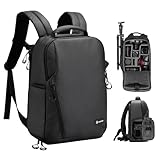
- SLIM PROFILE FOR URBAN EXPLORATION: Measuring with a 12.5L streamlined silhouette, this compact camera backpack accommodates up to 2 DSLR cameras and 5 lenses without the bulk of traditional gear bags. Balancing internal volume and exterior dimensions, providing a discrete aesthetic for street photographers navigating crowded city sidewalks or narrow subway aisles while maintaining professional equipment safety.
- ORGANIZED 14 INCH LAPTOP COMPARTMENT: Featuring 12 versatile compartments and a dedicated expandable sleeve fitting up to 14" laptops, the interior utilizes every inch of space for batteries, SD cards, and personal utilities. Removing the clutter from photography outings through modular dividers, allowing quick transitions between a specialized equipment carrier and a daily commuter pack for urban creators on the move.
- INSTANT SIDE ACCESS AND ANTI-THEFT PROTECTION: Integrating a rapid side entry for capturing fleeting moments without removing the dslr backpack, the design prioritizes speed during high-paced street photography sessions. Utilizing a secure back-opening main compartment to deter unauthorized access in busy tourist areas, ensuring expensive lenses and camera bodies remain protected against the user’s back throughout travel.
- BREATHABLE SUPPORT FOR TRAVEL CONVENIENCE: Incorporating a rear padded air mesh panel and adjustable chest straps, the system distributes weight evenly to reduce fatigue during extended photo walks or day hikes. Featuring a built-in luggage pass-through for securing onto suitcase handles, streamlining airport navigation and transit for videographers requiring a lightweight secondary bag alongside heavy rolling cases.
- WEATHER RESISTANT NYLON CONSTRUCTION: Constructed from water-resistant 1200D nylon fabric offering high resistance against tearing and abrasion in demanding outdoor environments. Supplementing protection with an included waterproof rain cover for extreme weather conditions, creating a durable shield for mirrorless setups during unpredictable urban commutes or nature excursions without compromising the minimalist design.
Security depends on the surrounding design: lockable zipper pulls, hidden pockets, minimal branding, how far the bag must rotate, and whether the camera compartment advertises expensive equipment. A photographer working in a crowded train station may prefer rear access, while a street photographer may accept the exposure in exchange for faster shooting.
The Lowepro Flipside 400 AW III is a relevant rear-access alternative, not a side-access product. Choose the Flipside when access without placing the bag on the ground and crowd security matter more than opening a camera door from either side.
How do you test side access before keeping the bag?
Test the complete packed system with the camera, lens, strap, quick-release plate, batteries, and personal gear you actually use. Manufacturer photographs rarely reveal whether a loaded backpack rotates comfortably or whether a gripped body catches on the opening.
The Tool Desk
Outbyte Driver Updater FREEFix the driver behind crashes, sound loss and screen glitchesFind Drivers →Outbyte PC Repair FREEClear out junk files and repair common Windows errorsFree Scan →- Loosen one shoulder strap without removing the other.
- Swing the backpack around to the front of your body.
- Stabilize the pack with the remaining shoulder strap.
- Open the side zipper fully rather than trying to extract the camera through a narrow gap.
- Remove the camera without catching the strap, lens hood, quick-release plate, or divider.
- Replace the camera, close the compartment, and resling the backpack before walking away.
Repeat the test from both sides. Check whether the camera is upside down or lens-first, whether dividers collapse when the bag rests on its side, whether a battery grip clears the opening, and whether the full personal compartment makes the pack too difficult to rotate.
Test the system in rain planning as well. A rain cover may need to be removed before the side door can open, and the open door itself can expose the camera compartment to water. Practice the motion before using the backpack in traffic, at an event, or on a steep trail.
What are the main trade-offs?
| Priority | Favors | Cost or compromise |
|---|---|---|
| Fast two-sided access | Peak Design Everyday 30L or Lowepro BP 350 AW III | More zipper exposure and potentially less security than rear access |
| Maximum camera structure | Lowepro ProTactic series | More weight, bulk, and overt camera-bag styling |
| Long-distance carrying | Shimoda Explore V2 or F-Stop systems | Camera units and accessories may be additional purchases |
| Everyday flexibility | Peak Design Everyday 30L or WANDRD PRVKE | Less dedicated protection or more dependence on an insert |
| Lowest complete-system cost | A ready-to-use smaller Lowepro or Peak Design 20L if the kit fits | Less room for large lenses, clothing, or future expansion |
A practical weighted decision model gives side-access usability 25%, carrying comfort 20%, protection 20%, capacity and flexibility 15%, travel practicality 10%, and value and ownership 10%. The weighting explains why there is no universal winner: a hiking photographer and an event photographer are solving different carrying problems.
Which camera backpack should you buy?
| Choose this | Best for | Why | Who should skip it |
|---|---|---|---|
| Peak Design Everyday Backpack 30L | Best overall hybrid | Dual side access, top access, flexible dividers, everyday appearance, and hybrid personal storage | Heavy professional kits, long hikes, or maximum impact protection |
| Lowepro ProTactic BP 350 AW III | Best compact dedicated professional bag | Four access points, dual camera doors, structured protection, harness features, and included rain cover | Lightweight travelers carrying only a small mirrorless kit |
| Shimoda Explore V2 30L/35L | Best hiking and outdoor option | Trail-oriented harness, waist-belt support, Core Unit modularity, and side/rear access | Buyers who want a simple, slim city bag |
| Lowepro ProTactic BP 450 AW II | Best larger professional alternative | More room and modular attachment capability for DSLR, mirrorless, telephoto, and video equipment | Small kits and photographers prioritizing low weight or discretion |
| WANDRD PRVKE | Best travel-lifestyle hybrid | Personal and electronic storage with camera capability through an insert | Anyone seeking dedicated dual-door camera access |
| F-Stop Kashmir 2 AIR or Tilopa | Best modular outdoor system | Hiking-oriented pack design and configurable Internal Camera Units | Buyers who do not want to select and price a camera unit separately |
| Lowepro Flipside 400 AW III | Best rear-access alternative | Rear-panel access can be preferable in crowded environments | Anyone specifically requiring a side camera door |
For most urban photographers, buy the Peak Design Everyday Backpack 30L. For a compact but more protective professional camera bag, buy the Lowepro ProTactic BP 350 AW III if its 5.07 lb empty weight is acceptable. For long hikes and outdoor travel, choose the Shimoda Explore V2. For a large professional kit, move up to the Lowepro BP 450 AW II or a larger Shimoda or F-Stop configuration.
Free tools Windows power users keep installed
One-click scans. No signup required.
Frequently Asked Questions
Can you access the camera in a side-access backpack without taking it off?
Yes, most side-access backpacks are designed to be loosened at one shoulder and swung around to the front, allowing the photographer to open a camera-side door while still wearing the pack. The motion can become awkward when the backpack is full, a tripod is attached, or the camera has a grip or large lens.
Is side access safer than rear access for theft?
No. Side access is faster for the owner but can expose the camera compartment when the pack is swung around in a crowd. Rear access is generally less exposed to someone directly behind the wearer, so security-conscious travelers may prefer a rear-access design such as the Lowepro Flipside 400 AW III.
Does the Peak Design Everyday Backpack 30L have a dedicated camera compartment?
The Peak Design Everyday Backpack 30L has a configurable padded camera section with dual side access and MagLatch top access. The design is hybrid rather than as rigidly dedicated as the Lowepro ProTactic series, making it more flexible for personal gear but less suited to very bulky professional kits.
Is the Lowepro ProTactic BP 350 AW III waterproof?
No waterproof or immersion claim should be inferred from the Lowepro ProTactic BP 350 AW III’s weather protection. Lowepro includes an All Weather Cover, but a rain cover, water-resistant fabric, and protected zippers do not establish that the backpack is safe to submerge.
Recommended Free Tools
Do camera inserts cost extra in modular backpacks?
Often, yes. Shimoda Explore V2 and F-Stop systems use removable camera units, and a WANDRD PRVKE camera-ready setup depends on an insert. Compare the complete backpack-and-insert price rather than comparing a shell-only price with a ready-to-use dedicated camera bag.
The Bottom Line
Bottom line: The Peak Design Everyday Backpack 30L is the best all-round side-access camera backpack for moderate kits and everyday travel. The Lowepro ProTactic BP 350 AW III is the more protective dedicated option, despite its 5.07 lb empty weight. The Shimoda Explore V2 is the better choice for long hikes, while the Lowepro BP 450 AW II is the more appropriate starting point for a large professional kit.
Quick Recap
Product prices and availability are accurate as of the date/time indicated and are subject to change. Any price and availability information displayed on Amazon at the time of purchase will apply.

