
The Tool Desk
Outbyte Driver Updater FREEFix the driver behind crashes, sound loss and screen glitchesFind Drivers →Outbyte PC Repair FREERepair Windows errors before they cause bigger problemsFix Now →iTechGuides is reader-supported. When you buy through links on our site, we may earn an affiliate commission. As an Amazon Associate I earn from qualifying purchases. Learn more
There is no universal replacement for a ship’s dedicated two-way radios. The right choice depends on whether you need routine onboard coordination, coastal contact, offshore ship-to-shore communication, or regulated distress and safety capability. A cellular phone can supplement communications near shore; a satellite phone can provide longer-range ship-to-shore voice service where its network is available; and VHF, recognized mobile satellite service equipment, and EPIRBs have specific maritime safety roles. None should be treated as an automatic substitute for required GMDSS equipment or as proof that an internal crew-radio system has been replaced.
Start with the communication job, not the device
“Two-way radio” can describe several different jobs on a vessel. A deck crew may need instant one-to-one or group coordination while loading. The bridge may need to contact another vessel, a harbor authority, or a shore station. The master may need a recognized distress system that alerts ships and rescue services beyond the vessel’s immediate contacts. Those use cases have different range, coverage, licensing, redundancy, and regulatory requirements.
Before replacing equipment, write down the exact functions that must remain available:
- Internal coordination: Can crew members reach one another throughout the working areas, including machinery spaces, weather decks, and accommodation areas?
- Ship-to-ship safety: Can nearby vessels hear an urgency, safety, or distress call and respond?
- Ship-to-shore contact: Can the vessel call an office, port, agent, medical adviser, or emergency service along the planned route?
- Distress alerting and location: Can the vessel send an alert and position through equipment recognized for its applicable safety obligations?
- Continuity: Does communication still work if the cellular network, internet connection, local power, or a single handset fails?
A phone that solves one of these jobs may be unsuitable for another. Treat alternatives as layers in a communications plan rather than interchangeable gadgets.
#1 Best Overall

- Uniden's Marine Radios protect you from what lies ahead, as well as getting you out of dicey waters, by informing you the moment a storm starts brewing and transmitting your location should you need help.
- With triple watch features, DSC capabilities, a range of international marine channels and S. A. M. E Weather Alert—the UM385 brings everything you’ll need on the water into one compact design.
- The UM385 rugged handheld mic allows you to transmit easily from the wheel while keeping your focus on the waters ahead.
- Waterproof Radio – Complies with IPX4 waterproof standards, which means the radio is resistant to damage from rain or splashing water.
- DSC (Digital Selective Calling) - Includes Distress Button, Position Send and Request. Gives you the ability to press one button to call for help during an emergency. Full Class D DSC capability. High performance transceiver ensures clear communication and
Quick comparison of the main alternatives
| Option | Best-supported role | Important limitation | Checks before adoption |
|---|---|---|---|
| Cellular smartphone | Calls, text messages, and data when the vessel is within a usable coastal cell network | Offshore coverage is limited; a call normally reaches only the party called and may not alert nearby ships or multiple rescuers | Route coverage, carrier availability, waterproofing, charging, spare devices, and a way to transmit precise position |
| Satellite phone or mobile satellite service | Longer-range ship-to-shore voice contact where the selected service is available | Connectivity does not automatically mean GMDSS approval; coverage, hardware, installation, and vessel obligations differ | Route coverage, device/service compatibility, antenna or installation requirements, emergency functions, flag-state rules, and sea area |
| VHF marine radio | Maritime ship-to-ship, ship-to-shore, and distress or safety communications | It is a maritime radio, not a generic internal crew-network replacement; range and carriage rules depend on vessel and operating area | Range, watchkeeping, Digital Selective Calling capability, installation, portable use, licensing, and operator qualifications |
| Recognized mobile satellite service ship earth station | Satellite communications equipment used in applicable GMDSS arrangements | Applicability depends on vessel class, flag, sea area, and approved equipment; it must not be confused with consumer satellite internet | Vessel class, flag administration, sea area, equipment approval, service coverage, maintenance, and survey documentation |
| EPIRB | Emergency distress alerting and location in applicable safety arrangements | It is not a routine voice or crew-coordination system | Required carriage, registration, mounting, release arrangements, battery status, testing, and crew operating procedures |
The available official guidance does not establish a universal product, cost ranking, or market leader for replacing an internal crew-radio system. Current prices, coverage maps, device models, and licensing terms must be checked for the vessel, route, and purchase date.
Cellular smartphones: useful near shore, weak as a safety-radio substitute
What a phone can do
The Australian Maritime Safety Authority (AMSA) lists internet access, voice calls, text messages, and data transmission as possible when a vessel is within range of a cellular tower. That makes a smartphone practical for contacting a shore office, sending a manifest, exchanging photos, or coordinating a harbor operation in coastal waters.
For internal work, phones can also provide a convenient individual contact method when everyone has service and can keep a device charged. That is a supplemental convenience, not evidence that the vessel has a resilient local communications network. A phone may be silenced, locked, dropped, out of battery, or unusable in a noisy or wet work area. Test the actual workspaces and establish a backup method before relying on it.
Why a phone does not replace maritime distress communications
The U.S. Coast Guard’s Cellular Telephones on Boats fact sheet, published in January 1994, warns that cellular phones generally cannot provide ship-to-ship safety communications. A distress call normally reaches only the selected recipient; offshore cellular coverage is limited; and locating the caller can be difficult. The fact sheet states: “The Coast Guard does not advocate cellular phones as a substitute for the regular maritime radio distress and safety systems recognized by the Federal Communications Commission and the International Radio Regulations — particularly VHF maritime radio.”
That warning remains important when evaluating modern smartphones: better cameras, messaging apps, and faster data do not create a shared maritime channel or a recognized distress-alert function.
Rank #2

- Uniden's Marine Radios protect you from what lies ahead, as well as getting you out of dicey waters, by informing you the moment a storm starts brewing and transmitting your location should you need help.
- With triple watch features, DSC capabilities, a range of international marine channels and S. A. M. E Weather Alert—the UM385BK brings everything you’ll need on the water into one compact design.
- The UM385BK rugged handheld mic allows you to transmit easily from the wheel while keeping your focus on the waters ahead.
- Waterproof Radio – Complies with IPX4 waterproof standards, which means the radio is resistant to damage from rain or splashing water.
- DSC (Digital Selective Calling) - Includes Distress Button, Position Send and Request. Gives you the ability to press one button to call for help during an emergency. Full Class D DSC capability. High performance transceiver ensures clear communication and
Coastal-phone implementation checklist
- Map the route: Identify where the vessel will leave reliable terrestrial coverage, including approaches, anchorages, and working areas behind terrain or structures.
- Confirm service: Check the carrier’s current coastal coverage for the exact country and waters. Do not infer offshore availability from a signal at the berth.
- Provide resilience: Carry more than one charged device, spare power, waterproof protection, and a charging method that remains available if the primary electrical supply fails.
- Share position deliberately: Ensure crew know how to communicate latitude and longitude or another precise position format; a caller’s number alone may not identify the vessel’s location.
- Keep the maritime system available: Put the phone in the vessel’s communications plan as a supplement, never as the only distress or safety path.
Satellite phones and satellite services: longer-range contact with important distinctions
What satellite phones are good at
The U.S. Coast Guard’s Radio Information For Boaters material discusses satellite telephones as an option for longer-range communications. A satellite phone can therefore fill a ship-to-shore role after the vessel leaves terrestrial cellular coverage, provided the selected service covers the route and the device can maintain a usable link from the vessel.
Typical uses include contacting an owner or manager offshore, arranging technical assistance, consulting a doctor, or coordinating a port call from beyond cellular range. Those are valuable capabilities, but they are point-to-point communications: the crew must know whom to call, and the recipient must be reachable.
What’s actually slowing this PC down?
Pick the symptom - the matching free tool is one click away.
Connectivity is not the same as GMDSS compliance
A satellite handset or broadband terminal may provide a connection without satisfying the vessel’s regulated distress and safety obligations. AMSA specifically states that Starlink is not approved to meet GMDSS obligations. That distinction applies broadly: consumer satellite internet, a general-purpose satellite phone, and a recognized mobile satellite service ship earth station are not automatically equivalent.
For a regulated vessel, verify the approved equipment and service for the applicable sea area with the flag administration, classification or authorized survey organization, and the vessel’s safety management system. Do not label a device “GMDSS compliant” merely because it works through satellites or can place an emergency call.
Satellite-service selection checklist
- Route coverage: Confirm service availability along the complete voyage, not only at the departure port.
- Device and service compatibility: A handset may require a particular subscription, antenna, terminal, or activation arrangement.
- Installation: Determine whether the vessel needs an external antenna, clear sky view, fixed power, mounting, or weather protection.
- Emergency behavior: Document which number or service receives an emergency call and how the vessel’s position will be conveyed.
- Approval status: Separate ordinary ship-to-shore connectivity from equipment recognized for the vessel’s GMDSS obligations.
- Fallback: Keep an independent communication path in case the satellite device, subscription, power, or sky view fails.
VHF marine radio: the maritime option for shared local awareness
Why VHF is different from a phone
VHF marine radio is designed for maritime communications. Depending on the channel, installation, and local rules, it supports ship-to-ship, ship-to-shore, and distress or safety traffic. Nearby vessels monitoring the relevant channel can hear a call, which is fundamentally different from a private cellular conversation.
Rank #3

- High Visibility Floating Core - The perfect compact VHF radio for marine use on any size vessel, designed with a high-visibility orange floating core for buoyancy and easy retrieval if dropped overboard
- 6 Watt VHF Power – Switchable between 1/3/6 Watts of power for range demands and battery optimization, use only the amount of power you need for vessels/stations near and far
- Day/Night Display - Day/Night selectable LCD display for easy viewing and high visibility at any time of day or night, regardless of weather conditions
- Tri-Watch Mode - Instantly access Channels 9, 16, and any user-specified channel with Tri-Watch, allowing you to monitor multiple channels at once in busy waterways for safety
- NOAA Weather Alerts - 12 weather channels and National Oceanic and Atmospheric Administration emergency broadcast channel access to stay informed and safe on the water
The U.S. Coast Guard identifies VHF maritime radio as part of the regular maritime distress and safety system. AMSA guidance for tender operations says, “The preferred method for communicating is a VHF marine radio.” That statement is specific to the tender-operation guidance in which it appears; it is not a blanket legal rule for every vessel or country.
Recommended Free Tools
Limits and operating requirements
VHF is not automatically a replacement for an internal crew-radio network. Its usefulness depends on propagation, antenna height, obstructions, channel discipline, watchkeeping, installation quality, and the range required. A handheld set may be convenient on deck but have less endurance or range than a properly installed fixed set. Digital Selective Calling (DSC), licensing, operator qualifications, and channel-monitoring requirements vary by jurisdiction and vessel type.
Before changing equipment, determine which channels and functions the vessel is required or authorized to use, who maintains the listening watch, how distress and urgency calls are initiated, and how portable radios are charged and accounted for during an emergency.
GMDSS, EPIRBs, and the equipment you cannot casually remove
The regulatory framework
The International Maritime Organization (IMO) describes the Global Maritime Distress and Safety System (GMDSS) as an integrated system using satellite and terrestrial radiocommunication systems. Its requirements are contained in SOLAS Chapter IV. IMO identifies passenger ships and cargo ships over 300 gross tonnage on international voyages as subject to specified equipment requirements under that framework. “Over 300 gross tonnage” is a regulatory threshold, not a measure of radio performance, range, or reliability.
Requirements change with vessel type, voyage, sea area, flag, and applicable national implementation. The UK Maritime and Coastguard Agency’s MSN 1903 (M), GMDSS ship requirements, illustrates this by specifying different installations by sea area, including VHF, distress alerting, and radio or recognized mobile satellite service equipment.
Rank #4

- High Visibility Floating Core - The perfect compact VHF radio for marine use on any size vessel, designed with a high-visibility orange floating core for buoyancy and easy retrieval if dropped overboard
- 6 Watt VHF Power – Switchable between 1/3/6 Watts of power for range demands and battery optimization, use only the amount of power you need for vessels/stations near and far
- Day/Night Display - Day/Night selectable LCD display for easy viewing and high visibility at any time of day or night, regardless of weather conditions
- Tri-Watch Mode - Instantly access Channels 9, 16, and any user-specified channel with Tri-Watch, allowing you to monitor multiple channels at once in busy waterways for safety
- NOAA Weather Alerts - 12 weather channels and National Oceanic and Atmospheric Administration emergency broadcast channel access to stay informed and safe on the water
EPIRB’s narrow but critical role
An Emergency Position-Indicating Radio Beacon (EPIRB) is for distress alerting and location in applicable safety arrangements. It is not a voice channel, a dispatch system, or a substitute for routine crew coordination. Its value is that it provides a dedicated emergency path when normal conversation is unavailable.
Check the vessel’s required carriage, registration, mounting, release arrangements, battery expiry, testing schedule, and crew training. A beacon that is unregistered, inaccessible, incorrectly mounted, or unfamiliar to the crew may fail when needed even if the hardware itself is approved.
Independent reader supportYour contribution helps us test, update, and keep practical guides available for everyone.How to choose a layered setup
For harbor and near-coastal operations
Use the vessel’s required maritime equipment for safety traffic. Add cellular phones for shore-office calls, electronic documents, and routine coordination while coverage is reliable. If work occurs across multiple decks or in noisy spaces, assess a dedicated internal solution separately rather than assuming phones will be heard or answered.
For coastal passages beyond dependable cell coverage
Retain the applicable VHF and distress systems. Add a satellite phone or approved satellite service for planned ship-to-shore contact after confirming route coverage and power requirements. Prepare a written contact list and position-reporting procedure so the satellite device is useful when the crew needs it.
Quick wins for a faster PC:
Clear out junk files and repair common Windows errorsFree Scan →Scan for outdated or missing drivers - takes under a minuteDriver Scan →Repair Windows errors before they cause bigger problemsFix Now →For offshore or international voyages
Start with the vessel’s flag-state and SOLAS/GMDSS obligations for the route and sea areas. Determine which recognized mobile satellite service equipment, VHF functions, distress alerting, and reserve arrangements are required. Consumer phones and broadband terminals can be additional communications tools, but they do not by themselves demonstrate compliance.
Best Value
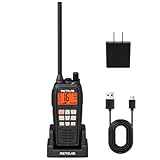
- IP68 waterproof marine radio; the RM15 VHF radio marine resists saltwater corrosion; rated for water immersion up to 1.5 meters for 30 minutes; corrosion-resistant charging contacts; perfect for offshore fishing, bass fishing, and fishing tournaments
- Floating design; the RM15 vhf radio marine stays on the water’s surface if dropped overboard; a water activated emergency strobe light indicates its location; suitable for marine activities such as boating fishing or kayaking; RM15 complies with PART 80
- Dual-way noise reduction system; the RM15 VHF marine radio reduces noise on both transmit and receive audio for clearer two-way communication; a powerful 1000mW (1W) speaker delivers loud, crisp sound even in noisy marine environments
- 16km long range communication;6W vhf marine radio;designed for open water marine activities;whether racing sailboats or navigating choppy seas during fishing trips;helps you stay connected in demanding offshore environments
- Long battery life; the RM15 VHF marine radio features a 2000mAh battery, USB-C ports on both the radio body and charger, and a included cable for 5V/2A or 5V/1A adapter charging. Enjoy over 10 hours of operation and up to 100 hours standby.
A practical evaluation procedure
- Describe the vessel: Record vessel type, gross tonnage, flag, passenger or cargo status, voyage area, sea areas, and whether the voyage is international.
- List communication tasks: Separate internal crew coordination, ship-to-ship safety, ship-to-shore operations, distress alerting, and position reporting.
- Mark coverage zones: Divide the route and vessel into cellular, VHF, satellite, and known dead zones. Include engine rooms, cargo spaces, and enclosed accommodation areas.
- Check legal requirements: Consult the flag administration, applicable national rules, the vessel’s safety management system, and authorized survey or classification advice before removing or downgrading equipment.
- Test candidate devices: Conduct practical checks for audibility, range, battery life, charging, wet or gloved operation, antenna view, and use by the least experienced crew member.
- Build redundancy: Ensure a failure of one network, handset, subscription, antenna, or power source does not eliminate every communication path.
- Document procedures: Specify who carries each device, which channels or numbers are used, how position is reported, when a backup is activated, and how incidents are logged.
- Train and drill: Practice normal calls, loss of coverage, battery failure, man-overboard coordination, urgency traffic, and distress escalation without transmitting false alerts.
- Review after changes: Recheck coverage, subscriptions, batteries, registrations, and regulatory status whenever the route, flag, vessel configuration, or equipment changes.
Common mistakes and how to avoid them
Calling a consumer connection “GMDSS equipment”
Satellite connectivity is a service characteristic; GMDSS recognition is a regulatory and equipment-approval question. Keep those statements separate in specifications, procedures, and crew training.
Assuming a phone can alert everyone nearby
A cellular or satellite phone call is normally directed to a chosen recipient. For ship-to-ship safety awareness, use the applicable maritime radio procedures and maintain the required watch.
Using coastal coverage as an offshore plan
A strong signal at the dock says little about the route after the vessel leaves tower range. Mark the expected loss-of-service point and switch to the planned satellite or maritime system before the phone becomes unusable.
PC Slower Than It Used to Be?
A free scan shows the junk files, broken settings and background clutter dragging Windows down - then fixes them in one click.Free scan · Windows 10 & 11Outdated Drivers Are Slowing You Down
One free scan finds every outdated or missing driver and matches the right update for your exact hardware.Free scan · exact hardware matchReplacing internal radios without testing the work environment
Phones and data applications may fail because of noise, gloves, water exposure, poor signal inside steel structures, notification settings, or depleted batteries. Test every required location and task, then provide an independent fallback.
Ignoring the vessel’s regulatory profile
The same device choice may be acceptable as an operational supplement on one small domestic vessel and unacceptable as a replacement for required equipment on an international cargo or passenger ship. Vessel and voyage details must drive the decision.
What to record in the vessel’s communications plan
- The purpose and coverage area of every communication method.
- Primary and backup devices, their assigned users, charging points, spare batteries, and maintenance responsibilities.
- VHF channels, DSC procedures, satellite numbers or services, shore contacts, and position-reporting formats.
- Conditions that trigger escalation from routine contact to urgency or distress procedures.
- Known dead zones, antenna or sky-view restrictions, and steps for loss of power or network service.
- Registration, inspection, battery, licensing, and training records for safety equipment.
- The date and authority used to verify flag-state, sea-area, and GMDSS requirements.
AMSA notes that the communication method should suit the operation and be considered in the vessel safety management system. Its cited guidance concerns tender operations in Australia, so apply that principle through the rules governing your own vessel rather than treating the page as universal law.
Bottom line for ship owners and crews
Use cellular smartphones as coastal supplements, satellite phones or satellite services for appropriately planned longer-range ship-to-shore contact, and VHF or other recognized maritime systems for shared safety communications. Keep EPIRBs and any required GMDSS equipment in service. For internal crew coordination, specify the coverage, handling, and resilience requirements first and evaluate an onboard system against those requirements; no evidence supports treating a generic phone or broadband link as a universal replacement for dedicated crew radios.
Do these 3 things before closing this tab:
1Repair Windows errors before they cause bigger problems2Scan for outdated or missing drivers - takes under a minute3Clear out junk files and repair common Windows errorsQuick Recap
Product prices and availability are accurate as of the date/time indicated and are subject to change. Any price and availability information displayed on Amazon at the time of purchase will apply.

