
iTechGuides is reader-supported. When you buy through links on our site, we may earn an affiliate commission. As an Amazon Associate I earn from qualifying purchases. Learn more
The right acoustic amplifier depends on where you play and what you need to connect—not on wattage alone. For home practice or recording, a compact amp may be enough; singer-songwriters need independent guitar and microphone channels; louder stages call for more output and practical feedback controls. For outdoor playing, decide whether you need a battery-powered guitar amp or a portable PA.
The models below are matched to those use cases using manufacturer specifications. Those specifications are not independent sound-quality tests, and no controlled listening comparison establishes one universal best.
What an acoustic amplifier should do
Acoustic amplifiers are generally designed to reproduce an amplified instrument cleanly and preserve its character. An electric guitar amp commonly adds more tonal coloration. This is a category-level distinction, not a guarantee: the result still depends on the amplifier, instrument, pickup and settings. Sweetwater’s acoustic amp buying guide and Guitar World’s guide to acoustic guitar amps provide further buying context.
“Natural,” “clear” and similar descriptions on product pages are manufacturers’ claims, not standardized ratings. Wattage is useful as one specification, but by itself it does not tell you how loud an amp will sound in your room or band mix, or how good it will sound. Compare the complete setup, intended venue, speaker format, inputs and controls.
#1 Best Overall

- Professional Dual-Channel Sound: Designed for singer-songwriters, this amp features independent guitar and vocal channels for seamless play-and-sing performance. Precision impedance matching captures every nuance of your acoustic guitar, while a 2-band EQ (Bass/Treble) sculpts your voice to perfection. With built-in Reverb on both channels, you’ll enjoy a rich, stage-ready sound
- 20W RMS Full-Range Performance: Driven by a 5.5" full-range speaker and a high-efficiency Class-D amplifier, this amp delivers 20W RMS of powerful, balanced audio—from deep lows to crystal-clear highs. Thanks to an optimized power management system, it ensures stable, distortion-free output that carries clearly up to 60m (200ft) away. Perfect for cutting through the noise in open-air settings
- 8-Hour Playtime & Steady Power: Powered by a 3000mAh battery, this amp delivers up to 8 hours of non-stop performance. Unlike standard amps that lose volume as the battery fades, advanced chip maintains full output power until the very end. Its high-efficiency, low-heat design includes built-in safety guards for long-term durability. Stay in control with a clear 4-level LED power display
- Wireless Freedom & Easy Control: Experience lag-free audio with advanced wireless 5.3 technology. A stable 50ft (15m) range allows you to move freely during practice or performance. With independent play/pause buttons directly on the amp, managing your accompaniment is effortless, no more fumbling with your phone mid-song
- The Perfect Retro Elegance Gifts: Blending classic woven mesh with sleek geometric lines. It’s an ideal gift for guitar enthusiasts, partners, or friends. Weighing just 4.2 lbs with a portable handle, it transitions effortlessly from indoor practice and backyard hangouts to camping trips or street performances
Match the amplifier to where and how you play
| Use case | What to prioritize | Models to consider |
|---|---|---|
| Home practice or recording | Compact format, instrument input, useful EQ and an output for recording or a mixer | Fishman Loudbox Micro |
| Rehearsal or moderate-volume gigs | More output, instrument and microphone channels if needed, and a way to send signal to a PA | Fishman Loudbox Mini |
| Guitar and vocals in one setup | Separate channels and controls, plus effects and feedback management suited to the venue | Fishman Loudbox Artist; BOSS Acoustic Singer Pro |
| High-volume performance | Stage-oriented output, feedback controls and connectivity for the sound system | Fishman Loudbox Artist; Fishman Loudbox Performer |
| Busking or playing away from mains power | Battery operation, portability and the right format for your inputs and placement | Fishman Loudbox Mini Charge; Bose S1 Pro+ as a portable PA alternative |
These are use-case matches based on stated features and intended positioning, not rankings from side-by-side listening tests. A guitar-and-vocal performer should check the number of channels and whether each input has the controls they need; a larger output figure alone does not replace that check.
How the leading options differ
Compact practice and recording: Fishman Loudbox Micro
Fishman lists the Loudbox Micro at 40 watts, with separate instrument and microphone channels, individual EQ, reverb and chorus, and an XLR direct output. Fishman positions it for practice and recording. See Fishman’s Loudbox range specifications.
Rank #2
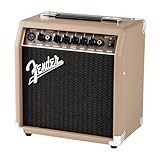
- The Fender Acoustasonic Guitar Amplifier features 15 watts, 11.5Hx11.19Wx7.13D inches
- The Acoustasonic 15's convenient dual front-panel inputs include a standard _ inch jack for an instrument and an XLR input for a microphone
- This unique amplifier is the only Fender guitar amp to feature a "whizzer" cone–a small supplementary speaker cone attached to the voice coil of the amps 6 inch speaker
- The portable and lightweight design allows for easy transport and its headphone output is a great solution for silent practice
- 2 Year Limited Warranty: Fender amplifiers are designed for players and built with unmatched quality, down to the last screw – Fender warrants this amplifier to be free from defects in materials and workmanship for two (2) years from original purchase
Rehearsal and moderate-volume gigs: Fishman Loudbox Mini
The Loudbox Mini is listed at 60 watts, with separate instrument and microphone channels, dedicated EQ and effects, Bluetooth playback and an XLR output. Fishman positions it for rehearsal and moderate-volume gigs, and says it is intended for acoustic instruments with a pickup system. Its product page displayed “OUT OF STOCK” when accessed in 2026; that page status does not establish availability at other retailers or today. Check Fishman’s Loudbox Mini page.
Recommended Free Tools
Battery-powered acoustic combo: Fishman Loudbox Mini Charge
Fishman lists the Mini Charge at 60 watts with an internal rechargeable battery, two channels, effects, XLR direct output and Bluetooth playback. It is the battery-powered acoustic-combo option in this group. The cited specifications do not state a battery runtime, so do not assume one from the model name. See Fishman’s Loudbox range.
Rank #3

- The Fender Acoustasonic Guitar Amplifier features 40 watts, 9.8Dx17.6Wx15.5H inches
- This unique amplifier is the only Fender guitar amp to feature a "whizzer" cone–a small supplementary speaker cone attached to the voice coil of the amps 6 inch speaker
- Enjoy extra ambiance with the instrument channel's built-in reverb
- The convenient dual front-panel inputs include a standard _ inch jack for an instrument and an XLR input for a microphone
- 2 Year Limited Warranty: Fender amplifiers are designed for players and built with unmatched quality, down to the last screw – Fender warrants this amplifier to be free from defects in materials and workmanship for two (2) years from original purchase
Performance with guitar and vocals: Fishman Loudbox Artist
Fishman lists the Loudbox Artist at 120 watts. It has two mic/instrument channels with three-band EQ and dual effects, Bluetooth, XLR outputs for each channel and the main mix, and phase and notch feedback controls. Fishman positions it for high-volume performance. Those features make it worth considering when a performer needs both instrument and vocal inputs and wants options for managing feedback. See Fishman’s Loudbox Artist specifications.
More output and a kick-back stand: Fishman Loudbox Performer
Fishman lists the Loudbox Performer at 180 watts, with an 8-inch woofer, 5-inch midrange driver, 1-inch tweeter, two channels, dual effects, Bluetooth and an integrated kick-back stand. These are manufacturer specifications; they do not establish that it will be louder or sound better than another model in every setup. See the Loudbox range.
Rank #4
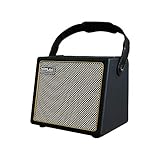
- 【30 Watt】: Portable acoustic guitar amplifier 1:1 restore the guitar tone, 30 Watts output and 6.5 inch speaker, providing you with professional and powerful guitar sound.
- 【2 Channel】: It is able to plug in 2 different instruments together, such as guitar, microphone, etc, and the microphone channel is embedded 2-band EQ(bass/treble) adjustment and reverb effect to achieve voice modification function.
- 【Bluetooth】: Compatible with most BT devices, such as smartphone, tablet, laptop and so on, you can play accompaniment music while do guitar practice or enjoy the fun of music listening.
- 【Portable】: With delicate wooden shell and compact size design, the guitar amplifier can be easily carried anywhere via the strap, which makes it quite suitable for travel use.
- 【Three-year warranty】: if there is any problem with the amp within three years, it can be replaced with a new one
Vocal features and looping: BOSS Acoustic Singer Pro
BOSS describes the Acoustic Singer Pro as a 120-watt, two-channel professional amplifier. Its guitar channel includes Acoustic Resonance processing, EQ and feedback controls. Its microphone channel includes phantom power, harmony and vocal effects; the amp also has a built-in looper and dual XLR/line outputs. Consider it when those vocal and performance features matter, rather than treating its wattage as a direct measure against other formats. See BOSS’s Acoustic Singer Pro specifications.
The Tool Desk
Outbyte PC Repair FREEClear out junk files and repair common Windows errorsFree Scan →Outbyte Driver Updater FREEScan for outdated or missing drivers - takes under a minuteDriver Scan →Portable PA alternative: Bose S1 Pro+
The Bose S1 Pro+ is a portable PA, not a dedicated acoustic guitar combo. Bose lists a built-in mixer, Bluetooth, four positioning options and a rechargeable battery rated for up to 11 hours. That is a manufacturer-rated maximum, not a measured runtime here. Bose also states a frequency range of 62 Hz–17 kHz; that specification is not an independent guitar-specific sound test. A portable PA format may suit a player who values flexible placement and broader PA-style use. See Bose Professional’s S1 Pro+ specifications.
Quick Recap
Best Value

- The Fender Frontman 10G Guitar Amplifier features 10 watts, 7.5Hx11.5Wx13.7D inches, 11.7 pounds
- The 6 inch Fender Special Design speaker delivers quality tones and variety of sounds from blues to metal
- Enjoy a breadth of controls, including gain, over-drive select switch, volume, treble, and bass
- The closed-back design packs a heavier bass response
- 2 Year Limited Warranty: Fender amplifiers are designed for players and built with unmatched quality, down to the last screwFender warrants this amplifier to be free from defects in materials and workmanship for two (2) years from original purchase
Check these features before you buy
- Inputs and channels: If you perform with vocals, confirm that the amp accepts both your instrument and microphone. Check whether the channels have separate EQ, volume and effects controls.
- Feedback management: On louder stages, look for tools such as phase switching or a notch filter, and consider how you will position the amp. A feature list cannot guarantee that feedback will be eliminated in your room or venue.
- PA and recording connections: An XLR direct output can send a signal to a mixer or PA. Check whether outputs are provided per channel, for the main mix, or both if that distinction matters to your setup.
- Effects and performance extras: Reverb, chorus, vocal effects, harmony, Bluetooth playback and looping serve different needs. Choose features you will actually use rather than treating a longer list as proof of better sound.
- Power and portability: If you play outdoors, verify that the amp itself runs on battery. Bluetooth playback does not mean an amplifier is battery powered. A battery amp and a portable PA are different formats, so check their inputs and intended use.
A practical way to choose
- List what you will plug in. Write down your pickup or instrument output, microphone, playback device and any connection needed for a PA or recording setup.
- Choose the venue and power source. Separate home use, rehearsal, moderate-volume gigs, louder stages and outdoor playing. For busking, decide whether you need an acoustic combo or a portable PA, and confirm battery operation if mains power is unavailable.
- Shortlist by required features. First eliminate models missing an essential input, feedback control, output or portability feature. Then compare the remaining models’ stated power and speaker configuration without treating those figures as a quality ranking.
- Check the current listing and generation. Manufacturer pages establish stated features, not current retailer stock, price or which generation a particular listing sells. Confirm those details with the seller before ordering.
- Try the complete setup if possible. Use your own guitar and pickup, microphone and expected playing level. Listen for how the amp handles your instrument and voice together, and test feedback behavior at a realistic position and volume.
Product prices and availability are accurate as of the date/time indicated and are subject to change. Any price and availability information displayed on Amazon at the time of purchase will apply.

