
iTechGuides is reader-supported. When you buy through links on our site, we may earn an affiliate commission. As an Amazon Associate I earn from qualifying purchases. Learn more
Automatic high beams switch a vehicle’s headlights between low and high beams in response to detected lighting and traffic. Also called high-beam assist or semi-automatic beam switching, the feature uses sensors or cameras to decide when to change beams—but the exact activation rules vary by vehicle, and the driver remains responsible for using appropriate lighting.
What are automatic high beams?
Automatic high beams are a driver-assistance feature that changes the headlamp setting between the lower beam and the higher beam as road conditions change. The National Highway Traffic Safety Administration (NHTSA) describes them as switching based on lighting and traffic, including when an oncoming vehicle approaches. The feature is also known as high-beam assist or semi-automatic beam switching.
High beams provide greater forward visibility when the road ahead is dark and clear. Switching to low beams helps avoid shining intense light toward other drivers. Automatic high beams perform that switch for the driver when the system detects conditions that call for it.
Quick wins for a faster PC:
Fix the driver behind crashes, sound loss and screen glitchesFind Drivers →Clear out junk files and repair common Windows errorsFree Scan →How does the system decide when to switch?
Automatic high-beam systems use photometric sensors or onboard cameras to detect lighting and traffic. In one Honda owner-manual example hosted by NHTSA, a camera mounted near the windshield detects lights from vehicles ahead. The system then changes the beams according to the conditions it recognizes.
#1 Best Overall

- [Universal for 12V Vehicles]: Universal compatibility with all standard 12V vehicles, easy installation that won’t disrupt your car’s lighting or electrical system
- [Auto ON/OFF Headlights]: Automatically turns your headlights ON/OFF based on ambient light levels, ideal for low-light scenarios like garages, tunnels, shaded roads and stormy weather
- [Adjustable Sensitivity]: This automatic headlights kit lets you adjust sensor sensitivity to match personal visual comfort, customizing how quickly your lights react to changing ambient light
- [Intelligent Light Sensing]: Promata intelligent car light sensor has less than 1s instant response and is stable without flickering in all light conditions
- [One Button Control]: The easy ON/OFF light sensor with one button allows you to activate or deactivate the automatic headlights system
Activation rules are vehicle-specific. In that Honda manual, the headlight control must be set to AUTO, the system must recognize night driving, and the vehicle must be traveling above 25 mph (40 km/h). Those are conditions for the vehicle covered by that manual, not universal requirements for automatic high beams.
How is high-beam assist different from adaptive driving beams?
Both technologies adjust headlamp illumination in response to traffic, but they do not do the same thing. Ordinary automatic high beams switch between the full low- and high-beam settings. Adaptive driving beams (ADB) can adjust portions of the beam, reducing light near other road users while maintaining more illumination in unoccupied areas.
Rank #2
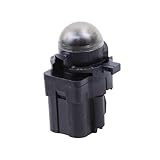
- Applicable for Cadillac CTS 2003- 2012, Deville 2000-2005, DTS 2006-2011, Escalade 2003-2012, Seville 2000-2005, SRX 2004-2009, STS 2005-2011, XLR 2004-2009; for Pontiac Bonneville 2000-2005, G6 2006-2009, G8 2008-2009, Grand Prix 2005-2008
- Applicable for Chevrolet Avalanche 2003-2012,Bravada 2002-2009,Caprice 2011-2012,Captiva 2012,Corvette 2005-2012,Malibu 2004- 2012,Silverado 2003- 2012,SSR 2002-2009,Suburban 2003- 2012,Tahoe 2003-2012,Traverse 2007- 2012
- Replaces part number: 25713063,13498958,25701236,25718566
| Feature | Automatic high beams / high-beam assist | Adaptive driving beams |
|---|---|---|
| Beam behavior | Switches between low and high beams. | Modifies portions of the beam dynamically. |
| Response to other traffic | Switches to low beams when traffic or lighting is detected, according to the vehicle’s system behavior. | Reduces illumination near occupied areas while maintaining more light in unoccupied areas. |
NHTSA describes ADB as using automatic beam technology to shine less light on occupied parts of the road and more on unoccupied parts. That targeted adjustment distinguishes it from a system that simply toggles between two beam settings.
Recommended Free Tools
What should drivers know about the limitations?
Automatic high beams are assistance, not a guarantee that the selected beam is right for every situation. Recognition and switching depend on the vehicle’s system and conditions, so do not assume it will detect every road user or change beams at the ideal moment. Check the owner’s manual for the controls, activation conditions, and any indicator lights for your make, model, and year.
Rank #3

- 1、Universal for all 12V vehicles
- 2、Turn your lights ON/OFF automatically when it gets dark/light
- 3、This system is very safe and easy to install and will not affect the vehicle lighting or electrical system
- 4、Autolight has been designed to control the vehicle lighting system and will switch the lights on automatically as it gets dark and off when it gets light.It will automatically control your lights without the need for manual operation
- 5、It is recommended to have this unit installed by a professional auto technician
A Honda manual hosted by NHTSA advises drivers to change the beams manually if the timing of automatic changes is inconvenient. Be ready to take control and use the beam appropriate to the conditions.
Independent reader supportYour contribution helps us test, update, and keep practical guides available for everyone.Why the feature matters—and what the evidence shows
High beams can improve visibility on dark roads, but drivers do not always use them when conditions allow. An IIHS summary of a 2017 study by IIHS and the University of Michigan Transportation Research Institute reported that only 18% of drivers sufficiently isolated to use high beams did so in and around Ann Arbor, Michigan. That figure describes the study area and conditions; it is not a measure of high-beam use by all drivers.
Rank #4

- Wide Compatibility: Fit for Buick Enclave Lacrosse Lesabre Rainier 2002-2012, fit for Cadillac CTS Deville DTS Escalade Seville SRX STS XLR 2003- 2012, fit for Chevrolet Avalanche Bravada Caprice Captiva Corvette Malibu Silverado SSR Suburban Tahoe Traverse 2007- 2012, fit for GMC Acadia Acadia Bravada C3500 Envoy Sierra Silverado Yukon 2003-2012. Confirm the vehicle model and plug type before purchasing
- Super Convenience: With changes in lighting conditions, the surrounding light intensity can be perceived, and drivers no longer need to manually adjust their headlights. The automatic headlight control of the ambient light sensor provides a convenient and worry free experience, allowing drivers to focus more on the road
- High Reliability and Durability: This ambient light sensor is made of durable ABS plastic, which is not easily cracked, ensuring reliability and durability. Excellent performance can be maintained even after prolonged use, making it an ideal choice for car owners
- Reduced Glare: Ambient light sensors can also help reduce glare for other drivers by automatically adjusting headlight intensity. This prevents overly bright headlights from affecting the vision of oncoming or preceding vehicles
- Easy Installation and Removal: The installation process is fast and easy, allowing for direct replacement of old or damaged automatic headlight control ambient light sensors, seamlessly integrating into the vehicle interior
Evidence about other headlight technologies should not be confused with evidence about automatic high-beam assist. For example, IIHS reports lower nighttime collision and property-damage-liability claim rates for a studied Mazda 3 configuration with curve-adaptive HID lighting than for comparison models with standard halogen lamps. Those findings concern curve-adaptive lighting, not automatic high-beam switching. IIHS also summarizes a University of Michigan and General Motors study that associated GM’s high-beam assist with reductions in nighttime crashes, but its overview does not give a numerical effect size. The available figures therefore do not establish a single effectiveness rate for all automatic high-beam systems.
The Tool Desk
Outbyte PC Repair FREEClear out junk files and repair common Windows errorsFree Scan →Outbyte Driver Updater FREEScan for outdated or missing drivers - takes under a minuteDriver Scan →Quick Recap
Best Value

- Work with vehicle electronics to help optimize vehicle capabilities
- Some GM Genuine Parts may have formerly appeared as ACDelco GM Original Equipment (OE)
- GM Genuine Parts are designed, engineered and tested to rigorous standards, and are backed by General Motors
- GM Engineers design and validate OE parts specifically for your Chevrolet, Buick, GMC, or Cadillac vehicle
- GM regularly updates production and service part designs to integrate new materials and technologies
Sources and vehicle-specific guidance
- NHTSA: Driver Assistance Technologies — definition, alternate terminology, and sensing methods.
- IIHS: Headlights — distinctions among headlight technologies and summaries of cited studies.
- Honda owner manual hosted by NHTSA — a vehicle-specific example of camera use, activation conditions, and manual control guidance.
- NHTSA: Adaptive Driving Beam Headlights — agency description of adaptive driving beams.
Product prices and availability are accurate as of the date/time indicated and are subject to change. Any price and availability information displayed on Amazon at the time of purchase will apply.

