
The Tool Desk
Outbyte PC Repair FREEClear out junk files and repair common Windows errorsFree Scan →Outbyte Driver Updater FREEFix the driver behind crashes, sound loss and screen glitchesFind Drivers →iTechGuides is reader-supported. When you buy through links on our site, we may earn an affiliate commission. As an Amazon Associate I earn from qualifying purchases. Learn more
Automated license plate readers (ALPRs) are specialized camera systems that detect and read visible license plates, attach a time and location to each read, and may save vehicle images or trigger alerts. “Traffic camera” is a broader term. It can mean a live roadway video camera, an incident-recording system, an enforcement camera, or a camera with plate-recognition software. The label alone does not tell you what data a particular installation collects.
The practical difference is function: an ALPR turns a plate sighting into searchable, time-and-place data, while a general traffic camera may simply provide video. Some systems combine both capabilities, so the hardware, software, placement and agency policy must be examined together.
What an ALPR system does
An ALPR uses cameras and software to locate a license plate in a scene, capture a plate image and apply optical character recognition (OCR) to convert the characters into text. A typical read can include:
- The plate number interpreted by OCR.
- The date and time of the encounter.
- The camera’s location, often represented by GPS coordinates.
- A color or infrared image of the plate.
- A photograph of the vehicle and, depending on framing, its occupants and surroundings.
Some deployments also classify visible vehicle characteristics such as color, make, model, damage or bumper stickers. Those capabilities vary with the camera, lighting, software and mounting position; they are not guaranteed in every ALPR record.
#1 Best Overall
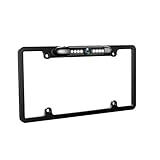
- HEAVY-DUTY LICENSE PLATE FRAME BACKUP CAMERA: Perfect for most of vehicles that use a standard US license plate. It is like a plate frame mounted on the license plate, holds the license plate securely without blocking the license plate info. Before buy, pls check your license plate size first. Not include Monitor.
- GUIDE LINE ON/OFF: Cut the Green Line, the Guide Line will be disappear. If Guide Line no disappear, please check your monitor if set with guide line
- WIDE VIEWING ANGLE: 170° viewing angle macro lens give you a wide viewing vision, high sensitive color CMOS image sensor. Lens angle physically 45° up and down adjustable on the camera, you can adjust the angle according to your needed
- MARINE GRADE WATERPROOF: Aluminum Zinc Material with IP-67 Standard waterproof , shockproof & dust-proof level, high performance in all-weather condition, Never be foggy or wet inside the camera even in a storm or serious rainy day
- TRUE COLOR NIGHT VISION No Purple : The License Plate Camera with 8LEDs, will supply you comfortable and clear image for night time and dark places. It with true color, no purple like infrared camera. The product is upgraded, it just rear camera now. Not Front Camera. If your image is reversed, pls check your monitor if set with mirror function
An ALPR read does not automatically contain a driver’s name. A plate can be linked to a registered owner or another person only when authorized users connect it with separate motor-vehicle, investigative or other databases. The plate record itself is generally an observation of a vehicle, not proof of who was driving.
Hot-list matching and alerts
ALPR software can compare the recognized plate text with a “hot list” of plates associated with stolen or wanted vehicles or other agency-defined criteria. A potential match can produce an alert for an officer while the vehicle is still in view. The system can also retain the read for a later search, even when no alert was generated.
What “traffic camera” can mean
Traffic camera is a purpose-based description, not a technical specification. Agencies use the term for several different systems:
What’s actually slowing this PC down?
Pick the symptom - the matching free tool is one click away.
- Traffic-monitoring video: a camera that provides live views of roads, intersections or congestion.
- Incident review: recorded footage that can be examined after a collision, road closure or other event.
- Rule enforcement: a system configured for a specific violation, such as running a red light or exceeding a speed limit.
- Surveillance-camera networks: remotely monitored cameras that may add infrared, pan-tilt-zoom or license-plate-recognition features.
- Integrated feeds: public, private and agency cameras presented together in a real-time crime center or similar operation.
A conventional video camera may show a plate without reading it. Unless plate-recognition analytics are enabled, the footage is not an ALPR record in the specialized sense. Conversely, an ALPR can be installed on a road, at a traffic signal or near a tolling point without being a general-purpose traffic camera.
ALPRs and traffic cameras: the operational differences
| Comparison point | ALPR | Traffic camera |
|---|---|---|
| Primary function | Detect and read license plates, then create searchable plate events | Provide video for monitoring, incident review, enforcement or another defined purpose |
| Typical structured data | Plate text, time, location and plate or vehicle images | Video frames or a live stream; structured plate data only when recognition software is enabled |
| Real-time operation | Can compare reads with hot lists and issue alerts | Can support live observation or an enforcement workflow, but does not inherently create plate alerts |
| Historical search | Past reads can be queried and plotted by time or map location | Depends on whether footage is recorded, indexed and retained; a general camera may require manual video review |
| Common purposes | Stolen-vehicle and wanted-vehicle alerts, investigations, vehicle-location analysis | Traffic management, situational awareness, collision or incident review, selected enforcement and tolling uses |
| Identity information | Plate observation; a person’s identity requires a separate authorized database connection | Video may show a driver, passengers or surroundings, but identity is not inherent |
These categories overlap. A road camera can include ALPR analytics, and an ALPR installation can sit beside a signal or other traffic infrastructure. To determine what a system really does, ask which functions are enabled rather than relying on its name.
What data each system can collect
ALPR records
The core ALPR event is a plate read tied to time and place. Depending on the deployment, the associated files may include a visible-light plate image, an infrared plate image, a wider vehicle photograph and a map point. The wider image can incidentally capture the driver, passengers, nearby pedestrians, buildings and other vehicles.
Rank #2

- 【Continuous Upgraded 1080P AHD Backup Camera】After launching three car backup cameras, PixelMan further upgrade and launch the new reversing camera PMD2A-S. This car camera use the latest chip special for reversing camera made in Japan, this chip not only has excellent image output, but also has stunning performance under strong light and dark light. Strict in details and only make the best products is what PixelMan pursues. It is also essential to you, isn't it?
- 【Support HD and AHD switching】This upgraded back up camera even supports HD and AHD switching. Each optimization improves the definition, signal stability, waterproof performance, durability, installation, etc. Our vehicle backup camera can be switched to AHD signal output to achieve 1080P display (Under the premise that the screen supports AHD signal).
- 【1/2.7in AHD 1080P Large Chip Adopted in This Reverse Cam】The chip size determines the amount of reversing camera output pixels, compared with 1/4in chip used in ordinary backup cam, the most apparent feature is the enhanced brightness and color saturation besides of the sufficient clarity. The colors become more vivid and true, the increased brightness makes the images more clearly, meanwhile, the night vision effect also be enhanced, you can back the car easily without extra light at night.
- 【170° Wide Angle Optical Glass HD Lens】The lens is the core component of the reverse camera for car. The HD lens used in PMD2A-S wide angle backup camera is very different from ordinary lens in appearance, it has a larger aperture and a stronger sense of technology. High transmittance glass, fish eye appearance, F1.4 aperture, all these features directly determine the wide angle, maximum output pixels and night vision performance of the license plate camera.
- 【Back Up The Car Easily】Whether it is day or night, you can see almost everything behind the car when reversing, PixelMan camera for car reverse will let your driving easier and safer. Isn’t it what you need?
Vehicle descriptors can be stored as software-generated attributes or observed by a person reviewing the image. Color, make, model, visible damage and bumper stickers are examples described by the Electronic Frontier Foundation (EFF), but the availability and accuracy of each field depend on equipment and placement.
Because OCR can misread characters and a plate can be obscured by dirt, glare or weather, the recognized text is an interpretation of an image. A hot-list hit should therefore be treated as a lead that requires confirmation, not as conclusive identity evidence.
Traffic-camera footage and feeds
A basic traffic camera may collect continuous or event-triggered video, transmit a live feed, or save clips for a defined retention period. The image can contain vehicles, people, signs, buildings and road conditions. A camera with pan-tilt-zoom or infrared can cover a wider area or operate in low light.
Whether a traffic camera stores footage, for how long, and whether anyone can search it depends on the system’s configuration and policy. Some networks expose public views; others are restricted to agency staff or approved partners. A camera network may combine feeds from public roads and privately owned cameras without giving every feed the same capabilities.
How law enforcement uses ALPR data
Immediate alerts
When an ALPR read matches a hot list, software can notify an officer near the camera. The alert may concern a stolen vehicle, a wanted vehicle or another criterion selected by the agency. The alert is an operational prompt, not an automatic finding that a person committed an offense.
Quick wins for a faster PC:
Fix the driver behind crashes, sound loss and screen glitchesFind Drivers →Repair Windows errors before they cause bigger problemsFix Now →The Marin County Sheriff’s Office policy provides a documented example of the verification step: after a hot-list match, an officer must visually compare the plate on the vehicle with the scanned plate and confirm the wanted status through the California Law Enforcement Telecommunications System (CLETS). That policy also notes that the wanted-vehicle database is not real time. This is an agency-specific example, and other jurisdictions may use different procedures.
Rank #3

- Super HD Day& Night Vision: Our HD Reverse Camera with new upgrade chips and glass lens, supply you HD true color, real time image at day and night. 9 Led lights will be Auto turn off in bright light areas
- Front/Rear View Camera & Guide Line On/Off: You can choose install the backup camera in front or back of your car, keep or move guide line. More flexible. Please Restart your radio again after you cut wire loops, then the image should be correct. IMPORTAT: Please Restart your radio again after you cut wire loops, then the image should be correct
- IP 69K Waterproof : Excellent waterproof design, better sealing technology, so that the backup camera can work good in extreme weather, no matter in Rain/Fog/Snow
- 149° Wide View Angle & Adjustable Lens: 149° wide view angle can meet your vision needs when driving or parking, adjustable camera lens allows you to find the best position, makes you drive safely
- Easy to Install: Easy to install, no need drilling in your car. 8M/26.2ft Long Video cable, also fit for long car, don’t need to buy a extra cable, save money. Fit for 12V Cars, Such as Pickup Truck, SUV, Minivan, Sedans, RV, Trailer and Sedans etc. Not include Screen
Retrospective searches
Stored reads allow an authorized user to ask where a plate was seen previously, then review the associated photographs or plot the events on a map. Investigators can use a time window and location to look for vehicles near a reported crime or to identify a vehicle that appeared at several relevant places.
When many timestamped reads are combined, they can reveal travel patterns. A record does not need a person’s name to be sensitive: repeated observations of a uniquely identifiable plate can describe where a vehicle regularly goes. Linking the plate to an individual requires additional records, but the movement history can still be revealing.
How traffic-camera footage is used
Live situational awareness
Transportation and public-safety staff may watch live views to understand congestion, road closures, weather impacts or developing incidents. A live feed can help dispatch personnel or coordinate a response without creating a searchable plate database.
Windows Errors? Fix Them Before They Spread
Repair common Windows errors and clear accumulated junk for a smoother, more stable PC - no reinstall needed.Free scan · no reinstallOutdated Drivers Are Slowing You Down
One free scan finds every outdated or missing driver and matches the right update for your exact hardware.Free scan · exact hardware matchAfter-incident review
Recorded footage can be reviewed after a crash, theft, public-safety event or traffic disruption. Investigators may manually follow a vehicle through successive camera views. If the network has plate-recognition analytics, the search can be automated; otherwise, the result depends on the quality of the video and the reviewer.
Enforcement and tolling
Some cameras are configured for red-light, speed or toll enforcement. Those systems may capture a plate and supporting images, but the legal notice, citation and retention process are defined by the applicable program. The existence of a traffic camera elsewhere in the network does not mean every camera issues citations or reads plates.
Scale of ALPR collection
EFF and MuckRock reported more than 2.5 billion scans in records from 200 agencies using the LEARN sharing system. The scans were recorded in 2016 and 2017, and the figure describes that defined dataset rather than a current national total.
Rank #4
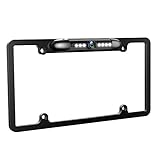
- Super HD Night Vision: Our License Plate Camera built in Latest Night Vision Nano Lens and sensor, provide 750 TV Lines,960*576 pixel pictures even in darkness, true color, no purple. AUTO-Lighting LED Lights Make Your Night Driving more Safety
- Front/Rear Camera & Guide Line On/Off: The backup camera default to Rear View with Guide Line; Cut the WHITE cable can be Front Camera; Cut the GREEN cable the Guide Line will disappear. You can choose install in front or Back to your car. IMPORTANT: Please Restart your radio again after you cut wire loops, then the image should be correct
- Wide Viewing Angle:170° viewing angle macro lens give you a wide viewing vision, Lens angle physically 45° adjustable on the camera, you can adjust the angle according to your needed, you can see all the blind spots behind the car
- Waterproof : Aluminum Zinc Material with IP-67 Standard waterproof , high performance in all-weather condition, Never be foggy or wet inside the camera even in a storm or serious rainy day
- Super Long RCA (AV) Cable: We supply 32.8 ft (10M) RCA Cable, you do not need to buy extra cable for cars, vans, and trucks (12V). Save Money. Wired Camera more reliable , more stable. The product is upgrading, for the install way, pls check the user manual. Thank you
In the same analysis, 99.5% of scanned plates were not under suspicion at the time they were collected. That percentage applies to the studied records and years; it is not a universal estimate for every ALPR deployment. It illustrates why retention, access and sharing rules matter even when a system is searching for a small number of wanted vehicles.
Retention, access and sharing are policy questions
There is no single nationwide ALPR retention period or traffic-camera data schema established by the sources described here. Agencies set different rules for how long they keep images and metadata, who may query them, whether searches are logged, and which organizations may receive copies.
A draft Marin County policy marked 2021 and reproduced in a 2022 settlement exhibit describes two-year retention, query logging, an annual audit and limits on sharing with specified California agencies. It also restricts use to official law-enforcement investigations or department-related civil or administrative action. Because the document is a draft example, it should not be treated as proof of current practice in Marin County or as a model that applies everywhere.
EFF’s 2018 reporting described broad sharing among agencies using the studied vendor system. That reporting concerns records and practices from the period examined, so a local agency’s current policy and applicable law are the controlling sources for present-day access.
How to find out what a local system records
Agency names and camera labels are often insufficient. Look for a current policy, public-records disclosure, contract, impact assessment or program page that answers each of these questions:
Do these 3 things before closing this tab:
1Scan for outdated or missing drivers - takes under a minute2Clear out junk files and repair common Windows errors3Fix the driver behind crashes, sound loss and screen glitches- What hardware and analytics are enabled? Determine whether the camera only streams video, records clips, performs OCR, classifies vehicle features or supports pan-tilt-zoom and infrared.
- Which fields are saved? Check for plate text, confidence scores, GPS coordinates, timestamps, plate images, wider vehicle photographs and any vehicle descriptors.
- Are reads checked against hot lists? Identify the lists used, the update schedule and whether alerts are informational or tied to an enforcement workflow.
- Can users search historical records? Establish whether searches are limited to live alerts, permit map and time queries, or include manual review of archived video.
- How long is data retained? Separate the retention period for plate metadata, still images, full-motion video, alerts and audit logs.
- Who can query or receive the data? Look for employee roles, partner agencies, private-camera owners, court or public-records access and cross-jurisdiction sharing.
- Are searches logged and audited? A policy should say whether each query is recorded, who reviews logs and how often audits occur.
- What verification is required? Find the procedure for checking a plate and confirming that a hot-list entry is current before an officer takes action.
Accuracy and failure modes
Plate recognition can fail when characters are blurred, angled, blocked, dirty or illuminated by glare. Similar characters can be confused, and a plate may be read correctly while the wrong vehicle is associated with it because of timing or camera position. A hot-list entry can also be outdated.
Best Value

- The Excellent License Plate Backup Camera is compatible with a wide range of vehicles,such as cars, pickup trucks, SUVs, vans, RVs, minivans, and sedans. The back up camera functions effectively on most types of vehicles, whether they are old, new, or used.
- HD backup camera easy to install, operates with any 9-15V DC power,just need to connect reverse camera's power to revering light, then connect the reverse camera to your car DVD players, radios, monitors, or screens by 26ft AV cable. Rear view camera includes 26ft RCA video cable.
- Vehicle backup cameras equipped with the latest HD 1/3-inch image sensor and a 150° wide viewing angle lens are great for clearly checking those hard-to-see blind spots, making parking safer and simpler
- The YIMU backup camera for cars is 100% waterproof and shockproof, boasting an IP69K waterproof rating. Back up camera will never fog up or get wet, even during storms or on rainy days. Backup camera for car professional shockproof design ensures the camera operates safely for your vehicle.
- NIGHT VISION WITH 7 LEDS,YIMU Car Backup Camera built in 7 leds to provides you realistic and comfortable images for night time or dark space backing up than other infrared camera,true color,no purple.AUTO-Lighting LED lights make your night driving more safety.
The safest operational practice is to treat an alert as a possible match, inspect the actual vehicle and plate, and confirm the status through the agency’s authoritative system. The Marin County example explicitly requires those checks because its wanted-vehicle database was not real time. Readers should consult their own jurisdiction’s policy rather than assume that exact rule applies locally.
Examples that show the difference
Roadside ALPR
A roadside unit photographs a passing vehicle, extracts the plate characters, stores a timestamp and location, and checks the result against a stolen-vehicle list. An officer receives an alert, visually verifies the plate and confirms the status before acting. The same read may later be found in a map search.
Intersection video camera without recognition
An intersection camera streams or records a wide view for congestion and collision review. It may show several plates, but no plate text is generated. An investigator would need to locate and inspect the relevant video manually, assuming footage still exists.
Free tools Windows power users keep installed
One-click scans. No signup required.
Traffic camera with plate analytics
A camera mounted at a signal can provide traffic video and run plate-recognition software at the same time. Its records and retention rules should be evaluated as both a video system and an ALPR system; calling it only a “traffic camera” would hide the searchable plate function.
Questions to ask before treating a camera label as meaningful
- Is the system recognizing plates, or merely recording a scene in which plates happen to appear?
- Does it create a structured event with time and location, or only a video file?
- Can an operator receive a live hot-list alert?
- Can authorized users search older reads or footage on a map?
- Are driver, passenger and surrounding-area images retained?
- What retention, audit and sharing limits apply today?
- What human verification is required before an alert is acted on?
The answers determine the real privacy and investigative impact. An ALPR is defined by its plate-recognition function, while a traffic camera is a broad category whose capabilities range from a public live view to a network that includes searchable ALPR analytics.
Quick Recap
Product prices and availability are accurate as of the date/time indicated and are subject to change. Any price and availability information displayed on Amazon at the time of purchase will apply.

