
Recommended Free Tools
iTechGuides is reader-supported. When you buy through links on our site, we may earn an affiliate commission. As an Amazon Associate I earn from qualifying purchases. Learn more
Yes—an AI system can be stopped, restricted, or taken out of service, but a button labeled “stop” does not prove that the system can be safely controlled. A useful kill-switch capability is an authorized, tested way to interrupt or limit the deployed system—including its tools and delegated actions—when defined risks arise, with a plan for what happens next.
What does “AI kill switch” actually mean?
The phrase is too vague to serve as a safety requirement by itself. It does not say what must stop, who may act, what evidence triggers action, or whether the intervention must be immediate, gradual, temporary, or permanent.
For practical purposes, treat it as a capability to interrupt, constrain, suspend, or safely decommission an AI system under specified conditions. The relevant system is not necessarily just a model process: it may include an agent, its permissions, connected services, deployment infrastructure, and work already delegated to other components.
Crashes, No Sound, or Screen Glitches?
Random freezes, missing sound and display glitches usually trace back to one bad driver. Find and replace yours safely.Free scan · under a minutePC Slower Than It Used to Be?
A free scan shows the junk files, broken settings and background clutter dragging Windows down - then fixes them in one click.Free scan · Windows 10 & 11There is no single universal technical design established by the policy and standards sources discussed here. The OECD AI Principles describe context-sensitive options to override, repair, or safely decommission systems. The EU AI Act’s Recital 73 addresses appropriate human oversight for high-risk AI systems; it does not establish a standardized kill switch for every AI system.
#1 Best Overall

- HEAVY-DUTY INDUSTRIAL PROTECTION: Engineered for rapid response, this Emergency Stop Switch features a prominent Red Mushroom Head for instant identification. Designed to cut off power in critical situations, it is essential for protecting machinery and equipment. Press to stop, rotate clockwise to reset
- DUAL CONTACTS (1NO + 1NC): Equipped with 1 Normally Open (NO) and 1 Normally Closed (NC) contacts. Rated for AC 660V / 10A, it provides flexible wiring options for a wide range of control systems, from lighting to motor controls
- IP65 WATERPROOF & WEATHERPROOF: Built for harsh conditions, the IP65-rated enclosure resists dust, water, and oil. The included sealing gasket ensures a reliable, tight fit—ideal for outdoor equipment, automotive shops, or demanding industrial settings
- DURABLE & HIGH-VISIBILITY DESIGN: The high-contrast Yellow & Black enclosure ensures maximum visibility in busy workspaces. Crafted from rugged, impact-resistant materials, this switch is built for long-lasting performance in heavy-duty environments
- WIDE INDUSTRIAL APPLICATION: A versatile solution for Automotive, Construction, and Control Systems. Whether upgrading existing machinery or building new control panels, this professional-grade Emergency Cut-off Switch provides a simple and reliable integration
Can a human really stop it?
Human oversight requires more than assigning someone a nominal role. The person must have usable authority, enough information to recognize when intervention is needed, and a mechanism the system will respond to. Recital 73, reproduced by the European Commission’s AI Act Service Desk, says that, where appropriate, high-risk AI systems should help the assigned overseer decide whether, when, and how to intervene—including stopping a system that does not perform as intended. It also describes operational constraints that the system cannot override itself.
That is an oversight objective, not proof that a particular control works in a particular deployment. A control may be ineffective if the operator lacks credentials, cannot reach it during an incident, does not know which system it affects, or cannot tell whether activity has continued elsewhere.
What exactly needs to stop?
First identify the unit of control. Depending on the deployment, stopping a model endpoint may prevent new requests but leave an agent with existing credentials able to act. Disabling one tool may leave other tools available. Suspending a service may not cancel work already handed to an external service or another agent.
What’s actually slowing this PC down?
Pick the symptom - the matching free tool is one click away.
Rank #2

- Product Name : Emergency Stop Push Button Switch ; Contact Type : 2 NC
- Ith:10A ; Ui:600V ; Type :Latching;
- Button Diameter : 40mm/1.6" ; Mount Hole Diameter : 22mm / 7/8";Fit Panel Thickness(adjustable) : 6mm / 15/64"(max.)
- Button size(Approx.) : 39 x 29 x 73mm/ 1.5" x 1.1" x 2.9"(L*W*H);
- Package Content : 2Pcs x Emergency Stop Push Button Switch.
| Control scope | What an intervention may affect | Question to resolve |
|---|---|---|
| Model or endpoint | New model requests through a particular process or service | Can existing sessions or queued requests still produce actions? |
| Agent or task | A particular agent, run, or delegated task | Have copies, scheduled jobs, or downstream agents also been identified? |
| Tool permissions | The agent’s ability to use specified tools or credentials | Are credentials revoked or constrained everywhere they can be used? |
| Deployment or connected service | A broader operating environment or integration | Will the action disrupt other services or people who depend on them? |
This is a planning aid, not a formal standard. NIST’s AI Risk Management Framework describes AI as socio-technical: risks can arise from interactions among technical systems, operators, and deployment context. It notes that complexity can make failures difficult to detect and respond to. A stop plan therefore needs to account for the system as operated, not just the model in isolation.
Who can trigger a stop, and on what evidence?
An organization needs to name the people or roles allowed to act, make their authority usable in an incident, and set an escalation path for cases where the first responder is unavailable. Depending on the deployment, responsibility may be divided among a provider, deployer, operator, incident commander, or other authorized party; the relevant decision rights should be explicit before an emergency.
It also needs to define what counts as a trigger. A threshold might be a specified safety signal, an operator’s judgment, an incident report, or an external order. The appropriate choice depends on the system and its use. Whatever the trigger, responders need to know what evidence is available, how quickly it can be assessed, and who can act when uncertainty remains.
Rank #3

- 【Package content】1 x Waterproof Emergency Stop Push Button Switch with Box
- 【High quality】screws do not rust, the shell is made of high flame retardant and waterproof materials, sealed dustproof and waterproof, stable and durable key contacts, engineering plastic anti-breakage, not easy to damage, IP67 protection level
- 【Multiple uses】waterproof e-stop push button switches with box is mainly used for indoor and outdoor electrical, communications, fire-fighting equipment, steel smelting, petrochemicals, electronic products, electric power, railroads, construction sites, mines, mining sites, airports, hotels, ships, large factories, coastal factories, terminal equipment, sewage treatment facilities, environmental pollution facilities
- 【Contact type】1NO 1NC.normally open (NO) and normally closed (NC). Ui: AC 660V; Ith: 10A
- 【Size】145 x 85 x 105mm/ 5.7" x 3.3" x 4.1" (L*W*H); waterproof level: IP67
- Authority: Which roles can restrict capabilities, suspend operation, or approve a return to service?
- Access: Do those roles have working credentials and a control path that remains available during an incident?
- Trigger: What observable condition calls for intervention, and who decides when the evidence is ambiguous?
- Coverage: Which connected tools, copies, integrations, or delegated tasks must be included?
Should the system stop immediately or enter a safe state?
Not every incident calls for the same interruption. A hard stop may be appropriate in some circumstances; in others, stopping abruptly could leave an operation in an unsafe state or interrupt a service that people depend on. A staged shutdown, restriction of particular capabilities, or controlled transition may be safer. The choice should be made for the actual use case rather than assumed in advance to be universal.
Teams should decide what happens to in-flight work, queued actions, and external dependencies. They should also establish what activity is blocked immediately and what, if anything, can continue under tighter controls. The OECD’s responsible-AI due-diligence guidance calls for ongoing attention to risks shaped by use case, system interactions, users, inputs, human involvement, geography, and foreseeable misuse; it also identifies monitoring and restriction of access or capabilities as possible controls.
What happens after suspension?
Stopping operation is not the end of incident response. Responders may need to preserve logs and other evidence, determine the scope of the incident, notify affected parties, and decide whether repair, recovery, continued suspension, or decommissioning is appropriate. The exact sequence depends on the system and the risk; evidence preservation and safe handling should be considered before controls are activated, not improvised afterward.
Rank #4
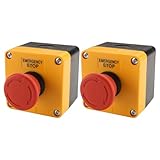
- HEAVY-DUTY INDUSTRIAL PROTECTION: Engineered for rapid response, this Emergency Stop Switch features a prominent Red Mushroom Head for instant identification. Designed to cut off power in critical situations, it is essential for protecting machinery and equipment. Press to stop, rotate clockwise to reset
- DUAL CONTACTS (1NO + 1NC): Equipped with 1 Normally Open (NO) and 1 Normally Closed (NC) contacts. Rated for AC 660V / 10A, it provides flexible wiring options for a wide range of control systems, from lighting to motor controls
- IP65 WATERPROOF & WEATHERPROOF: Built for harsh conditions, the IP65-rated enclosure resists dust, water, and oil. The included sealing gasket ensures a reliable, tight fit—ideal for outdoor equipment, automotive shops, or demanding industrial settings
- DURABLE & HIGH-VISIBILITY DESIGN: The high-contrast Yellow & Black enclosure ensures maximum visibility in busy workspaces. Crafted from rugged, impact-resistant materials, this switch is built for long-lasting performance in heavy-duty environments
- WIDE INDUSTRIAL APPLICATION: A versatile solution for Automotive, Construction, and Control Systems. Whether upgrading existing machinery or building new control panels, this professional-grade Emergency Cut-off Switch provides a simple and reliable integration
OECD guidance recommends responsible suspension when severe harm is occurring or imminent. It describes protocols for authorizing redeployment or choosing another recovery plan, with recovery tested and validated extensively, ideally with external stakeholders. If a robust fix is unavailable, decommissioning or coordinated responses may be needed; in extreme cases, recovery may not be possible.
- Specify who can authorize redeployment and what validation must be completed first.
- Decide who reviews the evidence and whether independent review is feasible.
- Set a fallback if the proposed fix does not address the risk or cannot be validated.
- Keep permanent decommissioning available when safe recovery cannot be demonstrated.
How should an organization make the capability credible?
Build it into ordinary risk management rather than treating it as a standalone button. NIST’s AI Risk Management Framework 1.0 organizes that work into four functions: govern, map, measure, and manage. The framework is voluntary and use-case agnostic; it can help an organization connect decision rights, deployment context, risk assessment, and response planning without prescribing one universal shutdown architecture.
Do these 3 things before closing this tab:
1Scan for outdated or missing drivers - takes under a minute2Repair Windows errors before they cause bigger problems3Fix the driver behind crashes, sound loss and screen glitchesBefore relying on a stop mechanism, test it in the deployment conditions that matter. Confirm who can activate it, which components and permissions it changes, what happens to in-flight work, whether copies or delegated actions remain active, and how responders verify the result. Test the recovery and authorization process too. A control that has only been described in a document is not evidence that the system can be brought to a safe state.
Best Value

- GET NEW ONE IF NOT MAN MADE BROKEN IN 3 YEARS SINCE YOU PURCHASE THE SWITCH.
- Product name: 22mm Emergency Push button Switch
- Fit panel thickness(adjustable): max 8. 5mm / 0. 3"; Size: 39 x 29 x 73cm/ 1. 5" x 1. 1" x 2. 9"(L*w*h); material: plastic and metal
- Main color: red, black;
- 1NC silver contact; Action: Latching, Push- Lock, Turn to Release.
What is known—and not known—about stopping agentic systems?
Distributed agents make simple shutdown assumptions harder to rely on: activity may be spread across infrastructure, tools, and actors, and control may be divided. Oren Perez’s September 19, 2026 preprint, “The Law of Stop,” offers one author’s analysis of this problem, not settled empirical consensus.
Perez reports that roughly 80% of 1,213 retained incidents in his analysis were coded as having no stop, and that seven of 39 governance instruments surveyed contained binding stopping requirements. These are author-reported results from a preprint, not official regulator statistics or established cross-study findings. They do not establish a universal failure rate or prove that a particular shutdown design works.
What should a written stop requirement specify?
Replace “the system must have a kill switch” with requirements that can be assigned, tested, and verified. A concise specification should identify:
- the risk conditions that require action and the evidence responders use;
- the authorized roles, credentials, and escalation route;
- the components, permissions, integrations, and delegated actions within scope;
- the required interruption behavior, including how in-flight work is handled;
- the logs or other evidence to retain and how the result is verified;
- the criteria and approval needed to resume, choose another recovery plan, or decommission the system.
These are practical design questions grounded in human-oversight, lifecycle-risk, and recovery guidance—not a checklist promulgated as a formal standard. The EU AI Act’s definitions of a “safety component” and “recall” can inform careful discussion of safety functions and taking a system out of service, but neither supplies a universal technical architecture for emergency interruption.
Quick Recap
Product prices and availability are accurate as of the date/time indicated and are subject to change. Any price and availability information displayed on Amazon at the time of purchase will apply.

