
iTechGuides is reader-supported. When you buy through links on our site, we may earn an affiliate commission. As an Amazon Associate I earn from qualifying purchases. Learn more
A 2026 human–AI mathematics collaboration improved the known bounds on the Grothendieck constant, but it did not determine the constant’s exact value. The more consequential finding is methodological: current AI systems can generate solutions and technical steps, yet still depend on human researchers to decide whether those steps are significant, general, and useful for building mathematical theory.
What the Grothendieck-constant result actually established
The case study concerns the Grothendieck constant, KG, a quantity that describes a hardness gap between certain combinatorial optimization problems and their continuous relaxations. Its exact value remains unknown.
In the August 11, 2026 arXiv preprint Long-Horizon AI Research for Grothendieck Constant: A Case Study in Human-AI Mathematical Collaboration, Alan Li, Rahul Saha, Anton Xue, Swarat Chaudhuri, Adam Klivans, Pravesh K. Kothari, and Raghu Meka report the following interval:
Recommended Free Tools
| Quantity | Reported result | What it means |
|---|---|---|
| Lower bound | 6π/11 | KG is at least this value. |
| Upper bound | π/(2 log(1+√2)) − 10−4 | KG is no greater than this value. |
| Exact value | Still unknown | The work narrows the possible interval; it is not a closed-form solution. |
That distinction matters. “AI solved the Grothendieck constant” would overstate the result. The defensible description is that the collaboration produced improved known lower and upper bounds, as reported in a preprint that has not yet become a final peer-reviewed publication.
#1 Best Overall

- ADVANCED GRAPHING & CAS – Explore complex math with computer algebra system, dynamic geometry, advanced graphing, and spreadsheet applications plus RPN. This color graphing calculator lets you switch between symbolic, graphical, and numerical views with dedicated keys.
- 3.5-INCH MULTI-TOUCH COLOR DISPLAY – Graphing scientific calculator with a large high-resolution color screen, pinch-to-zoom, interactive graph manipulation, and customizable backgrounds. Add background images and use your finger to sketch and adjust functions for blended learning.
- EXAM APPROVED & CLASSROOM READY – Approved for PSAT/NMSQT, SAT, IB, and select AP exams. Suitable as an SAT calculator, statistics calculator, calculus calculator, precalculus calculator, engineering calculator for college, algebra calculator, or geometry calculator.
- WIRELESS & APP INTEGRATION – Use HP Prime Wireless + Connectivity Kits to poll students, share data, and project screens. HP Prime Mobile App (Windows, iOS, Android) mirrors full calculator functionality. Brushed metal design includes a slide-on cover and rechargeable lithium-ion battery.
- EXPANDABLE MEMORY & STEM ECOSYSTEM – 256 MB flash memory stores programs, exam configurations, and images. Integrates with optional accessories for advanced classroom control, real-time collaboration, and interactive engagement across the complete HP STEM environment.
How the long-horizon collaboration worked
The preprint describes an AI research system operating across an extended program rather than answering a single contest-style question. It explored candidate approaches and generated technical insights while human researchers directed the work, evaluated ideas, and checked the mathematics.
What the system contributed
- Exploration of possible approaches over multiple stages.
- Generation of technical ideas and partial results.
- Continuation of lines of inquiry as failures and promising directions accumulated.
What the human researchers contributed
- Selection and steering of the research problem.
- Assessment of whether an intermediate idea was mathematically meaningful.
- Interpretation of results and decisions about which directions to pursue.
- Verification of the resulting arguments and bounds.
This division is central to the case study. The system was not presented as an autonomous mathematician that independently chose a theory, recognized its importance, and validated every implication.
Rank #2
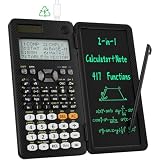
- 991ES MAX Multifunctional Scientific Calculators: ROATEE business calculator features 417 functions, deal For: General math and science, Pre-Algebra, Algebra 1 and 2, Geometry, Statistics and regressioncal culations, Calculus, fractions, decimals, Calculations involving specificnumber systems (BASE-N, binary,octal, decimal,hexadecimal), Complex number calculations, EQN, Matrix calculations, TABLE, VECTOR, SOLVE, Biology, Chemistry so on and it has memory function calculation more user-friendly
- Scientific Calculators with Notepad: This scientific calculators for school and business intergrates calculation and notebook with a stylus pen. The lcd writing tablet enables you to take notes during the calculation, which do great help for study and work. 👉NOTE!Only Unlock the LOCK KEY will the writing area and the erase button work
- Multiview: display shows 4 calculations at the same time on screen, greatly improves computational efficiency
- Dual Power Rechargeable & Coin Battery: The replaceble coin battery is built in this scientific calculators. It is also Rechargeable so you don't need to worry about battery depletion
- Anti-Drop Body with High Durability and Portable: The body of this scientific calculators undergoes rigorous quality tests. Due to the design of anti-drop body, no need to worry about the damage by accidentally falling and it has only weighs 5 ounces can be easily put in your pocket, which is convenient for business and it is a popular back to school supplies at the beginning of the school year
Why solving a problem is different from doing research
A mathematical problem can have a checkable target: produce a proof, derive a bound, or complete a calculation. Research judgment asks a wider set of questions:
- Is the result correct under independent checking?
- Is it genuinely novel rather than a reformulation of known work?
- Does it matter beyond the particular instance that prompted it?
- Can it support a broader theory or useful downstream applications?
- What should researchers investigate next?
A system may execute a technically difficult step without reliably answering those questions. Princeton’s Department of Computer Science and Princeton Engineering framed the collaboration as evidence of an asymmetry between mathematical problem solving and the judgment needed to recognize significance, generality, and downstream use.
Rank #3

- Newest in the TI-84 series: Built for everyday classroom use
- Icon-based home screen: Popular math tools are front and center for faster, more intuitive navigation
- 3x faster performance: A powerful processor delivers quicker calculations and smoother graphing
- Bigger, clearer graphs: 50% more graphing space makes it easier to see patterns and relationships
- Simplified keypad design: Larger buttons and reduced clutter help you work faster with fewer steps
How to evaluate an AI-generated mathematical claim
A correct-looking proof or bound is only one part of the evaluation. For future claims, readers should separate these dimensions instead of treating “the AI found a proof” as a complete assessment.
| Evaluation axis | Question to ask |
|---|---|
| Correctness and verification | Can independent mathematicians or a formal system check every step? |
| Novelty | Do domain experts judge the insight to be new? |
| Significance and generality | Does the result matter beyond the target instance, and does it support a broader theory? |
| Human contribution | How much problem selection, steering, interpretation, and checking came from researchers? |
| Reproducibility | Are the research trace, code, data, and proof available for independent examination? |
These criteria also clarify what the Grothendieck-constant report does and does not demonstrate. It documents a productive human–AI workflow and a mathematical advance in the form of tighter bounds. It does not establish that the system independently understood why the result matters or how to turn it into a larger theory.
Rank #4

- USER-FRIENDLY DISPLAY – Natural Textbook Display℠ shows expressions and results exactly as they appear in textbooks, simplifying writing and interpreting complex math.
- STUDENT FRIENDLY - Combines ease of use with advanced functionality—ideal for courses from Pre-Algebra to AP Statistics. Supports graph plotting, vectors, probability distributions, spreadsheets, eActivities, integrals, and more for a full range of math and science applications.
- PYTHON INTEGRATION – Program with MicroPython directly on the calculator, or connect to a PC to transfer, store, or share your programs.
- EXAM-APPROVED – Approved for use in AP, SAT, ACT, IB, and other standardized exams, making it a reliable choice for students.
- USB CONNECTIVITY: Easily store and transfer files to and from a computer using the included USB cable.
Does a convincing proof show that an AI understands the mathematics?
Not by itself. A proof can demonstrate that a sequence of formal steps is valid, while understanding as mathematicians practice it includes recognizing assumptions, connections, scope, limitations, and promising generalizations. The sources’ distinction between technical execution and research judgment supports a cautious conclusion: a generated proof is evidence of problem-solving capability, not conclusive evidence of broad mathematical understanding.
Crashes, No Sound, or Screen Glitches?
Random freezes, missing sound and display glitches usually trace back to one bad driver. Find and replace yours safely.Free scan · under a minuteWindows Errors? Fix Them Before They Spread
Repair common Windows errors and clear accumulated junk for a smoother, more stable PC - no reinstall needed.Free scan · no reinstallThat conclusion is an inference about capability, not a claim that AI systems can never develop stronger research judgment. It describes what this case study and Princeton’s October 13, 2026 report show about current systems: human oversight remained responsible for interpreting and validating the work.
Quick Recap
Best Value
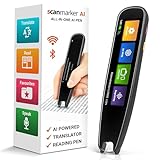
- INSTANT SCAN-TO-TEXT MAGIC – Slide, scan, and watch printed words appear on-screen in seconds with this ai pen with chatgpt. Scan to get answers for faster learning from textbooks, documents, labels, and study material when typing feels slow and frustrating.
- STUDY SMARTER, NOT HARDER – With this ai smart pen, capture key lines, definitions, and important sentences instantly-turn reading into clean notes for homework, revision, meetings, and research with less effort and more accuracy.
- TEXT-TO-SPEECH CONFIDENCE BOOST – Hear text read aloud clearly to stay focused, improve understanding, and reduce reading fatigue with this gpt pen style experience-great for students and busy professionals.
- TEXT-TO-SPEECH CONFIDENCE BOOST – Hear text read aloud clearly to stay focused, improve understanding, and reduce reading fatigue with this gpt pen style experience-great for students and busy professionals.
- SAVE, EXPORT & STAY ORGANIZED – Store scans, record key moments, and save notes in Favorites with this ai device, then export for editing and sharing—keep everything in one place so you review faster and stay on top of work.
What readers should take away from the 2026 report
- The concrete mathematical advance is a tighter interval for KG, not an exact determination.
- The underlying evidence is an August 11, 2026 arXiv preprint, so its claims should be read with preprint-era caution.
- The workflow relied on humans to steer exploration, judge ideas, interpret results, and verify the mathematics.
- The broader lesson is a capability gap: producing an answer is easier for current AI than judging whether that answer opens a significant, general, and useful line of research.
Product prices and availability are accurate as of the date/time indicated and are subject to change. Any price and availability information displayed on Amazon at the time of purchase will apply.

