
The Tool Desk
Outbyte Driver Updater FREEScan for outdated or missing drivers - takes under a minuteDriver Scan →Outbyte PC Repair FREERepair Windows errors before they cause bigger problemsFix Now →iTechGuides is reader-supported. When you buy through links on our site, we may earn an affiliate commission. As an Amazon Associate I earn from qualifying purchases. Learn more
Researchers are trying to make microbes produce more butanol, tolerate it for longer, and use a wider range of plant-derived sugars. But a better strain alone cannot solve biobutanol’s production challenges: feedstock preparation, fermentation conditions, product removal, and final separation all affect whether the process works. “Brewing” here means industrial biotechnology, not a home fermentation project.
How microbes make butanol
Conventional acetone–butanol–ethanol fermentation, or ABE fermentation, uses solvent-producing Clostridium bacteria to convert carbohydrate feedstocks into a mixture of acetone, butanol, and ethanol. Clostridium acetobutylicum is a major research model. The process makes a product mixture, not pure butanol straight from the fermenter; obtaining a usable butanol stream requires downstream separation.
Researchers study both the organism and the production system. Strain selection and metabolic engineering aim to improve traits such as solvent tolerance, robustness, substrate use, and product output. Work on engineered hosts such as Escherichia coli also appears in bioalcohol research, but these hosts should be understood as research platforms, not assumed commercial replacements for solventogenic Clostridium.
Why making a better strain is not enough
Butanol is toxic to the microbes that produce it. As product accumulates, it can inhibit the cells and limit how much fermentation can continue. That creates a basic process tension: the culture must make butanol, but the growing concentration can make continued production harder.
#1 Best Overall

- COMPLETE FERMENTING STARTER KIT - A 1 gallon glass fermenting jug bundled with a #6.5 rubber stopper, 6-bubble airlock, black plastic lid, yeast assortment, and yeast nutrients
- LARGE CAPACITY - 1 gallon clear glass jug with handle and screw top lid
- YEAST VARIETY PACK - Comes with Red Star Premier Classique, Premier Cote des Blancs, and Premier Cuvee varieties to start your wine brewing journey
- YEAST NUTRIENTS - Includes a 3.5 ounce jar of food grade yeast nutrients to support healthy yeast activity and efficient fermentation
- VERSATILE HOME BREWING - Perfect for brewing wine, beer, or kombucha, making large yeast starters, experimenting with fruit flavors, or storing sanitizer solution
Researchers therefore assess more than a strain’s headline output. A strain that improves one measure may still be a poor fit if it is less stable, cannot use the available sugars, or requires costly feedstock preparation or product recovery. The 2020 review in Biotechnology for Biofuels and Bioproducts discusses clostridial engineering, pathway regulation, robustness, and process design in this broader context.
Feedstock preparation shapes fermentation performance
Potential feedstocks include carbohydrate sources from plant biomass. Lignocellulosic material, however, generally needs pretreatment to make its sugars accessible. Processing can also leave compounds that inhibit microbes, so detoxification or other conditioning may be needed before fermentation.
Rank #2

- [WHAT'S INCLUDED] This comprehensive mead making kit includes everything needed for brewing - 1 Gallon Clear Glass Jug, 3pc Airlock, Rubber Stopper, Yeast Nutrient & Mead Yeast. Perfect for both beginners & experienced brewers seeking quality results
- [EASY TO FOLLOW DIRECTIONS] Just add Honey and we’ll provide everything else! Our kits include all the essentials to brew your own honey wine in just 7 days but will improve in taste with age
- [SUSTAINABLE & REUSABLE] This 128 oz glass jug is a sustainable alternative to plastic containers, this glass jug can be reused countless times, reducing waste and your carbon footprint.
- [TRANSPARENT FOR EASY MONITORING] The clear glass allows you to easily monitor the contents, whether you’re fermenting, brewing, or simply storing liquids. So you’ll always know when your 1 gallon glass jug needs a refill.
- [OUR COMMITMENT TO YOU] At FastRack, we stand behind the quality of our products and the trust our customers place in us. Your experience matters. If your order arrives damaged or incomplete, reach out—we’ll make it right.
Feedstocks can differ in cost, sugar composition, pretreatment burden, and inhibitor content. A microbe able to use a wider range of sugars may be valuable, but that trait does not by itself establish that the whole process is economical. A 2021 review by Veza, Said, and Latiff in Biomass and Bioenergy describes feedstock handling, fermentation, and product recovery as connected stages, with low yield and toxicity among the recurring constraints.
ABE and IBE make different product mixtures
Isopropanol–butanol–ethanol fermentation, or IBE, is a distinct route. Specific solventogenic Clostridium can convert acetone into isopropanol, changing the product slate. That may suit processes where isopropanol is a desired product or where acetone in the output mixture is a concern. It does not make IBE automatically more efficient or preferable: a 2019 review in Bioresource Technology describes IBE as less efficient and identifies engineered strains and cell retention as development areas.
Rank #3

- BREW YOUR OWN - Be more than a mead drinker; be a mead maker! This Craft a Brew kit will turn mead lovers into mead brewers and give you all the independence, experience, and fun that comes with brewing your own mead.
- HONEY WINE – Mead is the original fermented beverage, predating wine or beer. Making mead is as simple as combining honey, water & yeast. Drink it out of a goblet or a horn to channel the Vikings and ancient Romans who considered it to be the “nectar of the gods.”
- HOME BREWING STARTER SETS – Designed to help first-timers and hobbyists alike get the most of their craft brew experience, this mead starter kit teaches you about the art of brewing with our Craft a Brew Guide to Making Your Own Mead.
- WHAT’S INCLUDED – You bring the honey, and we bring the rest! Our kits come with everything you need to craft your own honey wine in just 4 weeks. Our Mead brew kit comes with all of the supplies you need to homebrew mead at home: 1 gallon Glass Carboy, Airlock, Rubber Stopper, Racking Cane & Tip, Transfer Tubing & Tip, Funnel, Yeast, Yeast Nutrients, Sanitizer, and Mead Making Guide.
- MADE IN THE USA – Each mead kit is assembled by hand in Orlando, FL instilled with the core values of providing high-quality ingredients, elegant and effective design, and an environmentally sustainable mindset. Enjoy mead the right way with your own kit.
| Route | Product slate | What to consider |
|---|---|---|
| ABE fermentation | Acetone, butanol, and ethanol | Butanol is one component of a mixed product stream; downstream separation is needed. |
| IBE fermentation | Isopropanol, butanol, and ethanol | The altered product mix may suit different goals, but its performance and recovery needs must be evaluated for the specific process. |
There is no universal winner established across product mix, organism, productivity, equipment, and recovery requirements. The desired products and the full process determine which route is worth considering.
Removing butanol during fermentation
One research strategy is in-situ product recovery: remove some product while fermentation is under way, with the aim of easing inhibition as butanol accumulates. Extractive fermentation is one studied approach. A 2015 Nature Protocols paper describes it as a research technique for ABE production; that protocol is not proof that the method is commercially optimal.
Rank #4
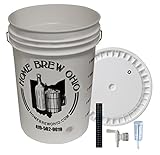
- 6.5-gallon bottling bucket: Ideal for handling large batches of home brew.
- Drilled and grommeted bucket lid: Ensures a secure fit and compatibility with the included Econolock 3-piece airlock.
- Econolock 3-piece airlock: Prevents contamination while allowing gases to escape.
- Dual scale thermometer: Provides accurate temperature readings in both Fahrenheit and Celsius.
- 3/8" Vintage Shop spigot: Facilitates easy and convenient transfer of your brew.
Integrating recovery with fermentation adds design questions. A method must be sufficiently selective, work with the fermentation broth, and concentrate the product in a form that can be recovered. Energy use and equipment integration matter too. Product removal can address one biological constraint while adding separation costs and operational complexity.
What strain engineering can—and cannot—fix
Engineering can target useful microbial traits, including tolerance to solvents, robustness, and the ability to use particular feedstock sugars. It can also alter pathways that affect which products the organism makes. These are meaningful opportunities, but they do not remove the need to prepare feedstock, maintain a suitable fermentation, manage product inhibition, and recover the desired compounds.
Best Value

- HARD CIDER KIT- Includes 1 gallon glass carboy, airlock, rubber stopper, siphon tube and clamp, funnel, yeast, yeast nutrient, spice melody, cleanser, temperature tape and guide. All you need is one gallon of apple juice or fresh apple cider.
- MAKE CRISP, REFRESHING HARD APPLE CIDER AT HOME- Turn store-bought apple juice into delicious hard cider with this easy-to-use apple cider kit. Designed to produce a clean, balanced flavor with a smooth finish—ideal for DIY enthusiasts and homebrew cider makers.
- BEGINNER-FRIENDLY FERMENTATION KIT- Specially designed for first-time brewers, this beginner brewing kit simplifies the cider making process with easy instructions and reliable ingredients—making it one of the best hard cider kits for beginners and hobbyists alike.
- PREMIUM INGREDIENTS FOR CLEAN FERMENTATION Includes high-quality yeast, yeast nutrients, and flavoring spices to help create a more refined, flavorful cider. This fermentation kit delivers better taste and consistency compared to basic cider making kits.
- REUSABLE HOME BREW KIT – MAKE BATCH AFTER BATCH- Durable, reusable equipment allows you to brew multiple batches and experiment with flavors. A complete homebrew cider kit that grows with your skills—perfect for long-term use and gifting. Refill kits are availabe.
That is why reports of an engineered strain or a proposed project should not be read as evidence of broad commercial competitiveness. For example, U.S. Department of Energy project descriptions concern proposed work on engineered solvent-producing bacteria and lignocellulosic hydrolysates; a project description does not establish current operation or commercial success. Reviews describe promising research directions, but the available evidence here does not establish one best strain, feedstock, or recovery process for every application.
This is industrial biotechnology, not a home fermentation recipe
Butanol fermentation involves biological and chemical process hazards and is not an appropriate home project. Laboratory work belongs in properly equipped, supervised research settings and should follow institutional biological and chemical safety procedures. The CDC/NIH’s sixth-edition Biosafety in Microbiological and Biomedical Laboratories (BMBL), updated March 18, 2026, is advisory guidance that emphasizes protocol-driven risk assessment; it is not a butanol production manual.
Quick Recap
Product prices and availability are accurate as of the date/time indicated and are subject to change. Any price and availability information displayed on Amazon at the time of purchase will apply.
Quick wins for a faster PC:
Fix the driver behind crashes, sound loss and screen glitchesFind Drivers →Clear out junk files and repair common Windows errorsFree Scan →
